In the Jingde period of the Song, two envoys went to the Liao court to congratulate the ruler on his birthday: Wang Shu, a doctor of the Grand College, and Li Wei, a bureau director. On their return they reported what no ceremonial code shows: the Liao ruler, meeting the Song envoys, 'forced himself to wear Chinese dress and cap; when it was over, he at once put on a cloth head-wrap and rode out hunting among the Khitan horsemen.' One scene, and the two wardrobes are already apart.
Two sets of clothes
The dynastic history states the rule plainly: after Taizong took the Jin capital, 'the emperor and the southern-rank Chinese officials used Chinese dress; the empress dowager and the northern-rank Khitan officials used national dress; the Chinese dress was the old system of the Five Dynasties' Jin.' Two ranks, two dresses, one court. The two ranks were also the two halves of government, north and south.
The Southern Song gazetteer is blunter: 'the empress dowager and the Khitan officials all wear barbarian dress; the ruler and the Chinese officials wear Chinese dress.' But the two books are not the same kind of witness. The Liao shi is a Yuan compilation of institutions; the Qidan guozhi is a Southern Song account built from earlier records and from envoys' reports. They are set side by side here, not fused.
National dress: felt caps and sable
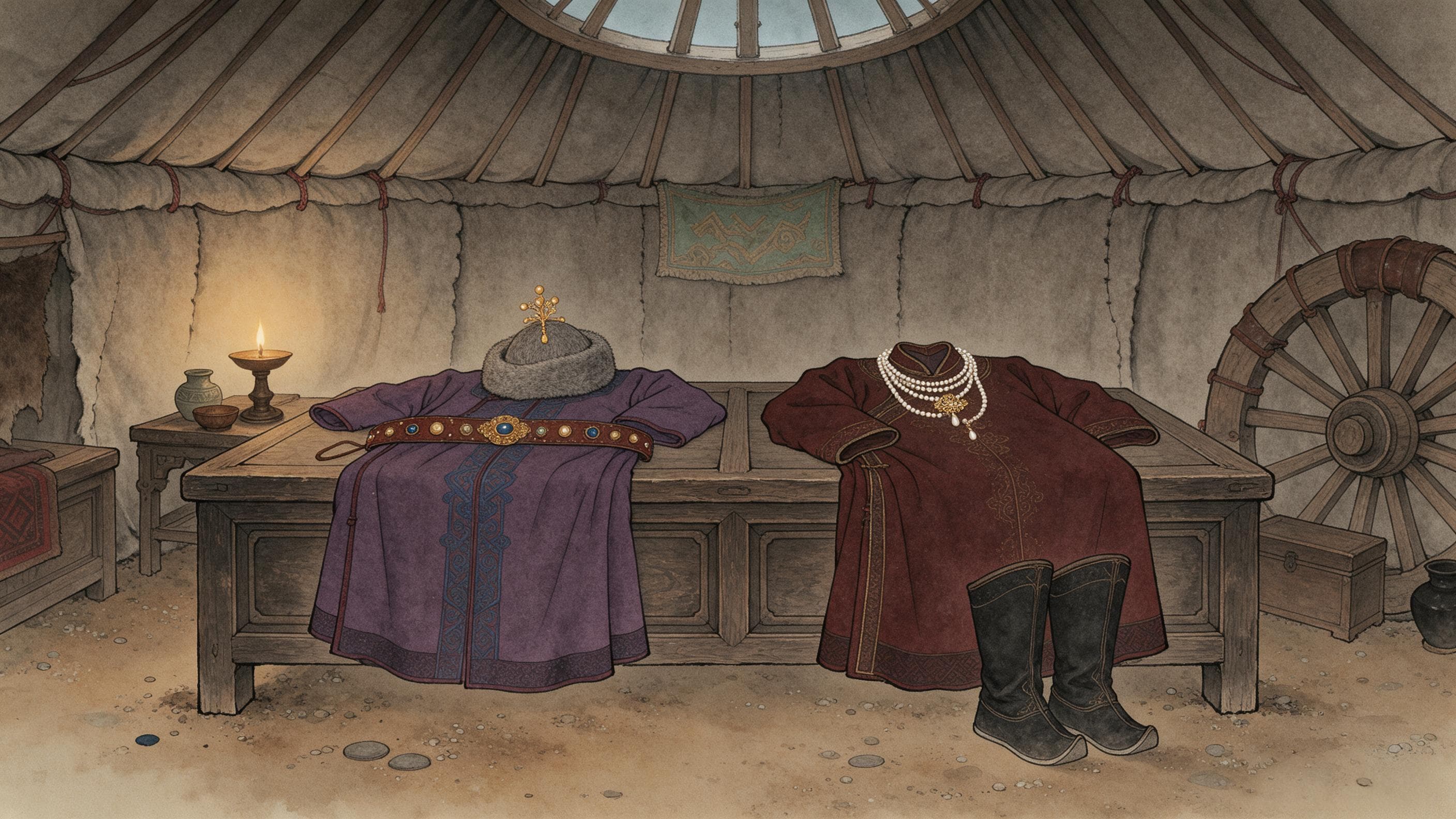
The Khitan official's dress is described piece by piece: a felt cap with gold flowers, or pearls, jade and kingfisher feathers; at the back a band of gold-flower weave holding 'a lock of hair'; a narrow purple robe; a belt — the zhantie — of leather wrapped in yellow-red silk, studded with gold, jade, crystal and dark stone, which was called 'coiled purple'. Or a gauze cap like a black gauze hat without a brim, that does not press the ears, gold flowers at the front and a purple band ending in pearls.
Rank was read in fur and colour: 'the noble wear sable; purple-black is the most honoured, blue next; silver-weasel is especially white; the base wear sable hair, sheep, rat and sand-fox fur.' The 'public dress' was called zhan-guo and worn purple; in 1053 the emperor regulated the cloth caps of the eight-branch clan, and in 1055 ordered that men who were not descendants of meritorious relatives, nor assistant envoys, nor holders of duty posts, were not to wear the cloth cap. Even a head-cloth was graded. For hunting the emperor wore a cloth head-wrap over armour, 'with sable, or a goose-neck or a duck-head as the waist guard'; officers in the field wore 'coats buttoned to the left, black and green'. The state did not prescribe much: 'the prohibitions were loose; usefulness was what mattered.'
Chinese dress: the mian and the five carriages
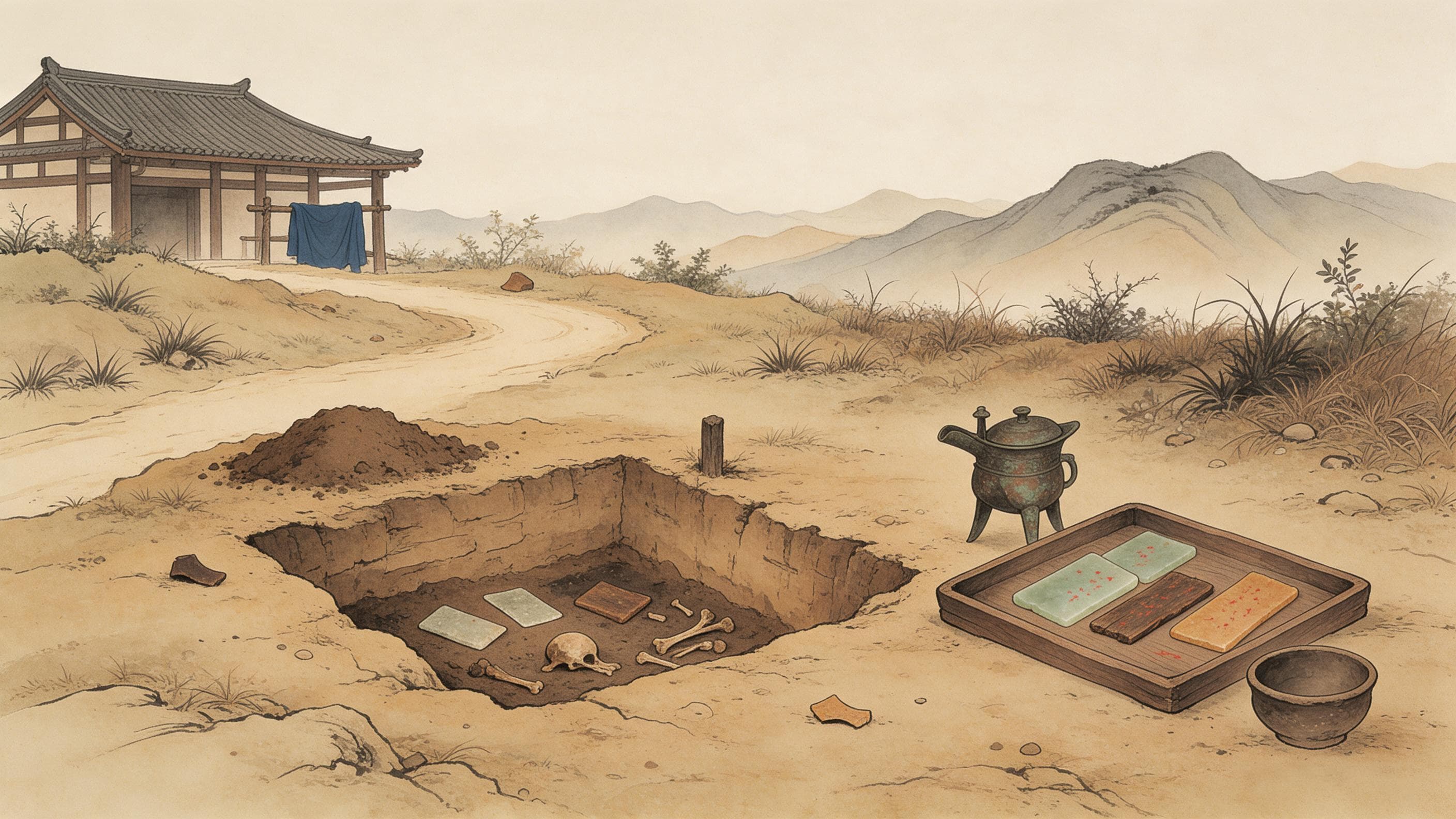
The Chinese half arrived with the regalia. In 938, when the Jin envoys Feng Dao and Liu Xu brought carriages, standards and ceremonial objects for the title rites of the emperor and empress dowager, 'from this the Son of Heaven's carriages and dress first appeared in Liao.' In 947 Taizong entered the Jin capital, held audience in Chinese style at the Chongyuan hall in Kaifeng, and on going north took the Tang-Jin ceremonial objects with him. The five carriages — jade, gold, elephant, leather, wood — were assigned to sacrifices, feasts, travel, campaigns and hunting; the plough-root carriage to the imperial field, the 'easy' carriage to imperial visits, the four-view carriage to tombs and condolences. Two carriages were for princesses: the blue-awning carriage, with two hornless-dragon heads and a silver-mounted canopy, drawn by a camel, given at a princess's marriage; and the funeral carriage, drawn by an ox and carrying a sheep, the 'sacrificial sheep', also given to princesses.
The ceremonial dress was the full Chinese set: the mian with gold fittings and twelve strings of white pearls, dark upper garment and red lower with the twelve insignia; the tongtian crown with crimson gauze robe for New Year and winter-solstice audiences; the winged shanyi cap with yellow robe, nine-ring belt and six-joint boots for ordinary court. Officials were graded by colour and belt: purple robe with gold or jade belt above the fifth rank, crimson with silver below, green with brass at the bottom; ivory tablets for the high, wooden for the lower. Civil officials hung from the belt a towel, a calculating pouch, a knife, a whetstone and a gold fish-bag; military officials carried the 'seven things of the zhantie' — sword, knife, whetstone, two small items the text does not translate, a needle-case and a tinder-bag.
When the clothes changed
The balance between the two shifted. In the Hui-tong period the rule was: empress dowager and northern officials in national dress, emperor and southern officials in Chinese. After Qianheng, 'even northern officials of the third rank and above wore Chinese dress at great rites'; after Chongxi, 'all great rites were in Chinese dress'. Yet 'ordinary court still followed the Hui-tong rule'. The ceremonial half moved toward Chinese dress; the everyday half kept the old one. The change was by layers, not by decree, and the record of it sits in the same chapter that lists the dresses.
The vehicles kept the same double track. The Khitan habit was for the saddle: 'moving with water and grass they had felt carts, big wagons for loads, women on horseback, small carriages for the rich with ornament'; the Chinese side had the five carriages and palanquins — the great phoenix palanquin with eighty bearers, the fragrant pavilion with a hundred and twenty, the roaming palanquin with twelve attendants. One side was 'usefulness was what mattered'; the other was ritual. The ceremonial side had been taken over whole, carriages, bearers and all.
What can and cannot be said
The limits. The two books are different kinds of witness — a Yuan institutional history and a Southern Song account built partly on envoys' reports; neither is a Khitan's own description. This is not a general history of 'nomadic dress'; the national and Chinese systems are not merged; no claim is made that one replaced the other; no measurements are converted; and nothing is added from sources not read here. Nor do these pages give a penalty for dressing wrongly: the sanctions are the grants and prohibitions themselves.
What remains is a court with two wardrobes and a rule for each occasion. A felt cap with a lock of hair at the back, a sable ranked from purple-black to sand-fox, a belt of gold and crystal; and beside them a pearl-strung mian, a crimson gauze robe, a carriage with eighty bearers. The Song envoys saw the seam between them: the ruler put on the Chinese set to receive them, and took it off when they had gone.
Sources & further reading
- 脱脱等《辽史》卷五十五·仪卫志一(舆服)、卷五十六·仪卫志二(国服、汉服)(Tuo Tuo et al., Liao shi, juan 55 and 56, 'Ceremonial Guards') — Yuan compilation of Liao institutions. Juan 55 states the rule that after Taizong took the Jin capital the emperor and southern-rank Chinese officials wore Chinese dress while the empress dowager and northern-rank Khitan officials wore national dress, and describes the Khitan carriages (felt carts, big wagons, women on horseback) and the Chinese five carriages and palanquins taken from the Jin. Juan 56 (https://zh.wikisource.org/wiki/遼史/卷56) gives the national dress in detail — felt cap with gold flowers, a woven band holding a lock of hair, purple narrow robe, the studded zhantie belt called 'coiled purple', gauze cap, sable ranked from purple-black to sand-fox, the hunting guard of sable or goose-neck or duck-head — and the Chinese ceremonial dress with its mian, twelve strings of pearls, twelve insignia, tongtian crown and graded robes and belts. Also records the shifts: after Qianheng northern officials of the third rank and above wore Chinese dress at great rites, after Chongxi all great rites did, while ordinary court kept the older rule.
- 叶隆礼《契丹国志》卷二十三·衣服制度 (Ye Longli, Qidan guozhi, juan 23, 'Clothing Regulations') — Southern Song account, compiled from earlier records and envoys' reports, not a Khitan self-description: 'the empress dowager and the Khitan officials all wear barbarian dress; the ruler and the Chinese officials wear Chinese dress'; describes the felt cap with its gold-flower band and lock of hair, the gauze cap without a brim, the purple narrow robe and studded belt, sable ranked purple-black, blue and silver-weasel, the base wearing sheep, rat and sand-fox, the waist guard of sable or goose-neck or duck-head; and reports that in the Jingde period Song envoys saw the Liao ruler force himself into Chinese dress and cap to receive them and, the audience over, put on a cloth head-wrap and ride out hunting among Khitan horsemen.