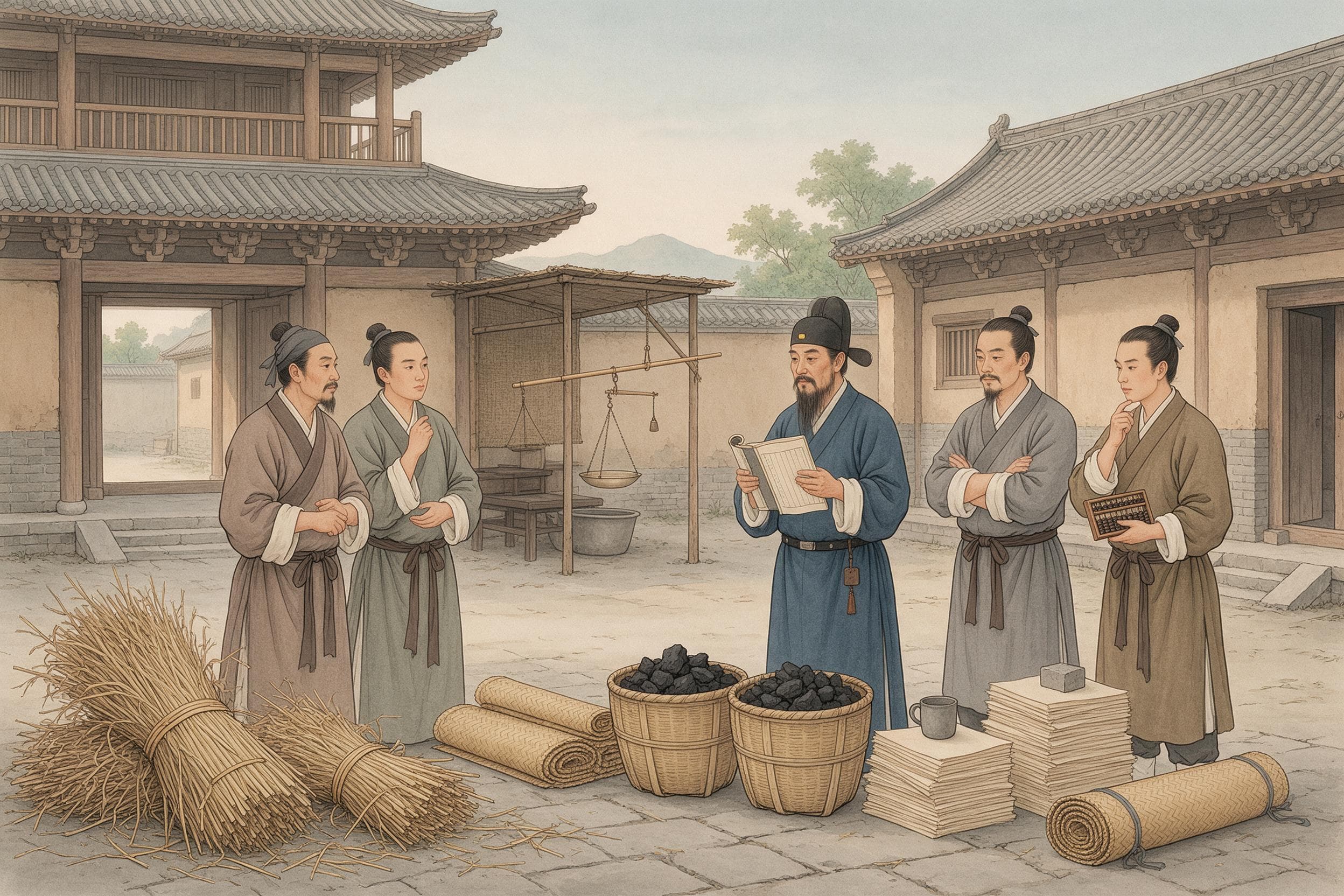
At a banquet in Northern Wei Luoyang, the emperor asked a surrendered southern official which was better, mutton or fish soup, tea or kumiss. Wang Su answered carefully: mutton was the best of the land, fish the best of the waters, each prized in its own way — but 唯茗不中,与酪作奴, tea was no good, fit only to be kumiss's slave. The court laughed, and from then on Luoyang called tea 'kumiss's slave' (酪奴). Two centuries later the Tang writer Feng Yan recorded another scene: the city had many shops, 煎茶卖之,不问道俗,投钱取饮 — they boiled tea and sold it, to monk or layman alike, and you dropped in your coin and drank. Between the slave and the coin box, one drink had marched north. The entry opens with tea's two harvest names — 早采者为茶,晚采者为茗, early picking is 茶, late picking is 茗 — and with the herbal saying that tea 止渴,令人不眠, quenches thirst and keeps you awake. Staying awake was the first card tea had to play.
Tea as kumiss's slave
The Luoyang Qielan Ji, juan 3, tells how Wang Su arrived from the south: 不食羊肉及酪浆等物,常饭鲫鱼羹,渴饮茗汁 — he ate no mutton or kumiss products, kept to carp soup, and drank tea when thirsty. The capital's scholars, seeing him drink a whole dou at a sitting, nicknamed him 'the leaking cup' (漏卮). Years later, at a palace gathering, Wang Su was eating plenty of mutton and kumiss porridge; the emperor, surprised, asked which he preferred. Wang Su's answer was a courtier's answer: praise both regions first, then demote his own tea to a servant. The prince of Pengcheng teased him the next day — he would serve 'the food of Zhu and Ju' (small southern states), with kumiss's slave to drink. So tea acquired a second name. This was not a quarrel about taste but about status: in the northern court, tea was first seen as a southern captive's habit. When a court official named Liu Gao later took up tea seriously, the prince mocked him for preferring 'the water misery of a menial' to the eight delicacies, 苍头水厄; and from then on, the text says, 朝贵宴会,虽设茗饮,皆耻不复食 — at noble banquets tea might be set out, but it was thought shameful to drink it.
From monastery to capital
How tea turned from a joke into a trade has a specific starting point in Feng Yan's account. 南人好饮之,北人初不多饮 — southerners liked it, northerners at first drank little. The turn came in the Kaiyuan era: at Lingyan Monastery on Mount Tai a master of esoteric Buddhism promoted Chan teaching, and students of Chan, who had to stay awake and skipped the evening meal, 皆许其饮茶 — were all permitted tea; so 人自怀挟,到处煮饮,从此转相仿效,遂成风俗 — people carried their own, brewed wherever they were, imitated one another, and it became a custom. The route is stated: 起自邹、齐、沧、棣,渐至京邑 — it began in the Zou, Qi, Cang and Di regions and reached the capital. The monastery's need to stay awake made tea a tool of practice before it became a city drink.
Coins in, bowls out
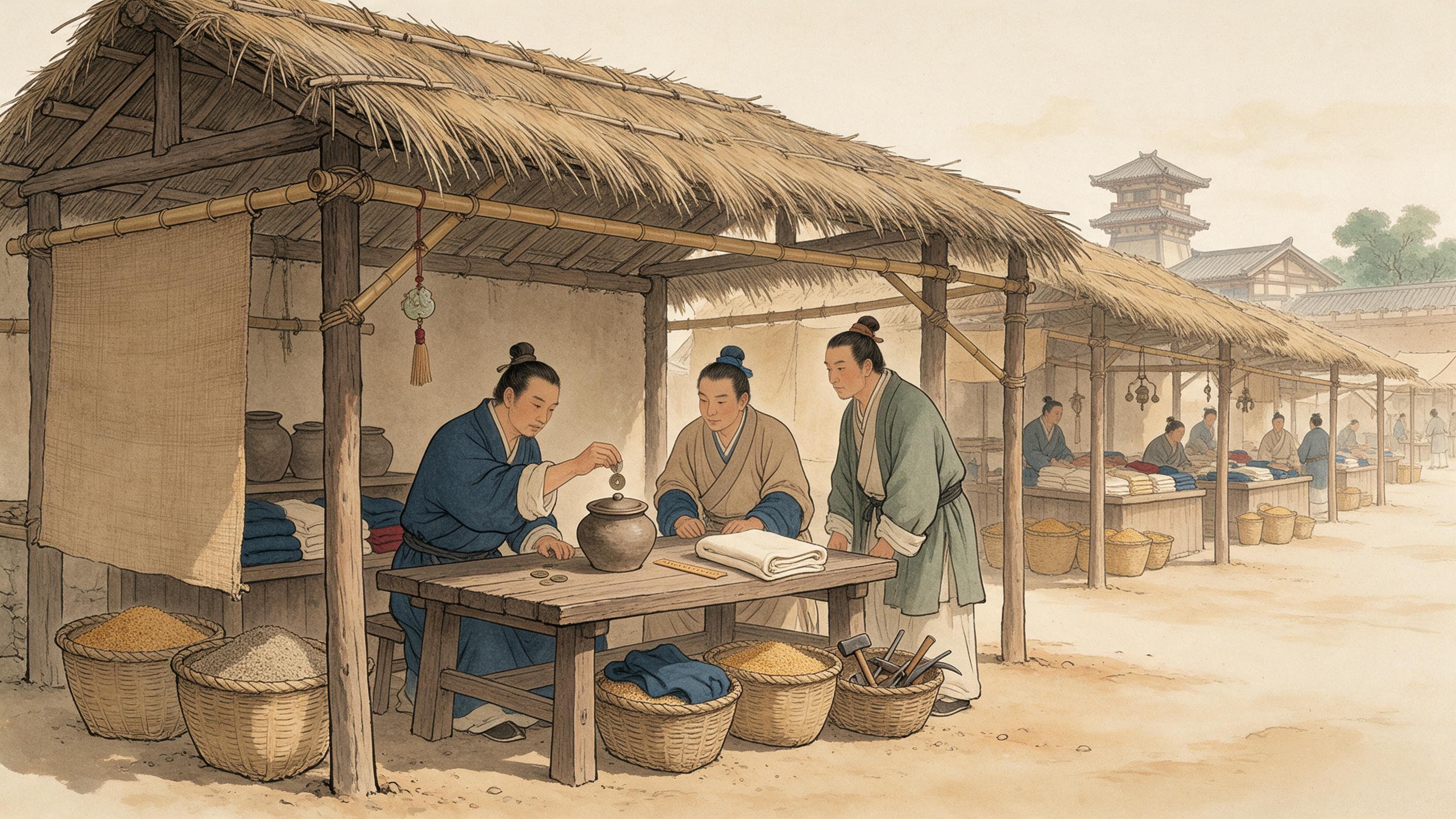
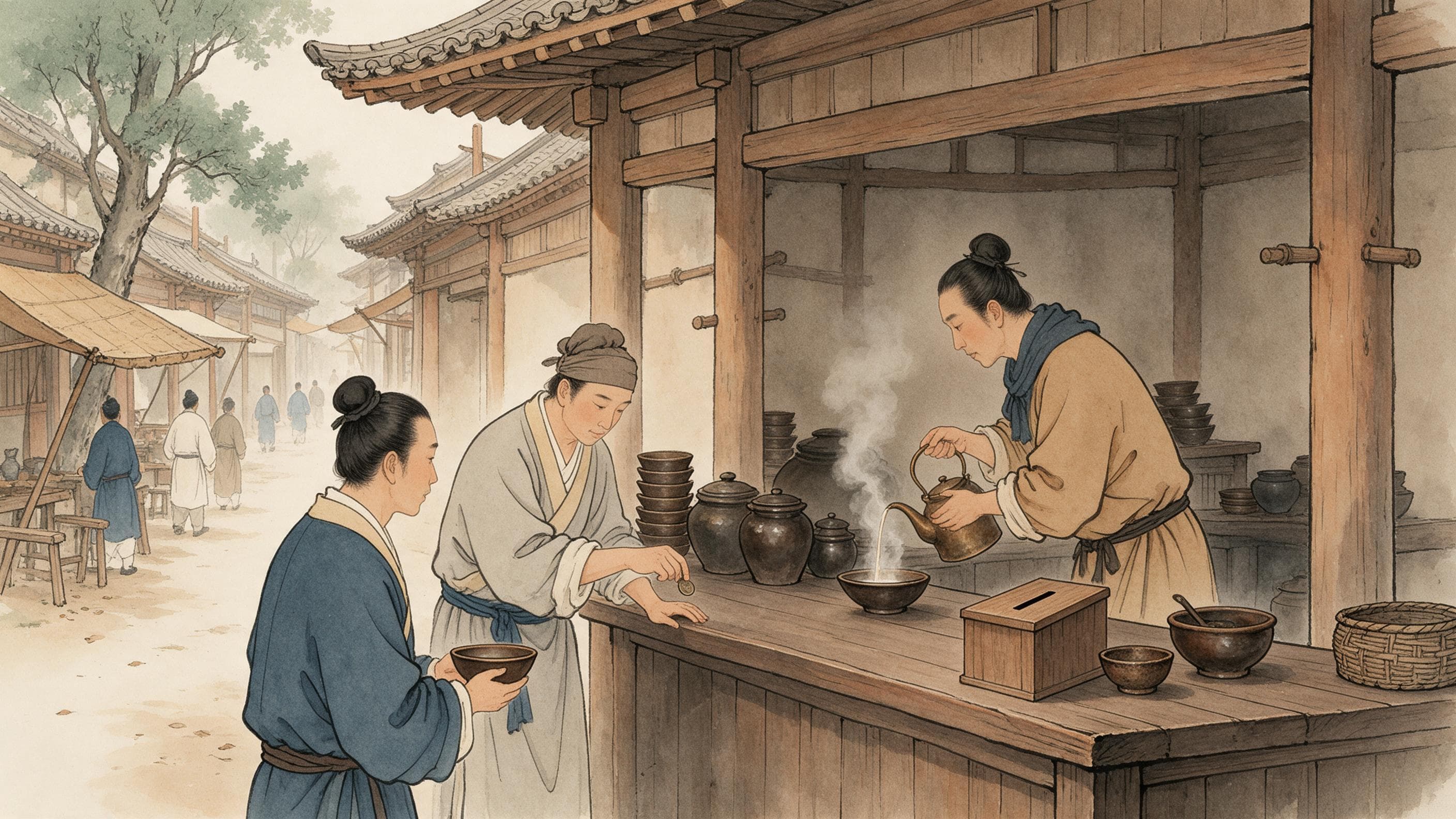
In the capital there were shops: 城市多开店铺,煎茶卖之,不问道俗,投钱取饮 — the city opened many shops, boiled tea and sold it, monk or layman alike, coin in, drink out. Those twelve characters contain a whole business: premises, brewed tea on sale, a price, and customers accepted regardless of status. The supply is in the next line: 其茶自江、淮而来,舟车相继,所在山积,色类甚多 — the tea came from the Yangtze and Huai regions, boats and carts in unbroken succession, piled up everywhere, in many varieties. The northern city's tea habit rested on southern goods. 投钱取饮 implies three things at once: a container to receive the money, a fixed charge, and a customer allowed to be a stranger who need not give his name — exactly what a market needs to stand up.
Thirty cash for the tea doctor
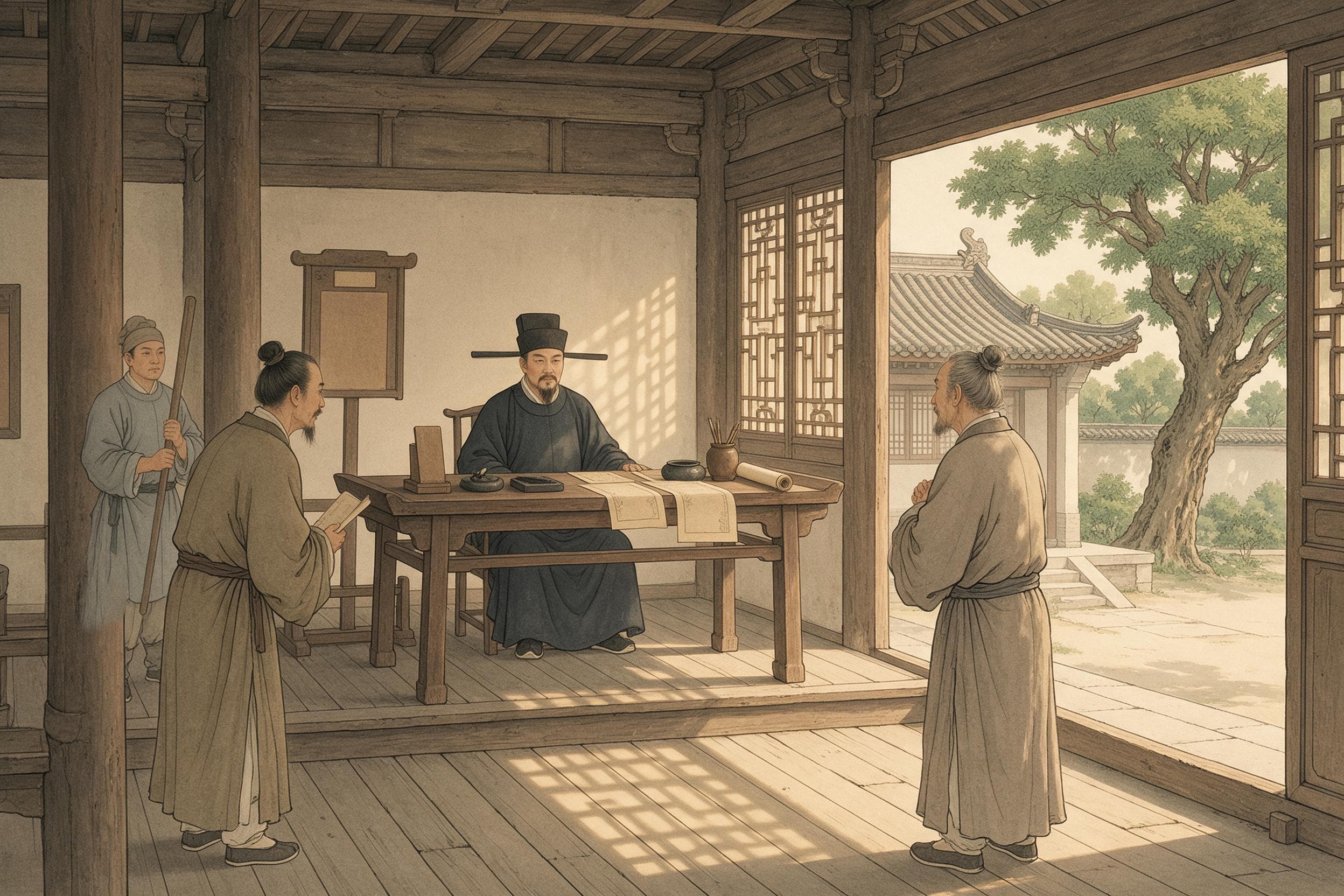
Shops needed brewers. Feng Yan describes Lu Yu, styled Hongjian, writing a Treatise on Tea that set out its effects and the methods of roasting and boiling, and making twenty-four tea implements kept in a 'unified basket' (都统笼), so that enthusiasts each kept a set at home; a man named Chang Boxiong then amplified Lu Yu's account, 于是茶道大行,王公朝士无不饮者 — and so tea ceremony spread, and no prince or courtier went without it. The anecdote that follows is vivid: when the censor Li Jiqing was in Linhuai he first invited Chang Boxiong to brew. Chang wore a yellow gown and black gauze cap, held the implements, recited the names of the teas, pointing and distinguishing, and the company stared. Later Li invited Lu Yu, who came 身衣野服,随茶具而入 — in rustic clothes, with his tea gear — sat down and laid out the tea 教摊如伯熊故事, in the same manner as Boxiong. Li privately looked down on him; when the tea was done he had a servant 取钱三十文酬煎茶博士 — fetch thirty cash to pay the 'tea doctor' (煎茶博士). Both the title and the fee are in that line. Lu Yu, shamed, later wrote a Treatise Condemning Tea; Chang Boxiong, drinking to excess, fell ill with a wind ailment and in later years no longer urged others to drink. The contrast had a class dimension too: Chang in a yellow gown and black gauze cap was performing tea; Lu Yu in rustic clothes was practising a craft. What Li looked down on was the bearing, not the drink.
One drink's journey north, not a history of tea culture
The limits need stating. Feng Yan was a Tang writer recording what Tang people saw; tea had been drunk before — his own entry cites the Wu ruler Sun Hao letting Wei Zhao substitute tea for wine, and Xie An visiting Lu Na and being served only tea and fruit — and he says so: 古人亦饮茶耳,但不如今人溺之甚,穷日尽夜,殆成风俗, the ancients drank tea too, but not as addictively as now, all day and all night, until it became a custom. He knew there was an earlier history; the custom, in his account, was Tang. This article does not attempt a history of tea ceremony. What is documented: tea as 'kumiss's slave' in the Northern Wei court; the Kaiyuan-era spread from monasteries and the Zou–Qi region to the capital; shops boiling tea and selling it to anyone who paid; brewers called 'tea doctors' and paid thirty cash. What is not documented: what a bowl of tea cost, how much a shop sold in a day, where its stock came from, who worked there — Feng Yan records only the thirty cash paid to a tea doctor, never the price of a bowl; nor does he say how many such shops the city had, on which streets, or how the tea was kept hot. One question the entry leaves open: if you dropped a coin in the box, how many cash was it? Feng Yan does not say.
Sources & further reading
- 封演《封氏闻见记》卷六·饮茶 — 「南人好饮之,北人初不多饮」;开元中泰山灵岩寺降魔师与禅教饮茶之风;「起自邹、齐、沧、棣,渐至京邑」;「城市多开店铺,煎茶卖之,不问道俗,投钱取饮」;茶自江淮「舟车相继,所在山积」;陆羽《茶论》、茶具二十四事、常伯熊;李季卿请二人煎茶并「取钱三十文酬煎茶博士」;孙皓以茶代酒、陆纳设茶果;末段「穷日尽夜,殆成风俗」
- 杨衒之《洛阳伽蓝记》卷三(王肃条) — 王肃初入北魏「不食羊肉及酪浆等物,常饭鲫鱼羹,渴饮茗汁」,「一饮一斗,号为漏卮」;高祖问「茗饮何如酪浆」,答「唯茗不中,与酪作奴」;彭城王设「邾莒之食,亦有酪奴」,因号茗饮为「酪奴」;刘缟专习茗饮被嘲「苍头水厄」,「朝贵宴会,虽设茗饮,皆耻不复食」