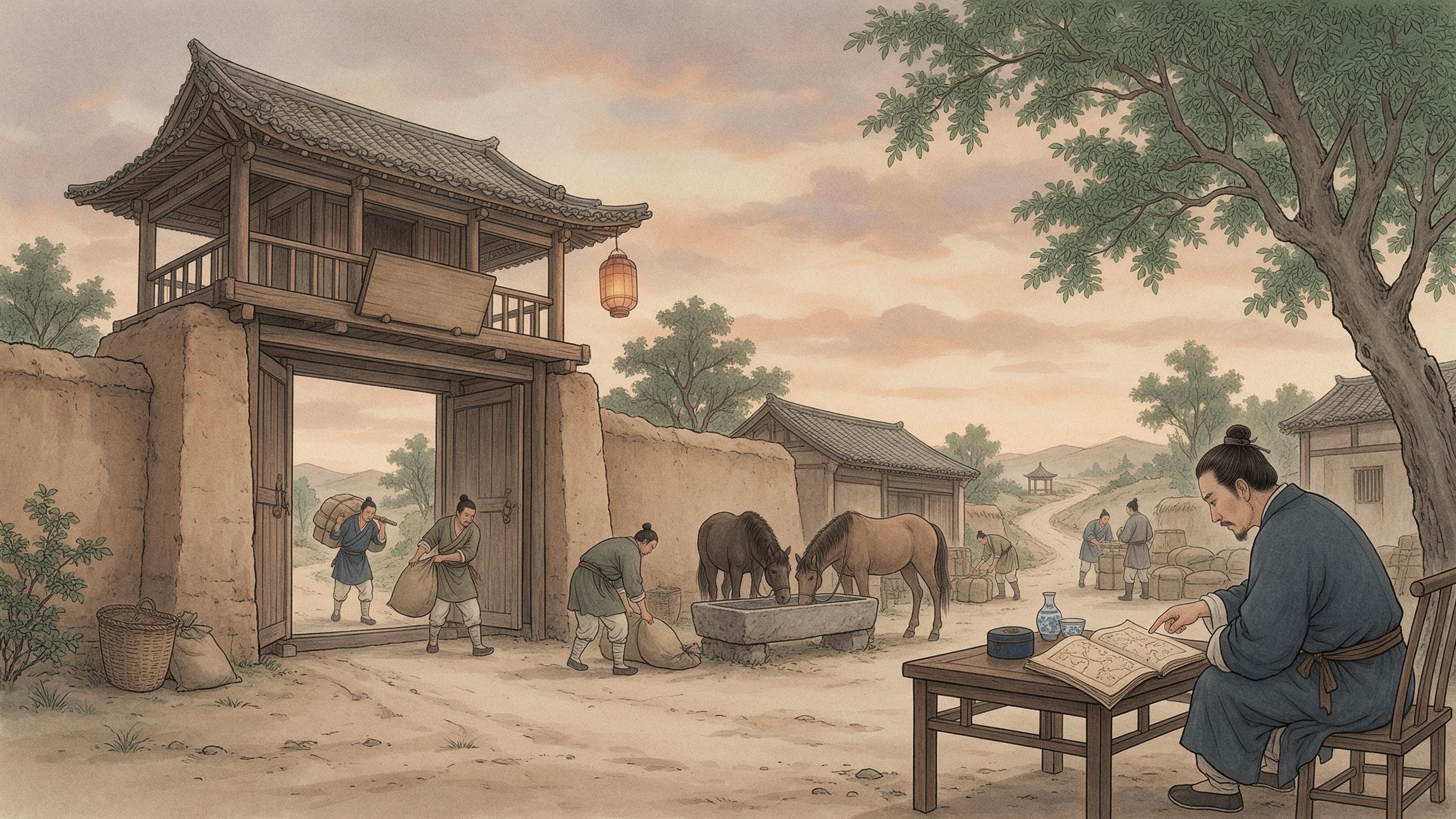
A field by the bridge at Zhou village, rented for five dou of grain a year. Two men held deeds to it. One of them sold it on; the buyer gave it away; and a county school accepted it. By the time the case reached a judge who wrote his judgment down, it had been running for fourteen years. The judgment begins with the rent, because the rent is the point: five dou a year, and fourteen years of litigation.
It survives in the Minggong Shupan Qingming Ji, a Southern Song collection of judges' rulings that comes down to us in a Ming edition, arranged by topic. In the standard fourteen-juan edition, juan 4 to 9 form the household and marriage division; land disputes alone run to more than a hundred items, close to a quarter of the book, while the earlier Song fragment preserves only 133 household judgments. This case is headed “Land already sold should not be donated to a county school,” and it was written by Weng Haotang, that is Weng Fu, one of the scholar-officials whose judgments the collection gathers. One caution before anything else: a judgment is not a transcript. We have the judge's narration and reasoning, not the parties' testimony. When the text says Wu Ba “attached himself to local power-holders,” or that the case went fourteen years undecided, that is the judge speaking. The collection was compiled as a working model: what it preserves is less the field than the way a magistrate handled the file.
Two sets of title deeds
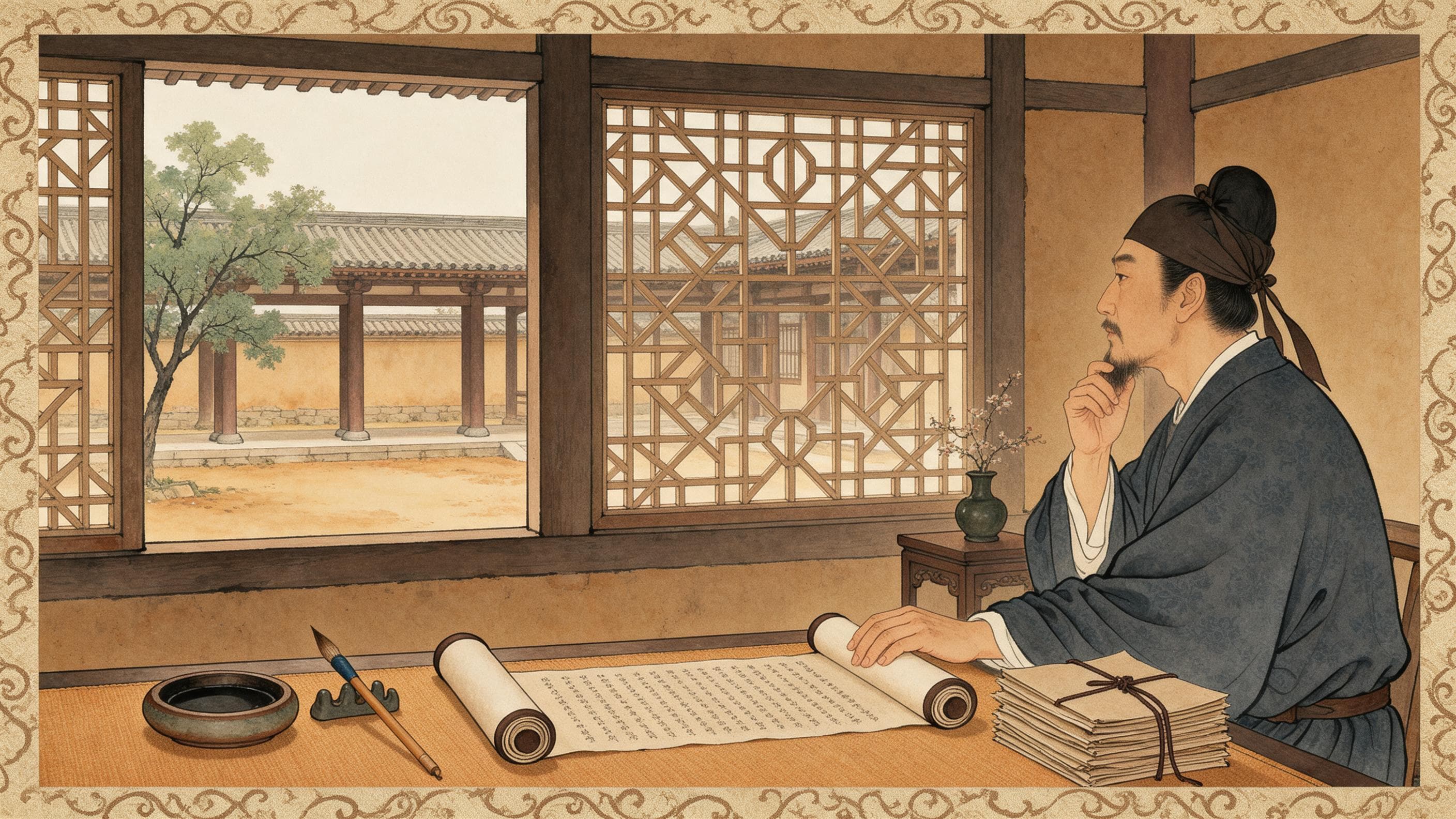
The judge begins by sending for the papers — ganzhao, the deeds and supporting documents. They show that Zheng Yingrui bought the property from Mao Reng'er guanren under a contract of the sixth year of Shaoding (1233), and that Wu Ba bought a plot from Mao Reng'yi guanren in the first year of Duanping (1234), one qiu, a single parcel, “inside the field Zheng Yingrui had bought.” That parcel is the five-dou field. Two deeds, one field; and the later purchase lay inside the earlier one. The two sellers are given as the first and second of what appears to be the same Mao Reng household; the judgment records the names and does not pause over the fact.
The judgment does not set out a doctrine of title. It sets out documents and a sequence: Zheng bought first; Wu bought a parcel inside Zheng's field; Wu then sold that parcel to Registrar Kong; and Kong, in the second year of Chunyou (1242), gave it to the county school. At that point, the judge says, both sides “could have withdrawn and rested.” They did not, because of the school.
A field already sold, given to a school
“Who Registrar Kong was, I do not know,” the judge begins — and then: “that in the second year of Chunyou he should donate this already-sold field to the county school. There was an acting magistrate, one Ni, who without asking where it came from wrote out a great public notice and promptly accepted it.” After that, says the judgment, Wu Ba grew bolder: he not only occupied and farmed the land but began harassing the neighbours.
Then comes the sentence that makes the case worth reading. If such a claim could be accepted, the judge writes, it would make “our most holy King Wenxuan” — Confucius, under his Song title — the patron of the land-grabbers; the school's fields would run to every boundary; and “what greater insult to the Sage, what greater defilement of the students?” School land was the endowment that paid for a county school's upkeep. The judge's charge is that a school taking land of doubtful title did not merely accept a bad gift: it turned the Sage's name into a licence for precisely the annexation a school should resist. And the scheme, he adds, was not Registrar Kong's alone: Wu Ba was in it with him. Why a school would take such land deserves a moment. School land paid for the school; a holding given to it passed under an official name, and the donor gained standing by the gift. The judgment does not spell this out — it assumes it, and aims its sarcasm at the moment a school stops asking where a field came from.
The man who called his paddy a graveyard
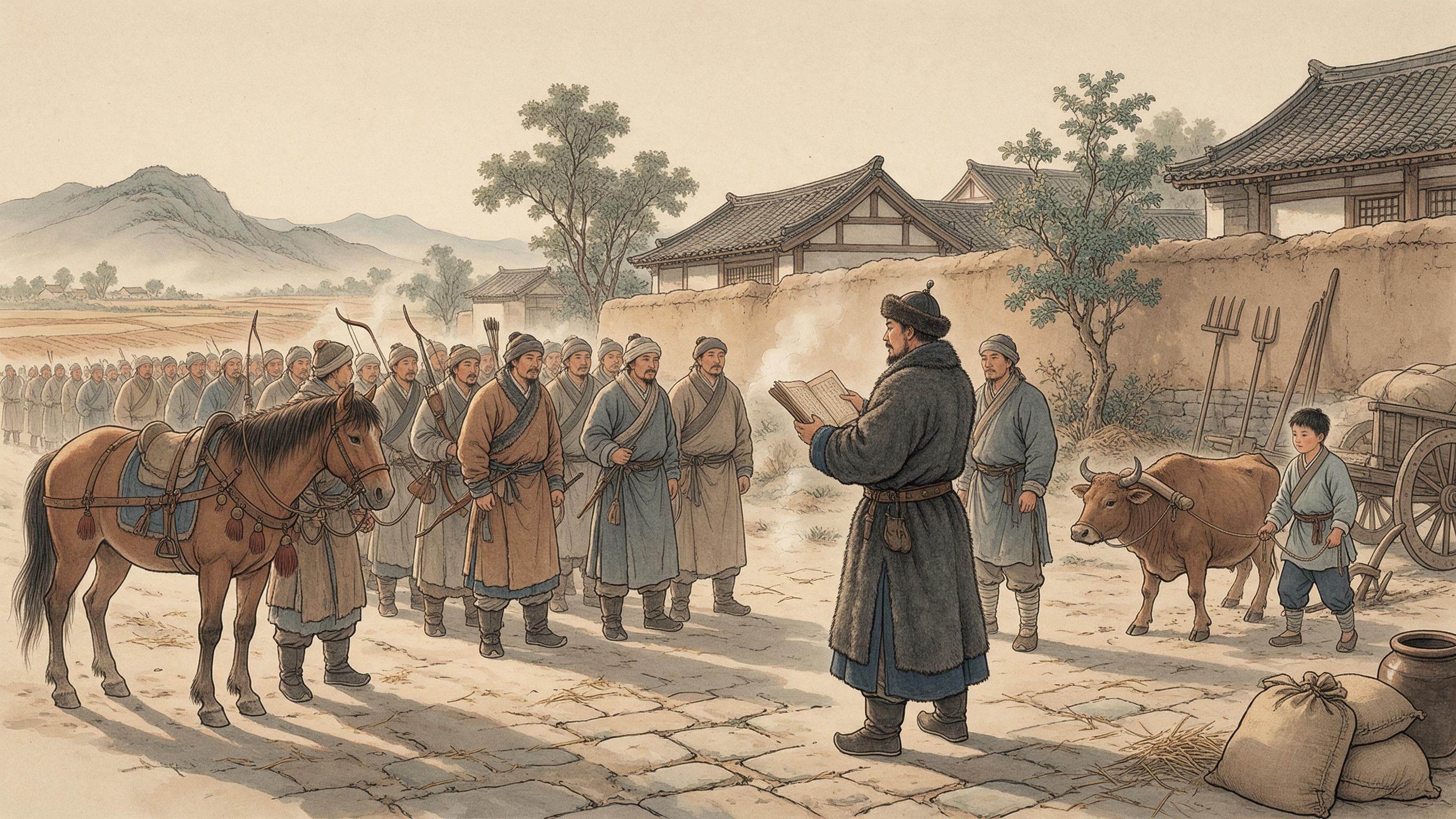
One more thing in the file explains why a land case reads like a burial case. Zheng Yingrui, the judge notes, was not a family that cremated its dead, and paddy fields are not burial ground; but his suit was getting nowhere, so he “borrowed the name of a burial dispute to press it.” The judge calls this “the exhaustion of his options” — not a compliment, but a description of a litigant with nowhere left to go. The fourteen years he attributes to Wu Ba's attachment to powerful households and to Registrar Kong's protection. Both are his characterisation; the parties never speak here.
How the judgment is written
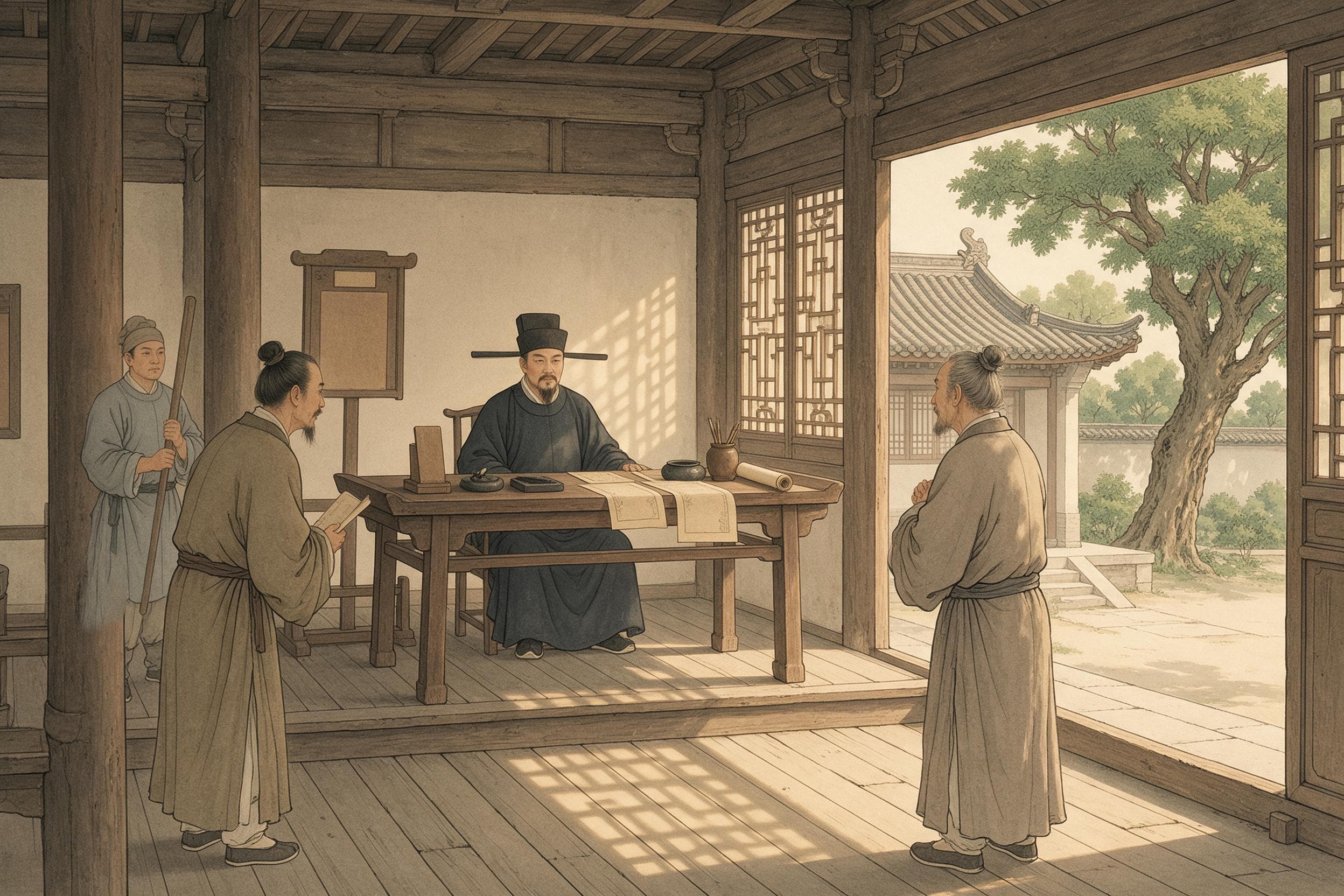
The sentence separates what modern readers tend to merge. On the criminal side: Wu Ba is given a hundred strokes of judicial flogging for illegal occupation. On the documentary side: the school's notice and warrant are to be destroyed. On the arrears: the unpaid rent grain is to be collected under supervision. On title: the ganzhao is returned to Zheng Yingrui “to hold as his property,” guanye, with a receipt issued to him. On procedure: the order is posted and reported up to the prefectural office. And one loose end: the Kong household's steward is exempted from prosecution “for the time being.” Punishment, documents, arrears and title are four separate things, and the judgment keeps them separate. Two terms are worth glossing: the hundred strokes are judicial flogging, not a prison term; guanye is to hold and work the property, with the deeds as the instrument of that holding; and the Kong steward, a ganren, is the household's agent, not its head. The judgment also speaks upward: it orders the result posted and reported to the commissioner's office, and its rhetoric is that of a magistrate writing for superiors as much as for the parties.
What the file does not contain
What the file does not contain matters as much. The county is never named, nor the prefecture, nor the circuit: this is one case in one Southern Song county, not a description of how such suits generally went. The parties' depositions are absent. Nothing is said about what happened afterwards — whether the school erased its notice, whether Zheng ever got his field back. And the judgment's references to “the law” are general; this article will not import statute numbers from the Song Xingtong to fill the gap. What is left is a small, sharp scene: a field worth five dou a year, a school that wanted it, a litigant who called his paddy a graveyard, and a judge who saved his heaviest sentence for the school.
Sources & further reading
- 《名公书判清明集》卷四·户婚门·争业上「已卖之田,不应捨入县学」(翁浩堂判;明张四维辑,识典古籍影印本) — Zheng Yingrui and Wu Ba disputing a field rented at five dou a year, fourteen years undecided; Zheng's 1233 deed from Mao Reng'er, Wu's 1234 deed to one plot inside Zheng's field; Wu sells to Registrar Kong, who donates it to the county school in 1242; judgment flogs Wu, destroys the school's notice, returns the title deeds to Zheng.
- 《名公书判清明集》目录(识典古籍影印本) — The fourteen-juan structure: juan 4 to 9 form the household and marriage division (disputed property, redemption, inheritance, illegal transactions).
- 李浩〈《清明集》蕴含「德法兼治」司法原则〉,《中国社会科学报》2023-04-07 — Textual history: the Jingjiatang Song fragment with 133 household cases, the Ming Longqing edition in fourteen juan, the seven divisions; land cases over a hundred, nearly a quarter of the book; Weng Fu (Haotang) among the Neo-Confucian magistrates whose judgments are collected.