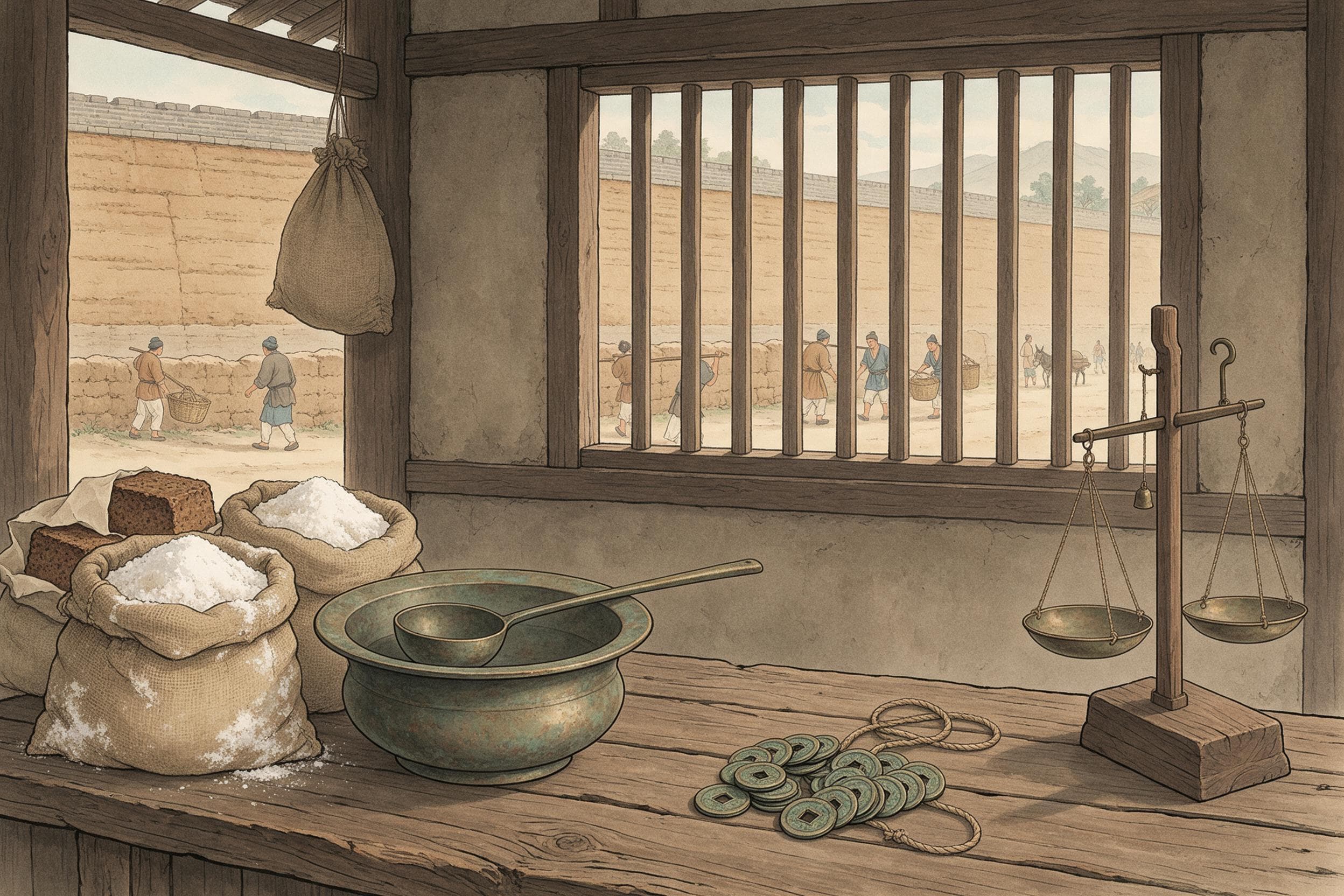
One item at a time, the bill for the summer solstice sacrifice at the altar of the square pool sets out what had to be bought: seven and a half willow baskets, two mace two fen five li; five wooden shovels, one mace five fen; ten brooms, one mace five fen; fifteen tiao brooms, seven fen five li; five bamboo baskets, five mace; five large wicker hampers, one mace five fen; six reed mats, two mace four fen; twenty lengths of hemp rope, two mace; ten carrying poles, three mace; five scraping boards, five mace; a hundred jin of incense charcoal, six mace. Total: two taels four mace nine fen. This is not a price list. It is a purchase order, with the buyer, the supplier and the fund written alongside.
The ledger is Shen Bang's Wanshu Zaji, “Miscellaneous Notes from the Wanping Office,” compiled in 1593 by the magistrate who took the post in 1590. It records one county's supply obligations to the court, the altars, the imperial tombs and the imperial progress. Wanping shared the capital with Daxing: the western half of the walled city was Wanping's, and offerings were often split — “apart from the half that Daxing provides” — so every total below is Wanping's share. Three boundaries first: these are one county's prices, between about 1586 and 1592, for one class of use — official procurement and sacrifice — not retail prices; the offering prices include what merchants and clerks took; and the silver stays in taels, mace, fen and li, with no conversion into modern money.
The bill for one altar, one sacrifice
Altar by altar, the prices run down to the fen and li. For the winter solstice at the circular mound: fifty bundles of reeds, fifty jin each, three mace for carriage; two hundred jin of incense charcoal at six mace a hundred; fifteen liang of lamp oil, four fen five li; a hundred jin of charcoal, eight mace — seventeen taels four fen five li in all. The altar of soil and grain cost thirty-nine taels five mace for its two annual sacrifices. At the Confucian temple even the animals are priced by weight: a sheep of thirty jin, five mace four fen; a pig of eighty jin, one tael six mace. Counts, weights and carriage are all here; market rates are not.
The ancestral temple's monthly offerings are another kind of account. First month: four jin of shepherd's purse, one tael two mace; two jin of lettuce, five mace; two jin of chives, five mace. Fourth month: a pig, one tael two mace; three pheasants, three mace; two jin eight liang of cherries, one mace two fen five li; eighty cucumbers, eight mace. Sixth month: fifteen watermelons, one tael five mace; fifteen winter melons, one tael five mace. Eleventh month: one deer and two wild geese, nine taels six mace. Within one book, four jin of shepherd's purse cost one tael two mace; a deer and two geese cost nine taels six. Those two lines can be compared with each other, and with nothing in a vegetable market.
The county's year
Over a year the account comes to three totals. The ancestral temple's regular sacrifices, after Daxing takes half, came to “about three hundred and ninety-seven taels three mace three fen four li for this county, paid from the guild levy, with merchants and the responsible clerk delivering.” Firewood and charcoal for boiling offerings at the tombs: nine hundred and eighty-four taels six mace five fen seven li five hao three si, paid by both counties. The imperial ploughing ceremony: eighty-nine taels four mace nine fen, of which the leading ox cost eight taels, twenty days of fodder one tael six mace, and fodder for the ministers' thirteen oxen six taels five mace. The money came from different funds — deed-tax silver, guild levy, shop tax — each with its own rule.
How merchants were graded
On the merchants' side stood the hang, the trade rows. At the founding of the dynasty, residents inside and outside the walls were enrolled by lane and ward, their trades and goods noted in the register; for great ceremonies they were called out by the register, and this was called dang hang. Later, because the losses were said to be ruinous, a levy replaced the service: nine grades, from nine mace at the top to one mace at the bottom. The text has a corruption here: the upper-middle grade is printed as “levied zhu mace,” where the sequence requires six — quoted whole, the character stays, with a note. Of 132 rows enrolled in the two counties, a hundred — pawnshops and the like — went on paying, and thirty-two were exempted. The two counties collected 10,641.31 taels. Wanping's quota was 2,663.4: 1,500 households in the top six grades paying 894.3, and 12,079 households in the bottom three paying 1,772.2 — which add up to 2,666.5, three taels and a mace more than the stated total. The text says what it says. In the 1588 reassessment Wanping's figure fell to 1,783.6 taels, listed ward by ward: Jincheng ward 196.8, Mingyu ward 167.5.
How people were counted
On the people's side stood the li-jia. “At the beginning of Yongle, the registered households were seventy-five li... by the twentieth year of Wanli, fifty remained.” The fifty include city wards like Mingyu and Wanbao, and also rural plots like the tenth tu of Qingshui village, three hundred li from the city. “From the founding to now, twenty-five of Wanping's ward-plots are gone... forty-nine plots short in all.” The author will not conclude that the people vanished: “can it be that no remnant of land or population is left, and the register is merely merged?” But of the lost registers he admits they are hard to check. Fifty li is a register, not a population.
The other side of the ledger
Corvée, too, was turned into silver. The chapter on offices lists the stipends: clerks at seven taels two mace a year from the single-whip levy; forty-nine runners at three taels two mace; six gatekeepers at three taels six; three granary guards at three taels eight; five night watchmen at seven taels two; ten lock-keepers at four. The capital county's magistrate ranked 6a, two grades above an ordinary county's. And the ledger has another side: after 1582, when the bottom three grades were exempted and the deed tax was cut, the treasury emptied. When magistrate Xu Qidong took over, “the books showed 7,238 taels of authorised expenditure, and the silver actually there was a little over 680.”
So what does the ledger support? That the altars, tombs and processions of one county can be costed to the fen and li; that merchants were graded and levied by grade; that households were counted in registers that fell apart. What it does not support: that these were the prices people paid in the markets of Wanli Beijing; that a line from a novel can be set beside them; that Qing prices can be read backwards; or that fifty li means a population. Its value is its narrowness — one county, one class of use, a decade of purchases, and fifteen brooms at seven fen five li.
Sources & further reading
- 沈榜《宛署杂记》卷十四·经费上(万历二十一年成书;国学典籍网全文) — Item-by-item procurement prices for the altars, ancestral temple, tombs and imperial ploughing: fifteen brooms at seven fen five li, a hundred jin of incense charcoal at six mace, four jin of shepherd's purse at one tael two mace, a pig at one tael two mace; the ancestral temple's regular sacrifices at about 397.33 taels for Wanping's half; tomb firewood at 984.66 taels for both counties; the ploughing ceremony at 89.49 taels.
- 沈榜《宛署杂记》卷十三·铺行(国学典籍网全文) — The nine grades of the trade-row levy from nine mace to one mace (with the upper-middle grade printed as 主 instead of 六); 132 rows, 100 paying and 32 exempted; 10,641.31 taels collected in the two counties; Wanping's quota of 2,663.4 taels against itemised figures that add to 2,666.5; the 1588 reassessment of Wanping at 1,783.6 taels, listed ward by ward.
- 沈榜《宛署杂记》全书(殆知阁,卷一至卷二十) — Juan 2 on the registers: seventy-five li under Yongle, fifty by 1592, twenty-five ward-plots lost and forty-nine plots short. Juan 3 on stipends: clerks at 7.2 taels a year, runners 3.2, gatekeepers 3.6, granary guards 3.8, night watchmen 7.2.