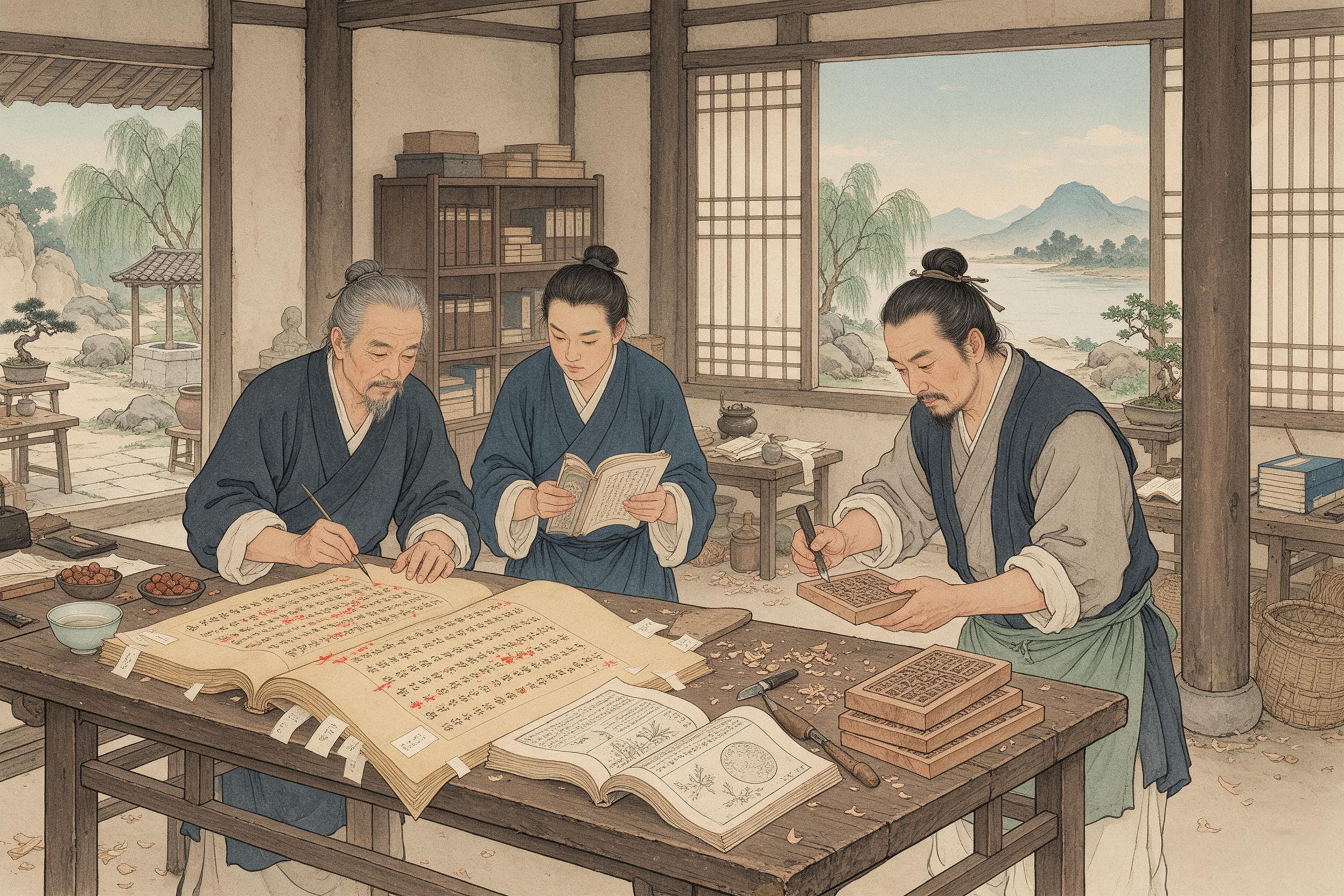
A red dye could be taken back out of the cloth. Song Yingxing, writing in 1637, gives the method: soak the dyed silk, drip a few dozen drops of lye water or rice-straw ash water on it, and the red draws itself out of the fibre and returns to the water with nothing lost. The recovered liquor is stored in green-bean flour and used again. Dye houses, he says, treat this as a secret and will not tell outsiders. It is workshop cunning set down for other craftsmen, and it says nothing about who was entitled to wear red.
The cloth that did not mark rank
The one textile the book treats as crossing rank is cotton. 'For keeping out the cold,' Song writes, 'cotton cloth is the same for noble and base.' The plant grew everywhere; the book knows tree cotton and grass cotton, flowers white and purple, white seed accounting for nine parts in ten. Weaving was best at Songjiang, sizing and dyeing at Wuhu, and yet every district made cloth: the difference was in the finishing.
The finishing depended on a stone. Cloth was calendered under a block of cold, fine-grained rock from north of the Yangzi, and a good one cost more than ten jin of silver — a price for the stone, not for cloth. The big Wuhu shops put the best stone first: if the stone does not heat, the threads stay tight instead of going slack. One line in the same chapter is plainer still: looms stood in ten households out of ten. Cotton was not a luxury with a supply chain; it was furniture.
Thirty-odd colours
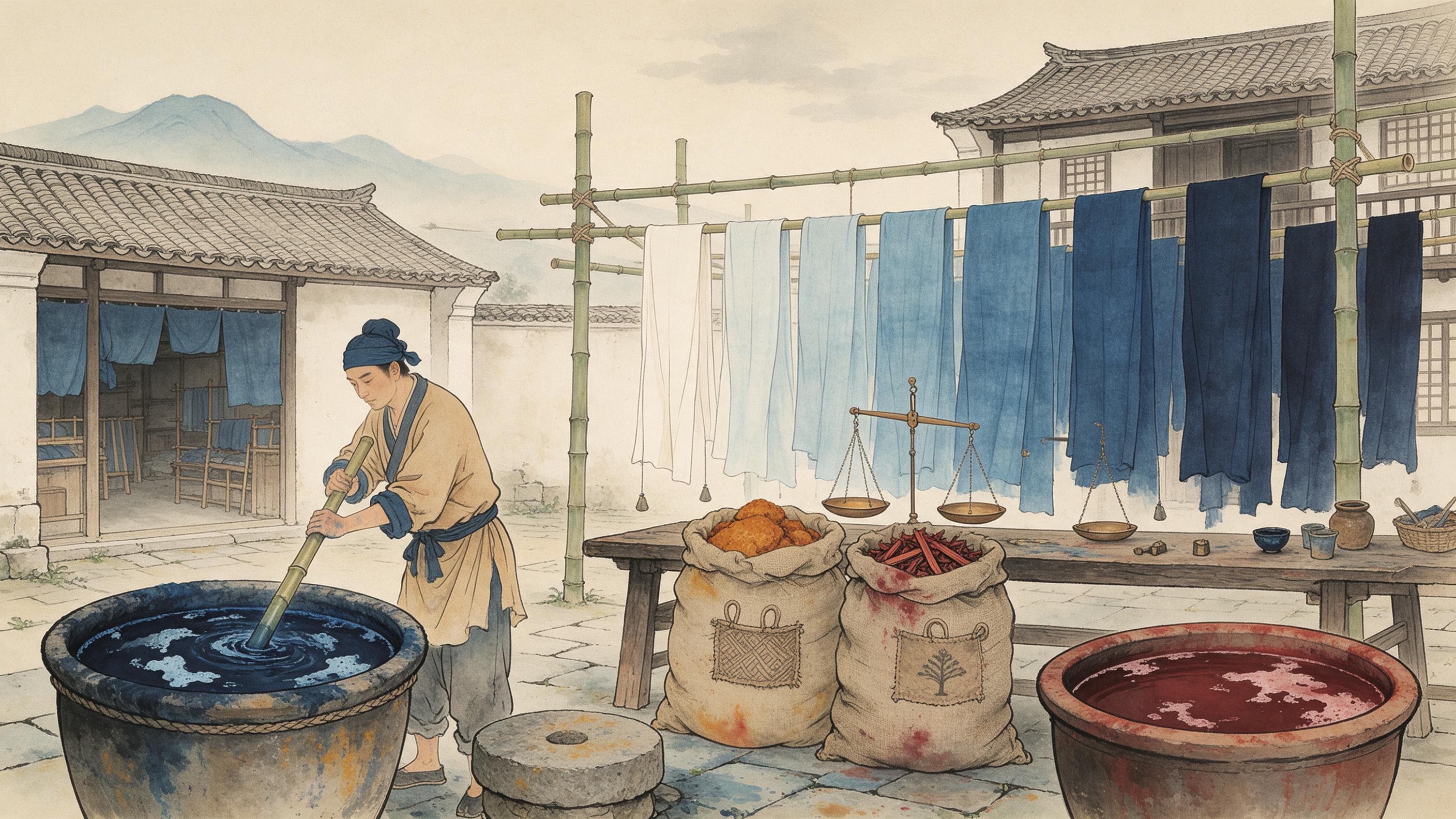
Colour, in the same book, is a question of ingredients and proportions. The chapter on dye materials lists more than thirty colours, each with its recipe. Great red is safflower cake alone, drawn out with dark plum water and then clarified several times with lye or, failing that, rice-straw ash; the more clarifications, the brighter the red. Cheaper dye houses, Song notes, first give the cloth a ground of sappanwood to save safflower. Four other reds — lotus, peach, silver and water — use the same safflower cake, differing only in the weight of dye; none will show on yellow cocoon silk, and all need white silk.
The other shades are the same few materials played against each other. Xuan, the near-black of formal dress, is indigo dyed to a deep blue-green and then covered with a decoction of equal parts reed-wood and myrobalan bark; the book offers a shortcut using indigo-sprout water with iron sulphate and nutgall, and admits that cloth dyed so rots easily. Moon-white is indigo barely dipped. Bean green is cork-tree bark with indigo over it; official green is pagoda-tree flower with indigo over that. Wood-red is sappanwood with alum and nutgall; purple is sappanwood as a ground with iron sulphate on top.
Blue was the colour most people could actually get. Five indigo plants serve: tea indigo, polygonum, baphicacanthus, wu indigo, and a small-leaved polygonum the book rates best. The leaves and stems are steeped seven days; to every shi of liquor five sheng of lime go in, and the mixture is stirred several dozen times until the pigment settles. The scum skimmed off and dried is indigo flower. Indigo entering the vat is first mixed with rice-straw ash water, then stirred daily with a bamboo pole uncountable times; the best vat is called the standard vat.
Read straight through, the chapter is instruction in proportion: so much safflower, this many clarifications, one decoction over another. It never says who should wear what. It even teaches the dyeing of xuan black — the very colour that the appended cases treat as forbidden, along with yellow and purple. A published recipe is not permission; but what stood between the recipe and the robe, the material does not say.
What the statute regulated
The Ming code's article on dress and buildings opens by asserting a ladder: houses, carriages, clothing and vessels, it says, each have their rank. To use a rank above one's own brought a hundred strokes and dismissal for an officeholder, fifty strokes for a commoner, the head of the household bearing it, and fifty for the craftsman who made the thing. Forbidden dragon-and-phoenix patterns were worse: a hundred strokes and three years of penal labour for official and commoner alike, a hundred for the craftsman, who was also sent to the capital with his whole household to be enrolled as a government artisan, the object confiscated. An informer received fifty taels — the commentary notes the reward attaches only to the dragon-and-phoenix clause — and a craftsman who gave himself up was pardoned and paid.
Cases appended later tightened the net around colour. Soldiers, commoners and clergy who wore brocade, damask, gauze or embroidered silk in ordinary dress, or made curtains and bedding of scarlet worked with gold, were to be punished under the appropriate article with the goods confiscated. One case names colours outright: usurping dark xuan, yellow or purple, or the python, dragon and flying-fish patterns, or using vermilion and yellow, was to be sentenced by analogy with the dragon-and-phoenix law. The one place where the code ties a material directly to an identity is the clause on monks and nuns, whose clothes may use only coarse silk, plain silk and hemp, not fine silk or patterned gauze, on pain of fifty strokes, laicisation and confiscation. The commentary explains the ban in four characters: it is because such people are of base sort.
The rungs of the ladder are elsewhere
But the rungs are not in the code. The article says ranks exist and punishes trespass; its own commentary points elsewhere for the detail, to the Da Ming Ling, the Ming ordinances. Neither those ordinances nor the sumptuary chapters of the administrative statutes could be read for this piece, so no rank is listed here. The often-repeated rule that merchants might wear only plain silk and hemp is likewise unverified here: no readable text was found, so it is recorded as a claim, not quoted. Declaring that Ming dress was rigidly graded would be filling this hole with an impression.
Between the statute and the cloth
What the code offers is a penalty, not a record. The penalties are precise down to the craftsman's household being marched to the capital, and the informer's fifty taels show what the drafters expected: enforcement by denunciation. Yet not one prosecution over a colour, and not one dyer questioned about a vat, survives in the material examined here. Statute and daily life are two ledgers, and only one of them is in hand.
The craft book is not the other ledger either. It gives no price for safflower or indigo, no wage for a dyer, no cost for a finished robe; the only price in the cotton chapter is the ten-odd jin for a calender stone, which is not cloth. Nor does it say that dye houses followed its recipes, or who bought the deep blacks. What can be said is narrower and firmer: cotton was cheap and everywhere, the chemistry of colour was written down and teachable, and the law's concern was pattern, colour and rank, with the detail kept in a book this article could not open. Song Yingxing closes his chapter on cloth with a judgement of his own: since it is cloth, plainness is enough. That is an author's taste, not a rule.
Sources & further reading
- 《大明律》卷十二·服舍违式、僧道拜父母(含条例;维基文库) — The ladder and the penalties: 'each has its rank' for houses, carriages, clothing and vessels; a hundred strokes and dismissal for an officeholder, fifty for a commoner, fifty for the craftsman; dragon-and-phoenix patterns a hundred strokes and three years; fifty taels for an informer, but the commentary says only for the dragon-and-phoenix clause. Appended cases name xuan, yellow and purple as forbidden colours and require sentencing by analogy with the dragon-and-phoenix law; clergy may wear only coarse silk, plain silk and hemp. The article's own commentary points to the Da Ming Ling for the detail of the ranks, which this piece could not read.
- 宋应星《天工开物》乃服第二·布衣(崇祯十年初刊;维基文库本页面标 25% 未校对) — 'For keeping out the cold, cotton cloth is the same for noble and base'; two kinds of cotton plant, white and purple flowers, white nine parts in ten; weaving best at Songjiang, bleaching and dyeing at Wuhu; a good calender stone worth more than ten jin (a stone, not cloth); looms in ten households out of ten; closing line 'since it is cloth, plainness is enough'.
- 宋应星《天工开物》彰施第三·诸色质料(崇祯十年初刊;维基文库本页面标 25% 未校对) — Recipes for thirty-odd colours: great red from safflower cake with dark plum water and repeated lye clarifications; lotus, peach, silver and water reds from the same cake by weight; blackish xuan from deep indigo covered with reed-wood and myrobalan; moon-white from a brief indigo dip; bean green from cork-tree bark under indigo; the trade secret for recovering red from dyed silk.
- 宋应星《天工开物》彰施第三·蓝淀(崇祯十年初刊;维基文库本页面标 25% 未校对) — Five indigo plants; leaves and stems steeped seven days, five sheng of lime to each shi of liquor, stirred until the pigment settles; dried scum is indigo flower; the best vat called the standard vat; indigo mixed with rice-straw ash water and stirred daily with a bamboo pole.