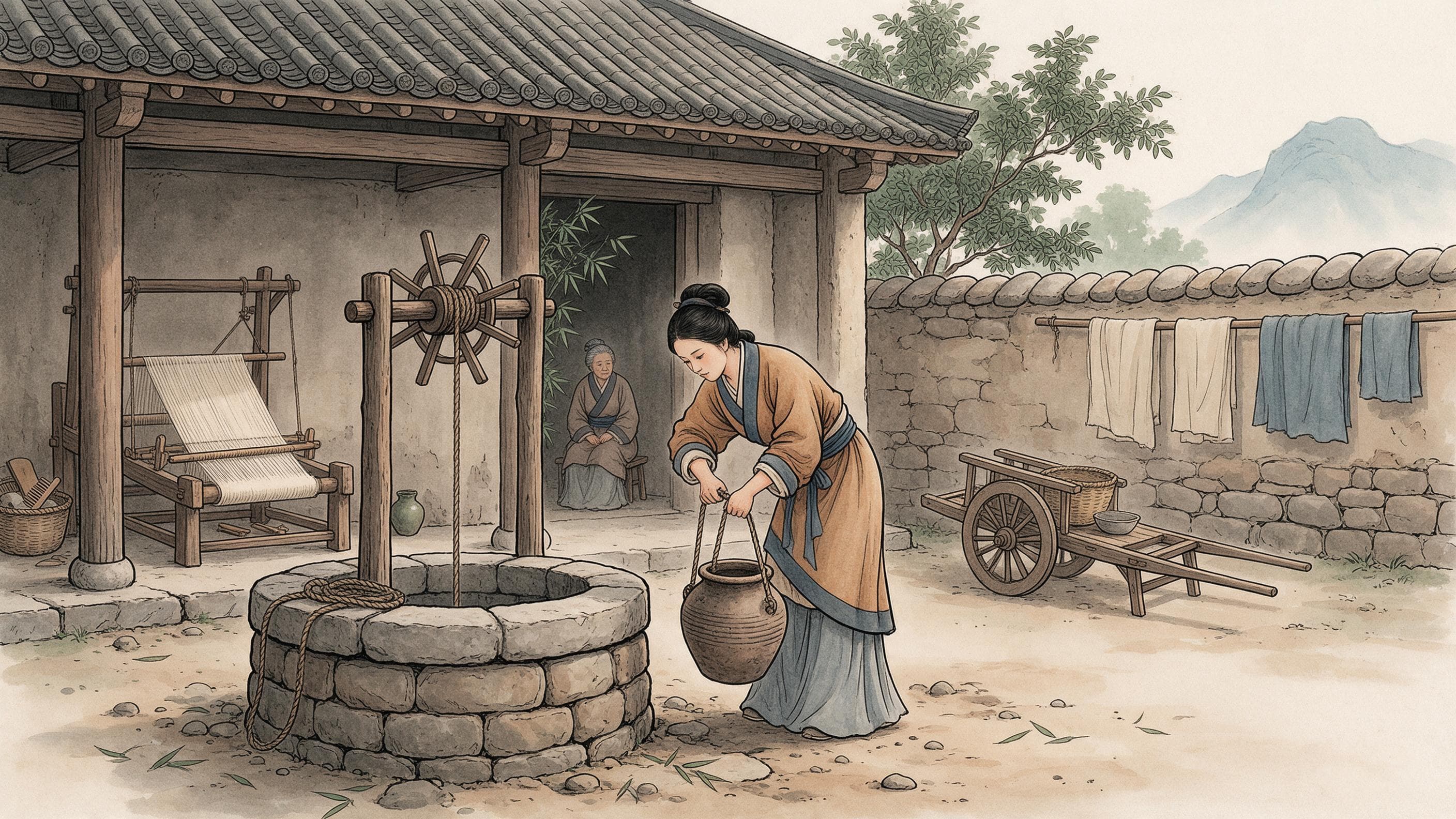
Fan Ye's chapter on exemplary women tells of a bride from the Huan family, married by her teacher father to a poor student named Bao Xuan with a handsome trousseau. Bao Xuan was not pleased. She returned all of it — the attendants' clothes, the ornaments — put on a short cloth skirt, and went home with him pushing their handcart between them. When the ceremony of greeting his mother was over, she took the water jar and went out to draw water. That is the whole record: four actions and one sentence of praise. What she thought while she did them is not there.
Three days old
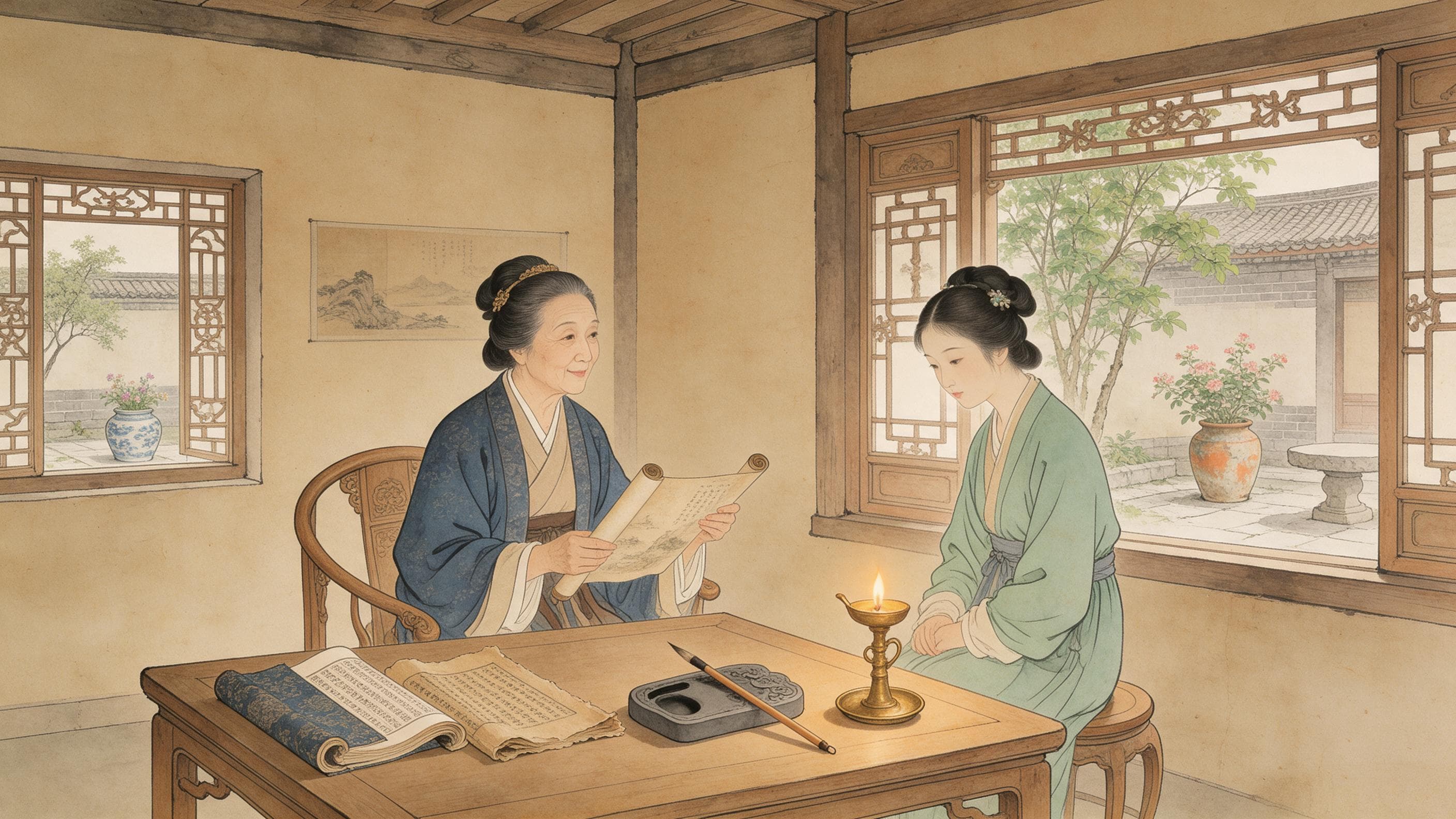
The rules for such a life were written by a woman who had lived it. Ban Zhao, daughter of Ban Biao and sister of the historian Ban Gu, was learned enough that the empress and the palace ladies studied with her, and the court called her the Great Lady. She entered the Cao household at fourteen; more than forty years later she wrote the seven chapters of Admonitions for Women for daughters about to marry and untrained in the rites. It was not a state ordinance but a mother's letter. It begins with a birth: 'In antiquity, when a girl was born, for three days she was laid beneath the bed, given a potsherd to play with, and announced to the ancestors.' Under the bed meant lowliness; the potsherd, the old commentary says, was a spinning whorl, and meant getting used to work. The first thing put into her hands was the tool of her trade.
Then the timetable: 'Late to bed, early to rise; do not flinch from night or dawn.' The fourth chapter lists four virtues — virtue, speech, bearing, work — and defines each downward: virtue need not be brilliance, speech need not be eloquence, bearing need not be beauty, work need not be superior skill. Work is two things: 'single-minded in spinning and weaving, not fond of joking laughter; clean and orderly in wine and food, to serve guests.'
Four virtues and a mother-in-law's heart
The sixth chapter, on compliance, is the bluntest: 'If your mother-in-law says a thing is not so, and it is so, you should still obey; if she says it is so, and it is not, you should still comply.' Do not argue the rights of the case. The seventh chapter gives the reason: a wife's standing with her husband depends on her parents-in-law loving her, and their love depends on the good word of her husband's younger siblings. A household manual, written for daughters, is largely a manual for living inside other people's judgement.
It also keeps the proverbs: 'A boy born like a wolf — and they still fear he will be weak; a girl born like a mouse — and they still fear she will be a tiger.' And Ban Zhao leaves one line of autobiography: 'At fourteen I took up the broom in the Cao house; it is now more than forty years.'
The loom
The other register is story. Fan Ye tells of the wife of Yue Yangzi, whose own family name was not recorded. Her husband found a piece of gold on the road; she would not touch it. He went away to study and came back after a year, saying he had missed home. She took a knife and stepped to the loom: 'This cloth is born from silk cocoons and made on the frame and shuttle. Thread by thread it becomes an inch; inch by inch, never stopping, it becomes a bolt. Cut the weaving now and the work so far is lost and the months wasted. Turn back halfway, and how is that different?' He went back and stayed away seven years. The original says yin dao qu ji — drawing the knife and stepping to the loom, not the later idiom of cutting the loom to teach a lesson.
The loom and the dishes are the same subject seen twice. Yue Yangzi's wife cuts the cloth for her husband to see; Jiang Shi's wife spins day and night, buys delicacies in the market, and has a neighbour carry them to her mother-in-law. Ban Zhao's abstract line — single-minded in spinning, orderly in wine and food — becomes in these stories a half-finished bolt on a frame and a parcel of bought food going next door.
Water, six or seven li away
The hardest physical work in these texts is water. Huan Shaojun takes the jar the moment the greeting is over. Jiang Shi's mother liked the taste of river water, and the river was six or seven li from the house, so the wife went upstream to draw it. Once the wind delayed her, the old woman grew thirsty, and the husband blamed his wife and sent her away. She lodged with a neighbour, kept spinning, bought delicacies and had the neighbour deliver them, until the old woman asked who was sending the food. The record also says, in a line easy to pass over, that a son of theirs drowned while fetching water from a distance, and that his mother, afraid of grieving the old woman, said only that the boy had gone away to study.
The Admonitions has nothing on this. The four virtues do not mention water; the chapter on diligence speaks only of late nights, early mornings, and not shrinking from hard or easy work. Drawing water appears only in the stories, as the background against which a daughter-in-law is measured: six or seven li, upstream, a place where a child did drown — and the record spends five characters on it.
Years later, an old woman, she was asked by her grandson whether she still remembered the days of the handcart. She answered with her mother-in-law's words: 'In safety, do not forget danger; in survival, do not forget ruin. How would I dare forget?' What she kept was what she had been told.
Two texts, two sieves
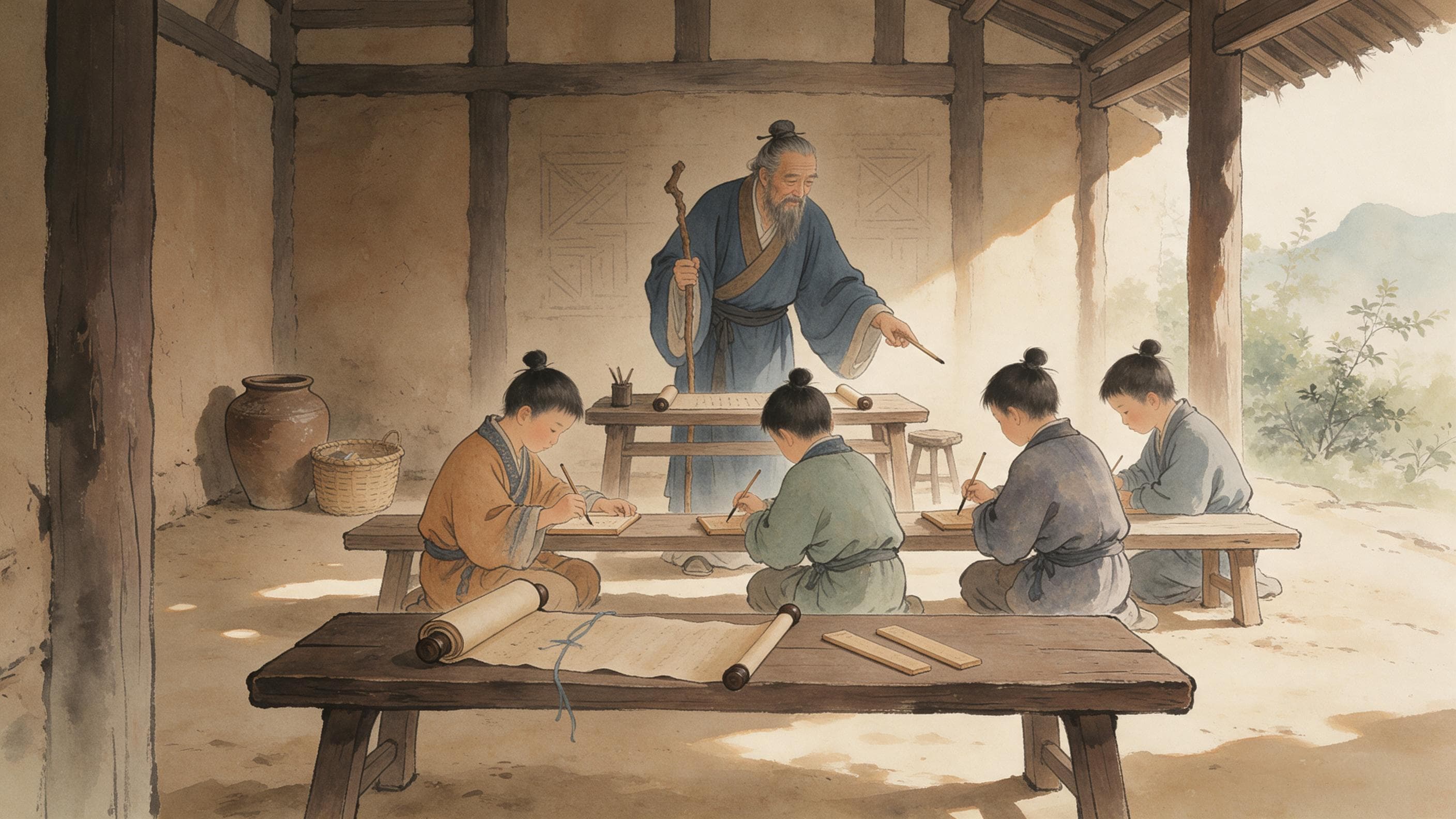
Each text sifts in its own way. The Admonitions began as one mother's letter and became a classic: Ma Rong, the great commentator, admired it and had his wife and daughters study it, and Fan Ye copied it entire into his chapter. The chapter itself is an honour roll, and says so: 'I have merely collected and arranged those whose talent and conduct were especially high and outstanding; I have not confined myself to one kind of constancy.' Fan Ye wrote in the fifth century, under the Liu Song, from Han materials he chose and reshaped. Liu Xiang's older anthology, with its seven categories — motherly example, discernment, benevolence, chastity, integrity, eloquence, ruinous favourites — established the frame of writing women into books by type; its stories are mostly pre-Han and serve here as background only.
So what can be said? Spinning, drawing water, preparing food and serving the parents-in-law recur in both the rulebook and the honour roll, and that repetition is good evidence that these were ordinary work. The texts cannot say what share of a day each task took, how old most women were when they married, how many children they bore, or how many could read. Foot-binding and chastity arches belong to later centuries and are absent here. What the two records offer is not a Han woman's day but something narrower: what the people who wrote her down wanted her to be, and which women they decided to remember.
Sources & further reading
- 班昭《女诫》(东汉;维基文库,摘自《后汉书》卷八十四) — Seven chapters written for her own daughters. Birth ritual: three days under the bed, a pottery spinning whorl to play with, an announcement to the ancestors, each with its reading. Late to bed, early to rise. The four virtues, with work defined as single-minded spinning and clean, orderly wine and food for guests. Compliance with the mother-in-law. A wife's standing comes from her parents-in-law, whose love comes from her husband's younger siblings. Her own line: at fourteen she took up the broom in the Cao house, and it is now more than forty years.
- 范晔《后汉书》卷八十四·列女传(南朝宋;维基文库) — The compiler's own filter: 'I have merely collected those whose talent and conduct were especially high and outstanding.' Huan Shaojun returns her trousseau, wears a short cloth skirt, pulls the handcart home with her husband, and after greeting her mother-in-law 'takes the jar and goes out to draw water'. Yue Yangzi's wife steps to the loom with a knife. Jiang Shi's wife draws water upstream six or seven li away, is sent away, lodges next door, spins day and night and buys delicacies for her mother-in-law; a son later drowns fetching water. Ban Zhao's own biography: the Han court's 'Great Lady'.
- 刘向《列女传》(西汉;维基文库总目) — Seven categories — motherly example, discernment, benevolence, chastity, integrity, eloquence, ruinous favourites — the earlier framework for writing women into a book. Its stories are mostly pre-Han and are used here only as background to the genre, not as Han evidence.