Three sentences from one chapter of the Jin Shi describe the same institution at three different sizes. In the second year of Emperor Taizu: “three hundred households were made a mou-ke, and ten mou-ke a meng-an.” In the fifteenth year of Dading (1175): “no mou-ke is to exceed three hundred households, and one meng-an is set over seven to ten mou-ke.” At the end, after the court had fled south: “twenty-five men were made a mou-ke, and four mou-ke a meng-an.” The same name, three shapes — and between them sixty years and a collapse.
The meng-an mou-ke was the Jurchen military-household organisation. This article uses three chapters of the Jin Shi, the history commissioned by the Yuan court under Tuotuo: the treatise on the army (juan 44) and the two chapters on the economy (juan 46 and 47). They give quotas and realm-wide totals. They do not give one household's fields, tax or conscripts, and the three chapters cannot be used to fill each other's gaps. One warning first: this is a Jurchen military-household system, not the ordinary household classification of registered subjects described in juan 46, and the two must not be equated.
The establishment: three hundred, seven to ten, twenty-five
The founding quota is dated: in Taizu's second year, after 2,500 men broke Yelü Xieshi, “three hundred households were made a mou-ke, and ten mou-ke a meng-an.” Before that there was no fixed establishment at all: a tribal chief was a bojin, and “on campaign they were called meng-an and mou-ke, taking their titles from the number of men” — the “thousand-man commander” and “hundred-man commander” are campaign titles, not household quotas, and no one should read ten soldiers per household out of them. Xizong graded the units into three classes; Hailing abolished the grades. Then Dading 15 re-fixed them: three hundred households at most, one meng-an to seven to ten mou-ke. By 1183 the registers counted 202 meng-an, 1,878 mou-ke, 615,624 households and 6,158,636 persons. In the last years: twenty-five men to a mou-ke, eighteen fighting men left after the five men of the flag-and-drum detail — “in name only.”
Fields: the ox-plough unit
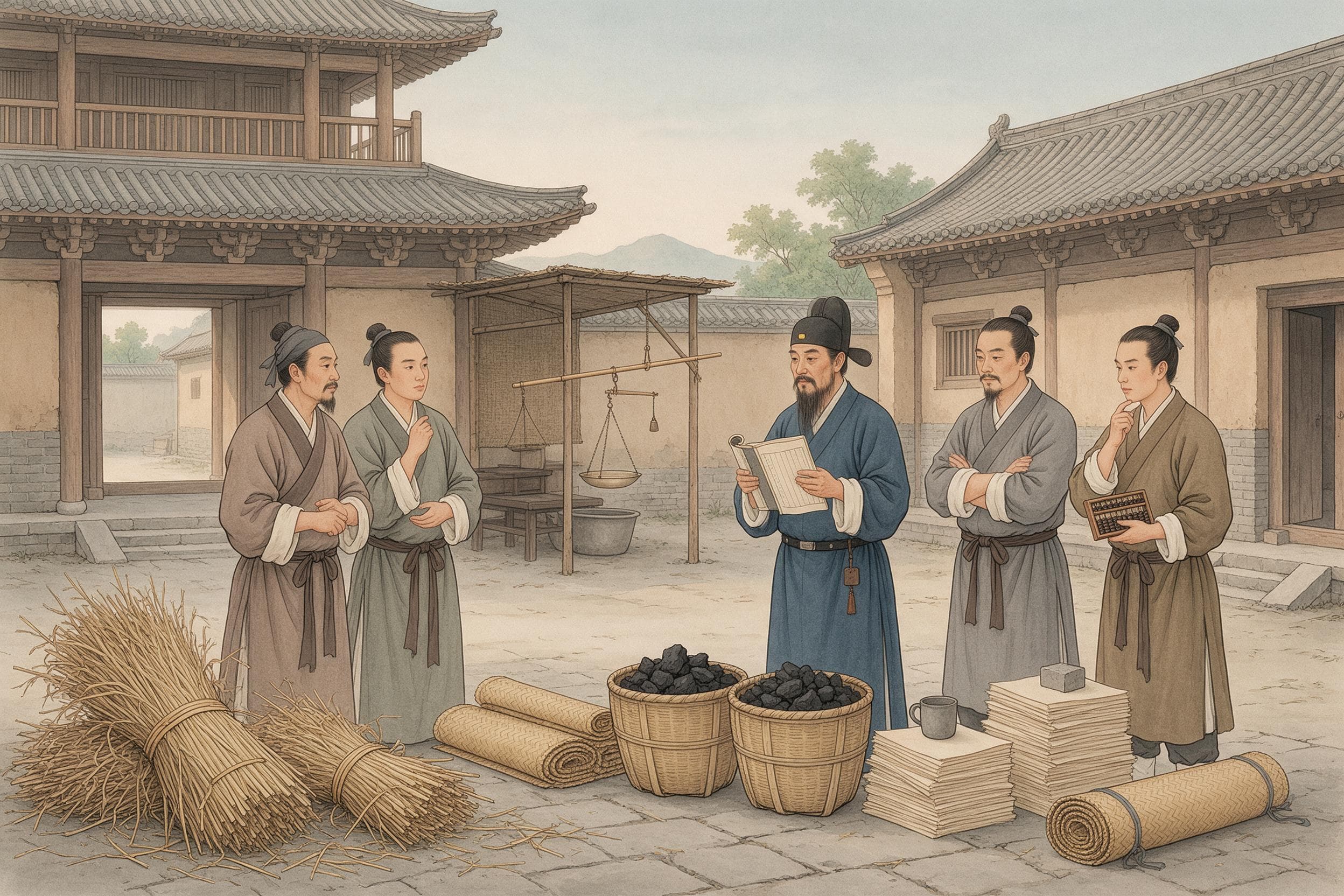
Land was counted in niu ju, plough-ox units. “Every three plough-oxen make one unit; the limit is twenty-five mouths receiving four qing four mu and a little over” — a quota per unit of about twenty-five people, not per household; the annual grain tax is “roughly not more than one shi,” and no official or commoner may hold more than forty units. In 1126 the court fixed five dou of grain per unit. Frontier garrison troops received land by rank instead — five qing for a thousand-household commander, four for a mou-ke, three for a puliyan, two for a regular soldier, one for an alixi — which belongs to their pay, not to a peasant household's holding.
The other tax: property assessment
The ox-head tax ran beside another levy, the wuli qian, assessed on “fields and gardens, town houses, vehicles, livestock, what is planted, and the amount of silver hoarded,” at rates that varied, and reassessed in periodic inspections. In 1195 the registers of the whole realm gave 7,223,400 Jurchen, Khitan and Chinese households and 2,604,742 strings of means levy — a national figure. And there is one contemporary verdict on these households, worth quoting because it is a verdict: in 1181 Emperor Shizong complained that the meng-an mou-ke households of Shandong and Daming were “arrogant and idle, not attending to farming,” letting Chinese tenants till the land and taking the rent; “the rich all wear silk and brocade and give themselves to wine and feasting, and the poor vie to imitate them.” That is the emperor speaking, not a statistic.
Conscription: rules, not a per-household number
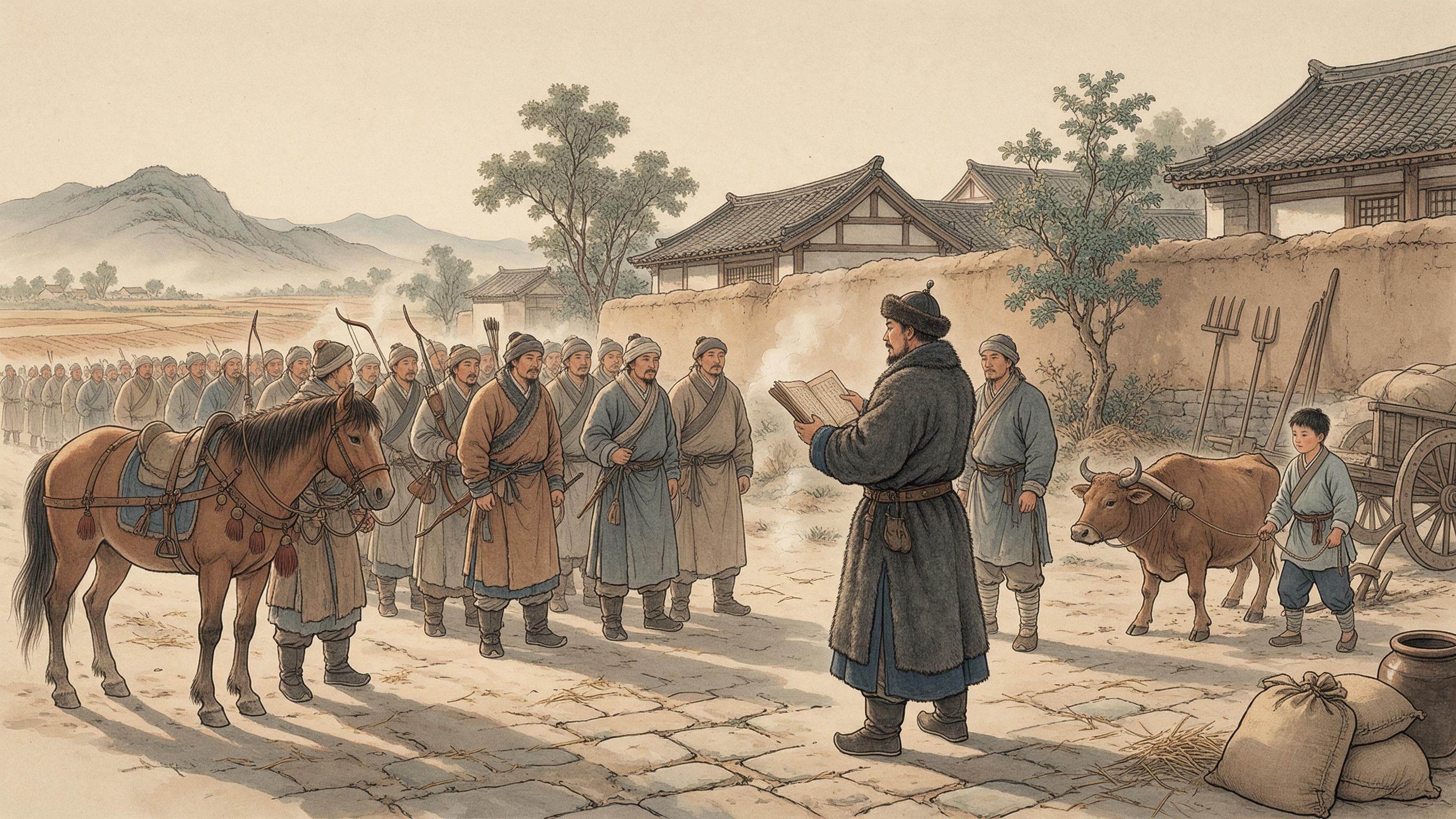
The early state described itself plainly: among the tribes “there were no other corvée duties; the able-bodied were all soldiers.” In peacetime they fished and hunted; “when there was alarm, orders went out within the tribe and envoys were sent to the bojin to call up troops,” each man providing his own weapons and rations. Chinese troops were a separate system: “when there was trouble they were conscripted from the people; when it was over, they might be released.” Beneath a mou-ke stood the puliyan as deputy and the alixi as auxiliary. Later the rules became administrative: in 1163, where a household's father and elder brothers were already armoured soldiers and the sons were alixi, “one man was exempted” so the farm would not fail, and a dependent servant could take the alixi duty instead; in 1180, frontier soldiers over fifty-five could hand over to a son or a nephew in the same household, and substituting a slave was punished. What no chapter gives is a number of soldiers per household.
Totals, and the household that is missing
What the chapters do give is a census of the system at one moment: in 1183, 202 meng-an, 1,878 mou-ke, 615,624 households, 6,158,636 persons, 1,690,380 qing of cultivated land and 384,771 plough-ox units. Divide the land by the households and you get about 2.7 qing per household — but that is arithmetic, not a record: the Jin Shi never states it, and “household” and “unit” are not the same thing. The figures can tell us the size of the machine in one year; they cannot tell us what one family held, paid or sent.
The pay scales are the same kind of evidence. A garrison officer of a meng-an in the Henan, Shaanxi and Shandong commands drew eight strings of cash, five shi two dou of rice, eight bolts of silk and fodder for six horses a month; a mou-ke six strings and two shi eight dou; a puliyan four strings; a regular soldier two strings, one shi five dou, four bolts, fifteen ounces of cotton and two horses' fodder; an alixi one string five hundred cash. On retirement after ten years a thousand-household commander received fifty ounces of silver and thirty bolts of silk, a regular soldier fifteen ounces and ten bolts, an alixi eight ounces and five bolts. These are individual pay and bonuses, not a household's income, and the eight strings are not converted into anything here.
So the three ledgers come out like this. The establishment has quotas, but three sets of them, each dated, the last a ruin. The land has a quota per ox-unit of about twenty-five people, and a land allowance per rank for garrison troops, but no figure for a household. The tax has a grain quota per unit and a means levy on property, assessed realm-wide and never itemised by family. The soldiers have rules for calling men up and excusing them, and no quota of men per house. A household in 1183 is one of 615,624, and it has no name in the record — which is the point: the Jin Shi tells us how the machine was supposed to be counted, not how one family lived inside it.
Sources & further reading
- 脱脱等《金史》卷四十四·志第二十五·兵(兵制、禁军之制、养兵之法) — Taizu's second year: three hundred households to a mou-ke, ten mou-ke to a meng-an; Dading 15: no mou-ke above three hundred households, one meng-an to seven to ten mou-ke; the last years: twenty-five men to a mou-ke; exemptions and substitution; garrison pay scales, retirement awards, and land by rank for frontier troops.
- 脱脱等《金史》卷四十七·志第二十八·食货二(田制、租赋、牛头税) — The ox-head tax: three plough-oxen to a unit, twenty-five mouths receiving four qing four mu, about one shi of grain a year, holdings capped at forty units; 1126, five dou per unit; the definition of the means levy; Shizong's 1181 criticism of Jurchen military households.
- 脱脱等《金史》卷四十六·志第二十七·食货一(户口、通检推排) — The realm-wide census of 1183: 202 meng-an, 1,878 mou-ke, 615,624 households, 6,158,636 persons, 1,690,380 qing of cultivated land, 384,771 plough-ox units; registration every three years; the 1195 figures for households and means levy (national totals).