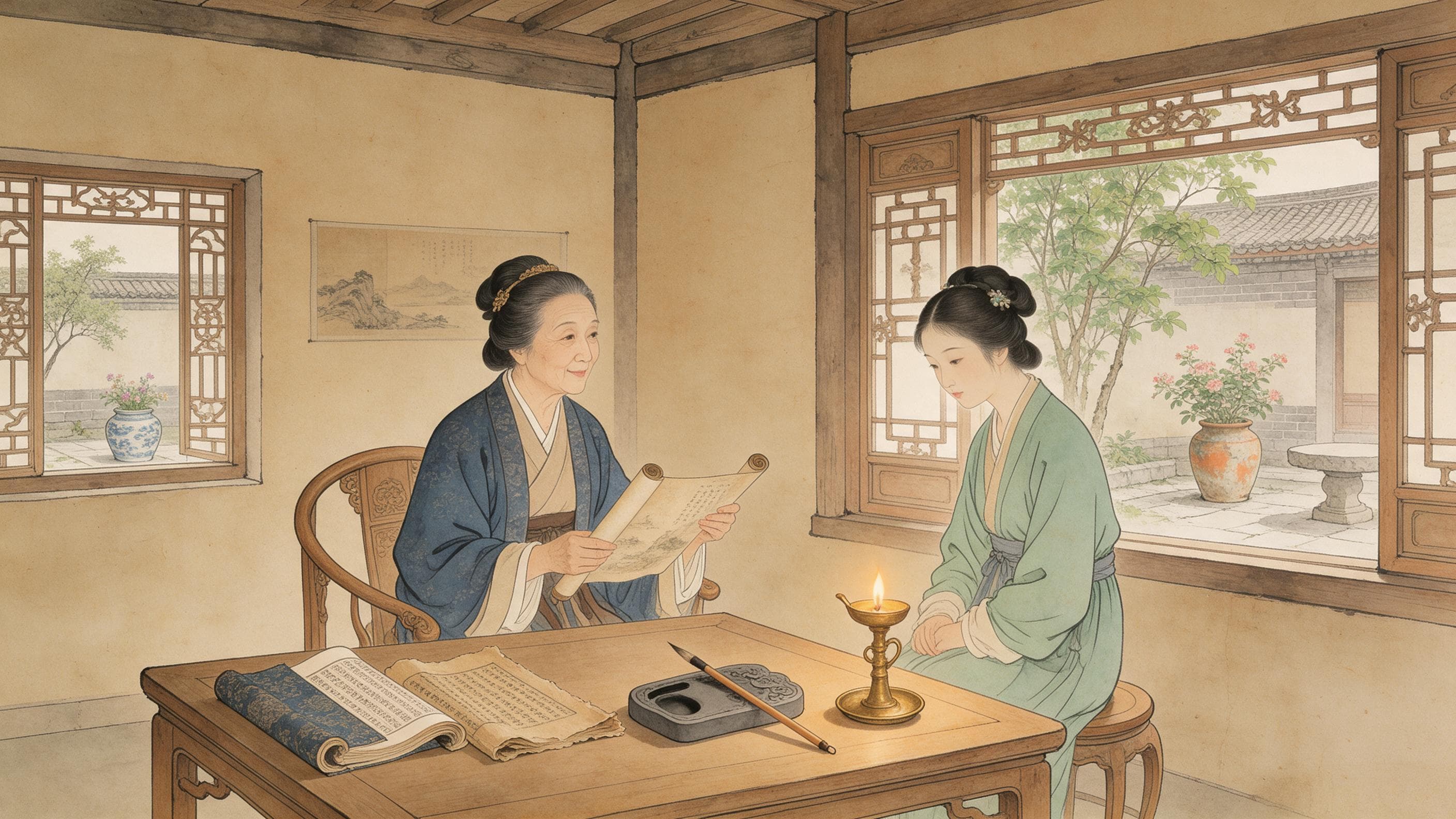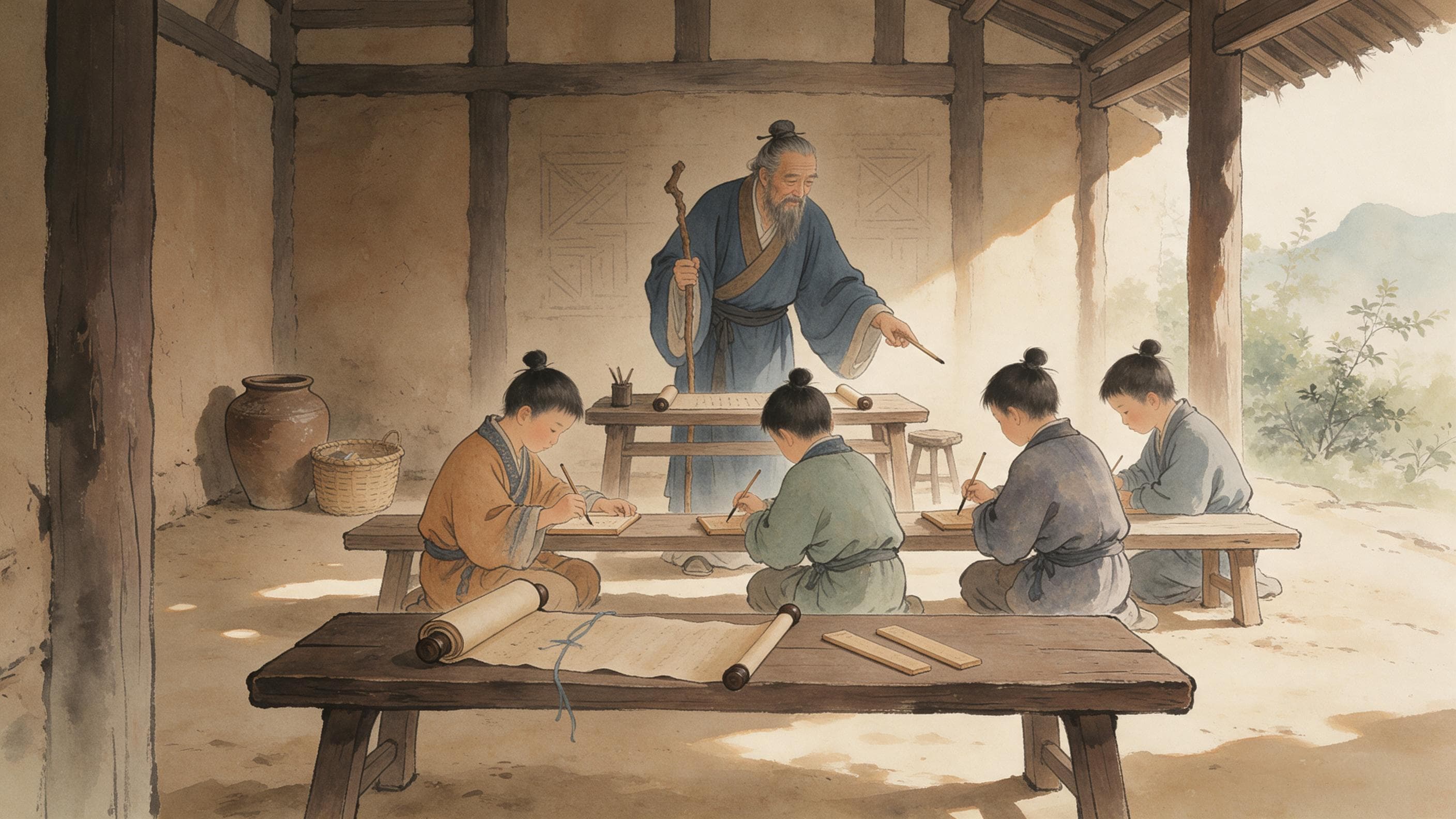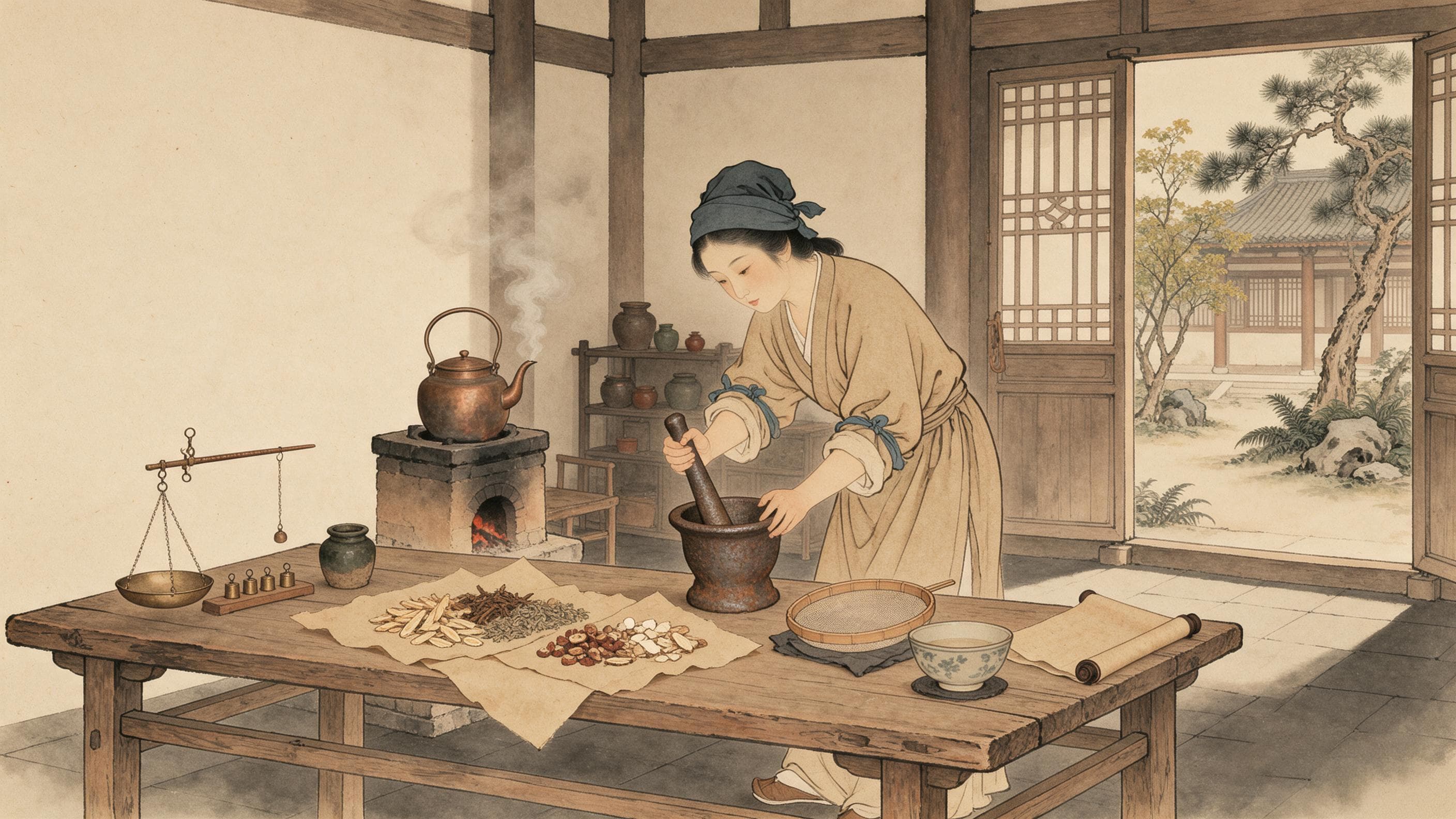
The first thing this book says about making up a prescription is not a list of drugs. It is a rule about the scales: “Every drug, once it has been sorted, cleaned, roasted or simmered, is then weighed for use; it must not be weighed raw.” So the small steelyard is not where the work begins. The drugs have already been trimmed, scraped, soaked, roasted over ash and sifted; only then do they go on the beam.
The book is Sun Simiao's Beiji Qianjin Yaofang, “Essential Prescriptions Worth a Thousand in Gold for Emergencies,” written in the seventh century and read here in the Northern Song edition corrected by Lin Yi and others. Its first juan is not a catalogue of remedies but a workshop manual in nine parts: how to study, how to behave, how to diagnose, how to prescribe, how to combine drugs, how to compound them, how to take them, and how to keep a store at home. Everything below comes from that juan. Two boundaries first: the book teaches what should be done, not what every Tang doctor did; and it gives no prices. The other great Tang formulary, Wang Tao's Waitai Miyao, reaches us the same way: the surviving edition was printed in 1640, and its editor notes that the book was compiled in Tang, printed again in Song, and not cut in wood since Yuan — a Ming voice describing a Tang book, not a Tang one.
First, the diagnosis
The sequence begins with the patient, not the pharmacy. “To treat an illness, first examine its source and watch the workings of the disease.” The pulse is taken at dawn, before food, while the yin is still; the physician works through the three sectors and nine positions, the body's shape, the colour of the face. Sun's contempt is for those who skip it: physicians who “ask about the illness with a ready tongue, and after a moment's look prescribe a decoction,” who “take the inch pulse and not the foot.” The prescription is the last step.
Nothing is weighed raw
Then the drugs are made ready, and the rules are specific. Liquorice, magnolia bark and bitter orange are roasted. Aconite and its relatives are “roasted in ash until they crack slightly, the black skin shaved off, and only then weighed.” Pinellia is washed in hot water to take off its slipperiness. Ephedra has its nodes cut away and is boiled separately, the scum skimmed, before the rest goes in. Stones are broken to the size of rice grains and wrapped in cloth. A drug is not a substance off a shelf; it is a substance that has been through a procedure, and the procedure is written into the weight.
The weights carry a history the book stops to explain: “The old steelyard had only the zhu and the liang, and no name for the fen. Now ten millet grains make one zhu, six zhu one fen, four fen one liang, sixteen liang one jin.” For powders there are the fangcunbi spoon, the daogui, the pinch, the ladle and the ge; for drugs too light to weigh, a measuring cup one cun across at the top and eight fen deep. A household following this book needed a beam, a set of measures, and a cup.
Boiling and taking
Boiling is given as a ratio, not a recipe: “Roughly twenty liang of drugs to one dou of water, boiled down to four sheng; strain off the dregs and measure out the doses.” Draw the water fresh from the well, keep the fire low so the liquid only trembles; for a purgative use less water and take more liquid, for a tonic more water and less. Two people wring it through new cloth with a wooden stick, and it is divided into three doses. Pills are the size of a wutong seed: a tonic starts at ten and rises, but not past forty. Drink the decoction warm, walk a hundred paces, stay indoors for the day.
Then the abstinences, which take more space than the recipes: no raw or cold food, no vinegar, no slippery food, no pork, no large poultry, no fish, no oil, no wheat noodles, no garlic, no fruit — and by drug, asparagus root forbids carp, atractylodes forbids peaches and plums, liquorice forbids cabbage and seaweed. Avoid the sight of corpses and of women in childbirth; avoid anger and grief. Taking a prescription, here, is largely a matter of not doing things.
Who mixes the medicine
The only place money appears in this juan is where the doctor is told to ignore it: “A physician must not rely on his skill to set his mind on profit”; he must not, “because the patient is rich, prescribe costly drugs to make them hard to obtain and show off his ability.” Fees existed; the book gives no figure, and neither does any other source used here. What the juan does describe is the supply chain, and it dislikes it: “Of late, households in the countryside buy drugs at the market and, right there, hire someone to pound and mix them.” The hired pounder ignores the method, steals and discards the difficult drugs; dust gets in; the sieves are coarse; a crowd of mouths tastes it and a crowd of noses smells it, and the essence of the medicine is gone.
The medicine store, and what is missing
His answer is a box at home. The juan ends with the yaocang, the medicine store: “Those who care about such things should keep a store of drugs against emergencies.” He shames the rich by comparison: households that keep horses lay in tens of jin of horse medicine, while a man who keeps himself has not a zhu for his own body — “to value the beast and cheapen the body is truly shameful.” The kit follows: iron and wooden mortars, silk and horsehair sieves, a knife and block, a jade mallet, a porcelain bowl, copper pots, a cauldron, spoons. Drugs go into new earthenware sealed with mud, pills and powders into wax-sealed porcelain, good for thirty years, all kept three or four feet off the ground.
One rule belongs with the store: Sun will not use living creatures as medicine — “my prescriptions do not use life as a drug” — and buys only leeches and gadflies already dead in the market. That is the whole of it: a pulse at dawn, drugs roasted and weighed, a decoction boiled by ratio, three doses, a long list of things not to eat, and a box for next time. What the juan never gives is a price, a fee, or a promise that any of it worked. Far west at Dunhuang the library cave preserved fragments of Tang medical books — selected remedies, a materia medica, a dietary manual, a cold-damage treatise — but those are local copies from a frontier town, not a Chang'an household. What the book shows is a table with a scale on it, and someone who has just been told not to weigh the drugs raw.
Sources & further reading
- 孙思邈《备急千金要方》卷一·序例(北宋林亿等校正本,识典古籍) — Juan 1 in nine sections: study, conduct, diagnosis, prescription, combining drugs, compounding, taking, and the home medicine store. Rules for roasting and weighing drugs, the weights and measures, the decoction ratio of twenty liang to one dou down to four sheng, the three doses, the abstinences, and the market where drugs are bought and pounded for hire.
- 《备急千金要方》目录(识典古籍) — The thirty-juan structure: juan 1 on general rules, juan 2 to 4 on women's medicine, juan 9 on cold-damage, juan 26 on diet, juan 27 on nourishing life, juan 30 on moxibustion.
- 王焘《外台秘要》卷首·序(明崇祯重刊本,识典古籍) — A Ming preface, not a Tang text: “this book was compiled in Tang, printed again in Song, and since Yuan has had no woodblock”; describes the manuscript bought and corrected for the 1640 reprint, and the Ming editor's contempt for unlearned physicians.
- IDP〈Abstracts of the Medical Manuscripts from Dunhuang〉(英文提要目录) — Catalogue of the Dunhuang medical manuscripts: Tangren xuanfang (P.2565, P.2662, P.3731), Xinxiu bencao (P.3714 and others), Shiliao bencao (S.76), Shanghan lun fragments (S.202, P.3287), and Buddhist remedy texts. Titles and numbers only; this article quotes no Dunhuang text.