Start with the hardest sentence: 'Women are allowed only a rough knowledge of a few hundred characters — firewood, rice, fish, meat; more literacy does no good and does harm.' The person who said it was a mother; the person who wrote it down was her son. In the same era an empress wrote a twenty-chapter manual on how women should live, and a historian admitted in the preface to a dynastic history that exemplary women were selected. Three texts, three positions: prescription, instruction, commendation. All three speak about women; none speaks from the same place.
The empress's table of contents
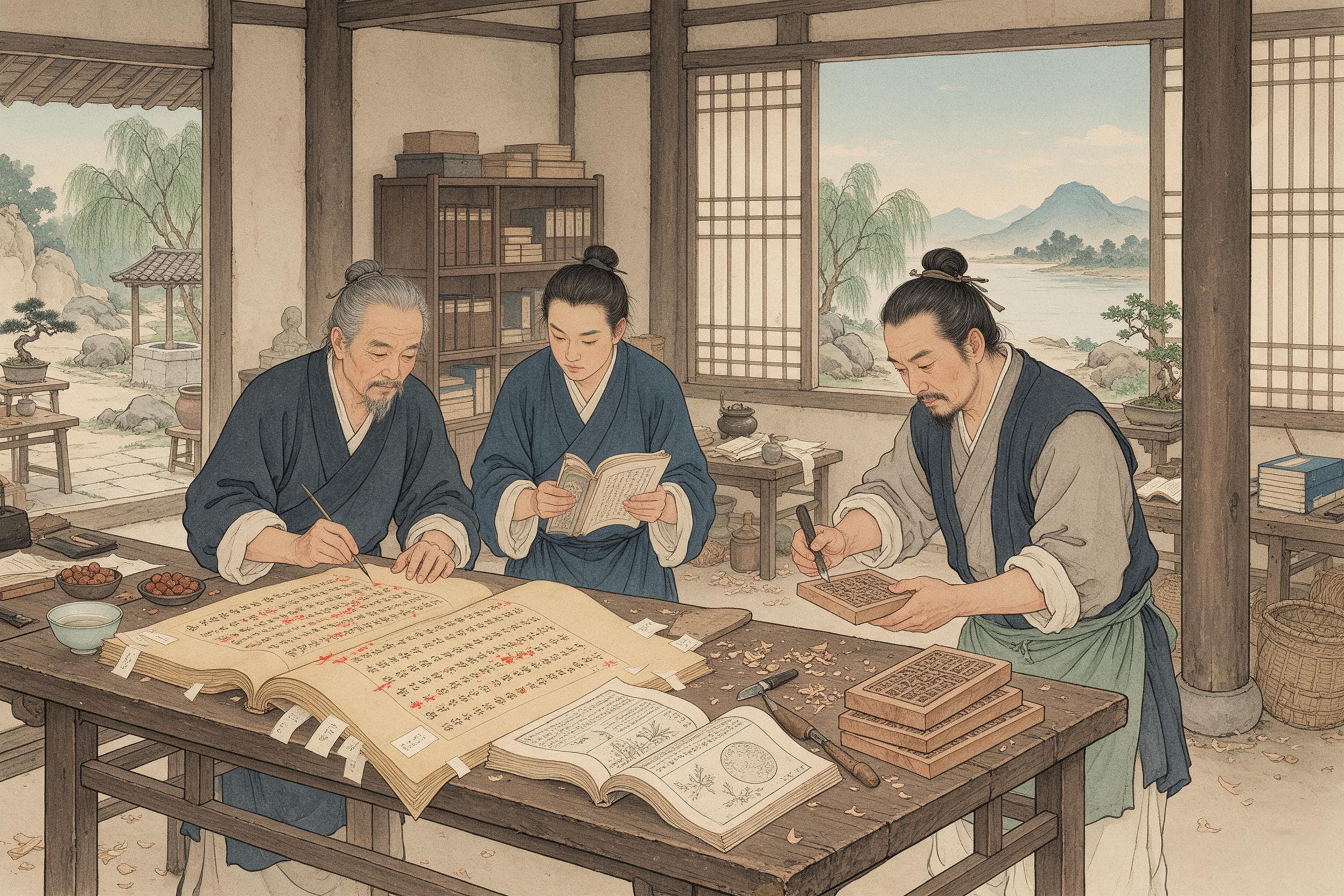
In the winter of 1404 the Empress Xu, wife of the Yongle emperor, finished the Inner Admonitions in twenty chapters and wrote its preface the following spring. The chapter titles are themselves a classification: virtuous nature, self-cultivation, careful speech, cautious conduct, diligence, vigilance, frugality, accumulating good, turning to good, honouring the sages' teaching, emulating worthy models, serving parents, serving the ruler, serving parents-in-law, attending the sacrifices, motherly example, concord with kin, kindness to the young, generosity to subordinates, and the treatment of the empress's own relatives. From a woman's inner temper to her relations with her natal family, one compartment after another. The preface says: 'In antiquity teaching had its order: boys entered the elementary school at eight; girls received the governess's teaching at ten.' She takes teaching as a given — girls too are taught, only differently, by a female teacher from the age of ten.
Her motive is in the preface too. Worthy women in the histories, she says, were all formed by teaching; yet while Zhu Xi had compiled a book for boys' elementary learning, there was no complete book for women, and people fell back on the Han History and Ban Zhao's Admonitions for Women, 'always finding them too brief'. So she supplied the lack. Two things must be said. She was an empress, and the book was written for the palace and for aristocratic women ('to teach the inner palace'); and 'elementary school at eight, the governess at ten' is a description of ancient practice, not the Ming school system. The Qing editors of the Complete Library debated when the book was printed and handed to officials — the Ming History says 1405 for its promulgation, another source says the eleventh month of 1407 for the gift to officials — but that is the history of its circulation, not a change in what kind of text it is.
A mother's voice
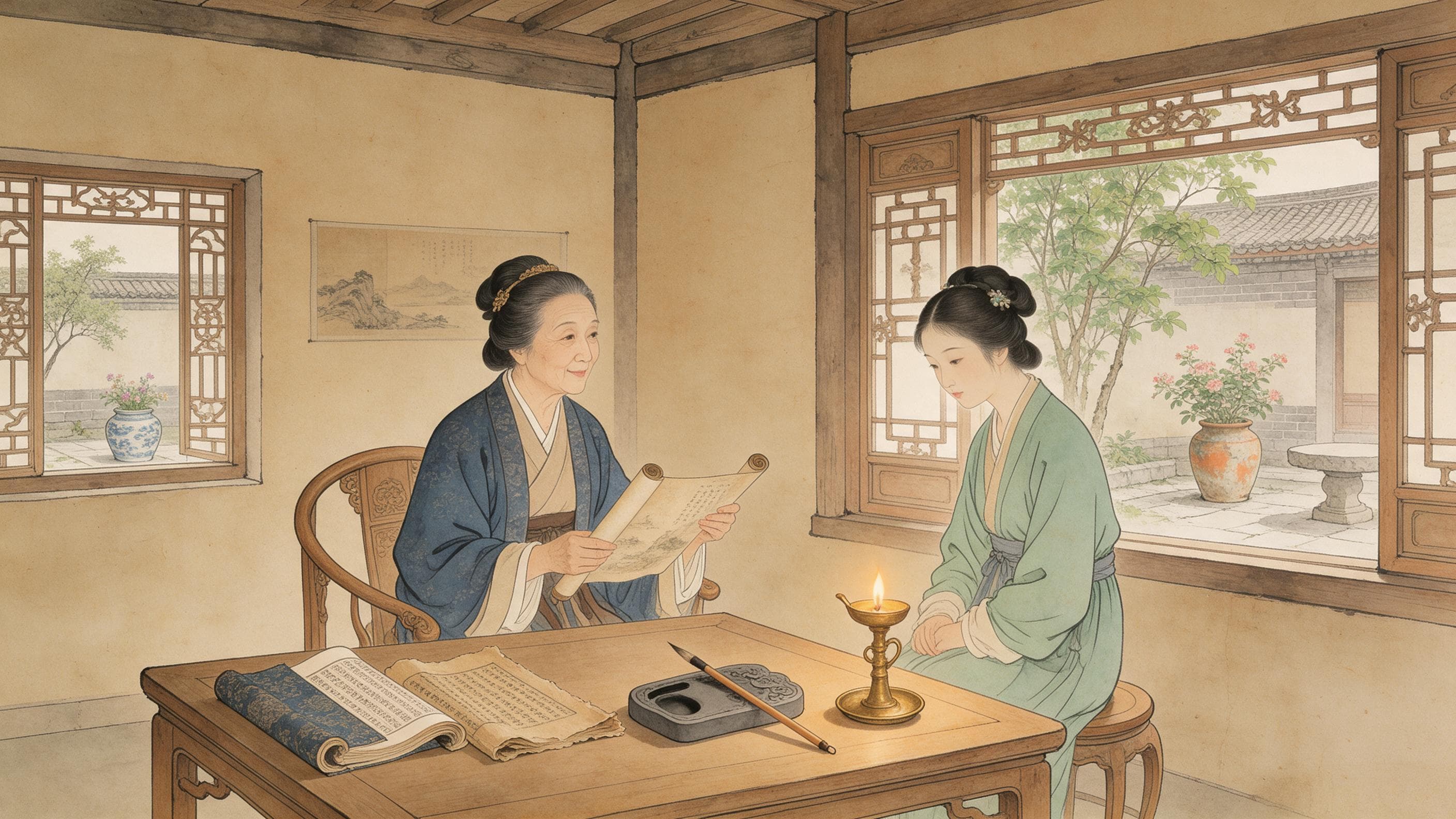
The second text is different in kind: Mother Wen's Instructions, a son's record of his mother's talk. Wen Huang, her son, passed the highest examination in 1643, served as a prefectural judge in Huizhou, and after the Ming fell raised troops and died when his city was taken; the instructions survive as an appendix to his collected works. The mother is concrete. 'Women are allowed only a rough knowledge of a few hundred characters — firewood, rice, fish, meat.' On young widows she refuses the high line: 'Do not urge her to keep her vow; do not force her to remarry. There is a direct way to tell: look at whether she sleeps late and rises early, hates ease and loves work, and is busy every moment; that is certainly a woman who will keep her word.' Her formula: 'A diligent widow, one character.' On relatives: 'Let them all be well off, and let me keep my own poverty.' On life: 'A person needs only one word — get through: get through the day, get through the month, the farmer through the year, the examination candidate through three years.'
Her view of reading is not consistent, and that is the interesting part. When her son remarked that scholarship ruined a family's livelihood, she answered: 'Scholars, farmers, craftsmen and merchants each follow one trade and each makes his own living; for you, study is your living.' To her son, reading is a profession. To women, she draws a line at a few hundred characters. This is not opposition to literacy but a line drawn along the sexual division of labour: outside for men, inside for women. Two limits must hold. The text is a son's record of his mother, not her own writing; and instruction is not life — 'a few hundred characters' is her opinion, not a Ming literacy rate.
What the historian admitted
The third text is the frankest. The preface to the Ming History's Biographies of Exemplary Women begins with origins: 'Liu Xiang's biographies of women took deeds that could serve as warnings, and did not preserve one single kind of constancy. Fan Ye followed him, and did not value chastity and martyrdom alone.' Then the turn: 'From Wei and Sui onward, historians preferred hardship, flight and self-sacrifice; for the feeling of recent times neglects ordinary conduct and prizes the extraordinary and vehement.' So the state's commendations, the local gazetteers, the talk of the lanes all took 'the most extraordinary and the most bitter' as the hardest thing to achieve — and 'writers and painters were drawn to unusual and striking conduct, to give their fine, vehement, sweeping, delightful thoughts an outlet'. People wrote extremes because extremes are good copy.
The weight of the passage is that the compilers of a dynastic history are saying: we know this is a selection. But it is a preface written under the early Qing, not a Ming self-description and not a statistic. It cannot be turned into 'how Ming women lived', nor can the number of entries in the following chapters be counted as data — this article counts nothing. The preface describes a principle of choice, not a society.
Three positions
Set side by side, the three texts do not yield a 'Ming view of women' but three mechanisms of selection. An empress writes prescriptions in the palace, cutting conduct into twenty compartments because there was no complete book of women's education. A mother instructs her son and household in a scholar-official family, on the limits of literacy, on widowhood, on how to treat relatives. A historian compiles a dynastic history under the new dynasty, admits that commendation is selection, and explains why later ages loved extremes. All three come from the palace or from scholar-official households; the materials of ordinary peasant women, bondservants and palace women are not here, so they cannot be pressed together into 'Ming women'.
Three sentences
Put the three sentences side by side. The empress: at ten a girl should have a governess — teaching is something that ought to happen. The mother: a few hundred characters are enough for a woman — teaching is cut along the line of sex. The historian: later ages 'neglect ordinary conduct and prize the extraordinary and vehement' — the women written down were chosen. The three sentences do not explain one another and do not cancel one another. What can be read from them is only the place each one speaks from.
Sources & further reading
- 《内训》(明·仁孝文皇后徐氏撰;四库全书本,维基文库) — Twenty chapters catalogued by the Qing editors from 'virtuous nature' to 'treatment of the empress's kin'; the preface's 'in antiquity teaching had its order: boys entered the elementary school at eight, girls received the governess's teaching at ten'; written in the winter of 1402 and prefaced in the first month of 1403, because there was no complete book of women's education and the old ones were 'always found too brief'. The Siku editors note that the interlinear commentary under each chapter was probably added by scholar-officials, not by the empress, and they debate whether the printing and distribution to officials began in 1405.
- 《温氏母训》(明·温璜录其母陆氏之训;维基文库) — A son's record of his mother's talk: 'Women are allowed only a rough knowledge of a few hundred characters — firewood, rice, fish, meat; more literacy does no good and does harm'; on young widows, 'do not urge her to keep her vow, do not force her to remarry', and her rule of thumb 'a diligent widow, one character'; on relatives, 'let them all be well off and let me keep my own poverty'; and to her son, 'scholars, farmers, craftsmen and merchants each follow one trade; for you, study is your living'. The son Wen Huang was a Chongzhen jinshi who died resisting the Qing; the text survives as an appendix to his collected works.
- 《明史》卷三百一·列女传一(清初修;维基文库) — The compilers' own preface on selection: Liu Xiang's biographies of women took only deeds useful as warnings and 'did not preserve one single kind of constancy'; Fan Ye followed him and 'did not value chastity and martyrdom alone'; from Wei and Sui onward historians preferred hardship, flight and self-sacrifice, because 'recent times neglect ordinary conduct and prize the extraordinary and vehement', and because writers were drawn to 'unusual and striking conduct' as matter for fine prose. This is a Qing compilation; the preface describes a selection principle, not a statistic.