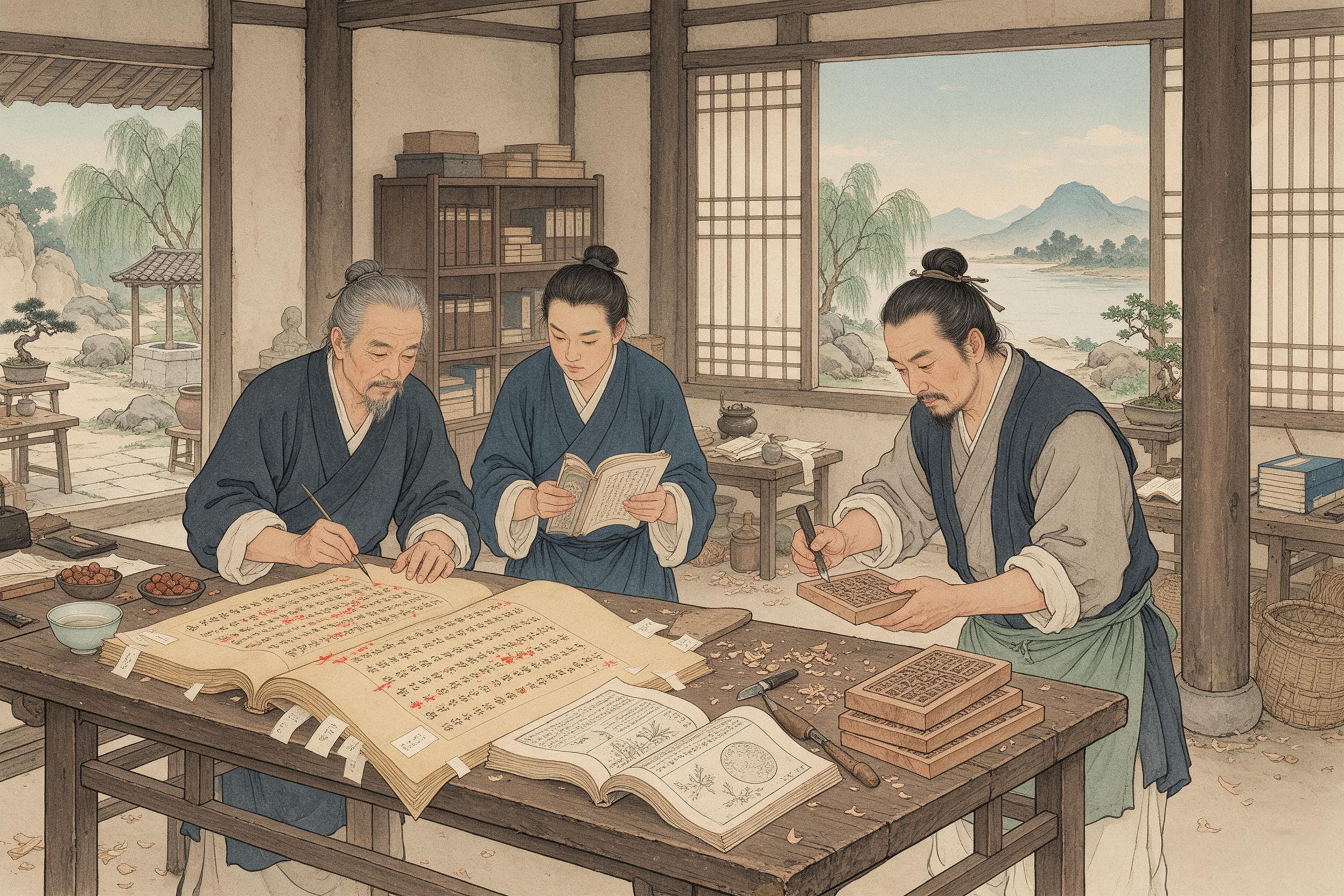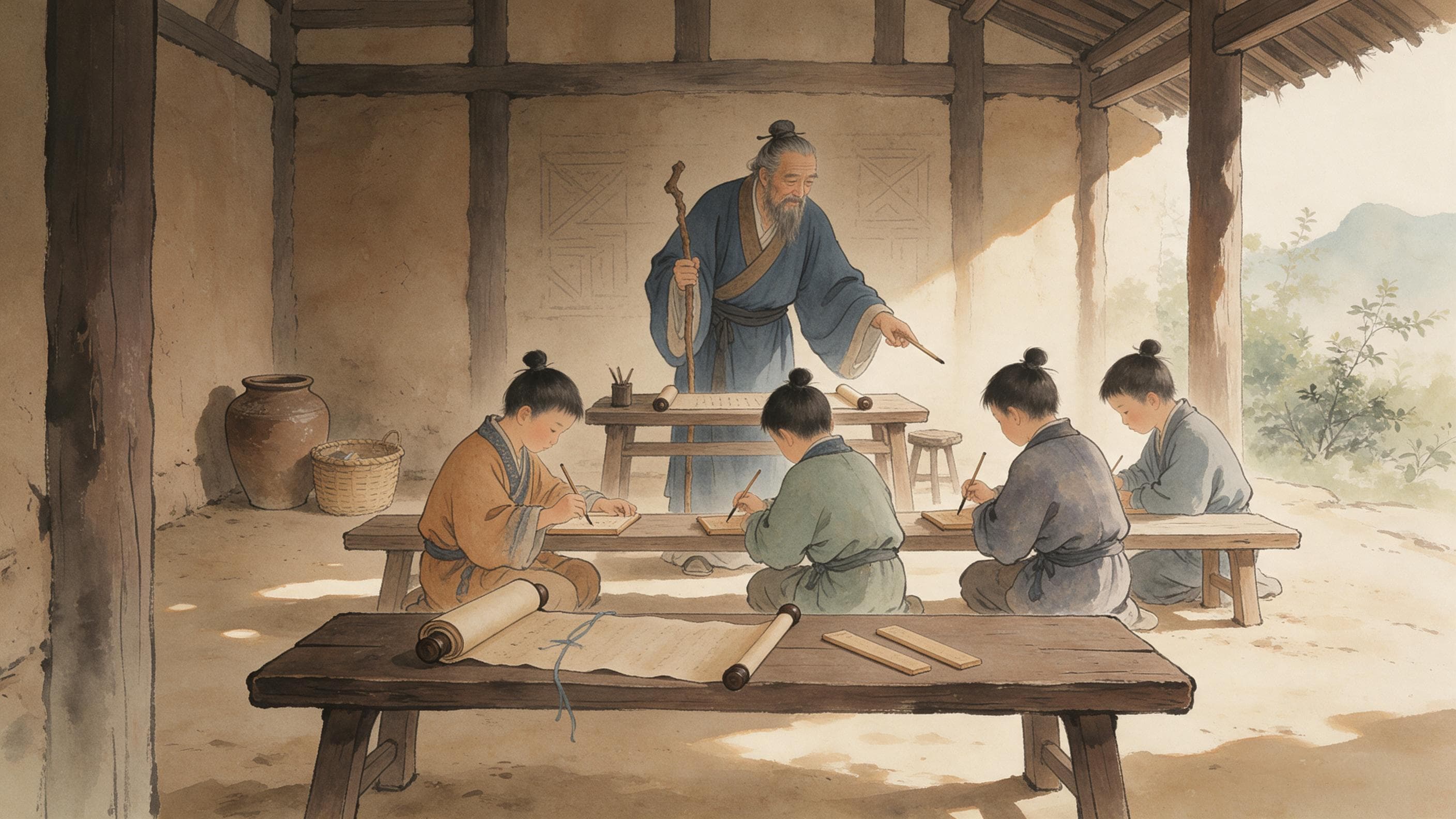
The book announces itself: 'The quick mastery of the strange tablet is unlike other things: it lays out the names of things and of surnames, divided by kind, not jumbled together. The days it takes are few, and the pleasure is real; work at it, and there will surely be joy.' The 'tablet' is the wooden board a child wrote on. But when a child opened it, what came first was not a story but a wall of personal names: Song Yannian, Zheng Zifang, Wei Yishou, Shi Buchang, Zhou Qianqiu, Zhao Ruqing — on and on, until the line 'the names are done; now speak of things.' The first lesson was to memorise names.
A run of names before anything else
The names are not random. Yannian, 'prolong the years'; Yishou, 'add to life'; Qianqiu, 'a thousand autumns'; Wansui, 'ten thousand years'; Liqin, 'benefit kin'; Fengde, 'hold to virtue'; Xianliang, 'worthy and good'; Fugui, 'wealth and rank'; Pengzu, the long-lived sage. Others are animals and objects played as names — horse, ox, sheep; kingfisher, mandarin duck; 'the dragon not yet ended' — so that the list reads like a chant. Learning characters through names meant learning auspicious words at the same time. The section closes on four characters: 'the names are done; now speak of things.' From that line the book changes face.
The names are done; now speak of things
The things begin with cloth and clothing: robes and jackets, lining and outer cloth, curved collars, skirts; the straight-fronted coat, lined and unlined and padded garments, trousers and drawers; the single-layer robe, the knee cover, cloth socks, needles and thread and mending and hems and borders; and a crowd of shoes. Before that lies a long stretch of silk names and colours — brocades, damasks, pale blues, green gauzes, blacks and purples, crimson and red. A child who got through this section had walked through the wardrobe of his world.
Then food. 'Rice, panicled millet, glutinous millet, common millet, husked millet, hemp, japonica' — a row of grain names; 'cakes, dumplings, wheat meal, sweet bean broth'; 'mallow, leek, scallion, wild garlic, smartweed, perilla, ginger; turnip, salt, fermented beans, vinegar, sauce.' Later come pears and persimmons and crab apples and peaches, jujubes and apricots and melons, fried sweets and syrups. The business of eating was broken into grain, cooked dishes, greens, seasonings, fruit and sweets, and memorised in that order.
Then vessels. Bronze bells and cauldrons and the many kinds of pot and pan; bamboo ware, umbrellas, rain hats, mats and baskets; trays and basins and dishes and cups and bowls; jars and crocks and pots and urns and flasks; steamers and earthenware basins. From bronze through bamboo to pottery, item after item. To recite these characters was to count over the contents of a house.
The second half of the book changes subject: offices, schooling, statutes, geography, illness and drugs, sacrifice, prisons. The third chapter runs through military levies, bronze and iron ware, bamboo and pottery; the fourth opens with 'all things ended, the five offices come out', and goes on to recitation of the Odes and the Classic of Filial Piety, the Spring and Autumn and the Documents, the statutes and ordinances, and then the chancellor, the censors, the ministers, the generals, the marquises — and also 'affrays and wounds and killings, the neighbours arrested', 'thieves and prisoners, the rod on the buttocks'. It ends with 'the land of Han is vast and holds all things'. A book for learning characters ran from kitchen pots to court and prison: the road of literacy was also a road through the world.
Who learned it, and who sneered
Yan Shigu, annotating the book in the Tang, left a remarkably candid sentence in his preface: 'Humble country folk, children of poor villages, passed it down from one to another and still competed to learn it; but with no good teacher, they only added errors.' Then a colder line: 'As for the gentry of fine talents and the well-fed sons of rich houses, they called it vulgar and were ashamed to look into it.' One primer, two attitudes. It should be said plainly: Yan was writing in the early Tang, annotating an old book, and what he describes is a long-standing situation, not a snapshot of one year of the Han.
Where it sits in a catalogue
The Han History's bibliographical chapter files it under 'elementary learning': the Scribal Primer in fifteen chapters, the Cangjie, the Fanjiang, the Jijiu, the Yuanshang, the Xunzhuan and a Glossary in thirteen, 'ten schools of elementary learning, forty-five chapters'. The note says: 'In the time of Emperor Yuan the Yellow Gate commandant Shi You made the Jijiu pian.' It also says that 'in antiquity one entered elementary learning at eight', where the Master of the Clan taught the six scripts. More striking is an early Han rule: 'The grand scribe tested schoolboys; those who could recite and write nine thousand characters or more might become scribes, and they were tested in the six scripts as well.' And: 'when officials or commoners submitted documents, if the characters were not correct, they were impeached.' Literacy was not only a scholar's accomplishment; it was a gate into office. The same chapter notes that village schoolmasters combined the Cangjie, Yuanli and Boxue into one primer, cutting sixty characters to a chapter for fifty-five chapters: the men who taught in the villages assembled their own textbooks.
The limits need saying too. The author can only be given as 'Shi You, in the time of Emperor Yuan'; the Han History's note calls him a Yellow Gate commandant, and nothing else about him can be checked, so no life is supplied here. This was not the only primer: it stood beside the Cangjie, the Fanjiang, the Yuanshang and the Xunzhuan, and should not be described as a unified Han textbook. There are no figures for school attendance, literacy, numbers of schools, book prices, fees or teachers' gifts. The physical evidence — fragments of the Jijiu on writing slips from Juyan and Dunhuang — would be excellent, but no readable edition was found for this piece, so it is marked as still to be added and is not used; nor does this article reason backwards from later primers to Han teaching.
What a word-list weighs
It does not teach morals; it sorts. Names in one section, cloth and clothing in another, food in another, vessels in another, then offices, geography, illness, statutes — each in rhyme, easy to chant, easy to keep. A child who finished it knew several thousand characters and had walked once through the world by categories. Yan Shigu's complaint that it was vulgar turned out to be its longest epitaph: the book travelled from the Han to the Tang on the copying of country children whose teachers were not good, and what the record preserves of them is one sentence of a Tang scholar's disdain — not the name of a single pupil.
Sources & further reading
- 史游《急就篇》(西汉;颜师古注、王应麟补注;维基文库) — The word-list itself: the opening 'quick mastery of the strange tablet, a listing of the names of things and surnames'; a long run of personal names closed by 'the names are done; now speak of things'; then cloth and clothing, grain and vegetables and seasonings, bronze and bamboo and pottery vessels, and in the later chapters officials, law, geography and disease. Yan Shigu's preface: country children 'passed it around and competed to learn it', while gentry sons 'called it vulgar and were ashamed to look at it'. Yan was writing in the Tang about a book already old; his testimony is about its long use, not a snapshot of one Han year.
- 班固《汉书》卷三十·艺文志(小学类)(东汉;维基文库) — The catalogue placing the book: 'in the time of Emperor Yuan the Yellow Gate commandant Shi You made the Jijiu pian'; elementary works ten schools, forty-five chapters, with Cangjie, Fanjiang, Jijiu, Yuanshang and Xunzhuan side by side. Also 'in antiquity one entered elementary learning at eight' and the six scripts; and the Han statute by which the grand scribe tested boys who could recite nine thousand characters before they might become scribes, with writing tested in six scripts. Village schoolmasters combined the Cangjie, Yuanli and Boxue into one primer of fifty-five chapters.