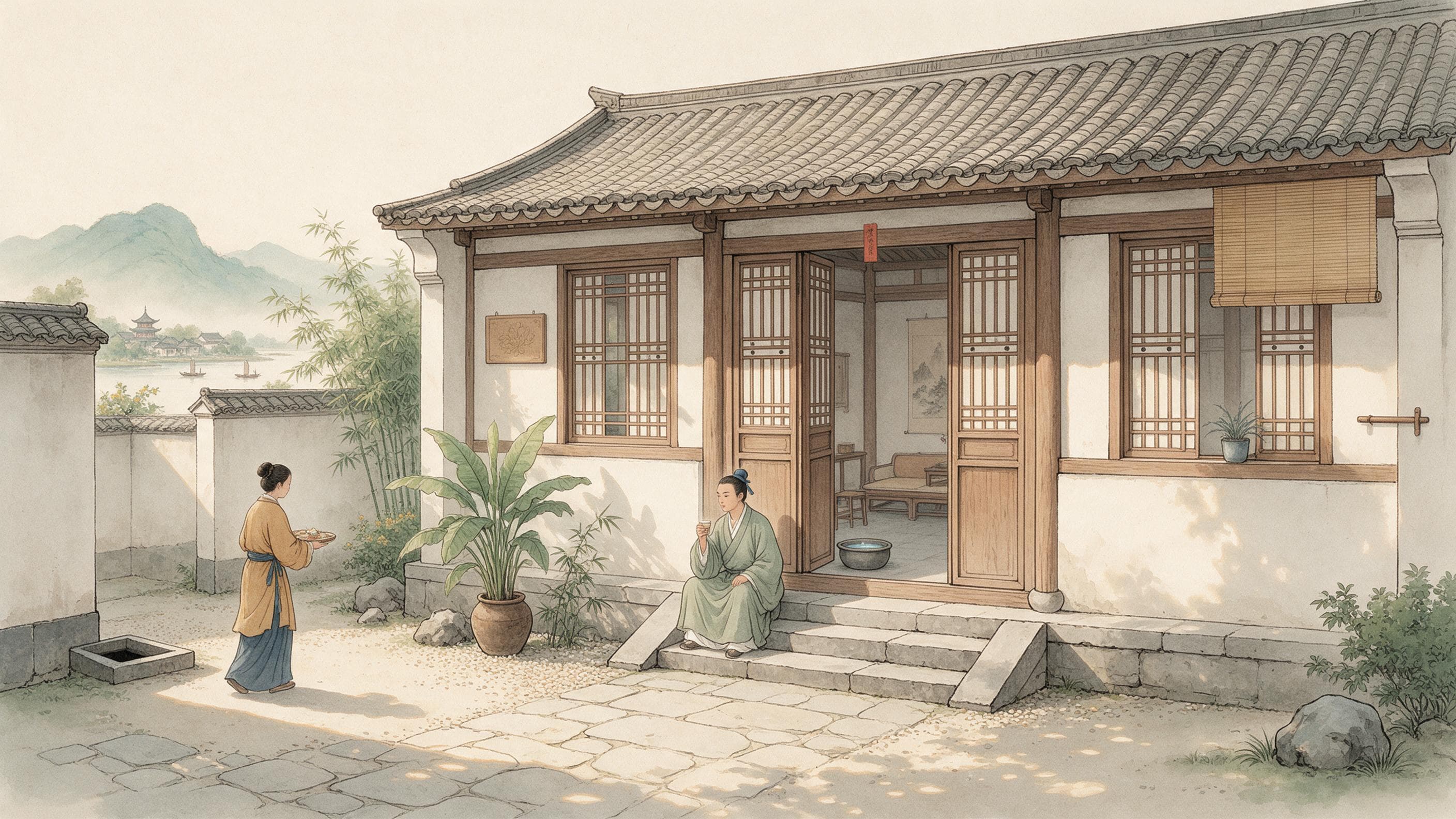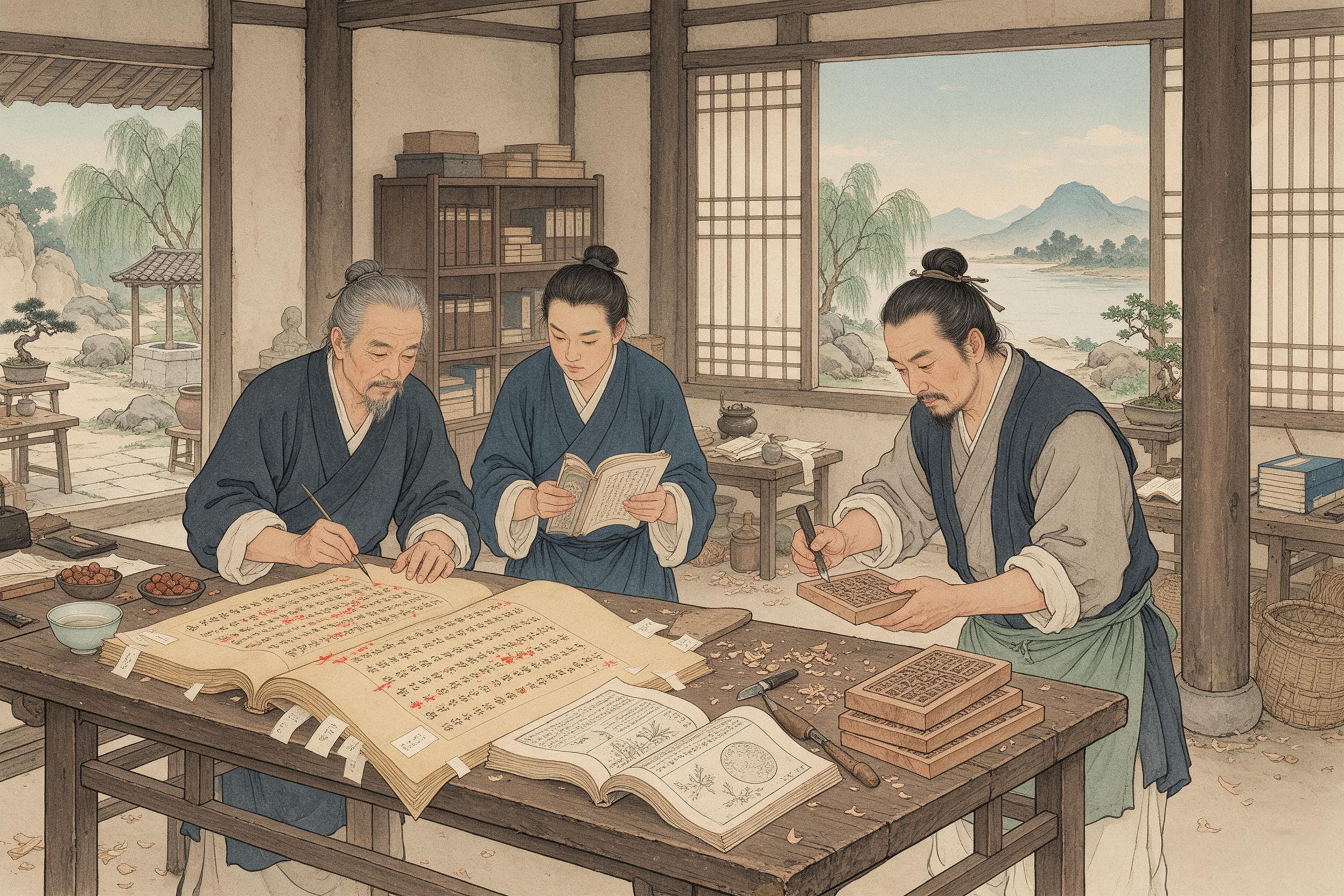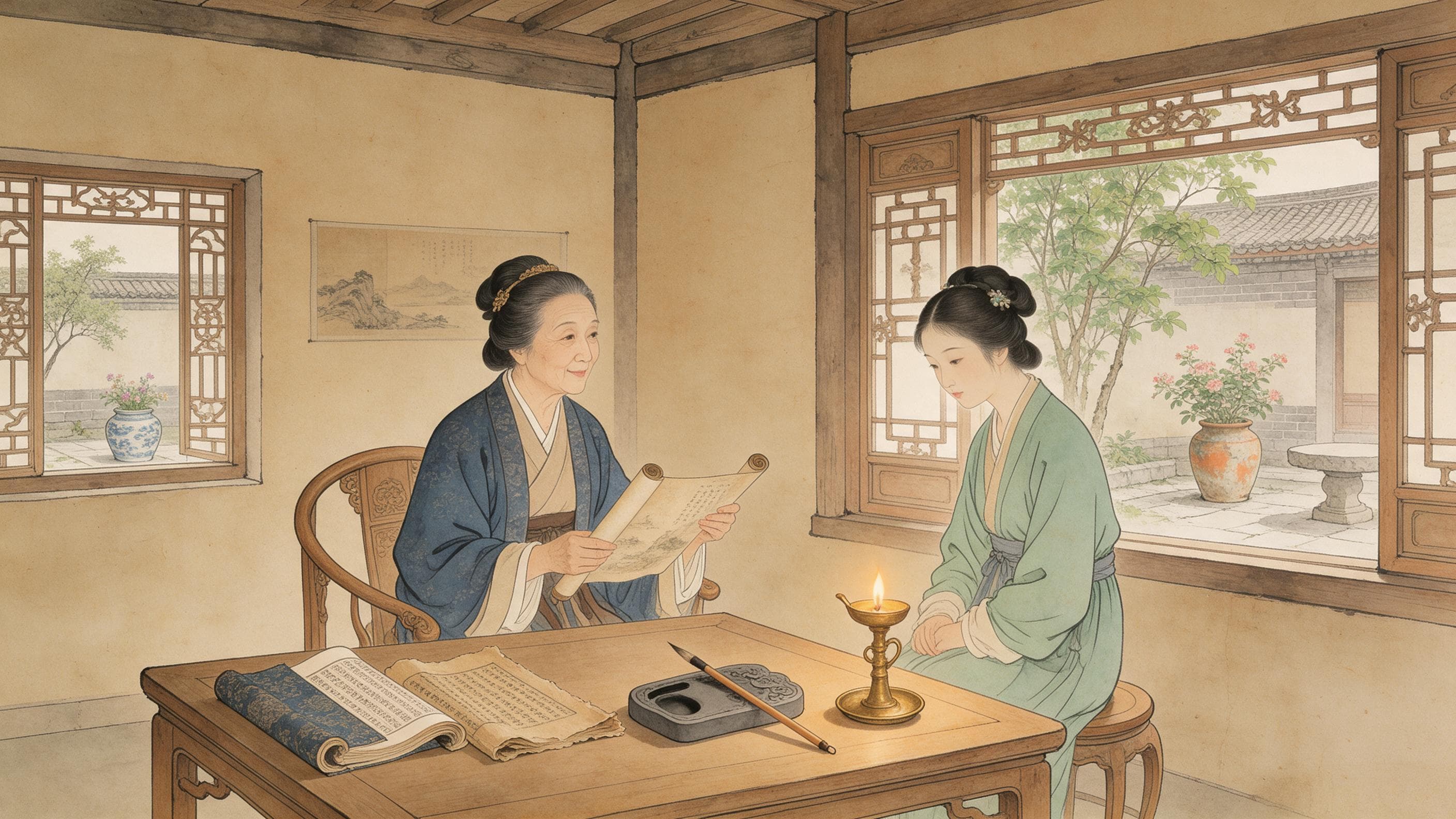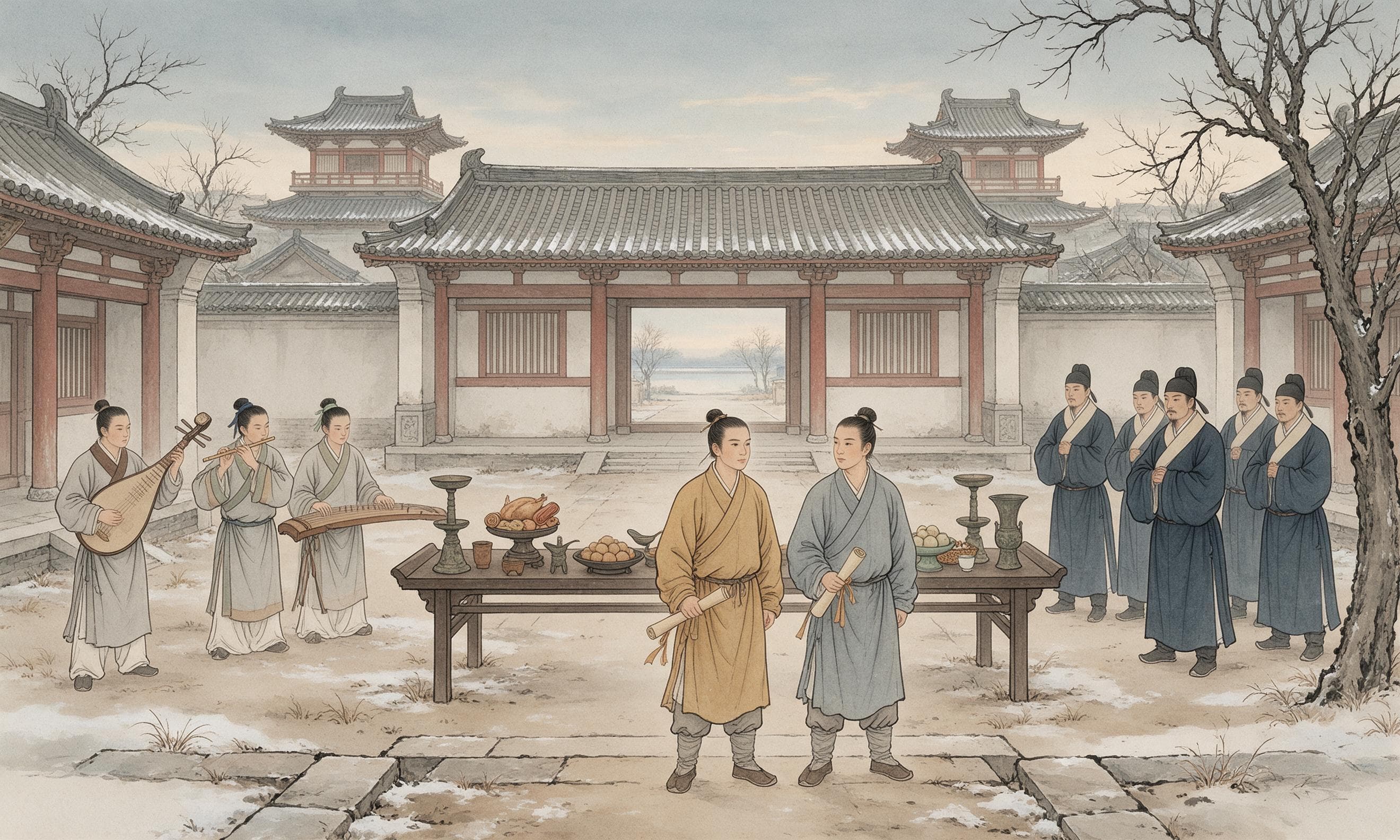
Every winter in the eleventh month, a Tang prefecture held a ceremony before sending its candidates to the capital: the governor and his staff set out the ritual vessels and the meat offering, the strings and pipes were played, the poem 'Deer Call' was sung, and the village elders were invited to watch. Then the candidates left. According to the Tongdian, 'after the farewell feast they went up with the accounts' — they travelled in the same convoy as the year's tribute. What they were examined on, and what waited at the end, is the subject here.
Two ways in
There were two ways to become a candidate. One was through a school. The New Tang History lists the numbers: the School for the Sons of the State took 300 students, the Great School 500, the Four Gates School 1,300 — of whom 800 were 'outstanding commoners' — the law school 50, calligraphy 30, mathematics 30; provincial and county schools ran from 80 at the capital county down to 20 at a small county. Students had to be between fourteen and nineteen, had one day off in ten, and were examined at the year's end.
The other way was local tribute. Anyone who had not studied in a school was a xianggong, and, in the history's phrase, 'came to the prefecture or county with his document and enrolled himself'. The prefecture examined him first, and the governor gave the farewell ceremony. The quota was nominal: 'a superior prefecture three a year, a middling two, an inferior one', though an old regulation adds that 'though the limit was one, two or three, in practice there was no fixed number'. At the capital the Board of Revenue checked the registers, and the examination was run by the vice-director of the Bureau of Merit — after 736, by a vice-minister of rites.
What the examination asked
The papers differed by degree. For the jinshi, the New Tang History says, a candidate wrote five policy essays and 'pasted one major classic' — the jingtie, where characters of a text were covered and had to be supplied. A pass on both made the first class; four essays and four pasted characters the second. For the mingjing he first did the pasted classic, then answered ten questions on the meaning of the text aloud, then wrote three policy essays. The xiucai wrote five essays on strategy. Four grades existed on paper; in practice, the Tongdian says, 'since the founding of the dynasty the mingjing has only ever been placed in the fourth grade, the jinshi only in the second'.
The papers kept being added to. In 634 the jinshi was given a section on reading the classics and histories; in 680 a memorial had the pasted classic added to both degrees; in 681 an edict required six of ten in the pasted classic and two pieces of prose, 'and only those who know the rules of prose then sit the policy essays'. The pasting was done by covering both ends of a passage and leaving one line open, with paper masking three characters; four, five or six supplied correctly counted as a pass. As candidates multiplied the method grew harder — 'they wanted them to fail' — until examiners pasted characters from the commentary and left one or two at the end, which they called 'pulling up by the roots'.
Two degrees, two sets of numbers
Why the jinshi was hard, the Tongdian states in two figures: 'of the jinshi, roughly ten or twenty pass out of a thousand; the mingjing takes ten or twenty out of a hundred, ten times as many.' The edict examinations were worse: 'two thousand candidates at most, never fewer than a thousand, and a hundred are taken out of a hundred' — one in a hundred. Both degrees had grades on paper: the jinshi two, the mingjing four. In practice only the lowest was ever used.
'Of all the degrees,' the New Tang History says, 'the jinshi was the most honoured.' Under Wenzong an edict told the Board of Rites to take 'thirty a year, and if there are not the men, do not fill the number' — even thirty was a ceiling. The xiucai degree died early: in the Zhenguan period a prefect whose candidate failed was punished, 'and the degree lapsed'; it was formally abolished in 651. After that the great clans aimed at two degrees only, mingjing and jinshi.
After the pass: thanks, the river party, the Board of Personnel
Passing did not make a man an official. The New Tang History describes the ceremonies: the candidates 'formed up, announced their names and thanked the examiner at his house', standing below the western steps while he bowed back; then came the formal gathering, the party by the Qujiang canal, and the inscribed list of names. Li Deyu later had it all abolished — 'one visit to the office and no more; the gatherings, the calls, the Qujiang inscription are all to stop' — which shows how much standing those ceremonies carried.
The real gate was the Board of Personnel. The Tongdian sets out the selection: civil posts belonged to the Board of Personnel, military to the Board of War, and the process was called quanxuan. The board worked in three divisions, the minister taking one and the two vice-ministers the others. It chose on four counts: 'first, bearing, for a full and dignified appearance; second, speech, for clear and correct argument; third, writing, for elegant regular script; fourth, judgment, for sound reasoning in a ruling'. Men below the sixth rank were ranked by seniority and service; the best judgments were 'entered in the class', the worst 'ragged', and there were special tests for grand phraseology and outstanding talent. Appointment brought a notice of office stamped with the board's seal. A pass was only a qualification; office meant queueing here.
Rules are rules; numbers are numbers
These numbers have to be read in layers. The Tongdian is a Tang compendium of institutions; the New Tang History is a Song compilation. Both describe how the examination was supposed to work, not who passed in a given year. 'A hundred or two out of a thousand' is a summary; 'thirty a year' is a ceiling set by edict; they cannot be multiplied into a pass rate for any year, and this piece does not try. The sealing of names and the recopying of papers are not pursued here. The custom of showing one's poems to examiners beforehand — xingjuan, wenjuan — is not documented in these two chapters, so it is not described here.
Back to the winter ceremony: ritual vessels in a prefectural courtyard, the 'Deer Call' sung, a candidate who had never attended a school standing below the steps with his document, setting out next day with the tribute. What waited in the capital was the pasted classic, the prose, the policy essays, and then the Board of Personnel's four tests of bearing, speech, writing and judgment. In two centuries the subjects multiplied and the jinshi grew harder, while the number who passed stayed at ten or twenty in a thousand. The rules can be described exactly; the numbers only ever come as an approximation.
Sources & further reading
- 《通典》卷十四、卷十五·选举(唐杜佑撰;维基文库本,页标 textquality 25%,未与中华书局点校本复核) — Tang compendium of institutions, not a candidate's diary. Juan 15: the prefectural quotas of three, two and one a year with no fixed number in practice; the winter ceremony and the local tribute; the Board of Revenue's register check and the Bureau of Merit's examination; the pasted-classic method with its three characters and later 'pulling up by the roots'; the jinshi and mingjing papers; 'a hundred or two out of a thousand' for the jinshi and ten or twenty out of a hundred for the mingjing; one in a hundred for edict examinations; the 736 transfer to the Board of Rites; the Board of Personnel's four tests of bearing, speech, writing and judgment. Juan 14 has the Sui origin of the jinshi degree.
- 《新唐书》卷四十四·选举志上(宋欧阳修、宋祁等修;维基文库本) — Song compilation of Tang institutions. The two routes of students and local tribute, with the phrase about coming with a document and enrolling oneself; the school quotas and the age limit of fourteen to nineteen; the papers of each degree; the 681 edict adding prose; the 736 transfer to the Board of Rites; Wenzong's ceiling of thirty a year; the ceremonies of thanks, the Qujiang party and the inscribed list, abolished by Li Deyu.