Open the Bencao gangmu and each drug begins with its name set large at the top of the entry; below follow explanations of the name, collected commentary, flavour, indications and prescriptions. According to Wang Shizhen's preface, 'each drug has its proper name as the key and the explanations as the entries' — the title gangmu, 'key and entries', comes from exactly this. It is not a metaphor but a layout: the name is the key, everything else is the entry.
The structure of a book
Wang Shizhen sets out the layers: 'each drug has its proper name as the key, the explanations of the name as the entries — to begin correctly; then collected commentary, doubts and corrections, detailing where it grows and what it looks like; then flavour, indications and prescriptions, setting out its use.' Name first, then the correction of errors, and only at the end the prescriptions. The book is in sixteen sections and fifty-two juan; the imperial catalogue adds 'sixty-two classes', and records three juan of illustrations, two of preface and examples, two of drugs for the hundred diseases. Cut what was repeated, mend what was missing, straighten what was wrong — the three verbs are Wang's own.
Why redo it at all. The Ming History says the older herbals suffered because 'the categories were already many and the names confused: one thing split into two or three, or two things mixed into one'. The complaint is not that there were too few drugs but that the classification was a mess. The same entry lists how the older herbals had grown: 365 from Shennong, as many again from Tao Hongjing, 114 from Su Gong under the Tang, 120 more from Liu Han under the Song, until Zhang Yuxi and Tang Shenwei 'in all added up to 1,558'. 'So he searched far and wide, cut the clutter and filled the gaps': that is the Ming History's summary of his method.
Thirty years: from thirty to seventy
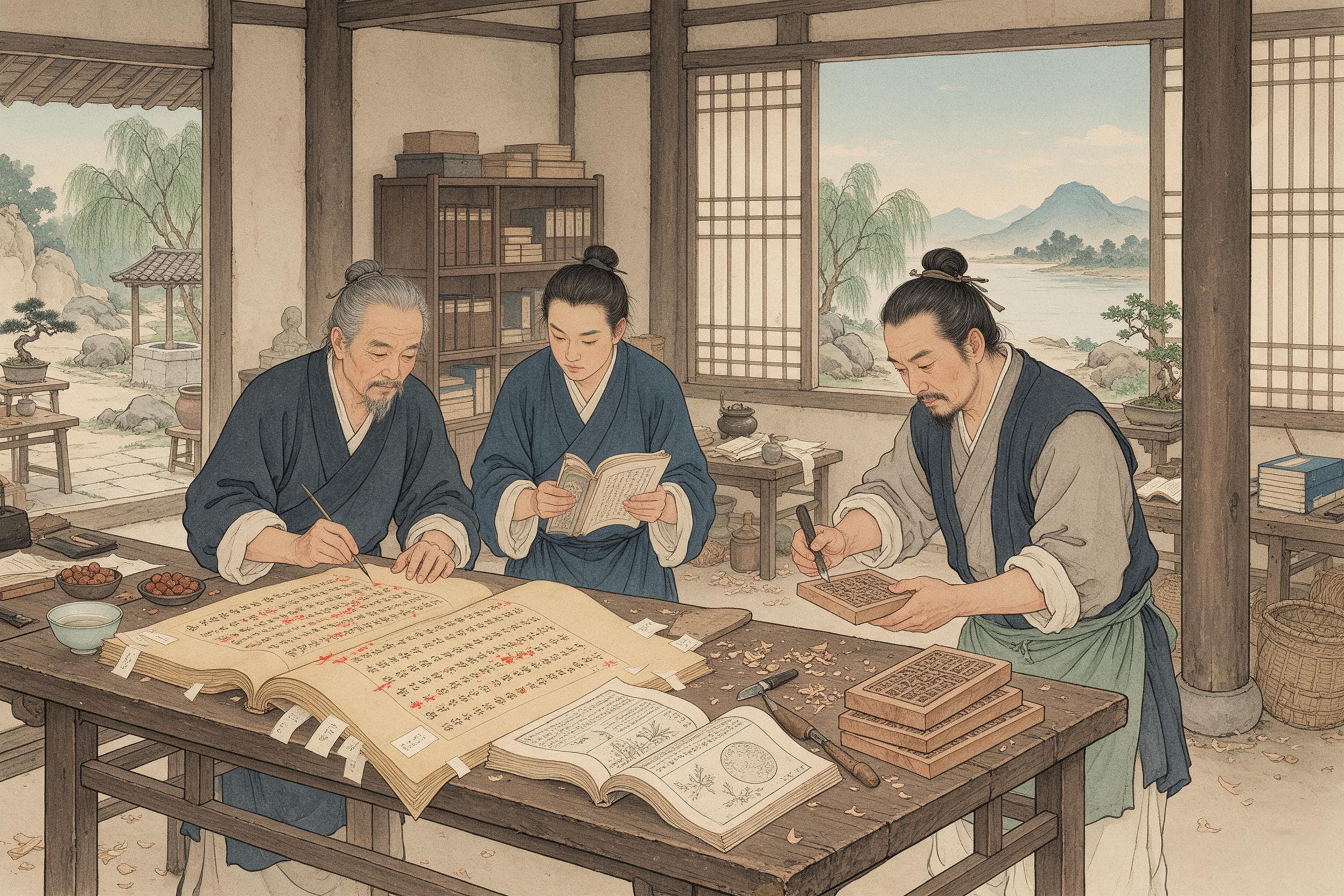
On the working time all three sources agree. The Ming History: 'thirty years, more than eight hundred books read, the draft changed three times'. Wang's preface: 'thirty years passed, eight hundred-odd books examined, the draft three times remade'. Li Jianyuan's memorial is more exact: 'at thirty he began collating with all his strength; by seventy the work was done'. Started at thirty, finished at seventy — forty years, three drafts.
There is only one firm date: Wang Shizhen's preface is dated 'the fifteenth day of the first month, spring, of the gengyin year of Wanli' — 1590. Otherwise the sources say 'in the Wanli era' or 'in the Shunzhi era', and this piece does not turn those into years. Three figures do agree across all the sources: fifty-two juan, sixteen sections, 374 drugs added. Those can be set side by side without trouble. Thirty years begun at thirty and finished at seventy are one account, not two.
Three totals
The totals do not agree. Wang's arithmetic is 'the old book had 1,518 kinds; now 374 have been added' — 1,518 plus 374 is 1,892. The Ming History puts it differently: 'successively added, in all 1,558', which is the running total of the older herbals up to the Song. The imperial catalogue says '1,882 kinds'. Three numbers side by side: 1,892, 1,558, 1,882. Each total carries its own arithmetic, and the arithmetic is the problem.
This piece does not reconcile them. The reason is plain: they count different things. Wang's 1,518 is 'the old book', the catalogue's 1,882 is the whole work, and the Ming History's 1,558 is the older herbals' own total. The 'old book' figure itself differs between sources, 1,518 against 1,558, and the additions are not made the same way. So no difference can be calculated: it cannot be said that the book 'actually contains 1,892 kinds', and 1,892 minus 1,558 cannot be presented as the new drugs. What is certain is the one figure all three agree on: 374 added. The imperial catalogue itself repeats '1,518 in the old book, 374 added' — which makes 1,892 — and then gives 1,882 as the total. The discrepancy sits inside a single entry.
How the book reached the court, and how it travelled
According to the Ming History, the book was 'about to be presented at court when its author suddenly died'. Soon after, the Wanli emperor ordered the national history compiled and books sought from all quarters; the son, Li Jianyuan, 'presented his father's memorial and the book, and the emperor approved it, ordering it printed for the realm'. The memorial is specific: 'just as the cutting was finished, his allotted years ran out' — the book was completed as the man died, which is why what the son presented was the printed book and the memorial. 'Every scholar's house had a copy' is a figure of speech, not a print run. His post was keeper of sacrifices in the household of the prince of Chu, a fact the Ming History also records.
The textual chain goes no further than this. The catalogue says the book 'was first printed in the Wanli era, with a preface by Wang Shizhen', that the son presented it with a memorial 'placed at the head of the volume', and that 'in the Shunzhi era Wu Yuchang of Qiantang revised and reprinted it'. Xia Liangxin wrote a preface for a reprint, so there was at least one after the Wanli edition. The year and name of the first edition were not verified in this round and are marked as pending; the often-repeated 'Jinling edition of 1596' is therefore not used here. The catalogue, writing after the Shunzhi reprint, says that from then on 'no practitioner's house was without a copy' — again a figure of speech.
What the book can and cannot show
Some limits first. The story that Li Shizhen tasted every herb is not in any of the three sources; it is later legend, and is not repeated. Print runs, prices, block-cutting costs and carvers are absent. The book is not treated as a measure of Ming medicine: it is a herbal, not a medical system. No judgement is made on whether the prescriptions worked. And the Siku edition altered medical books, so the catalogue's sixteen sections and sixty-two classes are not the original layout. The catalogue's praise of the thirty years' work as 'no empty boast' is an evaluation by the editors, and is quoted as one.
Back to the structure: a book that made each drug's name its key and its explanations its entries, thirty years in the making, eight hundred books read, three drafts, reaching the court at last through a son's memorial. And its total: three sources, three numbers, 1,892, 1,558, 1,882. The author treated classification as the problem to be solved; the book's own classified numbers are still not settled centuries later. That is not a flaw in the book. It is the account the book left open.
Sources & further reading
- 《明史》卷二百九十九·方技传·李时珍(清初修;维基文库) — Qing compilation, not a Ming archive. The genealogy of earlier herbals and their figures (365, then 114, then 120, 'in all 1,558'); thirty years, eight hundred-odd books, three drafts; 374 drugs added, sixteen sections, fifty-two juan; 'the proper name as the key, the explanations as the entries'; the book finished just as its author died, the son presenting the memorial and the book, the order to print it for the realm.
- 《本草纲目》卷首序跋:王世贞原序、李建元进疏、夏良心重刻序(明;维基文库) — The book's own front matter. Wang Shizhen's preface, dated the fifteenth day of the first month of 1590: thirty years, eight hundred-odd books, three drafts; 1,518 in the old herbals, 374 added, sixteen sections, fifty-two juan. Li Jianyuan's memorial: his father was thirty when he began collating and seventy when the work was done, and died just as it was cut. Xia Liangxin's preface to the reprint.
- 《四库全书总目提要》卷一百四·子部·医家类·《本草纲目》条(清乾隆官修;维基文库) — Qianlong imperial catalogue: sixteen sections, sixty-two classes, 1,882 drugs; three juan of illustrations, two of preface and examples, two of drugs for the hundred diseases; the earlier 1,518 and the 374 added; first printed in the Wanli era with Wang's preface, the memorial at the head of the volume, reprinted in the Shunzhi era by Wu Yuchang of Qiantang. A later catalogue, and the Siku text of the book itself was altered.