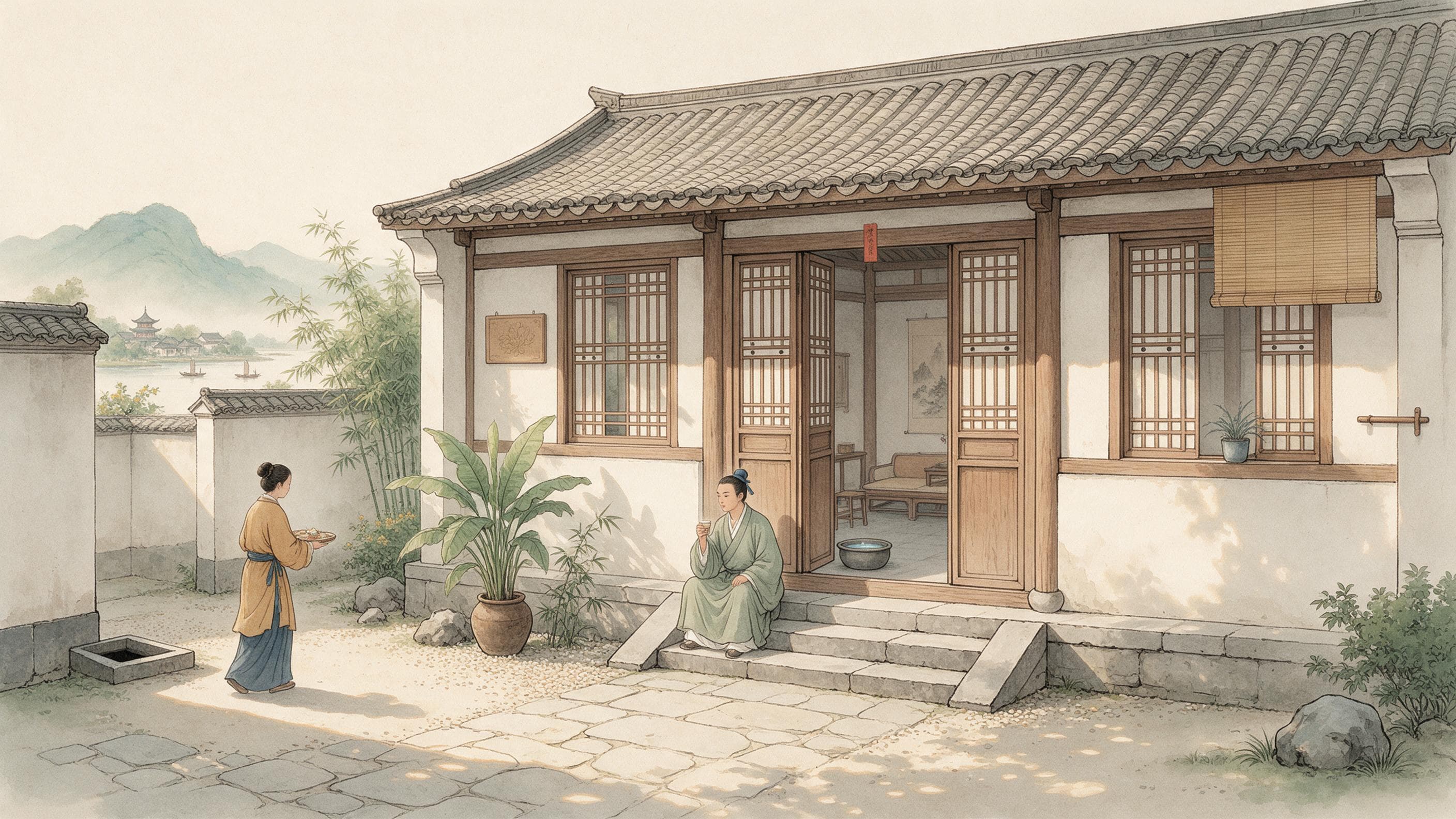
A Ming house was measured with two rulers: bays across the front, beams into the depth. In 1393 an edict fixed the commoner's house at 'no more than three bays and five beams, with no bracket sets and no painted colour' — three bays wide, five beams deep, the ceiling for an ordinary household. That ceiling was later loosened once, and it was loosened in the beams, not the bays. Bay and beam are the whole vocabulary of the subject.
Three bays, five beams: a ceiling
According to the Ming History, the 1393 rule was reissued in 1402: 'no one is to build in the numbers of nine or five bays; a house may run to ten or twenty separate structures, according to the site and the means, but may not exceed three bays.' The limitation is clear: it applies to the frontage of each building, not to the size of the plot. Brackets and painted colour were not for commoners; their houses were to be plain timber and tile.
In 1447 the rule was 'slightly relaxed: commoners' houses with more beams but fewer bays shall not fall under the prohibition'. That sentence is the hinge of the whole subject. What was forbidden was widening the frontage; what was let go was the depth. More beams into the depth were allowed, three bays across the front were not. The sources do not say why the change was made, and this piece does not supply a reason. In building terms such a house is deeper, not wider.
One ruler, several ranks
The same bay-and-beam count measured officials' houses. Dukes and marquises: front hall seven bays and nine beams, central hall seven and nine, rear hall seven and seven, gate three and five, family shrine three and five. First and second rank: hall five bays and nine beams. Third to fifth: five and seven. Sixth to ninth: three and seven. Galleries, kitchens and storehouses 'not over five bays and seven beams'. Behind a meritorious official's house, ten zhang of open ground, five on either side. The table ranks by bay and beam, not by measure in feet.
Put the commoner's rule back into that table: three bays and five beams, against the sixth-to-ninth rank's three and seven — the same frontage, two beams less. Seven bays and nine beams at the top. One rank down often meant one bay or one beam fewer. These are rules set against one another, not a description of how people lived: the table has no measured house and nothing on whether a commoner could afford three bays and five beams at all.
How the penalty fell
What happened to those who exceeded, the Great Ming Code, juan 12, sets out: 'houses, carriages, clothes and vessels each have their grade; anyone who exceeds his grade: if an official, a hundred strokes and dismissal; if not, fifty strokes, the household head answerable; the craftsmen likewise fifty strokes.' Dragon-and-phoenix patterns were worse: a hundred strokes and three years for officials and commoners alike; the craftsmen a hundred strokes and sent to the capital with their households as workshop artisans; the goods confiscated. An informer got fifty taels; a craftsman who confessed was pardoned and rewarded. Dismissal 'never to be reappointed' was, for an official, the heavier half of the sentence.
But the statute leaves a gap. Its commentary says the grades of houses, carriages, clothes and vessels 'are set out in the Ming ordinances' — the statute itself lists no bays or beams, so a case could not be decided on the statute alone; the ordinances had to be consulted. The detailed tables in the Ming Ordinances and the Collected Statutes were not available in this round, so this piece does not supply their numbers. Every bay-and-beam figure here comes from the Ming History's chapter on insignia. So the pointer to the ordinances is not a formality: without them a magistrate had no numbers to apply.
Down to window eyes and steps
The rules stop at bays and beams; finer dimensions come from a gentleman's notebook. Wen Zhenheng's Treatise on Superfluous Things: 'Steps: from three stages up to ten; the higher the older, and they should be cut from veined stone.' Windows: 'of coarse timber lattice, with three thin bars set inside, each eye two cun square and no larger; below the window a board a foot or so deep.' For winter sun, a separate frame 'with eyes a foot across'. Steps of three to ten, window eyes of two cun, boards of a foot — measured to the inch. Two cun across the eye is what decides the light and the privacy of a room; 'no larger' is the whole rule.
This must be kept apart: it is a Jiangnan gentleman writing about taste and practice, not a statute. The Treatise does not care what rank you are or whether you exceed your grade; 'the higher the older' is an aesthetic judgement, not a standard. Put it with the Ming History table and you have two sources for the size of a courtyard, but not one code. And the width of a 'bay' had no national standard, so this piece does not convert bays into square metres. The two sources answer different questions: one says how large you may build, the other how you should build. An eye of two cun is a small pane; a foot across is a large one.
Who fixed the size
Some limits again: three bays and five beams is a ceiling, not an average; there are no measured plans, courtyard depths or timber sections for Ming houses in these sources; no construction technique is described, because none of the three sources mentions it; no general claim about a rigid hierarchy is made, only the clauses and the penalties; and this piece does not repeat the two on clothing — those are about dress, this one about houses. Whether a commoner could afford the permitted three bays is not recorded; the rules say nothing about cost.
The size of a courtyard came from three places: the code set the ceiling on bays and beams, the ordinances held the detail of each grade (not available here, so not filled in), and a gentleman's notebook fixed the steps and windows. The sentence worth keeping is the one from 1447 — 'more beams but fewer bays shall not fall under the prohibition' — the frontage held, the depth released. That Ming houses grew deeper may start from that opening; the step is an inference, since the sources say only that such houses were no longer prohibited, not what people built. Three sources, three kinds of statement — statute, ordinance and taste — and not one single measured house among them.
Sources & further reading
- 《明史》卷六十八·舆服志四·第宅(清初修;维基文库) — Qing compilation, but the clearest thread of the rules: in 1393 commoners' houses were fixed at no more than three bays and five beams, without bracket sets or painted colour; in 1402 the ban was repeated; in 1447 it was 'slightly relaxed', so that houses 'with more beams but fewer bays' were no longer restricted. The table of official houses: dukes and marquises seven bays and nine beams, first and second rank five and nine, third to fifth five and seven, sixth to ninth three and seven; eaves galleries and stores not over five bays and seven beams; ten zhang of open ground behind a meritorious official's house.
- 《大明律》卷十二·礼律·仪制·服舍违式(明官修;维基文库) — The penalty article: officials who exceed their grade get a hundred strokes and are dismissed; commoners fifty strokes, the household head answerable; craftsmen likewise fifty. Using the forbidden dragon-and-phoenix patterns: a hundred strokes and three years for both officials and commoners, craftsmen a hundred strokes and sent to the capital with their families as workshop artisans, the goods confiscated, fifty taels to an informer, pardon for a craftsman who confesses. The commentary says the grades are set out in the Ming ordinances — the statute itself lists no bay or beam numbers.
- 《长物志》卷一·室庐(明·文震亨;四库全书本,维基文库;四库本无标点,引文按文义加标点) — A late Ming gentleman's book on taste, not a statute: steps from three to ten, 'the higher the older'; windows of coarse timber lattice with three thin bars inside, each eye two cun square and no bigger, with a board a foot or so deep below; winter window-frames with eyes a foot across.