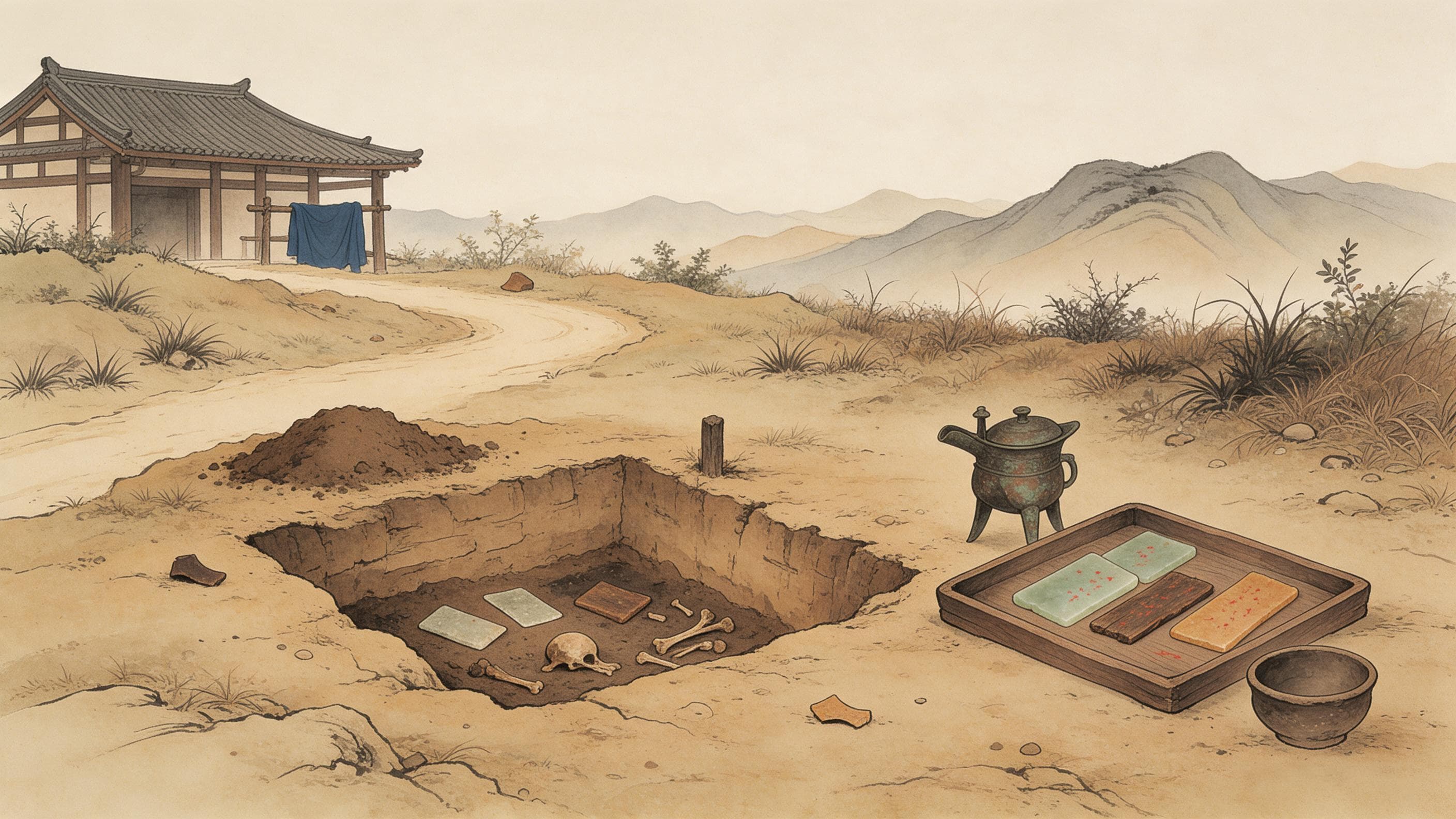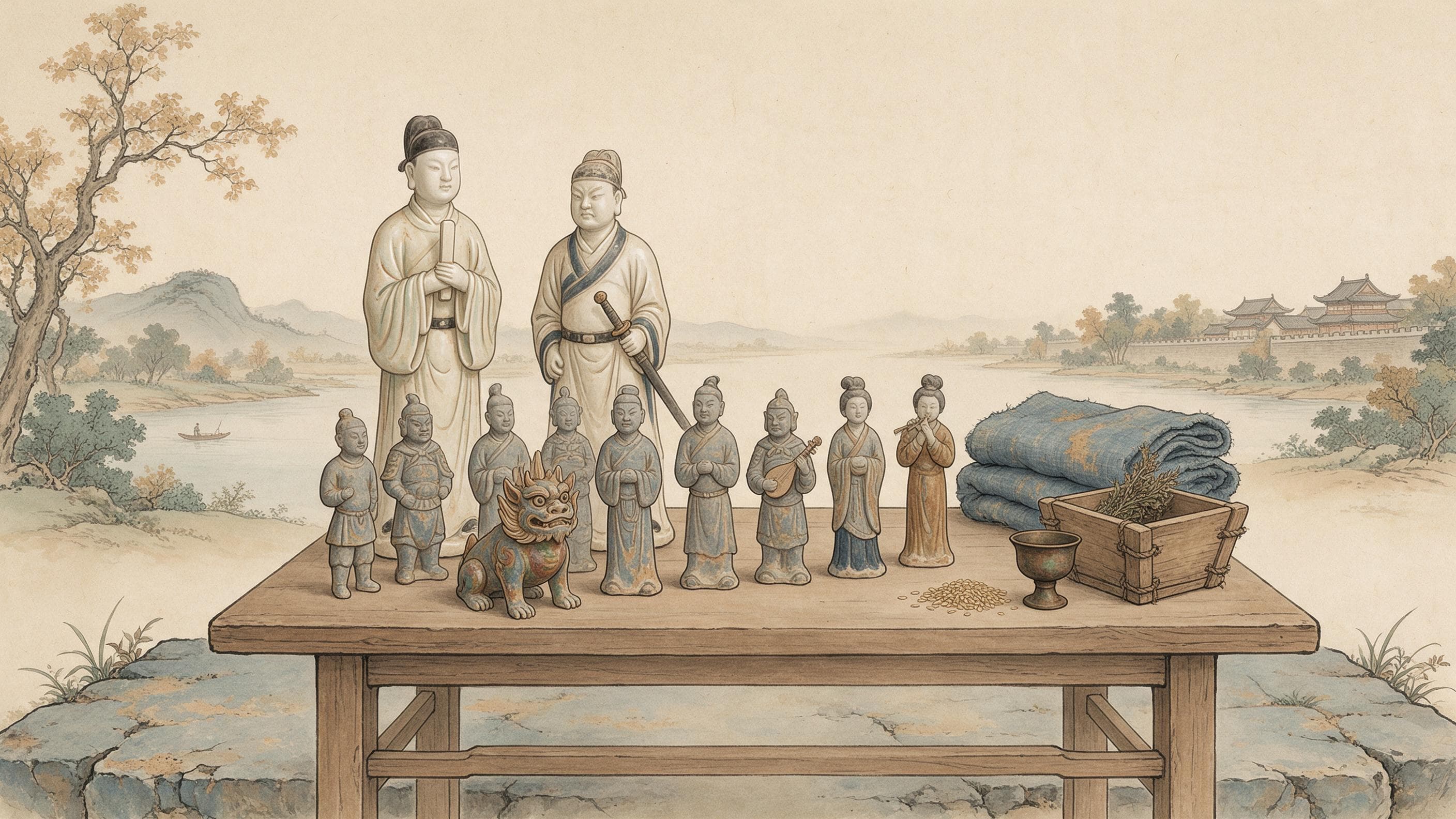
In 1959 a team from the Institute of Archaeology of the Chinese Academy of Sciences opened a tomb outside Anyang, in Henan, and took out 192 objects. Among them were white porcelain figures of civil and military officials, larger and more finely finished than the rest of the grave goods, and a tomb-guardian beast set beside them.
What a general took into the ground
The man in the tomb was Zhang Sheng, zhenglu jiangjun (General Who Subdues the Caitiffs) and zhongsan dafu, an honorary court title. He died at 93, having served five dynasties in a row: Northern Wei, Eastern Wei, Northern Qi, Northern Zhou and Sui. The tomb is securely dated to the early Sui, which makes it a fixed point for dating other objects, and it has produced more Sui pottery figurines than any other tomb: a ceremonial escort, warriors, attendant clerks, maids, musician-dancers, a monk, and models of household utensils.
The number needs a caveat. The tomb was excavated in 1959, but only a brief notice was published, in Kaogu 1959 no. 10; a full excavation report has still not appeared. The volume issued in May 2025, prepared by a Henan Museum research team, is the fullest publication so far. And the 192 are grave goods, not a household's possessions: a tomb is a display that someone arranged, not an inventory of a life.
A household that tried to need nothing from outside
The Yan shi jia xun, the Family Instructions of the Yan Clan, was written around the start of the Sui by Yan Zhitui, a scholar who had served the Northern Qi and lived on into the new dynasty; much of what he describes is northern life as he remembered it. His chapter on household management starts from first principles: "The root of the people's livelihood is to eat from sowing and reaping, to be clothed from mulberry and hemp." Vegetables come from the garden and chickens and pigs from the pen, and "beams and tools, firewood and lamps: none of these is anything but something planted and grown." A family that holds to its work, he says, can shut the gate and have what it needs, "except that no household has a salt well."
He then draws a line between the two halves of the country: the northern custom, he says, is to be frugal and make food and clothing go round, while southern luxury mostly falls short of that. It matters who is speaking. Yan is a gentry moralist writing instructions for his sons, so the sentence is a prescription as much as a description, and the missing salt well is an admission that even a self-sufficient household of his kind still stood inside a market.
Fifteen coins a head, one cup for a son-in-law
The same chapter holds the most concrete figure in Sui social history. A commander at Ye, the northern capital, was insatiably acquisitive: he kept 800 household servants and swore to reach a thousand. "Morning and evening each person's food was budgeted at fifteen coins," and when travellers arrived there was nothing to add. After he was executed and his property was confiscated, the inventory included a room full of hemp sandals and several storehouses of worn clothes, besides treasures past counting.
Then there is the miser of Nanyang. His son-in-law came to pay his respects after the winter solstice, and the host set out one bronze cup of wine and a few pieces of venison. The son-in-law, insulted by how little it was, drained the cup at a single go. The host was taken aback and ordered more, twice; afterwards he scolded his daughter: "The young man likes his wine, which is why you are always poor." When he died his sons fought over the property and the elder killed the younger.
On marriage Yan is sour. "In recent times marrying has come to mean selling a daughter to collect goods and buying a wife with silk, comparing grandfathers and haggling over a fraction," he writes, so that it is "no different from the marketplace." That is a complaint about a trend, not a price list, and it comes from a man who disapproved of the trend.
The fifteen coins should not be turned into a Sui price. The figure is what one Northern Qi grandee's household allowed per head per day, set down in a later recollection. The coin itself is better documented. The Sui minted a new five-zhu coin, a thousand of which weighed four jin two liang; the metal had to be alloyed with tin and lead; and private minting was so persistent that the court ordered the stalls of the capital and the provinces to post a sample coin on a board and refuse anything that did not match. Even the count of fifteen was a count of a coin the state was still trying to standardise.
The bill sent to a grown man
The Suishu, compiled under the Tang, lays out the machinery. Five families formed a bao, five bao a lü, four lü a zu, each with its head. Ages were graded: under three huang, under ten xiao, under seventeen zhong, eighteen and over ding — adult, liable for tax and labour — and at sixty a man became lao, old, and was released. Then came the bill for one ding, or more precisely for one "bed", the married couple that formed a tax unit: three shi of millet; on mulberry land one bolt of silk tabby with three liang of floss; on hemp land one duan of cloth with three jin of hemp. A single man, or a slave, paid half.
In 583 the terms were eased: the labour obligation was cut from twelve turns a year to twenty days, and the silk levy from a bolt to two zhang. The community granary (yicang) was founded in 585; the three-grade levy came later — an edict of 596 ordered 'community granaries, taxed by the three grades of upper, middle and lower', up to one shi for the upper grade, seven dou for the middle, four dou for the lower. People were counted as well as cloth. In the great search and inspection, da suo mao yue, officials checked faces against the registers and exiled village heads whose numbers were false; the operation added 443,000 adult males and 1,641,500 newly registered mouths. Those are the returns of one audit, not a national population.
The same chapter keeps the state's own account of what it could demand. The Guangtong Canal, dug by Yu Wenkai's engineers to bring Wei River water east from Daxing to Tongguan, ran more than three hundred li. The Eastern Capital at Luoyang was built with two million labourers a month. And the chapter's portrait of the founding emperor is worth reading for its tone: the women of the palace wore clothes washed and washed again, the emperor's carriage was patched rather than replaced, his meals ran to no more than one meat dish, and an official who delivered ginger in a cloth bag was scolded for extravagance. That is the Tang historians' portrait of him, a moral picture rather than an invoice.
What none of the three records has
There is no Sui equivalent of the Dongjing Meng Hua Lu, no street-by-street, hour-by-hour account of a city waking, trading and closing. There are no house dimensions and no food prices for ordinary households. The three records here belong to three different people: a general's grave goods, a gentry family's rules and food budget, and a tax code that states what a standard household owed rather than what any household actually paid. They cannot be laid end to end into a single Sui day. What they can do is show how far apart the three ledgers stood.
Sources & further reading
- 魏徵等《隋書》卷二十四·食貨志(Wei Zheng et al., Book of Sui, juan 24, "Food and Money") — Tang-compiled treatise: household units of five families, age grades huang/xiao/zhong/ding/lao, one 'bed' owing three shi of millet plus a bolt of silk tabby with three liang of floss or a duan of hemp cloth with three jin of hemp, twenty days of labour after 583, the graded community granary, the great search and inspection that added 443,000 adult males and 1,641,500 mouths, the Guangtong Canal of over three hundred li, two million labourers a month at the Eastern Capital, the Sui five-zhu coin at a thousand to four jin two liang, boards of sample coins posted at market stalls, and the frugal habits attributed to Emperor Wen.
- 顏之推《顏氏家訓》卷第一·治家(Yan Zhitui, Family Instructions of the Yan Clan, juan 1, "Household Management") — Gentry household manual, written around the start of the Sui but recalling Northern Qi and Liang: eat from sowing and weave from hemp, a closed gate supplies everything except a salt well, the Ye commander with 800 servants and fifteen coins a head each day, the Nanyang miser's one bronze cup of wine for his son-in-law, marriage as selling daughters and buying wives with silk, Ye households run by women, and Hebei women's weaving judged better than the south's.
- 《安陽隋張盛墓》出版報道(Guangzhou Daily, 7 May 2025, on the publication of the Zhang Sheng tomb volume) — Archaeological news report, not an excavation report: the tomb is securely dated to the early Sui, its occupant Zhang Sheng was a zhenglu jiangjun and zhongsan dafu who lived 93 years across five dynasties, it was excavated in 1959 by the Institute of Archaeology, it holds 192 grave goods including the largest assemblage of Sui pottery figurines and large white porcelain officials and a guardian beast, and only a brief notice appeared in Kaogu 1959 no. 10 before the 2025 volume.