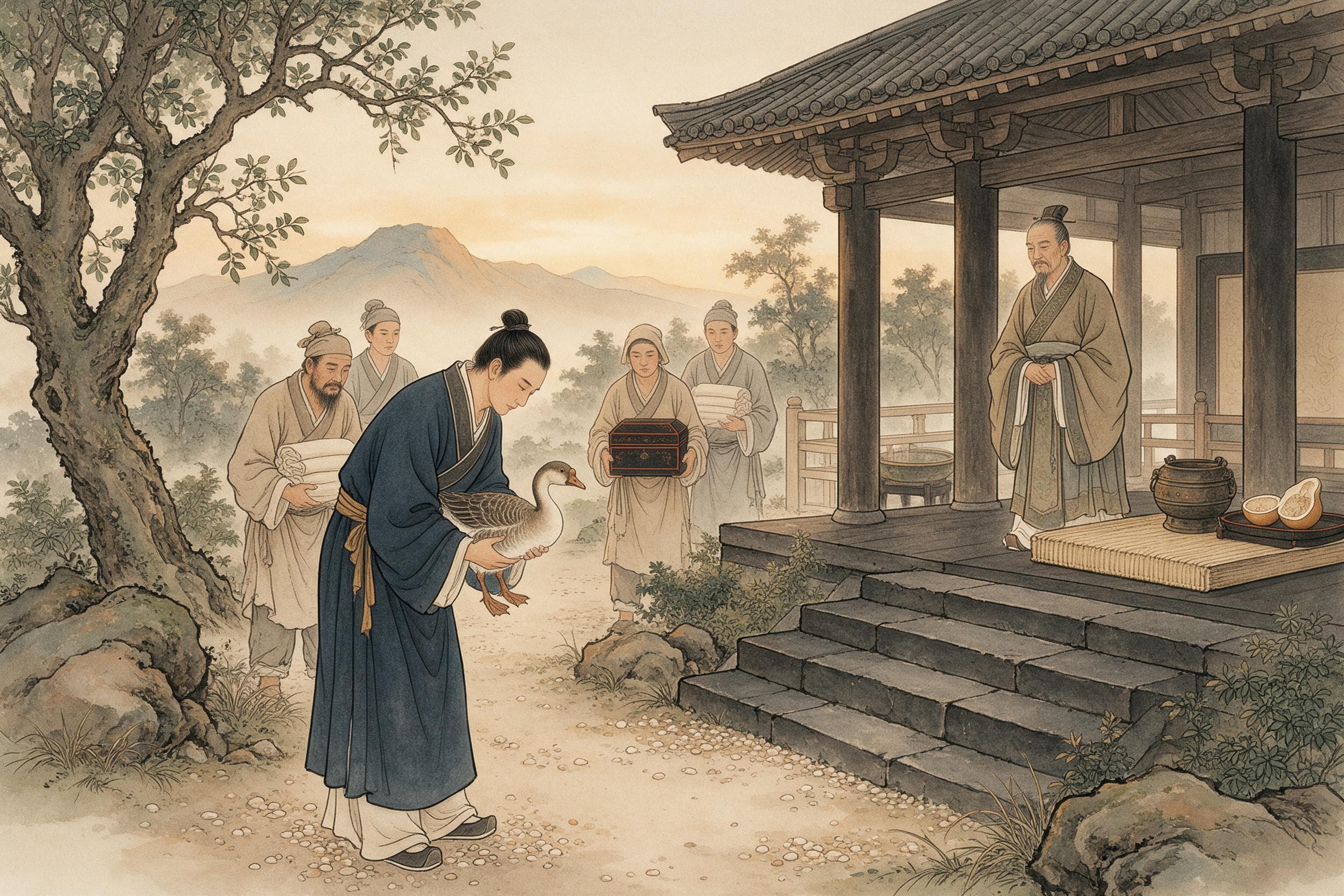
The bridegroom comes in carrying a goose. He yields his way up the steps of the hall, bows twice and sets the bird down — 壻執鴈入,揖讓升堂,再拜奠鴈. Later, in the new house, the pair eat from the same victim and drink from the two halves of one gourd cut lengthwise (共牢而食,合卺而酳), a gesture anyone who has seen a modern wedding would recognise as the remote ancestor of the shared cup. This is the script as the Book of Rites gives it, in the chapter called Hun Yi, "the meaning of marriage". The book is late: put together centuries after the Spring and Autumn period it describes. The goose is a prescription, not a photograph. The Zuo Zhuan, which does report those centuries, records almost none of it. It records envoys, women sent to travel with brides, and one or two marriages that went badly wrong.
The six rites, and what the order of them asks
The same chapter lists the stages: 納采, 問名, 納吉, 納徵, 請期 — the first approach, the asking of the name, the favourable divination, the presentation of betrothal gifts, the fixing of the date. Each was performed with the ancestral temple opened and the host bowing to the visitor outside his gate. Then follows the fetching of the bride: the father pours his son a cup and sends him on his way (父親醮子而命之迎). These five plus the fetching make the six rites (六禮) that later handbooks count.
Read the list as a procedure and one thing stands out: first the proposal, then the name. The name was asked because the surname mattered — a wife of one's own surname was forbidden, as the next chapter of the same book says — and 問名 is the point at which that was settled. This is inference from the order of the rites, not a sentence the text writes; but a procedure that asks the name before it asks anything else is a procedure with one question on its mind.
A go-between and a gift stood at the door
Two things, on the evidence of the Book of Rites, stood at the door of a legitimate marriage: a go-between and a gift. 男女非有行媒,不相知名 — without a go-between, man and woman do not learn each other's names; 非受幣,不交不親 — without the acceptance of a gift, they do not meet and are not close (曲禮上). Neither sentence gives an amount. The silence has to be respected: the ritual governs whether the door was used, not what was carried through it.
The Zuo Zhuan supplies one record of the gift stage, from the marriage of a Lu princess to the ruler of Song. In the eighth year of Duke Cheng (583 BCE) the text reads 宋公使公孫壽來納幣 — the duke of Song sent Gongsun Shou to present the betrothal gifts — and adds 禮也, "this was according to ritual". Earlier that year Song had sent an envoy to negotiate for Gong Ji; that winter, 衛人來媵, the men of Wei came with women to accompany the bride; the next year 晉人來媵, 禮也, Jin did the same. For the Zuo Zhuan, this is already a well-documented wedding.
Look at what those lines actually contain: a season, an envoy's name, a verdict of "ritual". No sum of betrothal money, no inventory of dowry, no description of a feast. A reader who wants to know what a Spring and Autumn wedding cost will not find it here, and should not be given a guess.
Do not marry your own surname
取妻不取同姓,故買妾不知其姓則卜之 — take no wife of your own surname; and since a concubine may be bought without knowing her surname, divine it (曲禮上). The rule is flat, the reason is absent. The explanations usually offered — lineage, alliance, the dangers of close kin — are later interpretation, not the text's own words. And the rule carries its own admission: if the law expects a man to buy a concubine without knowing her surname, it has already conceded that some cases cannot be checked.
How far the prohibition was obeyed is another question. The marriage records of the period do not run exactly along that line; same-surname unions are still to be found in the Zuo Zhuan. The cases I could verify this round were not enough to quote one, so the point is left where the sources leave it: a rule, and a distance between the rule and practice.
The women who came second
Then there were the accompanying women. When Gong Ji of Lu went to Song as a bride, 衛人來媵 — Wei sent women to accompany her — and the Zuo says it was ritual; the following year Jin sent women, also ritual. The rule is stated once: 凡諸侯嫁女,同姓媵之,異姓則否 — when a noble house married off a daughter, states of the same surname sent an accompanying woman, states of another surname did not. Wei and Jin were both Ji (姬) surname states, as Lu was, which is why their women travelled. How many came, what standing they held, whether anyone asked them: no source says.
What the ritual book does not stage
What no ritual handbook stages is the marriage that breaks the rules, and the Zuo Zhuan has one of those, told in a few lines. 初,衛宣公烝於夷姜,生急子 — Duke Xuan of Wei took to himself Yi Jiang, a woman of his father's household, and she bore him Ji Zi. He then arranged a marriage for Ji Zi with a woman of Qi; she was beautiful, 公取之, and the duke took her for himself; she bore Shou and Shuo. 夷姜縊 — Yi Jiang hanged herself. In one paragraph a ruler takes his father's woman and then his son's bride, and a woman dies. 烝 is the technical verb for that first act, and the Zuo uses it as a verdict on it. This is one family's scandal, reported as scandal; it is not evidence of a custom.
The layers should be kept apart. The goose and the gourd belong to a handbook compiled after the fact; the envoys and the lists of accompanying women belong to a chronicle; the hanging belongs to the same chronicle and to no one's recommendation. Of ordinary people's marriages the texts say nothing at all — no commoner wedding appears in them, no figure for a bride price, no account of a village feast. A history of how most people in the Spring and Autumn period married cannot be written from this material. What can be written is the machinery used by the nobility: a name, a gift, a go-between, a date, and a train of women walking behind the bride.
Sources & further reading
- 《礼记·昏义》(Liji, "The Meaning of Marriage") — The five stages of the betrothal, the groom's goose and the shared cup; a ritual handbook compiled after the period, so prescription rather than record.
- 《礼记·曲礼上》(Liji, "Summary of Ritual", Part One) — "No go-between, no names; no gift, no meeting"; the ban on marrying one's own surname, and the divination of a concubine's unknown surname.
- 《左传·成公八年、九年》(Zuo Zhuan, Duke Cheng, years 8–9) — Song's envoy presents the betrothal gifts for Gong Ji; Wei and then Jin send accompanying women, with the rule that only same-surname states do so.
- 《左传·桓公十六年》(Zuo Zhuan, Duke Huan, year 16) — Duke Xuan of Wei takes his father's woman (烝), then takes his son's bride; Yi Jiang hangs herself.