In the spring of 590 BCE the state of Lu did something important, and the chronicle gave it three characters: in the third month, "qiu armour was made" (作丘甲). The Zuo Zhuan's commentary does not explain how much armour a qiu supplied. A state's reform of military levy has left behind its name more completely than its content. This is also how the classic works: it records what was done, not why or how — a reform is noted because it happened, not because the annalists cared about detail. Yet those three characters are among the hardest evidence there is for a Spring and Autumn state beginning to count its people: the levy was being pushed down to a territorial unit.
The qiu: pushing the levy downward
A qiu was a local territorial unit. "Making qiu armour" meant levying armour by qiu — shifting a burden once carried by the nobles of the capital down to that level. Commentators disagree on the details, but agree on the direction: the taxpayers moved down the social scale.
How much armour, how many men, whether by household or by field: not a word. So it cannot be written that each qiu supplied a set number of armoured men, nor that qiu armour was a land tax. It was a military levy first. What can be said is one sentence: the cost of war began to be shared by the farmers who lived in the qiu.
Chu: counting before marching
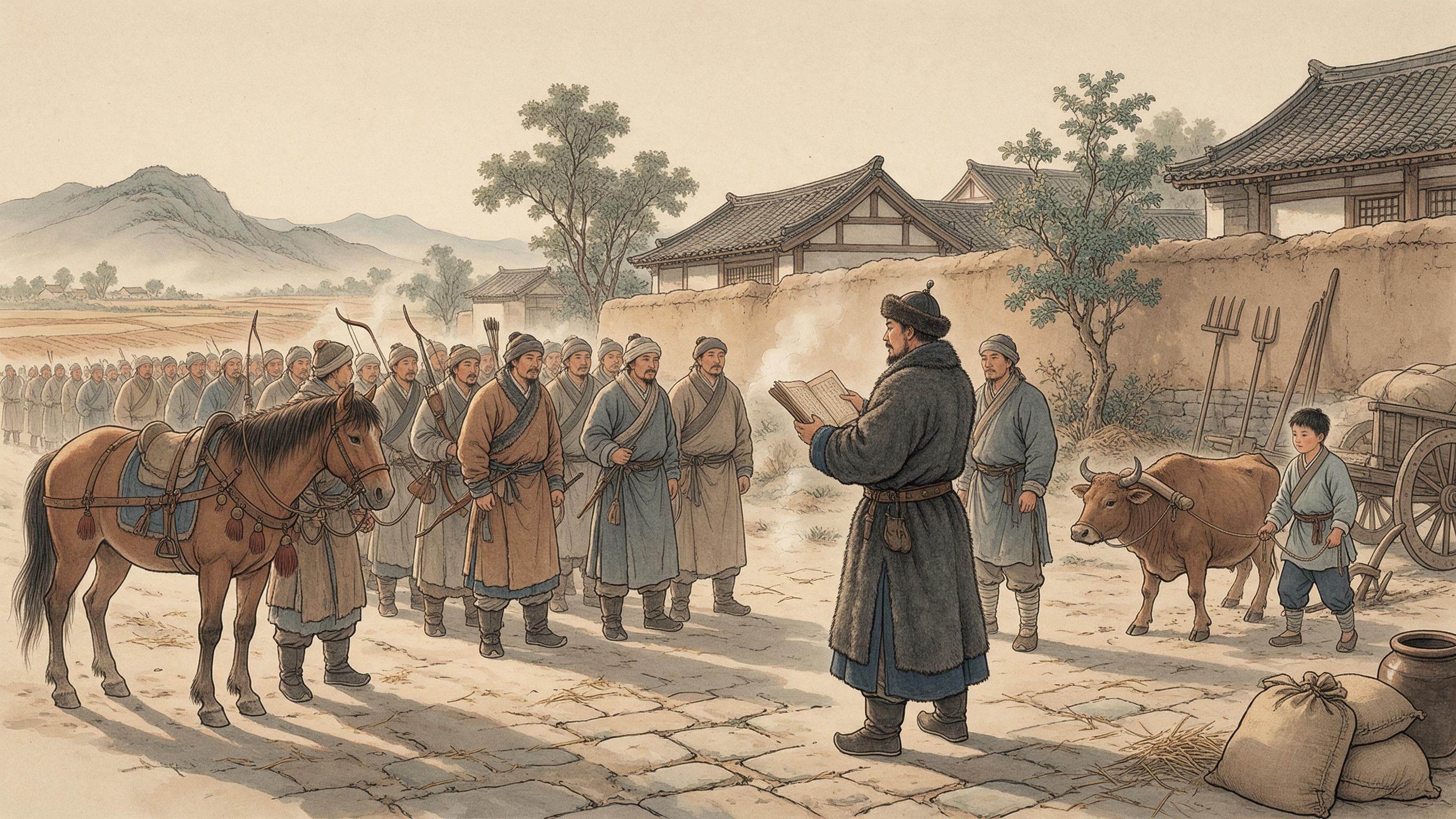
The next year, 589 BCE, Chu marched to relieve Qi in the Yangqiao campaign. Before setting out, the chief minister Zi Zhong did a series of things, recorded in the Zuo Zhuan, Duke Cheng, year 2: "He made a great numbering of households; cancelled debts; reached the widowers; relieved the needy; pardoned offenders; mobilised the whole army; the royal troops all marched."
The order matters: count first, settle the people second, march third. An old gloss reads da hu as "reviewing the people's households" — a census of households. But the glosses do not agree: one reads it as a review, another as an enlargement of registration. The text gives no method, no standard, no age, and never says the register was kept afterwards. So it can be called a household count, not the establishment of a registration system. Whether the debt cancellations and relief were preparation for the count or consequences of it, the source does not say.
Eight hundred chariots: the bill for one battle
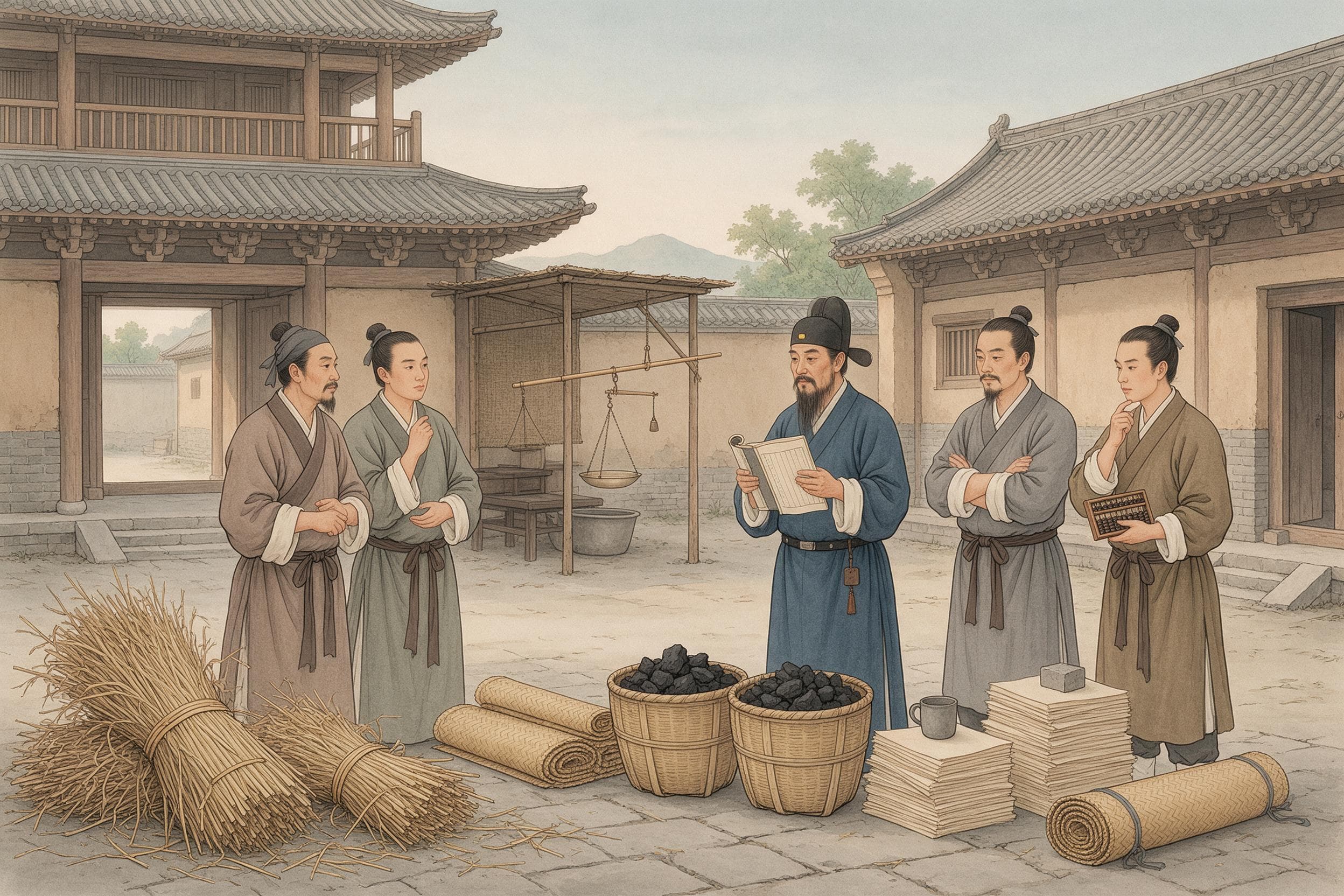
That same year Jin raised an army for the battle of An. The duke first granted seven hundred chariots; Xi Zhi said, "That was the levy of Chengpu", and asked for eight hundred, and the duke agreed. Eight hundred chariots means armoured men, infantry, horses, fodder and grain; a number that size had to be levied further down — to the qiu, to the household. How many armoured men and infantry made up one chariot is itself disputed in the old texts, so no arithmetic of men per sheng is offered here.
The figure must be kept in its place: it is the chariot force of one campaign, not Jin's standing army. The text uses the word fu (賦, levy) for the chariots, which is the point — the army was the levy, and the levy was the countryside.
The base: a farmer's year
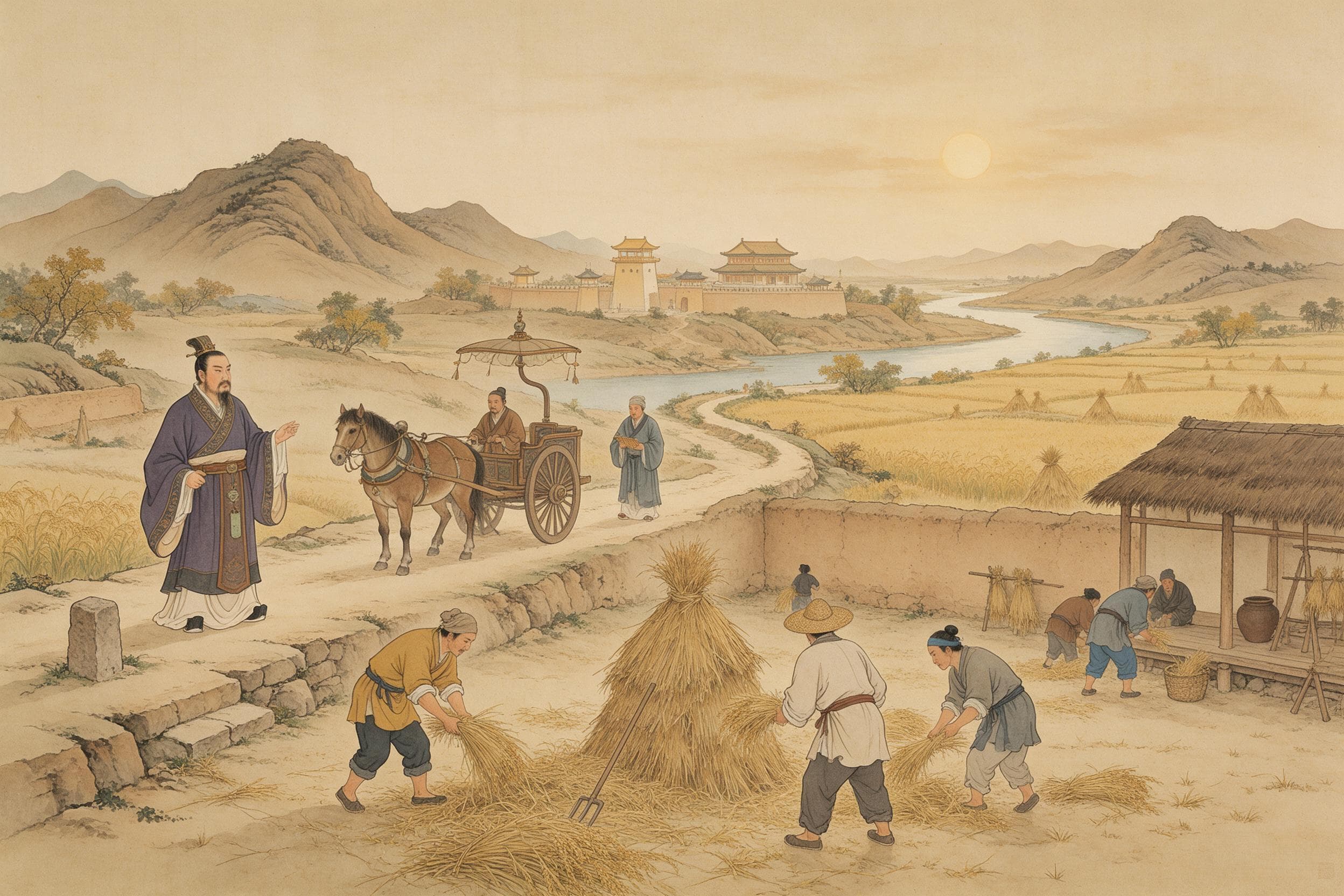
All of that armour, fodder and grain came out of the fields. The Shijing's "Seventh Month" gives the farmer's year: "In the ninth month we build the threshing floor and stack-yard; in the tenth we bring in the harvest — millet and grain, hemp and beans and wheat." And after the harvest, public work: "Our harvest is gathered; we go up and perform the palace work. By day we gather thatch, by night we twist ropes. Hurry and mount the roof; soon we begin to sow the hundred grains."
The poem does not describe collection, only a year of labour; but it sets out the base — the levy rested on these people's time and harvest. Mencius, later, described the well-field ideal: eight households farm a public field, and "only when public work is done dare they attend to private work". That is a Warring States picture of how things ought to be, useful as a comparison, not as a Spring and Autumn record.
The register that was never left
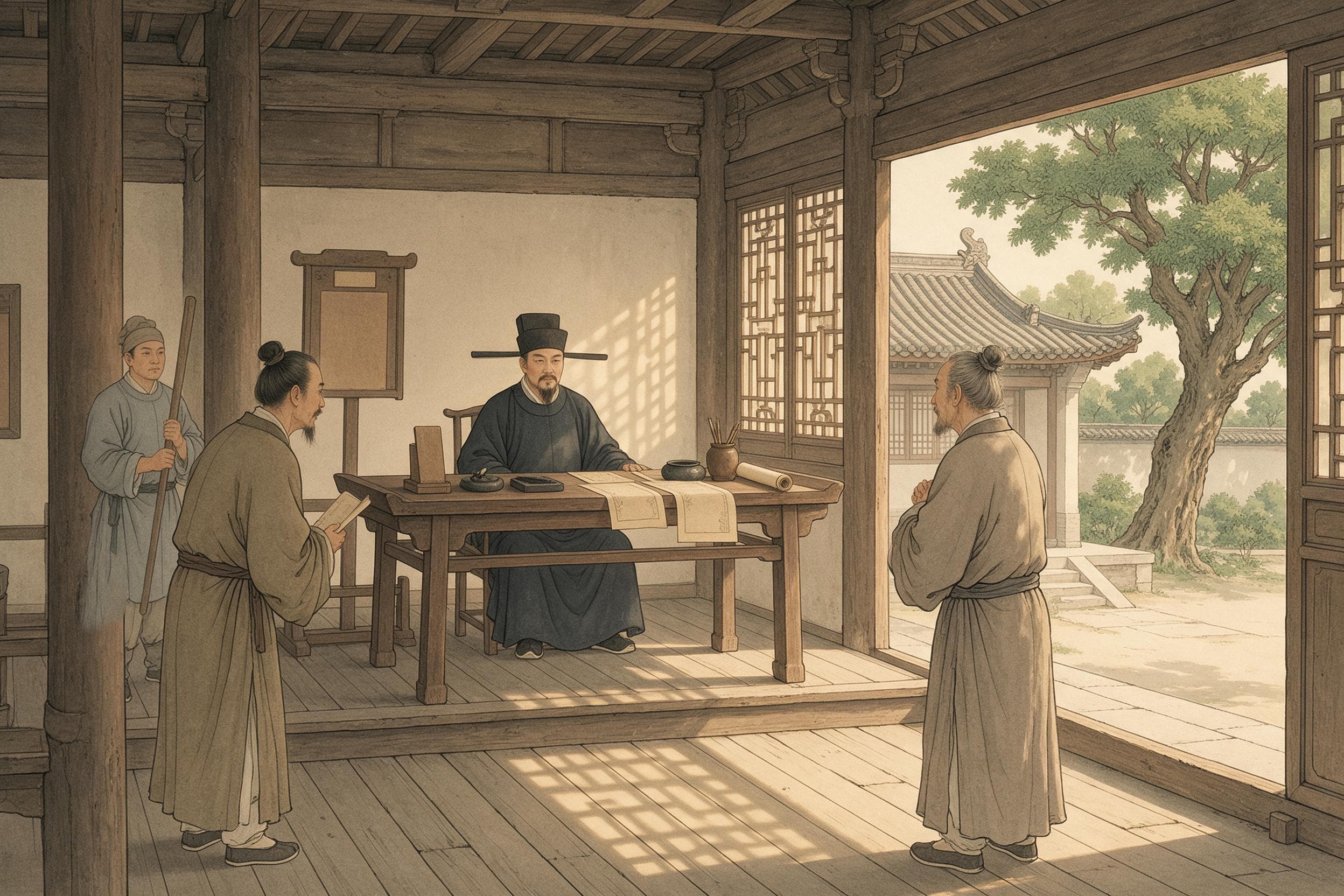
No Spring and Autumn household register survives, and no rate of assessment. The documents that would settle the question — a household roll, a levy schedule, a service list — have not come down. Three actions are all we see: Lu levying by qiu, Chu counting households before a campaign, Jin demanding eight hundred chariots for one battle. All point the same way — the state had begun to count people and to demand by unit — and none tells us how it counted.
So the conclusion is small but solid: in the middle and late Spring and Autumn period, as wars grew, men and levies were pressed down toward the base; counting people was part of a state's capacity, visible in the name of a reform and in the eve of a campaign, but not in any surviving ledger. How many men each household sent, at what age service began, who was exempt — the record is silent, and the silence is part of the history. Counting is visible; the count itself is not.
Sources & further reading
- 《左传·成公》(Zuo Zhuan, Duke Cheng, years 1–2) — Lu's 'making qiu armour' in 590 BCE, Chu's 'great numbering of households' before the Yangqiao campaign in 589, and Jin's request for eight hundred chariots at An.
- 《诗经·国风·豳风·七月》(Shijing, Bin, "Seventh Month") — The farming year: harvest, thatching, rope-making and the phrase 'we enter and perform the palace work' — the material base under levy and service.
- 《孟子·滕文公上》(Mencius, Teng Wen Gong I) — The well-field ideal: eight households share the public field and only 'when public work is done dare they attend to private work' — a Warring States retrospective, not a Spring and Autumn record.