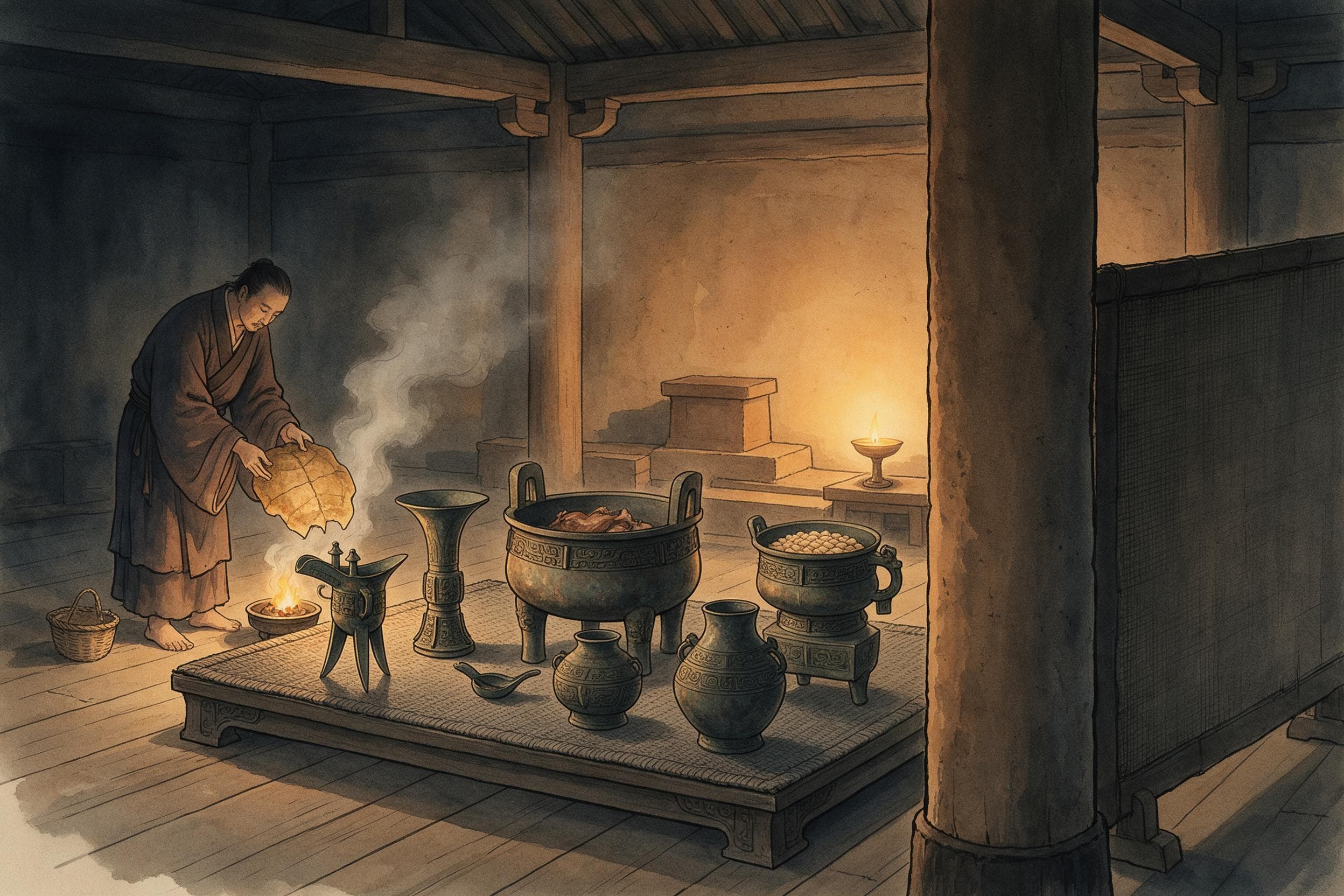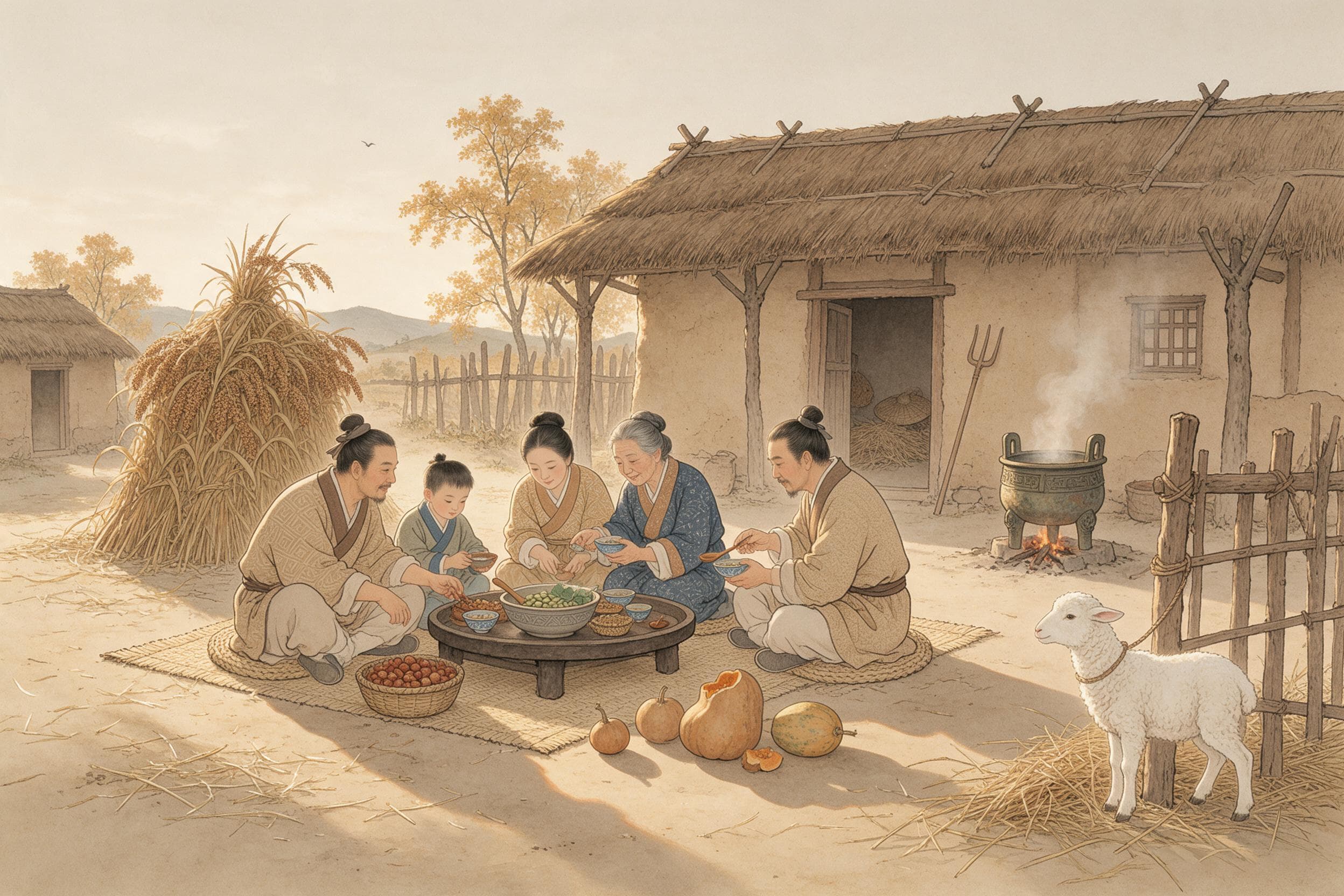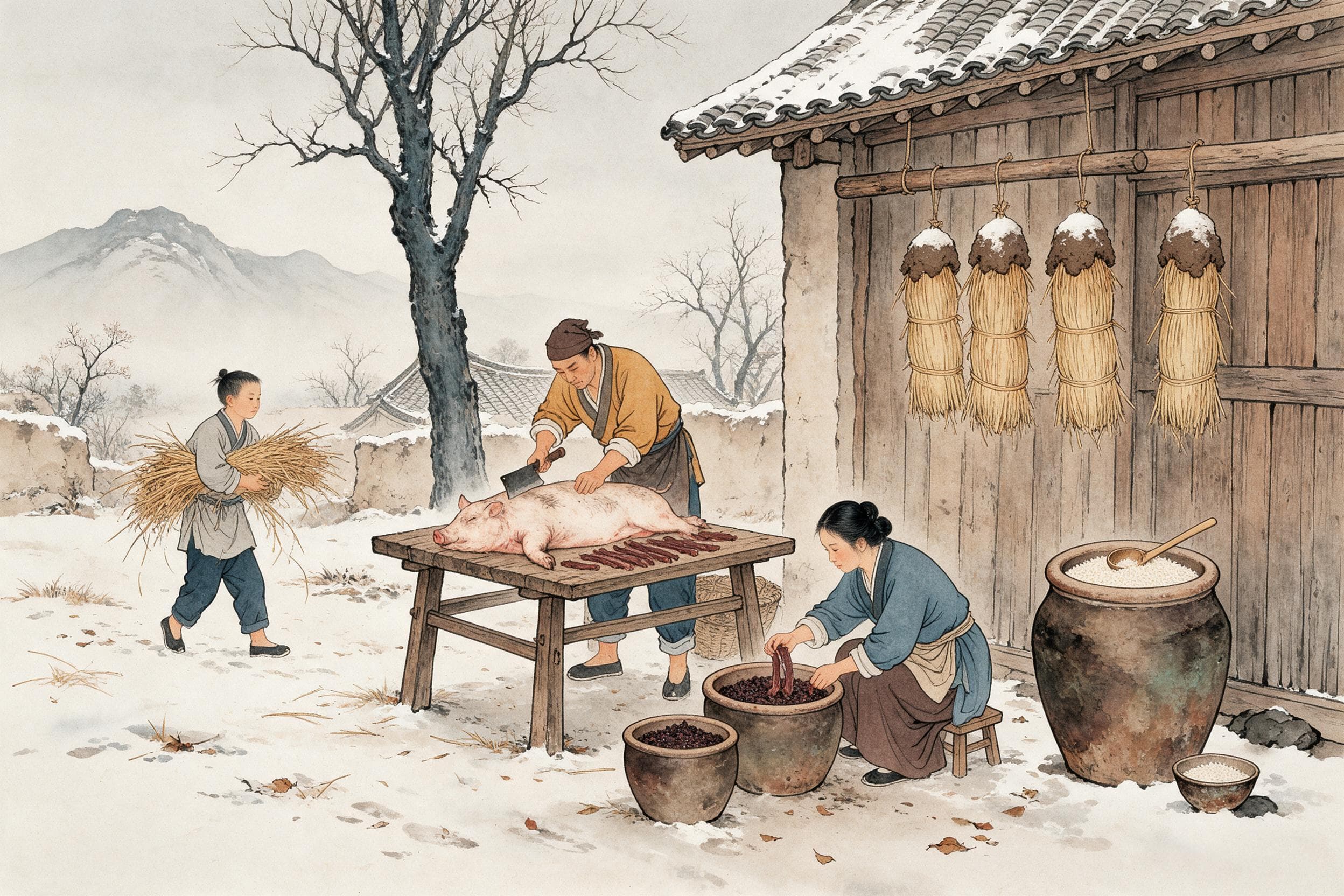
The first object in a Song wedding was a piece of paper. A matchmaker carried a draft card, a caotie (草帖), from the bride's household to the groom's, and it held little more than a birth date. Before money was mentioned, the groom's family took that date to a diviner. Only if the reading came back 得吉无克 — auspicious, without conflict — did they send a card in return. Wu Zimu's Meng Liang Lu, an account of the Southern Song capital Lin'an, opens its marriage chapter with exactly this: paper first, people later.
Two cards
The second card was the serious one: the dingtie (定帖), the settled card. It listed three generations of the groom's office and personal name, which son of the family he was, the hour of his birth, whether his parents lived, and which senior relative sponsored the match; if he was marrying into the bride's household, ruzhu (入赘), that had to be stated. Then came the inventory: “gold and silver, fields, property, houses, corridors and garden hills, all set out in the card” (将带金银、田土、财产、宅舍、房廊、山园,俱列帖子内). The bride's family replied in the same form, with her dowry and the land, buildings and garden that came with her.
Meng Yuanlao's Kaifeng account is shorter and keeps one detail the later book drops: the card noted whether the match was in mourning for a close relative (有服亲). A wedding could be a property deal and still be scheduled around a funeral. The two cards crossed; the couple had not met.
The hairpin and the consolation gift
The meeting was xiangqin (相亲), “looking at each other”. In Lin'an the two families met over wine in a borrowed garden or on a lake boat, and the pouring was graded: “the man's side four cups, the woman's side adds a double cup; the rite takes the meaning of the man being strong and the woman weak” (男以酒四杯,女则添备双杯,此礼取男强女弱之意).
If the match pleased, a gold hairpin went into the girl's coiffure — chajin (插钗). If not, the groom's family left two lengths of coloured silk and it ended. The Meng Liang Lu calls this yajing (压惊), “settling the fright”: a refusal was a payment for the disturbance of being looked at. In Kaifeng it was a relative of the groom, or his mother, who did the looking. Even matchmakers were graded by dress — the upper sort in a head-veil and purple jacket, speaking of official kin and palace favours; the middle sort in a cap and yellow chignon cover, or just a skirt, carrying a green parasol, always walking in pairs.
Who held the veto, neither book says. The Meng Liang Lu writes only that “the new people were pleased” (如新人中意), a phrase wide enough to cover both of them.
Who paid for what
Betrothal gifts were itemised by class. Wealthy households sent the “three golds” — a gold bracelet, a gold ring, a gold breast-ornament (金钏、金镮、金帔坠). Shopkeeping families without gold sent silver-gilt. “Among the lower sort, one or two bolts of cloth, one or two packets of official paper money, with goose, wine, tea and cakes, and that was all” (所送一二匹,官会一二封,加以鹅酒茶饼而已).
Below that was a category with a name worth keeping: douguo (兜裹). A poor household with a presentable daughter and nothing for a dowry received jewellery, cloth and “paper goods” (楮物) from the groom's side — a subsidy dressed as a gift. Whether 楮物 means cash or paper offerings here, the text does not say.
The day before the wedding the bride's family came to hang curtains and lay out the room: pufang (铺房), “spreading the room”. Trusted women and her own maids were then posted inside, and no outsider entered until the couple arrived.
Gifts moved as objects, not sums. The groom's people sent a load of wine hung with flowers and silk; the bride's sent back the empty bottles filled with fresh water, a few live fish and a pair of chopsticks — huiyuzhu (回鱼箸). Lin'an put four goldfish and two spring onions in the bottle. Water, fish, chopsticks, onions: a household, a live thing, a meal.
At the gate
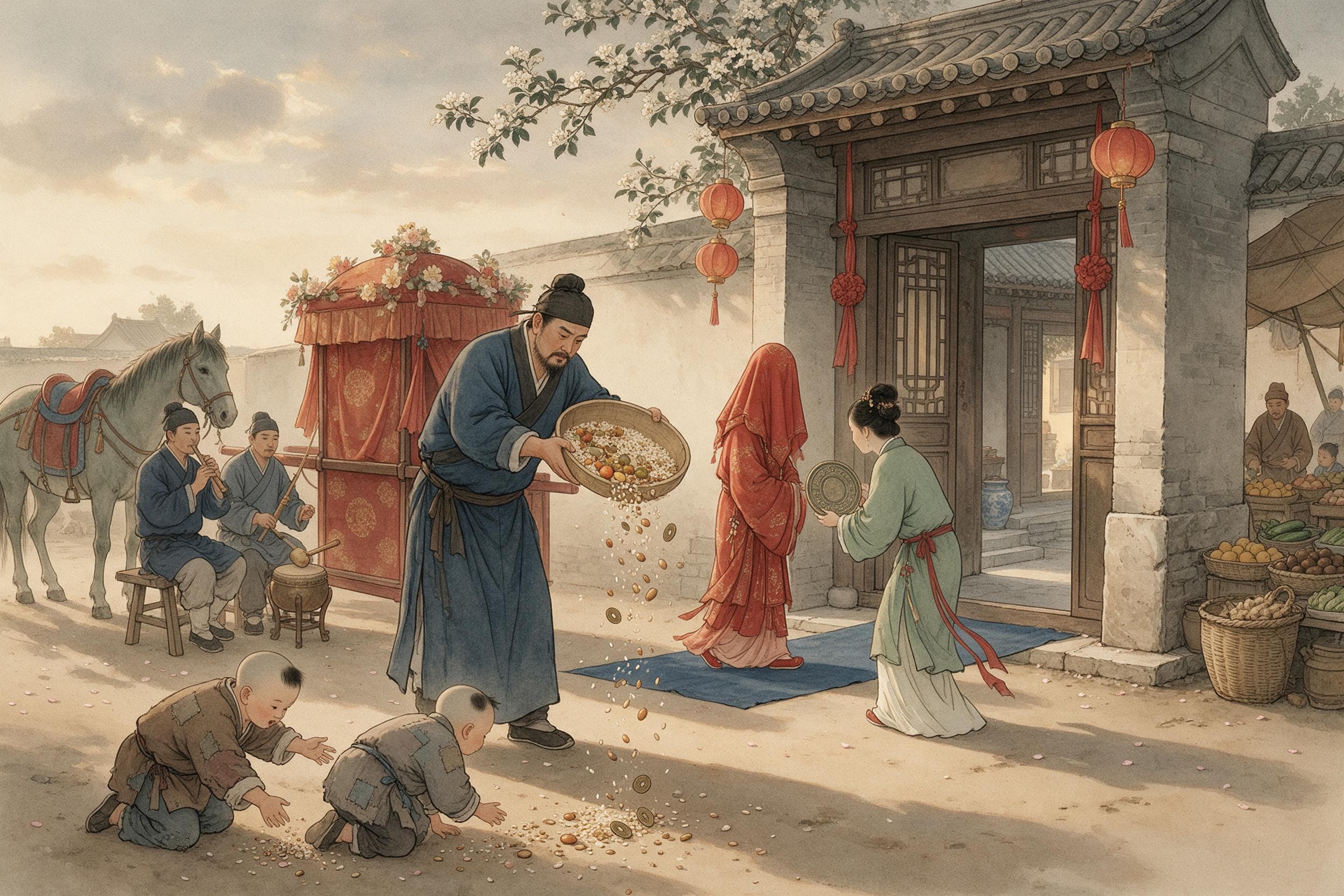
On the wedding day the groom's people came for her with a flowered sedan chair and a line of xinglang (行郎), hired men each carrying one stipulated object — flower vases, flowered candles, scent balls, washing basins, cosmetic boxes, mirror stands, clothes boxes, a green parasol, a folding chair. Hired singing women rode horses; musicians played. At the groom's gate the party stopped, because the gate had to be bought: “as the hour came due, the musicians, the singing women and the tea-and-wine men recited verses at each other and blocked the gate demanding lucky money” (拦门求利市钱红). Meng Yuanlao names the same moment dumen (杜门) and describes the same demand. Two words, 拦 and 杜, one shakedown.
Then the apotropaic work. A diviner held a peck measure of grain, beans, coins, fruit and grass joints, spoke the spell and scattered it at the gate while children scrambled for the pieces. Lin'an gives the reason in five characters: 以压青阳煞, to suppress the qingyang influence; Kaifeng says 厌青羊等杀神, to avert the green sheep and similar spirits. Neither book mentions fertility. The grain is a ward, and the children are scavenging, not blessing.
She did not walk on the ground: blue cloth was laid down, someone walked backwards ahead of her holding a mirror, and she stepped over a saddle, over grass, over a steelyard. Then each family produced a length of coloured silk, knotted into a single knot — qianjin (牵巾), “leading by the scarf”. The groom hung his end from his tablet of office, the bride took hers in her hand, and he walked backwards into the family shrine so that they faced each other the whole way.
Inside the room, and after
Inside, women threw coins and coloured fruit across the bed: sazhang (撒帐). A little hair was taken from each of them, left and right, and bound together — heji (合髻) — with the families supplying silk, hairpins and combs. Two cups tied with coloured cord were drunk in turn; in Kaifeng they were then thrown under the bed, and one landing face up and one face down was great luck. Lin'an placed them under the bed instead and read the same omen. Only Lin'an has the veil lifted with a steelyard beam or a loom shuttle, by a woman of the groom's family who still had both parents.
The Meng Liang Lu also records a rite going out of use. In Kaifeng the groom climbed onto a seat in the middle hall, and the matchmaker, then an aunt, then his mother-in-law each poured him a cup before he came down. The later book notes that “this rite has long gone unused” (今此礼久不用矣). A ceremony can lose a step inside a century.
What followed was a schedule. Next morning the bride bowed before a mirror set on a table. Within three, seven or nine days the couple went to her parents' house, baimen (拜门), where the banquet for the new son-in-law was called huilang (会郎). By the ninth day her family might move its kitchen to the groom's house for the nuannü hui (暖女会). On the seventh day she was fetched home and sent back with cloth and hair ornaments: xitou (洗头). At one month came a final banquet, the he manyue (贺满月会亲). “After this,” Meng Yuanlao writes, “the formalities were few” (自此以后,礼数简矣).
At the top of the scale, Zhou Mi's Wulin Jiu Shi records one imperial wedding: “since the move south, no princess had married” except the Princess of Zhouhan, the ceremony being rather grand (南渡以来,公主无及嫁者……礼文颇盛). The bride-price was ten thousand taels of silver, and a month beforehand the chief ministers inspected the trousseau item by item. The fullest description of a Song wedding we have describes something that happened once.
The last word belongs to the Meng Liang Lu. After listing every step it adds a clause that quietly undoes the performance: ordinary households should follow their own means and are not bound by this ceremony — “if there is truly nothing to manage it with, then let it go” (若果无所措,则已之).
Sources & further reading
- 孟元老《东京梦华录》卷五「娶妇」(Meng Yuanlao, Dongjing Meng Hua Lu, juan 5, "Taking a Wife") — The Kaifeng sequence from draft card and detailed card through the gate rites, the hair-joining and the shared cup, to the full-month banquet.
- 吴自牧《梦粱录》卷二十「嫁娶」(Wu Zimu, Meng Liang Lu, juan 20, "Marriage") — The Lin'an version: the settled card with its property list, the graded betrothal gifts, the three golds, the poor household's subsidy, blocking the gate, and the veil lifted with a steelyard.
- 周密《武林旧事》卷二「公主下降」(Zhou Mi, Wulin Jiu Shi, juan 2, "The Marriage of a Princess") — The single recorded Southern Song imperial wedding, with its ten thousand taels of bride-price and the trousseau inspected item by item.