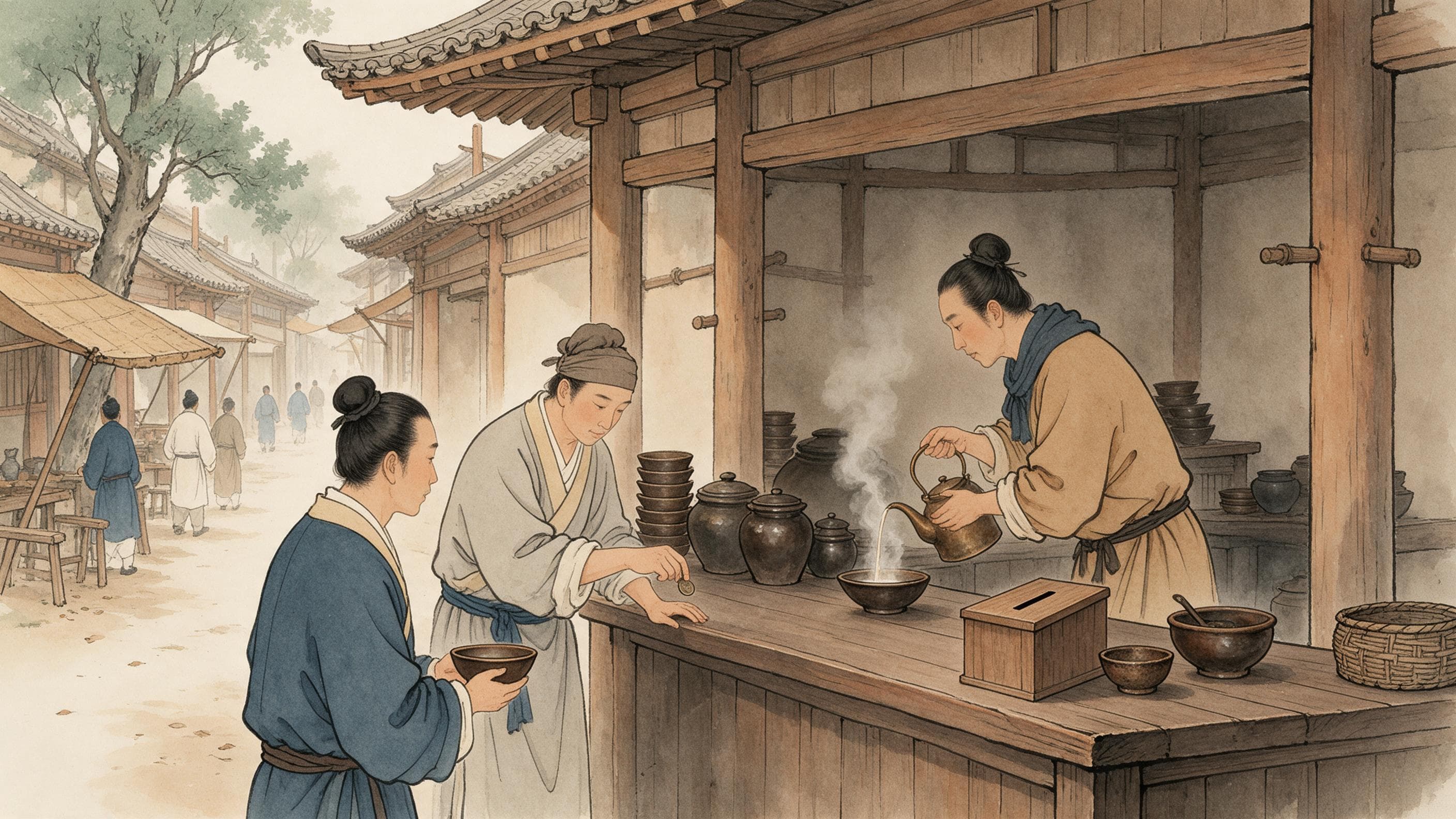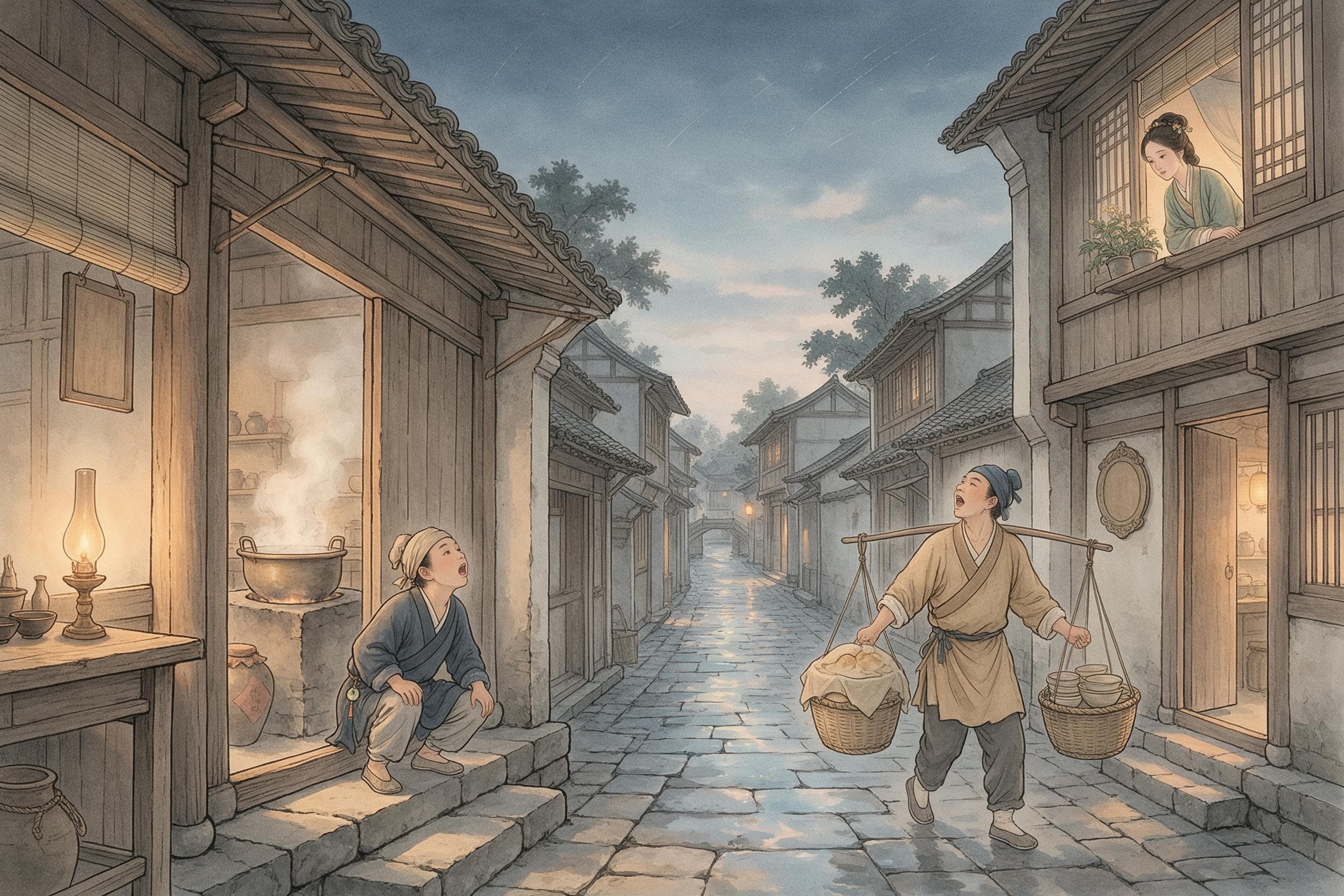
The day in Kaifeng did not begin with a hawker. It began with an iron clapper. At the fifth watch the monastery runners went out striking an iron plate or a wooden fish, each with his own stretch of streets, calling the hour and collecting alms by day. The people who had to be at court or in the market got up when they heard it. Then the city opened: wine shops lit their lamps and sold by the cup for no more than twenty cash, with porridge and dumplings; someone sold washing water; someone sold decoction tea and medicine, until daylight. And at the door of one gourd-soup shop, Meng Yuanlao notes, a small boy sat crying 叫饶骨头 — “spare a bone.”
A hundred ways of calling
Whether that boy was selling the bones or begging for them, the sentence does not say. It records only the action: a child at a shop door, shouting. The first voice in the record is already ambiguous.
A few lines later comes the phrase that names the whole trade. Along the imperial street from Zhouqiao down to the gate of the Southern Palace, the people who took advantage of the morning court to sell medicine and food, Meng writes, 吟叫百端 — they chanted and called in a hundred modes. 吟 is to drawl, to sing; 叫 is to shout; 百端, a hundred ways. He does not write down one of them.
That is the shape of the evidence for street cries in Song China. The sources tell us, repeatedly and in a few loud phrases, that the city was packed with the sound of selling. They almost never tell us what was said.
What was being cried
The nearest thing to a text is a menu. The Ducheng Jisheng, a guide to Hangzhou finished in the 1230s, describes the night trade: men carrying trays on their heads and racks on their shoulders, with quail dumplings, fried cakes, leek-and-mutton pancakes, stuffed buns, spring pancakes and rolled pancakes — and “all along the road they sang out” (遍路歌叫). Locals, the author adds, took it as a matter of course; people from distant parts, seeing it for the first time, thought it a rare sight.
That aside is worth more than any description. It means the sound had become dense enough that the people who lived in it stopped hearing it, and only strangers could still notice. The dish names also show what a cry had to carry: a bird, a fat, a cooking method — all of it inside one breath, and still intelligible.
The same book records where a voice could be trained. In the tea houses, it says, young men of the city took over the upper floors to gather and “learn instruments, or singing and calling” (习学乐器,或唱叫之类); the arrangement was called 挂牌儿, “hanging out the sign”. A voice was a skill you went somewhere to acquire, and a house you went to in order to be known for it.
Fitted to the modes
How the street became an art is stated in one sentence, in the same book's chapter on the entertainment quarter. 叫声, it says, “was composed from the capital onwards, taking the singing and crying of the various trades selling goods in the market and fitting it to the palace modes” (叫声,自京师起撰,因市井诸色歌吟卖物之声,采合宫调而成也). Street cries fitted to modes: the whole transformation is in that clause. The passage then lists the genre's parts — with a 嘌唱 prelude and four lines to enter, it is called 下影带; without the prelude, 散叫; with no drum head and only cups struck, 打拍.
The Meng Liang Lu, written in Hangzhou a generation or two later, describes the traffic going the other way: “now the streets and the great houses alike imitate the capital's 叫声, taking the singing and crying of the various trades selling goods in the market and fitting it to the modes to make its lyrics” (今街市与宅院,往往效京师叫声,以市井诸色歌叫卖物之声,采合宫商成其词也).
Put the two sentences together and the road runs both ways. A genre is built out of street cries and given a modal shape; the finished thing then comes back down into the street, where people imitate it. Hawking and 叫声 are not a one-way descent but a loop — and that is not my inference, it is half a sentence in each book.
It was also a bounded category, with edges. The Meng Liang Lu warns that anyone singing short lyrics must keep the voice soft and sweet, “not falling into the same register as 叫果子 and 唱耍令” (与叫果子、唱耍令不犯腔一同也). And it names 叫声 among the many registers a singer of 赚 had to master, alongside slow songs, broken songs, grand songs, 嘌唱, 耍令 and foreign tunes. By the end of the Song, the cry had become something to be listed separately, avoided separately, and learned separately.
Jiang Ade and the others
Later still, 吟叫 is a line on a roster. Zhou Mi's Wulin Jiu Shi, in its chapter on performers of the various arts, has a heading 吟叫 with six names: 姜阿得, 钟胜, 吴百四, 潘善寿, 苏阿黑 and 余庆. The same roster also carries ball-kickers, crossbow shooters, puppeteers, firework makers and snake catchers. A voice was a specialism, and a specialism was a name on a list.
It was taught to children, and it was organised. Among the clubs listed in the Ducheng Jisheng is a 小女童像生叫声社 — a society of little girls for “imitation cries”. Not a guild of hawkers: a club of children performing the sounds of hawkers, presumably for an audience. Somewhere between the market and the stage, the cry had become an item in a repertoire.
What the voice earned
The money is given in one paragraph. Street musicians worked in teams of three to five, with one or two dancing girls, singing short lyrics, “hurrying along the streets to catch what they could” (沿街赶趁). At the Lantern Festival, at spring garden parties, at the lake and at the tidal bore, they were hired at wine shops or at the singing houses of the pleasure quarters — “but the reward money was not much,” and the trade had a name for it: 荒鼓板, lean drum-and-clapper.
What is missing is the thing the article is about. Not one cry survives as text, and none as melody. 宫调 and 宫商 are categories of mode, not notation: they tell us that a cry was fitted to a key, not what it sounded like. Everything that can be said about how a Song hawker sounded is inference from menu names and from the fact that contemporaries thought the result worth arranging for the stage. The one thing the record insists on is number and variety — 吟叫百端, a hundred ways of calling. A hundred ways, and not one of them written down.
Sources & further reading
- 孟元老《东京梦华录》卷三「天晓诸人入市」(Meng Yuanlao, Dongjing Meng Hua Lu, juan 3, "At Dawn the Crowds Enter the Market") — The dawn sequence of Kaifeng and the phrase 吟叫百端 for the medicine and food sellers along the imperial street.
- 耐得翁《都城纪胜》「瓦舍众伎」「食店」「社会」(Nai Deweng, Ducheng Jisheng, sections "Various Arts of the Entertainment Quarters", "Food Shops", "Clubs") — The definition of 叫声 as street cries fitted to palace modes, the night hawkers' 遍路歌叫, and the club of little girls performing imitation cries.
- 吴自牧《梦粱录》卷二十「妓乐」(Wu Zimu, Meng Liang Lu, juan 20, "Music and Performers") — The hard sentence: streets and great houses imitating the capital's 叫声, and street cries fitted to the modes; also the lean economics of the 荒鼓板 street bands.
- 周密《武林旧事》卷六「诸色伎艺人·吟叫」(Zhou Mi, Wulin Jiu Shi, juan 6, "Performers of the Various Arts: Criers") — The roster of six named specialists in 吟叫, including Jiang Ade and Zhong Sheng.