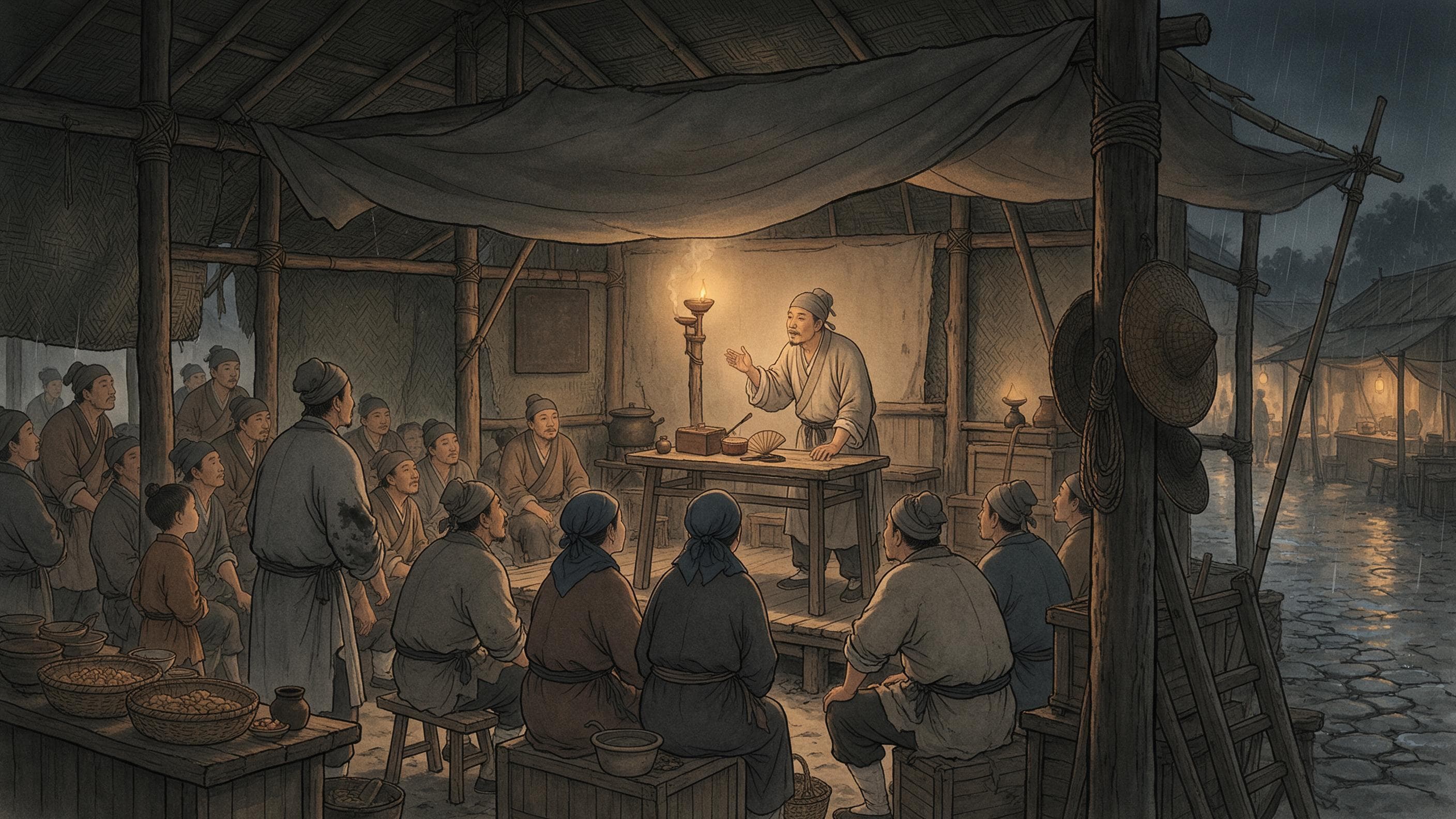
Rain was falling on the mat roofs, and nobody underneath got up to leave. Kaifeng's washe (瓦舍), the entertainment wards of the Northern Song capital, held more than one such shed: storytellers, shadow puppeteers, comic talkers, riddle-mongers, each with a pitch of their own, open day after day. Meng Yuanlao, writing up the old capital after it fell, listed the performers one by one, act by act, and then closed the list with a single sentence that is not about any one of them.
不以風雨寒暑,諸棚看人,日日如是。 — In wind and rain, in cold and heat alike, the crowds at the sheds were the same, every day.
The weight sits on riri rushi (日日如是), "every day like this". Not a festival, not a temple fair: an ordinary day. The chapter it closes is headed Jingwa jiyi (京瓦伎藝), "the arts of the capital's wa"; the wa is the entertainment quarter, the jiyi the skills sold in it. What the chapter hands over is a bill of names. How a shed was built, how many it held, how long a session ran — none of that is in it.
One bill of names
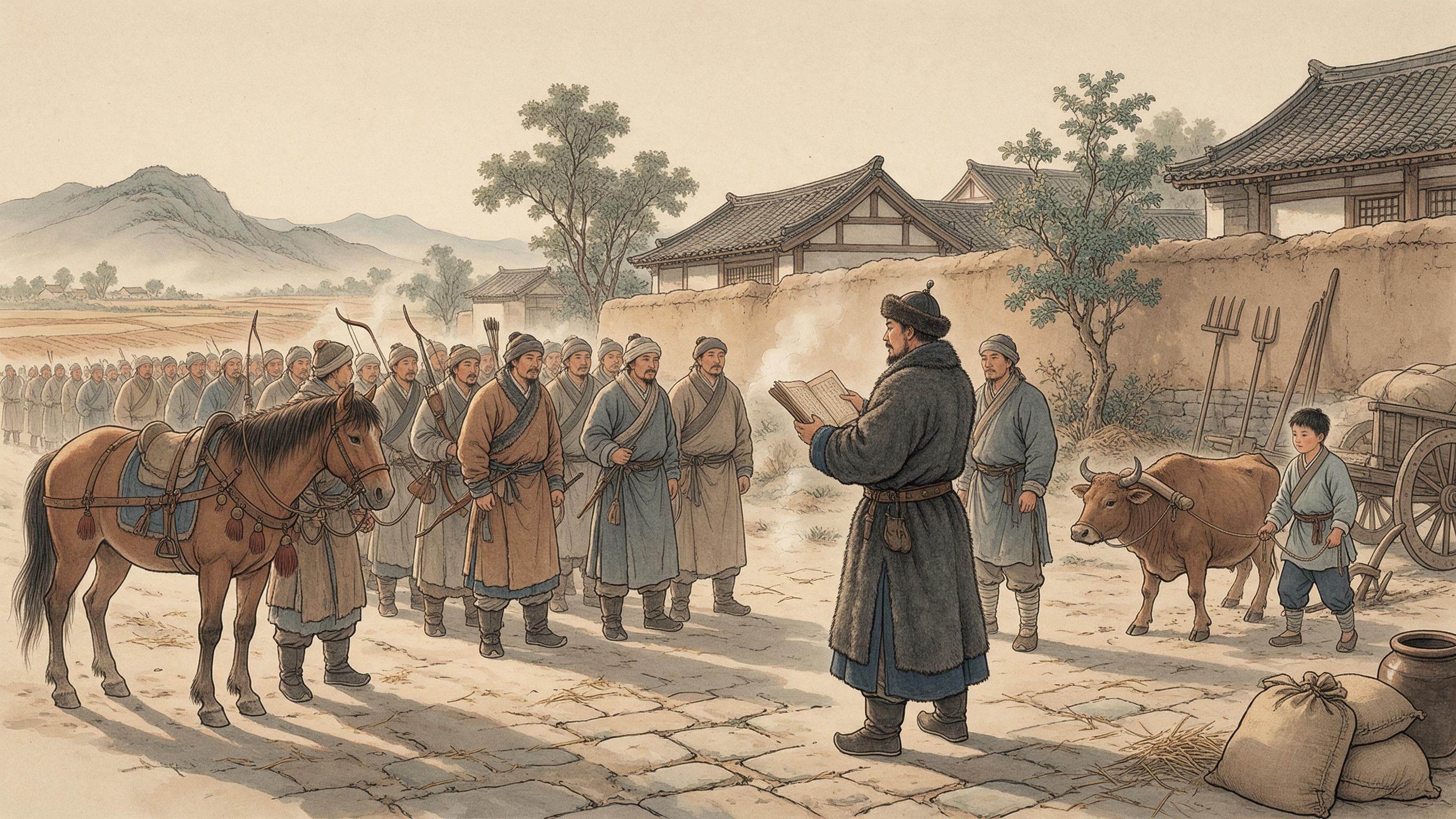
The list runs down by act, a string of names under each. Where it reaches the historians, it gives two lines and nothing else: one man, one title.
霍四究,說《三分》。尹常賣,《五代史》。 — Huo Sijiu told San Fen; Yin Changmai told the History of the Five Dynasties.
San Fen, "Three Parts", is the story later known as the Three Kingdoms; the Five Dynasties are the five short regimes that followed the Tang. The titles give the subject, not the text. Not one word of what these men actually said survives here, and whether any Song storyteller's prompt-book has come down to us is a separate and long-argued question, which this article will not settle. What can be said is that the two titles worked as a repertory: a name hung out at the front, so a listener knew what he was buying.
Four houses, four gates
Some hundred and thirty years later, writing in Hangzhou, Wu Zimu described the trade more sharply. Storytelling, he says, was also called shebian (舌辯), "the tongue's argument", and it had four houses, each with a gate of its own.
說話者謂之『舌辯』,雖有四家數,各有門庭。 — Those who tell stories are called shebian; though there are four houses, each has its own gate.
The four are fiction (xiaoshuo, 小說), expounding the scriptures (tanjing, 談經), shuocanqing (說參請), and history (jiangshi, 講史). Fiction took the affairs of men and spirits; tanjing was "the expounding of Buddhist books"; shuocanqing had masters and guests discussing the way; history took the chronicles of the dynasties. The same passage then slips in one more man, Dai Xin'an, who told hunjing, "joking sutras" — outside the four. The four houses were an insider's phrase, not a tidy table, and how exactly they divided is still disputed. This article lists them as the text does and goes no further.
The silver-lettered men
Fiction had a second name, and the name came with a long tail of subjects.
小說名『銀字兒』,如煙粉、靈怪、傳奇、公案樸刀桿棒發發蹤參之事。 — Fiction is called the "silver-lettered" kind: tales of powder and smoke, prodigies, marvels, cases at law, broadsword and staff, and the matter of fafazongcan.
Yinzi'er (銀字兒), "silver letters", is the trade name of the fiction house. What follows is a run of subjects: yanfen (煙粉), tales of men and women; lingguai (靈怪), prodigies and spirits; chuanqi (傳奇), marvels; gong'an (公案), cases; pudao and ganbang (朴刀、桿棒), the broadsword and the staff. The last four characters, fafazongcan (發發蹤參), are not clear and are given here as the page has them. A list that fine-grained suggests listeners who chose. Even inside one house there were doors.
And the fiction men were the ones the others feared. The passage ends with a sentence that is close to an admission:
但最畏小說人,蓋小說者,能講一朝一代故事,頃刻間捏合。 — But they feared the fiction men most, because a fiction man can tell the story of a dynasty, pieced together in a moment.
Qingke jian niehe (頃刻間捏合), "pieced together in the space of a moment", is where the two crafts part. The historian's capital is memory: dynasties, men, risings and falls, battles — one slip exposes him. The fiction man's capital is assembly: he builds it as he goes and closes the story inside the session. Wu Zimu adds that this was like the drinking game of qiling suiling (起令隨令), each man taking a topic in turn. One sells learning, the other sells nerve.
History: three books and a palace man
History's brief is stated with unusual clarity, down to the source book.
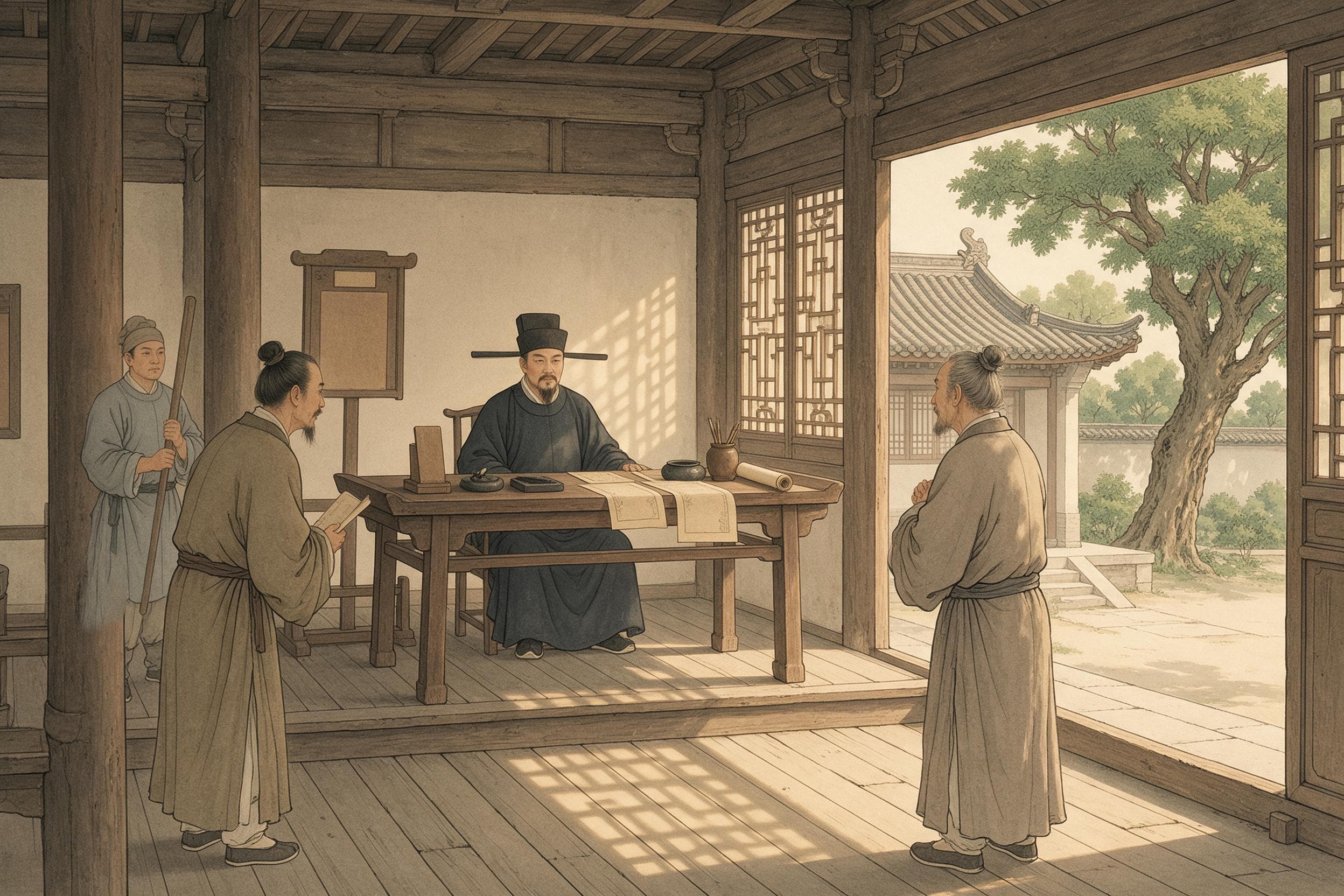
講史書者,謂講說《通鑑》、漢、唐歷代書史文傳,興廢爭戰之事。 — The history-tellers expound the Comprehensive Mirror and the histories and traditions of Han and Tang: the matter of rise and fall, of war.
The Tongjian is the Zizhi Tongjian, Sima Guang's chronicle for statesmen. A book written for men who governed had become a repertory text in an entertainment ward. Whether the teller followed it or went his own way, the entry does not say.
One name on the list comes with a career attached. Wang Liu daifu had been a yuqian gonghua (御前供話), a storyteller who performed before the throne. In the Xianchun era (1265–1274) he was expounding the Fuhua pian and the Biographies of the Restoration's Generals, and the entry says the listeners came in crowds: tingzhe fenfen (聽者紛紛). A palace performer had come down into the city and gone on working. The line is a small accidental record of how entertainers moved.
Neither book survives, and their contents can only be guessed from the titles (may have been): Fuhua, "restoring the flower", sounds like the recovery of the north; "generals of the restoration" sounds like the commanders of the first Southern Song generation. What such a programme felt like in the 1260s, with the dynasty entering its last decade, the entry does not say. It says only that the listeners came.
The list also says something easy to walk past. Among the historians are Zhang Xiaoniangzi and Song Xiaoniangzi; among the fiction men, Chen Langfu. By their names, three women. What they told, where they stood, whether they were billed like the men — the entry gives the names and nothing else.
After the last session
When the shed emptied, the accounting stopped. What a teller earned, who owned the pitch, whether a listener paid to sit, how long a session ran, how many the shed held — neither book says. Meng gives names; Wu gives houses. Money and seats are what they walk around.
What can be rebuilt is one plank of it: a shed, a man with a tongue, and a crowd that would not walk out into the rain. The names survive; "every day like this" survives; the rest is off the ledger. What Wang Liu told in his last year, which dynasties Zhang Xiaoniangzi took, where Huo Sijiu's San Fen stopped — those are the next questions.
Sources & further reading
- 孟元老《东京梦华录》卷五「京瓦伎艺」(Meng Yuanlao, Dongjing Meng Hua Lu, juan 5, "Arts of the Capital's Entertainment Wards") — The bill of performers, the two titles San Fen and Wudai Shi, and the line about full sheds in wind, rain, cold and heat.
- 吴自牧《梦粱录》卷二十「小说讲经史」(Wu Zimu, Meng Liang Lu, juan 20, "Fiction, Scripture-Telling and History") — The four houses, the subjects of fiction, the historians' brief, Wang Liu daifu's career, and the historians' fear of the fiction men.