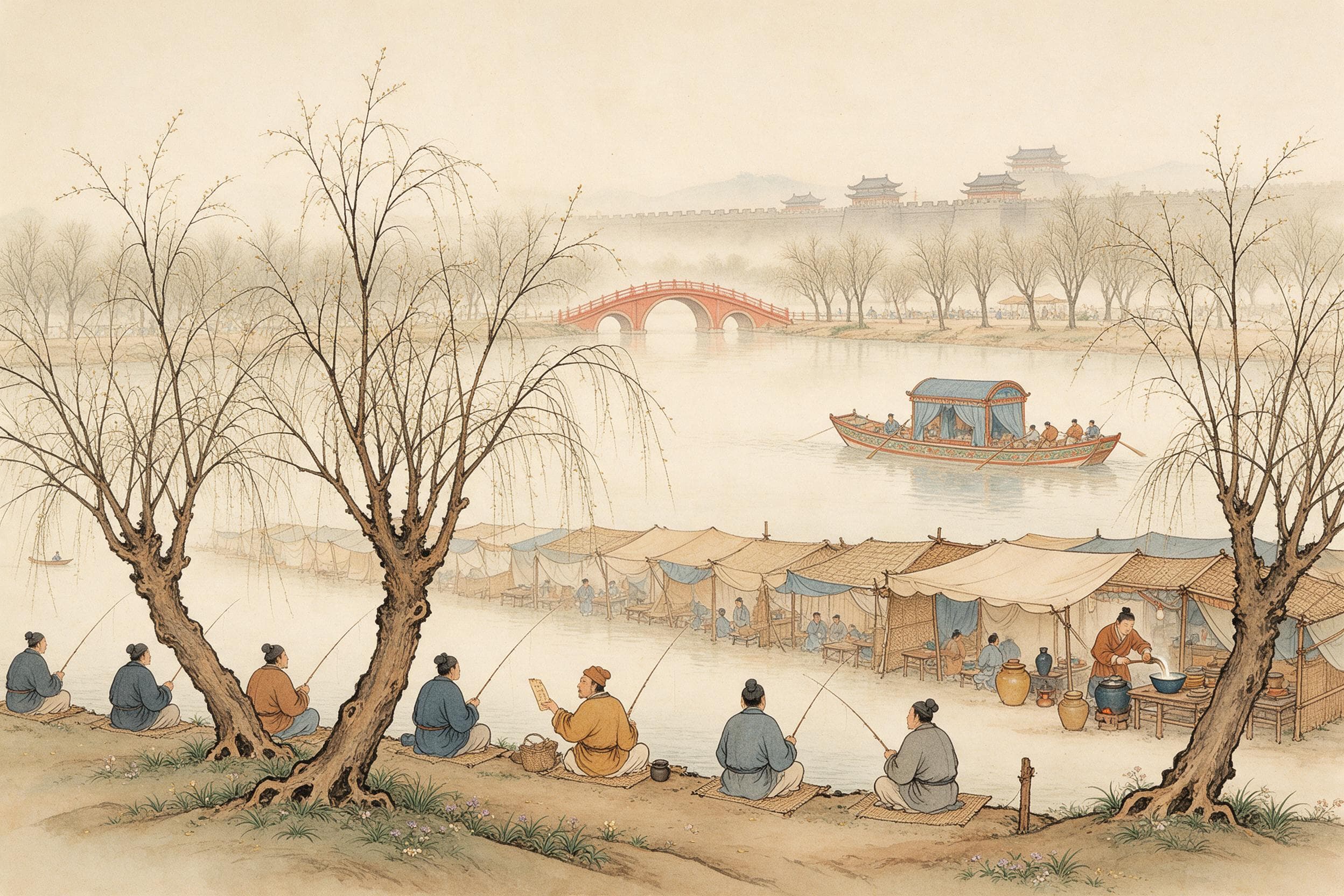
On the first day of the third month the gates of the Jinming Pool open outside the Shuntian Gate. Under the willows on the west bank sits a row of anglers. Before anyone may cast he must buy a wooden tag from the pool office; without a tag, no fishing. A fish that comes up is sold on the spot to visitors at double the going price and sliced into raw fish salad by the water, to go with wine. Who takes the difference the text does not say.
1. After the Lanterns, the City Empties
More than a month before the pool opens the city has made its first run out of the gates. The lanterns are hardly down before people race out to look for spring: the Jade Ford Garden and the Jade Immortal Abbey south of the city, the Happy Forest east, and west past the Shuntian Gate the whole Jinming complex. Meng Yuanlao lists them, then adds up his total:
大抵都城左近,皆是園圃,百里之內,並無閑地。 — Around the capital, in short, everything was garden; within a hundred li there was no idle ground.
"No idle ground" is not a remark about flowers. It is a remark about land, all of it spoken for. Some belonged to the state, some carried a grand marshal's or an imperial son-in-law's name, and one is recorded plainly as open to spring visitors (放人春賞). In spring they all become places a person may walk into and sit down in.
四野如市,往往就芳樹之下,或園囿之間,羅列杯盤,互相勸酬。 — The open country was like a market; people spread cups and dishes under the flowering trees or among the gardens and pressed food and drink on one another.
That is Qingming, the spring grave-sweeping festival. Officials and commoners jam every gate, and paper-offering shops stack paper into towers in the street. Nobody comes home empty-handed: steamed buns, clay figurines, toy swords, rare flowers, paper pavilions, duck eggs and chicken feed, all under one name, "the soil beyond the gate". Half food, half play; the name says as much.
2. The First of the Third Month
The pool lies north of the street outside the Shuntian Gate, about nine li and thirty paces around. A hundred paces in along the south bank stands the Waterside Hall, facing north; a few hundred paces west, the Immortal Bridge, three arches of red-lacquered railing with a humped centre called Camel Rainbow. At its far end five halls sit in the middle of the water.
三月一日,州西順天門外開金明池瓊林苑,每日教習車駕上池儀範。雖禁從士庶許縱賞,御史臺有榜不得彈劾。 — On the first of the third month the Jinming Pool and Qionglin Park opened outside the Shuntian Gate, and daily the imperial party rehearsed the forms for going out on the water. Guards and commoners alike were let in, and the Censorate posted a notice that no impeachment would follow.
That last clause is worth stopping over. The Censorate policed the conduct of officials, and in ordinary times an officer who spent his days at banquets could expect a memorial against him. For the season of the pool it posted a notice saying there would be none. The text never explains it; a temporary licence for the whole bureaucracy is the likeliest reading (may have been).
The pool stayed open until the eighth of the fourth month. Thirty-nine days.
自三月一日至四月八日閉池,雖風雨亦有遊人,略無虛日矣。 — From the first of the third month to the closing on the eighth of the fourth, rain or wind, there were visitors; scarcely a day was empty.
3. Ground Rented by the Season
The best place to watch was not the bridge but the bank. Under the weeping willows the awnings stood in a line:
臨水近墻皆垂楊,兩邊皆彩棚幕次,臨水假賃,觀看爭標。 — Along the water, against the wall, all was weeping willow; on both sides stood painted awnings and tented booths, rented out at the water's edge for watching the boat race.
Rented is the word. Watching the race for the flag required a place, and places were let by the season.
The street behind it was sorted by trade:
街東皆酒食店舍,博易場戶,藝人勾肆,質庫,不以幾日解下,只至閉池,便典沒出賣。 — East of the street stood wine shops and food shops, exchange stalls, the enclosures of entertainers, and pawnshops, which redeemed goods on any number of days but only until the pool closed; then the pledges were sold.
The pawnshop term is tied to the pool's calendar: no fixed number of days, but never past closing day, after which the pledge is dead and goes on sale. The cash flow of a whole street is pinned to the eighth of the fourth month. What people pawned, and why, the text does not record; paying for a spring outing is one guess.
Then came the gambling, guanpu (關撲), where coins were thrown and goods staked, winnings settled at valuation. Inside the pool grounds men staked one tablet and played for thirty; horses and carriages, land and houses, singing girls and dancers were all staked "at an agreed price". What a tablet was worth the text never says (uncertain).
Food at the pool had a list of its own: watered rice, cold green-bean soup, snail meat, plum-blossom wine, dried pear and apricot slices, plums, spiced crisp plums, fish sliced to order, black carp, salted duck eggs, mixed pickles. A dozen items, nearly all cold or cut on the spot; there was probably no stove on that bank (may have been).
4. Boats Priced by Size
宣、政間亦有假賃大小船子,許士庶遊賞,其價有差。 — In the Xuanhe and Zhenghe years boats large and small were also let out, officials and commoners alike were allowed on the water, and the prices differed.
The only sentence in the whole account that mentions boat prices, and it gives no figures. All it yields is four characters: the prices differed. Boats came in sizes and the tariff in grades, from the Xuanhe and Zhenghe reigns; who used the pool boats before that the text does not say. Wealthy households took another route: black-lacquered flat boats with purple curtains, their own musicians aboard, nothing rented.
承平時,頭船如大綠、間綠、十樣錦、百花、寶勝、明玉之類,何翅百餘。 — In the peaceful years the head boats, names like Big Green, Split Green, Ten Brocades, Hundred Flowers, Precious Victory and Bright Jade, numbered far more than a hundred.
Six are named here and all six are boats; the rest were past counting. A boat with a name is a boat with a signboard, and only a signboard gets you a price.
5. Garden Gates Opened
Beyond the pool the gardens opened too. North of the Lin'an wall, beside the residence of the eunuch Commissioner Jiang, stood the finest garden in the city, and every spring it let people in:
每歲春月,放人遊玩,堂宇內頓放買賣關撲、並體內庭規式,如龍船、鬧竿、花籃、花工,用七寶珠翠,奇巧裝結,花朵冠梳,並皆時樣。 — Every spring it was opened for people to stroll, and inside the halls goods and gambling were set out after the palace manner: dragon boats, festival poles and flower baskets built up in seven-treasure kingfisher ornaments, combs in the current fashion.
What filled the halls was not flowers but trade and staking, in a setting that aped the inner court. The garden even built a stretch of village scenery, a Peach Village with an Apricot Inn and a wine flag hung out, on a few mu of ground, and the onlookers were like a market. City people paid to look at countryside manufactured for them.
State gardens worked the same way. Qionglin Park was, in the text's words, mostly occupied by wine houses, and so was the Toad Pavilion. The garden was the state's; the trade was the wine seller's.
Which is how Hangzhou got its proverb. On the West Lake sightseeing and selling were forbidden to nobody: fruit and vegetables, soups and wine, gambling, playthings, festival poles, painted fans, sugar fish, cut flowers, clay babies, all under one name, "the lake's local goods". Musicians, comic actors, sleight-of-hand men, pot-throwers, ball players, water puppeteers and kite flyers were all "the crowd-chasers". At the end of a day:
日糜金錢,靡有紀極。故杭諺有「銷金鍋兒」之號,此語不為過也。 — Money was melted away daily without limit, and so Hangzhou had the name "the melting pot of gold"; the phrase was no exaggeration.
A pot of gold: money dropped in and dissolved. Not an insult but a set of accounts. On one side the rented lengths of bank, the fish sold back, the tablets staked, the dishes carried into a garden; on the other, thirty-nine days of pool and one street's pawn tickets.
On the eighth of the fourth month the gates shut. The pawnshop terms fall due the same day, and what was not redeemed goes out on the counter. That was the year's spring outing, settled.
Sources & further reading
- 孟元老《東京夢華錄》卷六「收燈都人出城探春」(Meng Yuanlao, Dongjing Meng Hua Lu, juan 6, 'The Lamps Are Put Away and the City Goes Out to Find Spring') — The rush out of the gates after the lanterns are taken down, the roll of gardens south, east and west of the city, and the line that within a hundred li there was no idle ground.
- 孟元老《東京夢華錄》卷七「三月一日開金明池瓊林苑」(Meng Yuanlao, Dongjing Meng Hua Lu, juan 7, 'On the First of the Third Month the Jinming Pool and Qionglin Park Open') — The opening day, the censorate notice, the measured circuit of the pool, rented waterside booths, the pawnshops on the east street, the fishing tags and the graded boat rents.
- 周密《武林舊事》卷三「西湖游幸」(Zhou Mi, Wulin Jiushi, juan 3, 'Excursions on the West Lake') — Trade on the lake forbidden to no one, the list of lake goods and of the 'chasing-the-crowd' trades, the named head boats, and the Hangzhou saying about the melting pot of gold.
- 吳自牧《夢粱錄》卷十九「園囿」(Wu Zimu, Mengliang Lu, juan 19, 'Gardens') — The eunuch's garden opened to the public every spring, with goods and gambling laid out inside its halls and a fake village built on a few mu of ground.