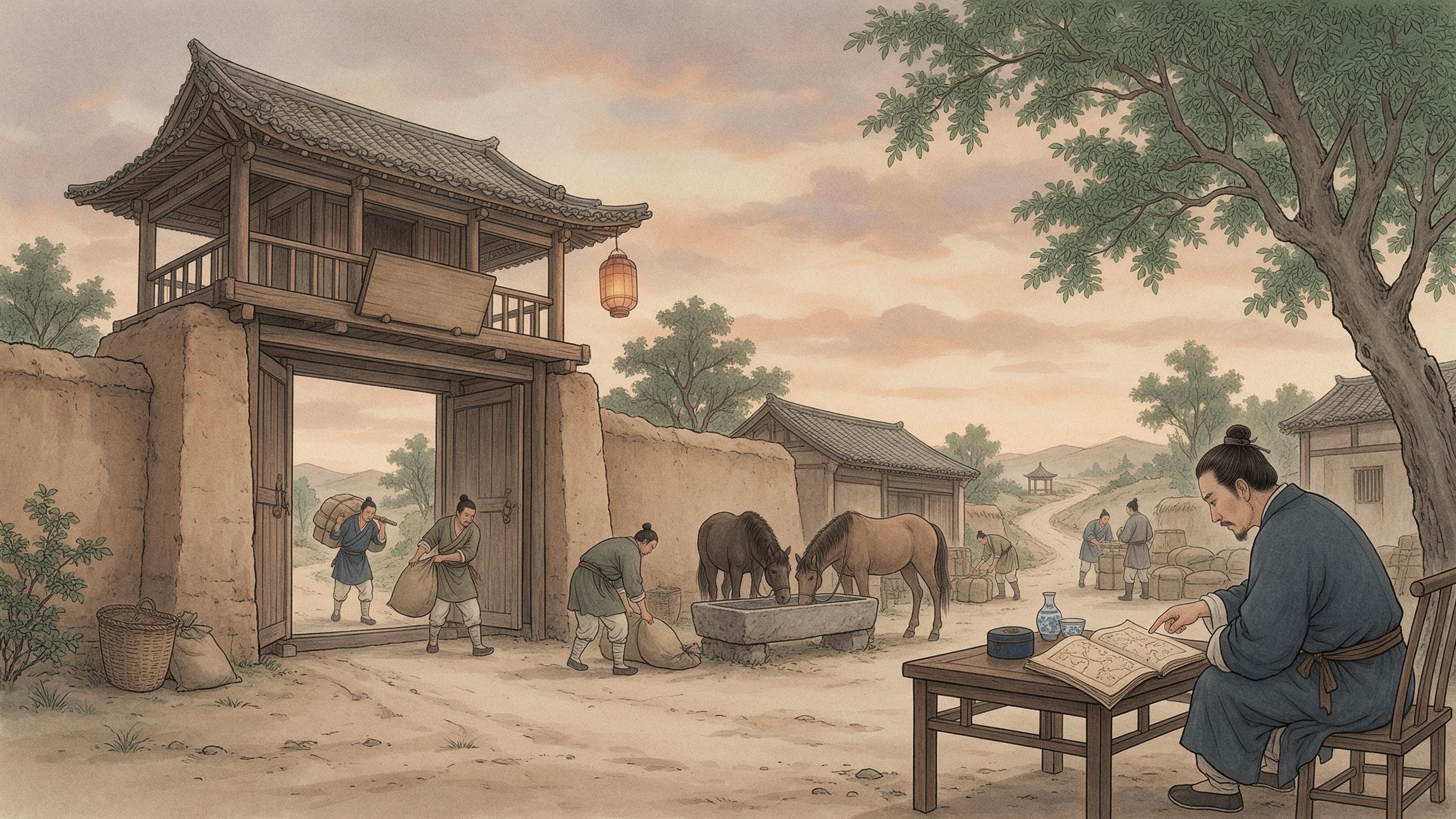
Before dawn by the Zhou Bridge in Kaifeng, the wine shops were already burning lamps. A portion of wine with rice and a snack cost “no more than twenty wen” — the price is recorded in juan 3 of the Dongjing Meng Hua Lu, in the entry on the crowds coming to market at first light. You count out twenty coins. But within the same day, the same string of coins behaves differently at the fish stall, at the goldsmith's, and at the broker's yard where a maidservant is hired. Each trade quoted by its own rule. How much was shaved off is set out in a single line of the same juan, under the heading “Urban Money-Strings”: officials used seventy-seven; the street in general, seventy-five; fish, meat and vegetables, seventy-two; gold and silver, seventy-four; pearls, the hiring of maidservants and the buying of insects, sixty-eight; writing, fifty-six. “Each trade has its own short and long usage.”
A string is a hundred wen on paper
Three units have to be kept apart. A wen (文) is one coin. A guan (貫), nominally a thousand wen, is the large unit of account. A mo (陌) is a hundred wen on the ledger. Duanmo (短陌), “short string”, means that this hundred is not paid in full: at seventy-seven mo, a hundred is written down and seventy-seven coins are handed over. Multiply up, and a guan of account comes to 770 coins. That is the whole answer to why a string of a thousand was counted as 770. It is not rounding, and it is not a discount haggled at the counter; it is an accepted conversion rate. The government collected tax and paid out of its warehouses at the official rate, and the market traded at the street rate. The rate was public, which is the part that matters.
The Song Shi gives the figure a history, and the history is one number being cut. In the Tianyou era of the Tang, with war and empty coffers, a hundred was reckoned at eighty-five coins. Under the Later Tang it was cut by five, under the Later Han by three more. Early Song taxpayers still paid eighty or eighty-five to the hundred, while “the various prefectures in private use followed their own customs, some reckoning a hundred at forty-eight coins”. Then an edict fixed the empire at seventy-seven coins to the hundred. The number was not a market outcome; it was a decree. The same juan, discussing Fujian's iron coinage, says a thousand iron coins were reckoned equal to 770 copper ones — the same ratio, carried over to another metal.
Six rates on one street
The entry gives six numbers and no explanation. What can be said is that they map onto six kinds of transaction, and that all of them are stated on the same footing, as so many coins to the hundred. Reduced to the guan:
- Official, 77: tax, salaries and warehouse accounts; a guan of account is 770 coins.
- General street, 75: everyday retail; a guan is 750 coins.
- Fish, meat and vegetables, 72: the wet market; a guan is 720 coins.
- Gold and silver, 74: bullion and jewellery; a guan is 740 coins.
- Pearls, hiring a maidservant, buying insects, 68: a guan is 680 coins.
- Writing, 56: scribes, documents, ghost-writing; a guan is 560 coins.
The order carries information even without a commentary. The closer a transaction sits to the state's own business, the longer the string; the closer it sits to petty service and to persons, the shorter. That hiring a maidservant and buying insects share a line is jarring now. The text offers only the juxtaposition and no reason, and it should be quoted as it stands: in that ledger, a girl's labour and a batch of insects were the same kind of purchase. Why writing was shortest of all may have to do with the small, piecework nature of scribal service — but that is inference. The Song left no explanation.
Two sets of books
Short strings are easily mistaken for fraud because the same coins are counted under two systems at once. On the government side the mo is a tax rule: pay seventy-seven and be credited with a hundred, and the difference accrues to the treasury — a surcharge that never appears in the stated rate. On the market side the mo is a quotation unit: when a shopkeeper says “twenty wen” he means twenty on the ledger, settled at his trade's rate, and both parties know it. Trouble came at the boundary — paying tax with street-rate coins, or buying vegetables with an official-rate string.
This is why the passage sits in juan 3 among lanes and shops, beside the physicians' row and the carters, rather than in a treatise on coinage. It is not monetary theory; it is a piece of city common sense. A few lines earlier the same juan prices a wine cask: “each cask holds about three dou, one guan and five hundred wen.” The entry does not say whether that sum is the cask, the wine, or the cartage, nor at which mo it was settled. A price with two blanks in it is evidence that the conversion was too obvious to write down.
The string gets shorter
In Southern Song Lin'an the curve runs to its end. The Meng Liang Lu, juan 13, in the entry “Urban Coins and Paper”: “Originally the capital's money-string was reckoned at seventy-seven mo; recently the market has cut it to fifty mo for general use.” The official seventy-seven still stood on paper; the street had moved to fifty. The same passage adds that after the gold-and-silver certificates were issued, “in every trade and every market goods rose in price and the money-string shrank” — inflation and the shrinking unit recorded as one event. Lin'an, short of copper, also cast tin-lead tokens to keep small payments moving.
From 77 in the Northern Song to 50 at the end of the Southern Song, what changed was not the weight of the coin but the meaning of the sentence “a hundred wen”. No edict announced a devaluation. The rate drifted, and by the time a guan was worth five hundred coins it was too late to argue.
What the ledger leaves out
The conversion rates, the edict and a handful of prices can be documented. The rest cannot, and should be labelled. Why fresh food was shorter than bullion, why writing was shortest of all, why a maidservant ranked with insects — the Song left no explanation, and later guesses about the cost of carrying strings, about small-change habits and about each trade's bargaining power remain guesses. Nor do these books offer a systematic price or wage series. Converting a guan into modern money would be arithmetic on sand, and is not attempted here.
What is left is a plain discovery: the value of money lies partly in the weight of the metal and partly in how a sentence is counted. When a Kaifeng resident said “one mo” he did not mean a hundred coins. He meant a hundred wen on the ledger. Who absorbed the twenty-three coins missing from each hundred is written into the order of those six numbers.
Sources & further reading
- 孟元老《东京梦华录》卷三「都市钱陌」(Meng Yuanlao, Dongjing Meng Hua Lu, juan 3, “Urban Money-Strings”) — The six conversion rates in one line, ending with the admission that each trade used its own; the same juan supplies the price data and the wine-cask price.
- 吴自牧《梦粱录》卷十三「都市钱会」(Wu Zimu, Meng Liang Lu, juan 13, “Urban Coins and Paper”) — The Southern Song drift from seventy-seven to fifty per hundred, the tin-lead tokens, the paper notes, and the link between note issue and the shrinking string.
- 脱脱等《宋史》卷一百八十《食货志下二·钱币》(Tuotuo et al., Song Shi, juan 180, “Treatise on Finance II: Coinage”) — The fiscal history of the rate: 85 to the hundred under the Tang, cut to 80, then 77, the Song edict fixing 77, and the iron-coin equivalence of a thousand to 770.