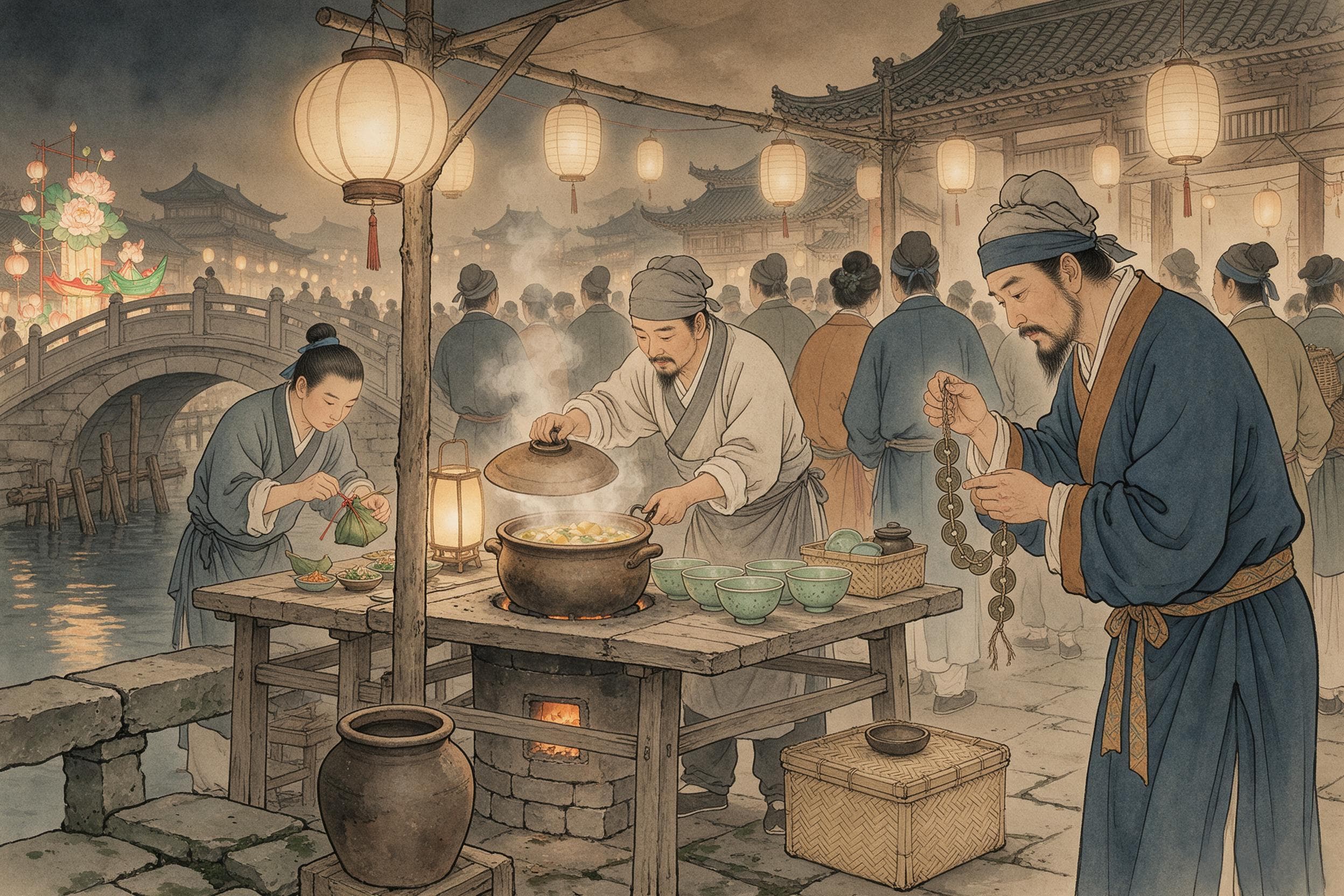
On the sixteenth night of the first month, in the last years of the Northern Song, the road from Kaifeng's northern gate to the Daoist palace of Baolu was lined with food stalls. An imperial viewing box stood behind a fence of thorns. The stalls, in Meng Yuanlao's account, were lit “as bright as day” and kept ready “for the emperor's summons.” Then, at the end of the description, comes a price: the gourd soup of a vendor remembered as Zhou Daizhao, the leftover of the tribute supply, at one hundred and twenty full coins a portion, while the market shops sold theirs for ten.
The soup under the imperial window
The sentence is short: “Only Zhou Daizhao's gourd soup, the tribute leftover, at one hundred and twenty full coins apiece; its coarse and fine grades really do differ from the ten-coin sort in the market shops.” Four things are packed into it. 貢餘, “tribute leftover,” marks the soup as the residue of a supply destined for the palace. 文足, “full coins,” means the count was not shortened, as cash strings often were in ordinary trade. 粗細果別 says the grades genuinely differed. And the comparison is with “the ten-coin sort,” not with an identical bowl. The passage does not say that the same soup cost twelve times as much. It says the two bowls belonged to different grades.
One distinction matters. The text says the stalls were kept ready “for the emperor's summons”; it does not say the emperor ate Zhou's soup. The viewing box was close by, and a tribute connection is implied by the word 貢餘, but how close the connection ran is not recorded. The 120 coins may have paid for grade, for a name, or for the distance to that ring of thorns.
Li He and the lotus leaf
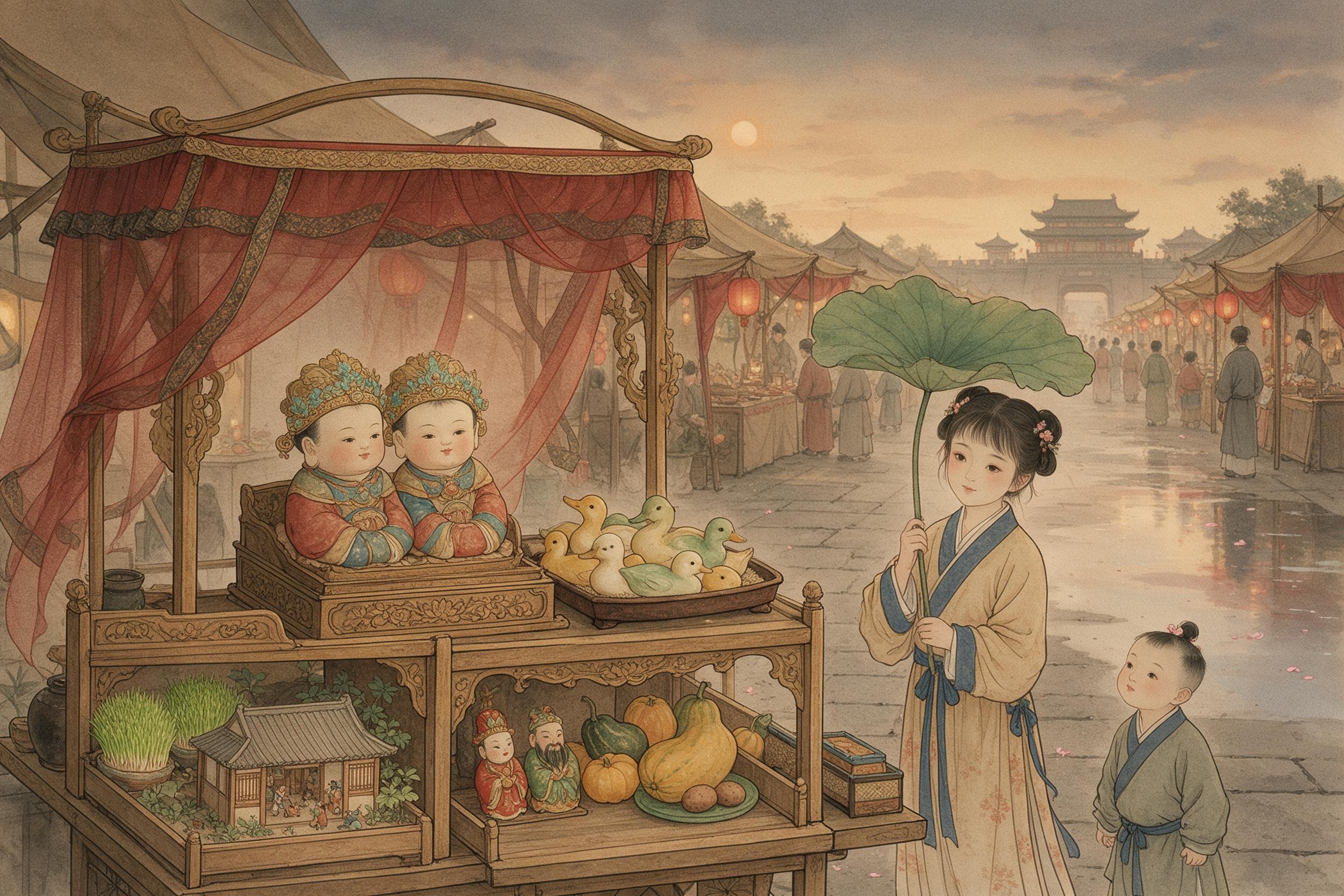
Decades later, remembering the beginning of autumn in Kaifeng, Meng Yuanlao wrote down another name: “When fox nuts come to market, Li He's house inside Liang Gate does the biggest trade. Palace favourites and imperial relatives send for them; casual orders from the palace keep gold boxes coming and going. Commoners buy them at ten coins a wrap, packed in a small fresh lotus leaf, dusted with musk, tied with a red cord. There are many sellers, but none matches Li He's single grade of silver-skinned tender ones.”
Fox nuts — jitou, “chicken head,” the seed of the aquatic plant Euryale ferox — were a seasonal delicacy of early autumn. Li He's shop had the palace trade and the court's casual orders, and it sold to ordinary customers at ten coins a wrap. The detail that matters is the last clause: many sellers, but none matched his uniform selection of silver-skinned tender seeds. 一色 means one grade, all of a piece; 揀 means selected. This is a claim about sorting, not about volume. The luxury sits in the selection and the wrapping — fresh lotus leaf, a pinch of musk, a red cord — rather than in a different plant.
The shops with silver
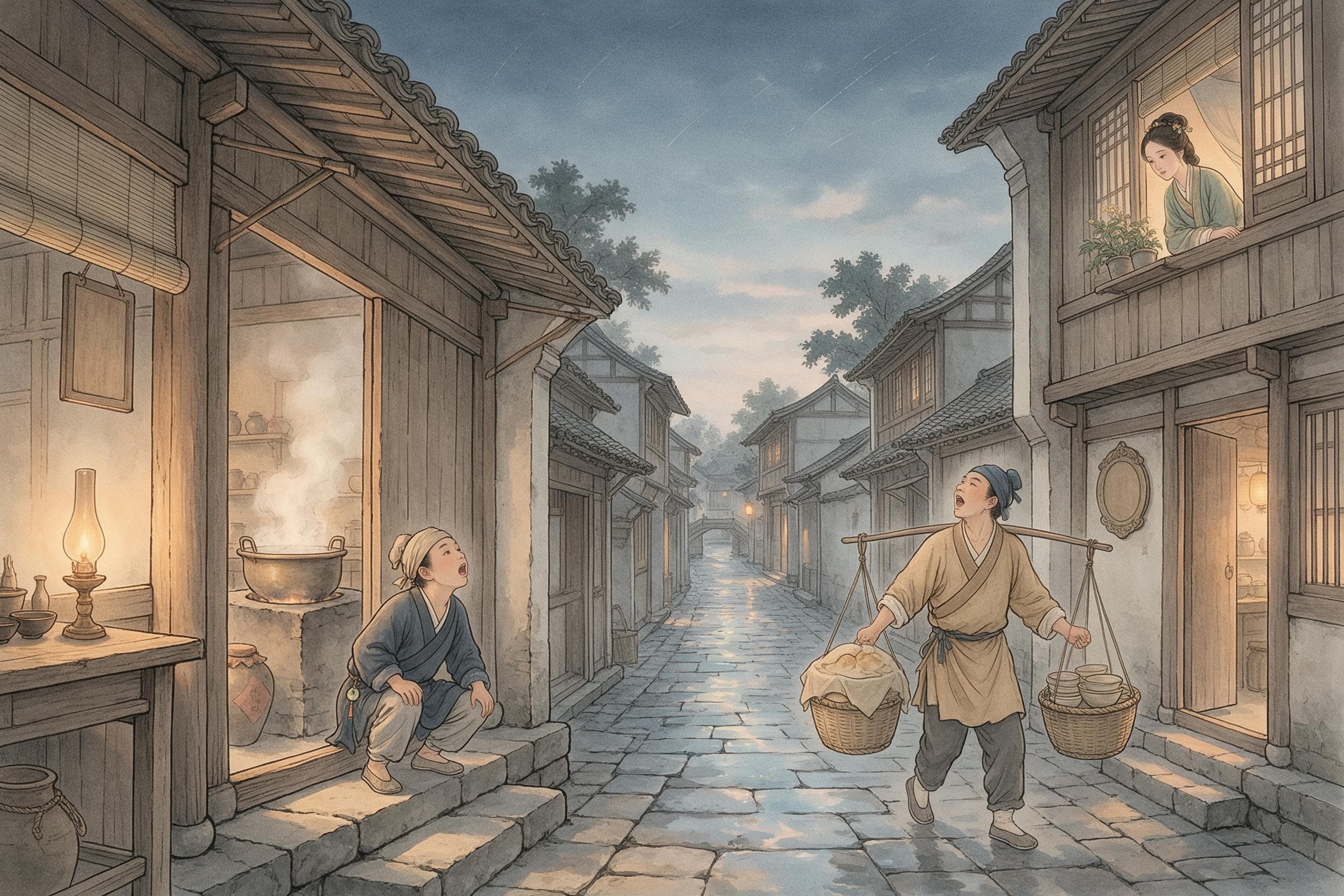
In the same chapter's list of high-summer street food, sold under blue cloth umbrellas on beds and benches set out in the road, one sentence stands apart: “For ice, only the two shops outside the old Song Gate did the biggest trade; every vessel they used was silver.”
Silver does not make ice colder. What it does is tell a customer, before he tastes anything, that this is a house with capital to tie up in metal and hand to a boy to carry through a crowd. The text records the fact and leaves the reason alone; to call the vessels a statement of rank is inference. It is worth noticing that the sentence sits among cheap summer snacks, and that these two shops are singled out for their dishes rather than their prices.
The fish soup that made an old woman rich
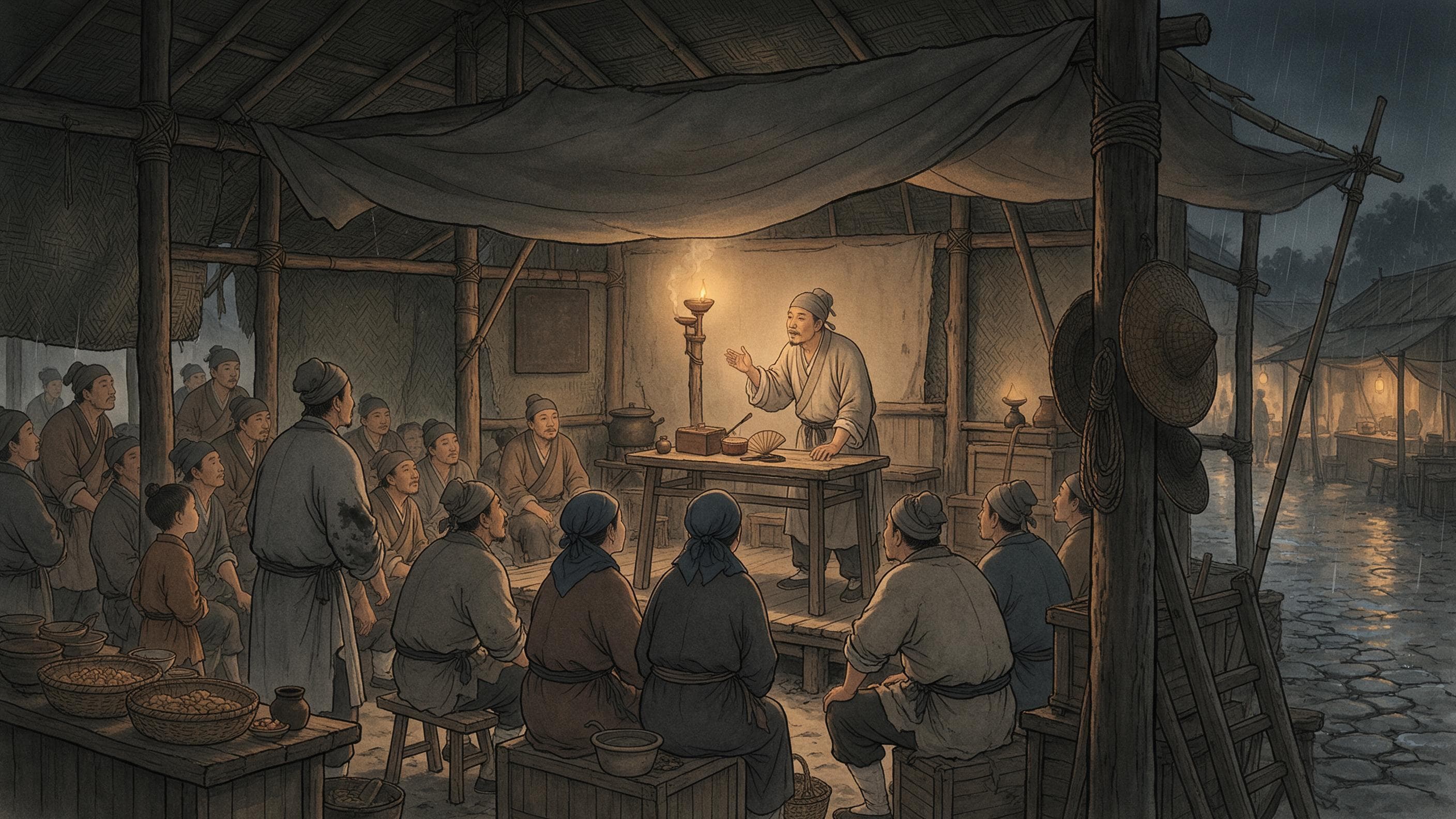
In the 1170s and 1180s, the retired emperor Gaozong lived at the Deshou Palace, and Emperor Xiaozong took him boating on West Lake. Painted barges crowded the water; small boats sold what Zhou Mi calls the lake's local produce — fruit, soups and wine, toys, flower baskets. “Small boats were sometimes summoned to the imperial barge and given gifts.” Then comes the sentence: “Such was Song Wusao's fish soup: once it had been tasted by the emperor, everyone rushed to it, and she became a rich old woman.”
Zhou Mi adds a poem by Zhu Jingjia: “The white-haired angler beneath the willow — no one knows in what year he was born. The last time the king went touring, selling fish he collected coins.” The poem is a gloss on the whole class of lake vendors: one pass of the imperial boat, and a small trade changes its fortunes.
The story needs discounting. Zhou Mi wrote after the Song had fallen, recalling events decades old, and the tale has the shape of an anecdote. “Summoned and given gifts” also suggests that imperial favour may have arrived as presents as much as purchases. How much she sold, what she charged, how many customers came — none of it is recorded. The four characters 遂成富媼, “and so she became a rich old woman,” are nevertheless the most direct statement in these sources that reputation turned into money.
Names, not brands
Three vendors, three mechanisms. Zhou Daizhao had the tribute grade and a position beside the imperial stand. Li He had selection, packaging and palace orders. Song Wusao had one imperial taste, and then the crowd. In each case the guarantee is a person: a title, a household, a woman known by her rank in the family. None of the three is a shop sign in the modern sense. What a customer recognised was the name attached to the goods, and what the name promised was a standard.
Modern readers reach for the word branding. The sources will not carry it. There is no advertising copy, no trademark, no sales figure, no margin. “Biggest trade” is the author's ranking, not a number. The 120-coin and ten-coin bowls are not the same product, so the gap cannot be read as a markup. What the texts support is reputation: a name that told a customer what to expect, and a price that told him which tier he was buying.
The 120-coin bowl and the ten-coin bowl were never the same soup. One was tribute leftover, sold where the emperor might look; the other was ordinary market stock. How much of the difference a customer paid for the grade, how much for the name, and how much for the nearness of that fence of thorns, the source does not say.
Sources & further reading
- 孟元老《东京梦华录》卷六「十六日」(Meng Yuanlao, Dongjing Meng Hua Lu, juan 6, "The Sixteenth Night") — Zhou Daizhao's tribute-grade gourd soup at 120 full coins against the market shops' ten, sold beside the imperial viewing stand.
- 孟元老《东京梦华录》卷八「立秋」「是月巷陌杂卖」(Meng Yuanlao, Dongjing Meng Hua Lu, juan 8, "Beginning of Autumn" and "Street Sales in This Month") — Li He's fox nuts at ten coins a lotus-leaf wrap, and the two ice shops outside the old Song Gate whose vessels were all silver.
- 周密《武林旧事》卷三「西湖游幸」(Zhou Mi, Wulin Jiushi, juan 3, "Imperial Excursions on West Lake") — Song Wusao's fish soup, tasted by the emperor, crowded by everyone, and the poem that follows the story.