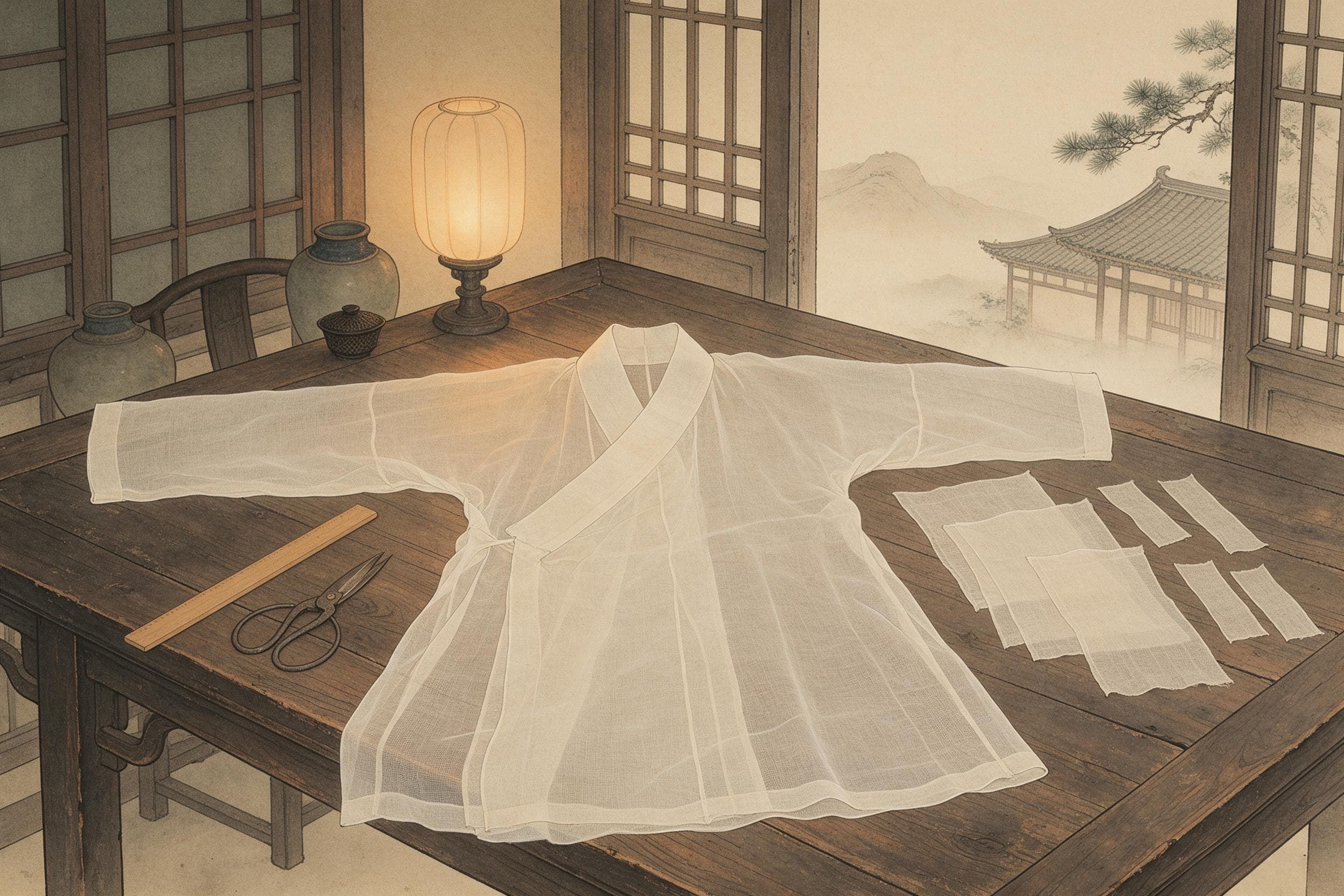
The first shadow puppets in Kaifeng were cut from plain paper. By the time the Song court had moved south and Lin'an took over the trade, the material had changed: figures were carved from sheepskin and coloured, because paper could not survive handling and leather could. The Meng Liang Lu records the shift in a single sentence. What it leaves behind is not a stage but a workshop. The change was not only material: the sheepskin figures were carved for shape and then coloured, so the puppet gained a painted face instead of a bare silhouette.
From paper to leather
The passage is precise: in the old capital the figures were first carved from plain paper; later, as the work grew finer, they were cut from sheepskin, coloured, and so "not easily damaged". In one sentence: a place (Kaifeng), a period (before the move south), a material and a technique. The Lin'an masters are named too — Jia Silang, Wang Sheng and Wang Runqing, who were "skilled at handling the figures and narrated standing up without a mistake". Working the puppets was one craft; narrating in performance was another, and a man needed both. The quarter's programme, recorded from the Chongning and Daguan eras (1102–1110), puts the shadow players on the same roster as the riddle sellers, the comic talkers and the street singers: one entertainment quarter, each act in its own booth.
The plays were not a separate literature. "Their scripts were much the same as the storytellers' of history, half true and half invented." The storytellers narrated the rise and fall of dynasties; the shadow play borrowed the same frame and mixed fact with invention. In Song China it was not an independent invention of narrative but a screen hung in front of a story bank the whole entertainment quarter already shared.
A face was an argument
The most striking rule is one of design: "the loyal and public-spirited were carved with upright features; the treacherous were cut with ugly shapes — praise and blame were lodged in the carving itself." A good minister got a straight face, a villain an ugly one. This is one of the rare places where a Song source states an intention outright: before the audience heard the story, the face told them who was who. It runs with the earlier note that the scripts were half true and half invented: the tale blurred fact, but the face was meant to be read instantly. How widely the rule was applied, the text does not say.
Four kinds of puppet
Between the two books, four kinds are named. Rod puppets (zhangtou kuilei, 杖頭傀儡): in Kaifeng the master Ren Xiaosan played "the first little comedy at the fifth watch — come late and you missed it"; in Lin'an the school of Liu Xiaopuye (劉小僕射) was famous for the opposite of realism, staging deities like the Giant Spirit (巨靈神) and Ji Daxian (姬大仙). String puppets (xiansi kuilei, 懸絲傀儡): the Kaifeng master was Zhang Jinxian; in Lin'an, a master Lu known as "Gold Thread" and Chen Zhongxi were said to handle figures "as if alive", with the wire-walkers even better. The Meng Liang Lu traces the art to a Han-dynasty stratagem story about Chen Ping, which is a tradition, not a record. Firework puppets (yaofa kuilei, 藥發傀儡): Li Waining is the name attached; the name suggests a pyrotechnic element, and the sources do not describe the mechanism. Water puppets (shui kuilei, 水傀儡): in Lin'an, Yao Yuxian, Sai Baoge, Wang Ji and Jin Shihao worked water spectacles in which fish and dragons "came to life"; again, how it was done is not recorded.
What the puppets performed is listed: tales of romance, the supernatural, armoured cavalry and criminal cases, and the histories of emperors, ministers and generals — "either as storytellers' history, or as comedy, or in the manner of yaci (崖詞)". Love, ghosts, war, crime and dynastic history all fitted on the same small stage.
The booth and the crowd
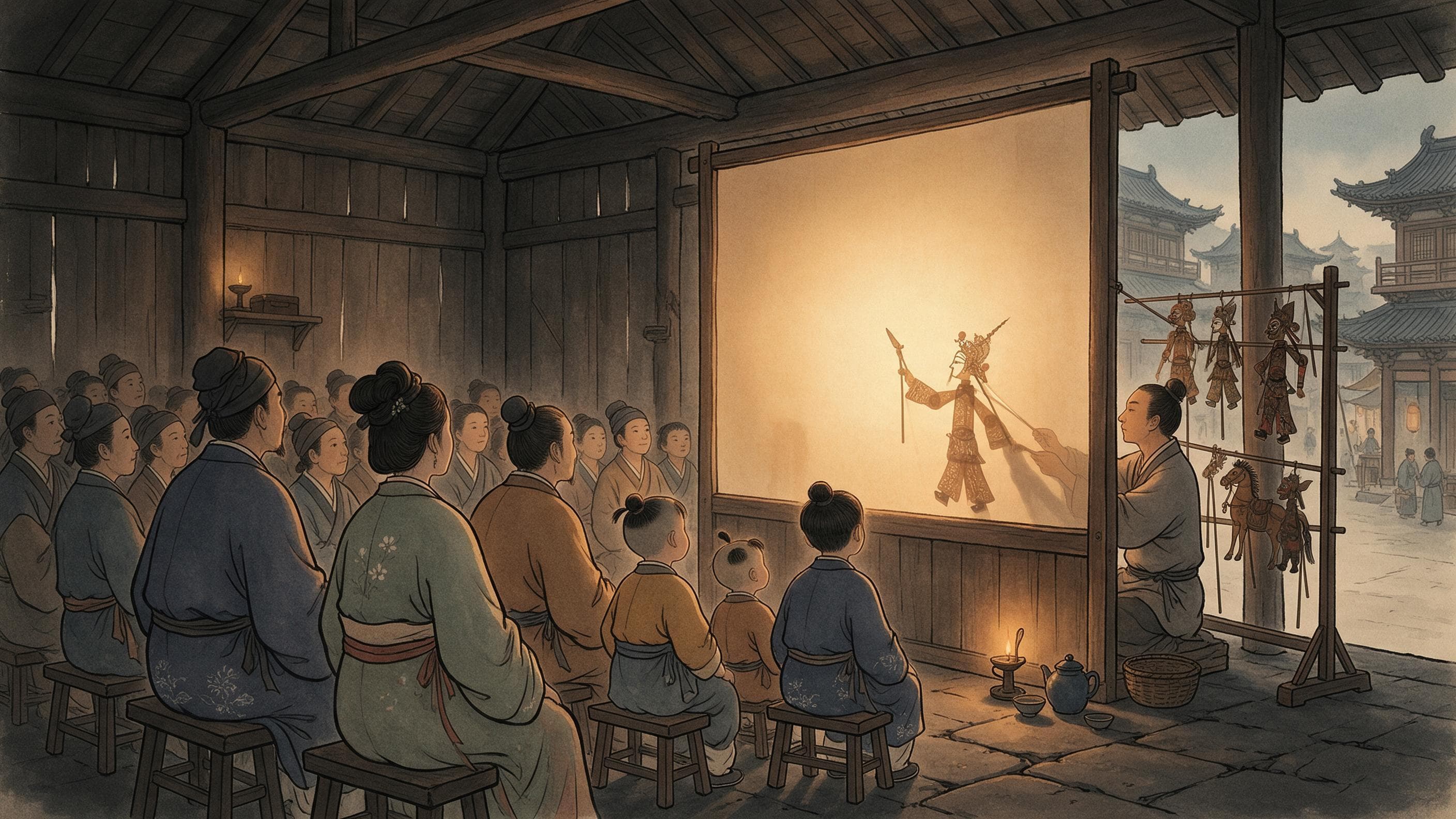
Kaifeng's register of performers keeps the shadow players' names: Dong Shiwu, Zhao Qi, Cao Baoyi, Zhu Po'er, Mei Kun Tuo, Feng Seng Ge and Zu Liujie, plus Ding Yi, Shou Ji and others who "worked comic shadow plays" (qiao yingxi, 喬影戲), where qiao implies parody or burlesque. The shows ran in the sheds of the entertainment quarter, and "whatever the wind, rain, cold or heat, the crowds in the sheds were there every day". The sheds were divided by act, and the shadow booth was one among them: the same audience moved on to the storytellers, the puppets and the comedy, buying a night's entertainment by the booth.
What is missing is just as clear. No Song shadow-play script survives — only the note that the scripts resembled the storytellers' and a few titles and names; no ticket price, no size for the booth, no description of how lamp and screen were set; and not one puppet. The figures were leather and paper, and they are gone. The scripts are the harder loss: the storytellers' texts from the Song survive only in later, altered recensions, so what a shadow play actually said cannot be recovered. What can be said is that it borrowed the storytellers' plots and people and performed them with its own figures.
A screen, a lamp, and figures moving between them: the arrangement looks familiar, though nothing about it was cinema. What the sources leave is a workshop inventory — paper, sheepskin, colour, a rack of faces carved for loyalty and villainy — and the names of the men who worked them.
Sources & further reading
- 吴自牧《梦粱录》卷二十·百戏伎艺 (Wu Zimu, Meng Liang Lu, juan 20, "Hundred Entertainments") — Shadow puppets moving from paper to coloured sheepskin, the Lin'an masters, the scripts shared with storytellers, faces carved for loyalty or villainy, and the four kinds of puppet with their repertoire.
- 孟元老《东京梦华录》卷五·京瓦伎艺 (Meng Yuanlao, Dongjing Meng Hua Lu, juan 5, "Entertainments of the Capital") — Kaifeng's register of puppet and shadow performers from the Chongning and Daguan eras, the fifth-watch first show, the named kinds of puppet, and daily performances in all weather.