In Kaifeng, on the twenty-fourth of the sixth month, the programme on the raised platform in front of the Guankou Erlang temple ran from morning to dusk: pole work, rope walking, wrestling, drum-and-clapper, singing, cockfighting, comic talk, skits — and, somewhere in the bill, shangmi, riddle-selling. More than a century later, in Lin'an, a writer gave the trade its own paragraph. Riddles in Song cities were not a parlour game. They were a performance with a crowd, a drummer and a fee.
The drum comes first
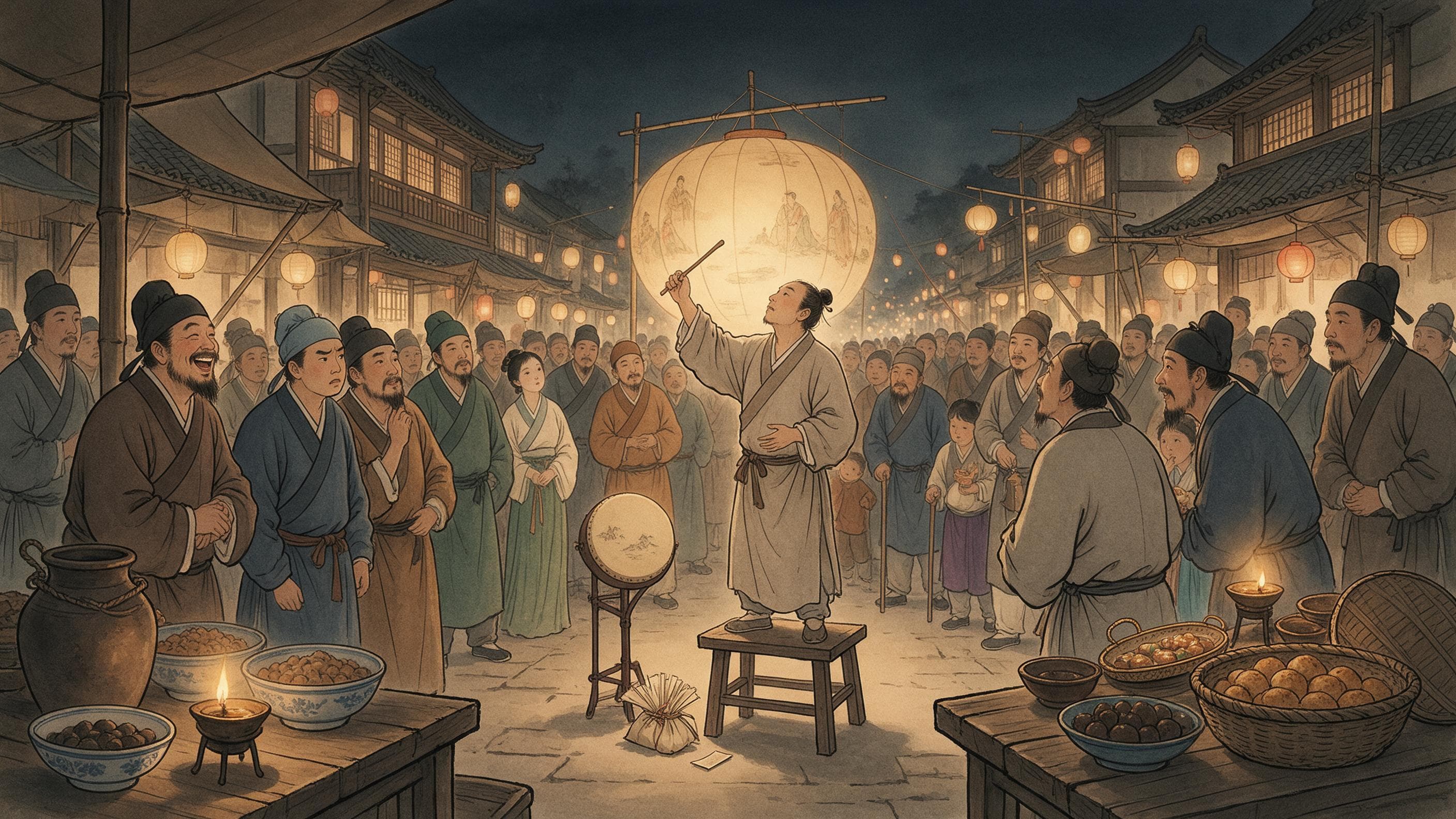
“The riddle seller first greets the crowd with a drum, then gathers people to guess poem-riddles, character-riddles, perverse riddles and society riddles; it is originally a hidden language.” The order matters: drum, crowd, guessing. The drum is not accompaniment; it is the shop sign. The same logic governed the wrestling booths, where women fighters opened with a few paired routines to pull a crowd before the real bouts began.
The word translated “greets” is he, which can mean to join in, to answer, or to congratulate. In this sentence it may describe beating the drum in rhythm to announce the show, or beating it to warm the ground. The source gives no rhythm, no duration and no words. What can be said is that the trade began with noise, and that the noise was addressed to strangers. Shang can mean to trade and to deliberate; this trade was both.
Four kinds of riddle
The four categories are poem-riddle, character-riddle, li-riddle and she-riddle. A poem-riddle uses a line of verse as its surface; a character-riddle takes a written character apart. Li is difficult: the word can mean perverse, contrary or obstinate, and a “perverse riddle” may have been one that twisted away from the obvious answer. She is harder still, because it can mean a society, an association, a village altar or the rites of the soil. The text names the categories and gives no examples.
A caution is needed here. It is often said that the Song had riddle clubs, mi she. The Mengliang Lu says she mi, “society riddles”, not mi she, “riddle society”; and the Wulin Jiu Shi's list of Lin'an associations — the Feilü she for variety plays, the Qiyun she for ball-kicking, the Eyun she for singing, the Jiaodi she for wrestling, the Xiongbian she for storytelling — contains no riddle club at all. A Song riddle society may have existed; these two texts do not show one. She mi might mean riddles posed by a society, riddles about a society, or something else. The word is a door with nothing behind it yet.
Seven moves
The most concrete passage is a list of technical terms, each with a gloss. Read together, they describe a three-way performance: the seller, the paying guesser and the crowd.
- Dao mi, also called “striking the riddle”; the surviving gloss is garbled and cannot be read with confidence.
- Zou zhi, “testing the wits”, glossed as “direct guessing”, where the customer asks for a riddle to solve.
- Xia tao, “setting the snare”: the seller teases the guesser with things of a similar category; also called “matching wits”.
- Tie tao, “sticking to the snare”: thinking close to the clue.
- Heng xia, “coming in sideways”: allowing bystanders to guess.
- Wen yin, “asking the cause”: the seller calls out the opening words of the line.
- Tiao shuang, “tuning the freshness”: pretending the riddle is hard, to make the guesser work.
Seven terms, and the roles are clear. The seller sets traps, calls out openings and fakes difficulty; the customer asks, thinks and guesses; the crowd is allowed in. This is not a solitary puzzle but a small theatre of teasing. The text gives no riddle, no prize and no price — only the moves.
Riddles on lanterns
The other setting was free. In the Wulin Jiu Shi chapter on lantern types, Lin'an's craftsmen made silk lanterns “cut and written with poems, sometimes containing mockery, and painted with figures, with hidden words at the head and old-capital jokes, to tease passers-by.” The lantern was a screen for a joke: an acrostic, a picture, a phrase that meant something else.
This is a different economy from the riddle seller's. One is a circle with a drummer and a fee; the other is a street full of lamps on the fifteenth night, where anyone may stop and try. What they share is the hidden language. “Hidden at the head” is one technique: the answer is carried in the first characters of the lines. Not one lantern riddle survives in these texts. We know that riddles were written on lamps; we do not know a single one.
Two names and a programme
Only two practitioners are named. In Lin'an, “among the riddle-guessers of Hangzhou, to speak of one or two: there was the monk Yougui and Ma Dingzhai, of broad memory and learning, whose names have long been transmitted.” The praise is specific: ji wen bo qia — widely remembered, widely informed. Riddle work was a branch of memory.
The Kaifeng evidence puts the trade in a rowdier place. On the twenty-fourth of the sixth month, the birthday of the god of the Guankou Erlang temple outside the west gate, “from morning the hundred entertainments were set out” — pole work, rope walking, wrestling, comic talk, skits, and shangmi among them: “every kind was there, and by dusk they had not finished.” It was one item on a long bill, performed on a raised platform in front of a temple.
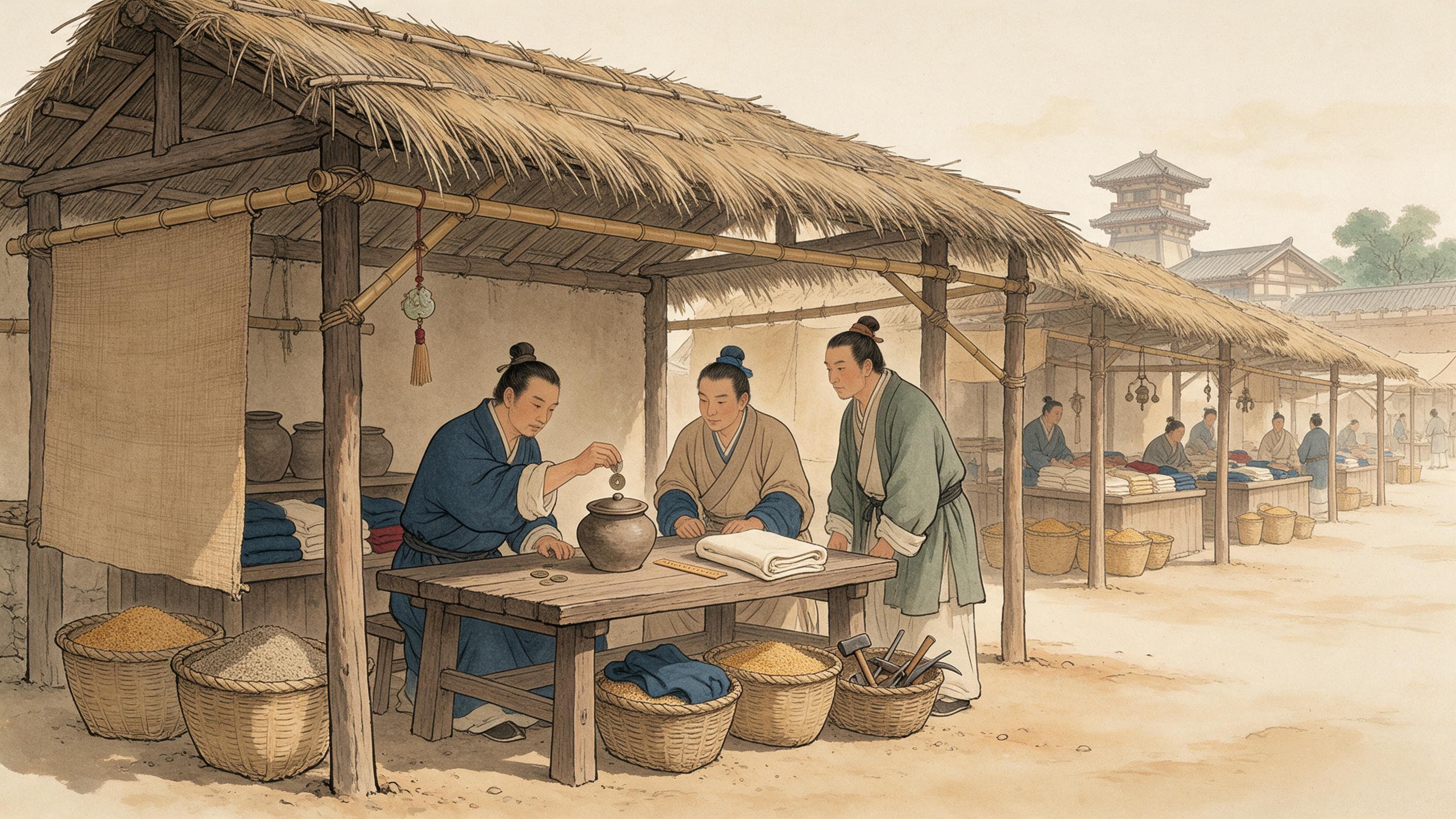
Neither book describes how the stall was run. The Mengliang Lu files it in the same chapter as storytellers, in sequence; the Dongjing Meng Hua Lu puts it on a temple platform. One is a catalogue, the other a stage. Together they suggest a circuit of market quarters, temple fairs and raised platforms, though what a stall looked like, or what a guess cost, the sources do not say.
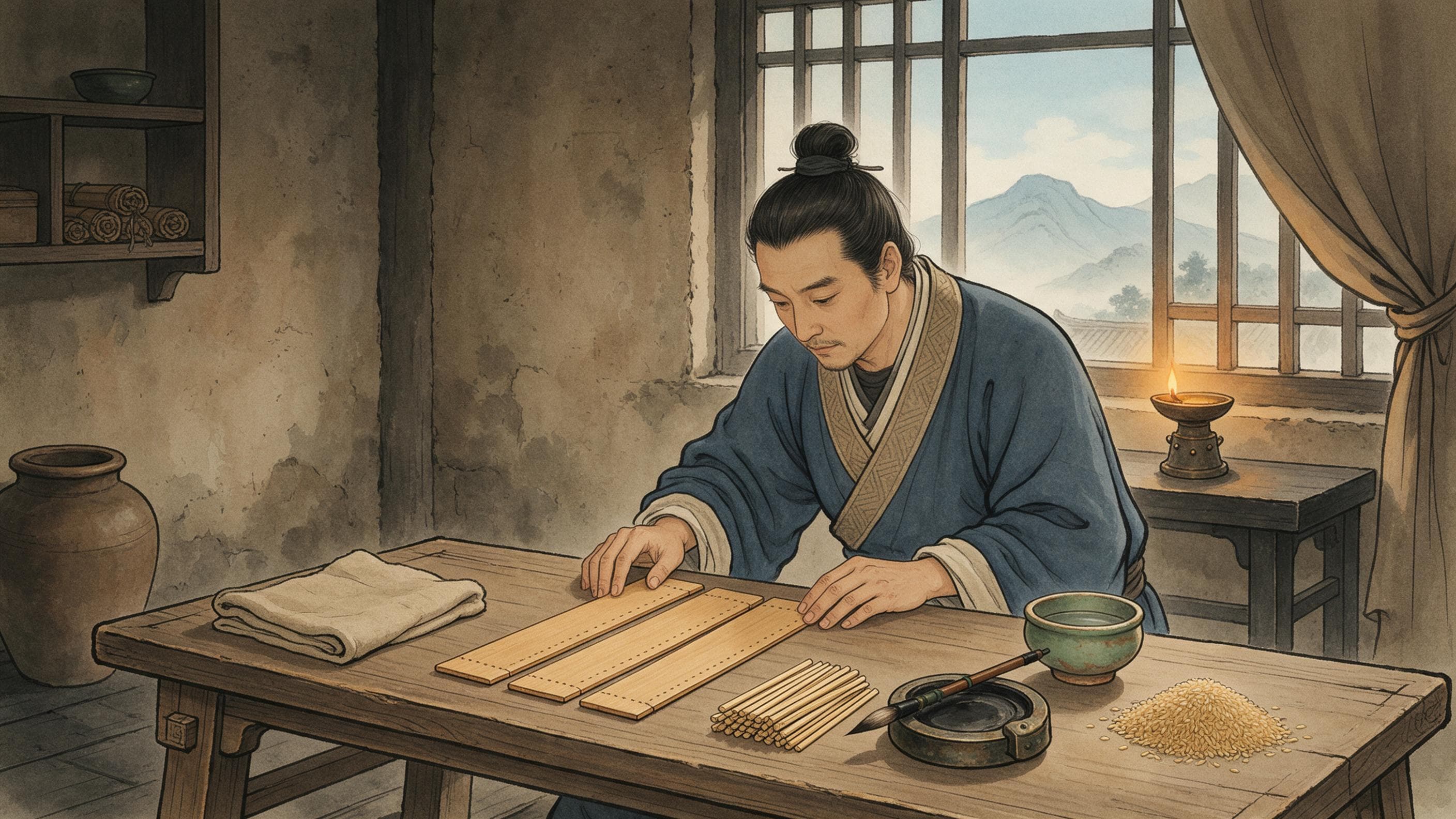
What remains is thin: a taxonomy, seven technical terms, two names, a line about lanterns. No riddle text, no answer, no takings, no record of how a guesser learned the trade. The Song riddle seller is visible only as a procedure — drum, crowd, trap, tease, payment. What the riddles actually were is the part that did not survive.
Sources & further reading
- 吴自牧《梦粱录》卷二十·小说讲经史 (Wu Zimu, Mengliang Lu, juan 20, “Storytellers, Sutra Lectures and History”) — The riddle seller's drum, the four kinds of riddle, the seven named techniques with their glosses, and the two Lin'an masters remembered by name.
- 周密《武林旧事》卷二·灯品 (Zhou Mi, Wulin Jiu Shi, juan 2, “Kinds of Lanterns”) — Silk lanterns cut and written with poems, figures, hidden words at the head and old-capital jokes, made to tease passers-by at the Lantern Festival.
- 孟元老《东京梦华录》卷八·六月六日、二十四日 (Meng Yuanlao, Dongjing Meng Hua Lu, juan 8, “The Sixth and Twenty-Fourth Days of the Sixth Month”) — The day-long programme of temple-fair entertainments at the Guankou Erlang temple, with riddle-selling listed among acrobats, wrestlers, comic talkers and mimics.