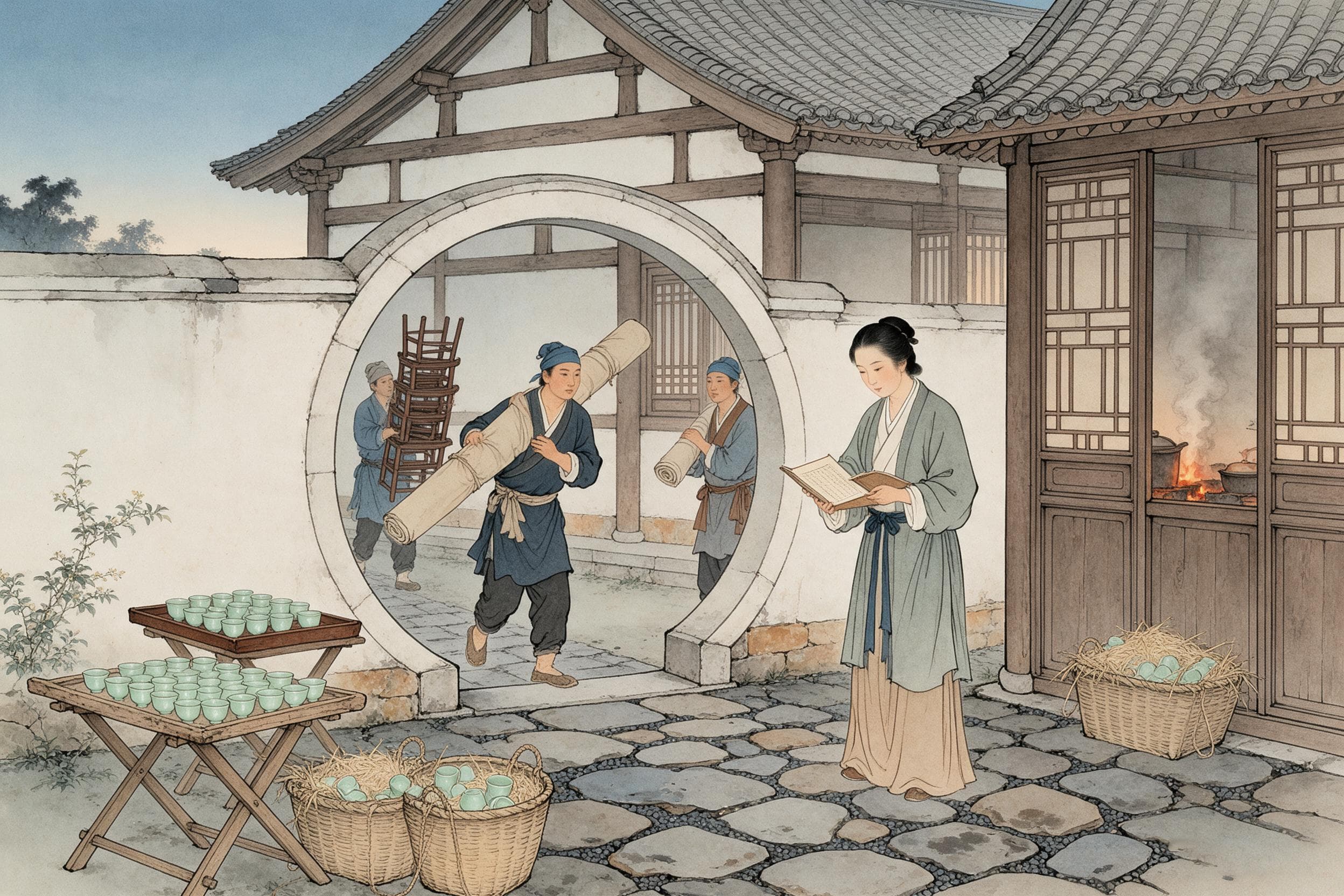
Before dawn, a line of porters comes through the gate of a courtyard in Lin'an, the Southern Song capital. They are carrying chairs, stacked and roped, then trestles, rolled curtains, and baskets of wine cups packed in straw. By midday the empty courtyard is a banqueting hall: tables set out, screens hung, candles in place, a kitchen team at work behind a partition. By the next morning it is empty again. Apart from the house itself, the family that paid for the wedding owns almost none of it. The inventories behind this scene are real; the scene is a reconstruction from them.
A list of things you could hire
The fullest inventory comes from Zhou Mi's Wulin jiushi (武林舊事), “Old Affairs of Wulin,” a portrait of Lin'an written after the Song collapse. Chapter six has a section headed simply 賃物 — “goods for hire.” The items are set down without comment: flower awnings and wine awnings; jewellery; clothes; bedding; sedan chairs; cloth bags; wine vessels; curtains and furnishings; utensils; trays and boxes; and, last, funeral goods (喪具). The list opens with awnings and closes with the equipment of a funeral, which is a fair summary of the trade: the same business fitted out a wedding and a wake.
Zhou Mi then explains how it worked. “For occasions of good and bad fortune,” he writes, “there were always the so-called tea-and-wine cooks (茶酒廚子), who took charge of food, guests and the seating. Everything needed was hired in, with no effort left to the household. Even a great spread could be done on the instant.” The sentence is compact and worth unpacking. 吉凶之事 means occasions of good and bad fortune — marriages and deaths. The tea-and-wine cooks were caterers. 一切賃至: everything was rented. 咄嗟辦 describes the result: arranged between one breath and the next. No price is given, and even the existence of a rental firm is left implicit.
Four offices and six bureaus
A second text goes further. Wu Zimu's Mengliang lu (夢粱錄), a description of Lin'an compiled in the 1270s, devotes a section to what it calls the four offices and six bureaus (四司六局). “If you wish to use a famous garden, a strange pavilion, a temple terrace, or a painted boat on the lake to entertain guests,” it says, “you need only give the word to the bureaus, and it is done at once, all in the proper form.” A proverb in the same passage makes the commercial logic explicit: burning incense, whisking tea, hanging paintings and arranging flowers — “four idle accomplishments that should not be allowed to burden the household.” The skills of a refined house were available for hire, so the house did not need to keep them.
The ten units had between them almost the whole apparatus of a formal banquet:
- The Office of Hangings (帳設司): awnings, table covers, matting, curtains, screens, paintings and painted bed-hangings — the work of dividing a space.
- The Tea and Wine Office (茶酒司): tea, wine, serving, toasts and seating; for common households it also supplied gold and silver wine and tea vessels.
- The Kitchen Office (廚司): raw and cooked dishes, carving, seasoning, soups.
- The Tray Office (臺盤司): carrying trays, presenting dishes, bowls and plates.
- The Fruit and Preserved-Fruit Bureaus (果子局, 蜜煎局): fresh and dried fruit, honeyed shapes for the table.
- The Vegetable, Lamp and Incense Bureaus (菜蔬局, 油燭局, 香藥局): greens, lighting, censers and incense.
- The Arrangements Bureau (排辦局): tables, chairs, stools, and the sweeping and wiping afterwards.
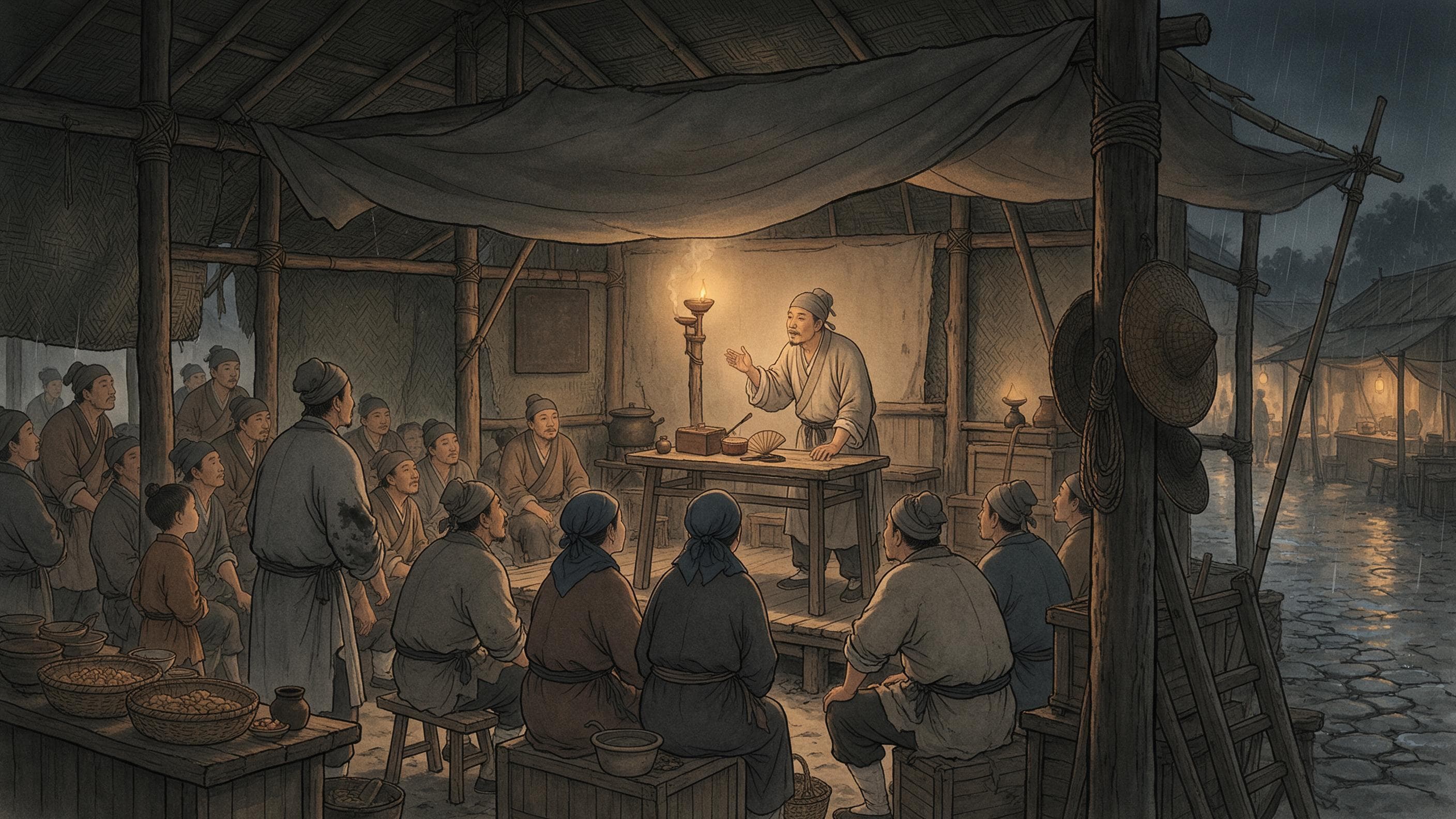
The text is explicit about who called them in: government spring banquets, village gatherings, the Deer Cry Feast for candidates who had passed, the joint banquet of officials who passed the examinations together, and the emperor's birthday banquets. It adds that for the weddings and funerals of rich commoners (富豪士庶吉筵凶席) a household could simply summon the bureau staff and be served. There was a second channel as well: officials could have staff assigned from government offices for their own residences. The poor do not appear in the passage.
Appearance on credit
Renting was not confined to parties. In the same chapter, a section on workshops describes another way of using goods without owning them: “The people of the capital are idle and proud; when they buy and sell, they mostly take ready-made goods from the workshops to peddle, and seek a profit of one in ten. If a poor man is willing, he takes frames and goods of every kind from the workshop and pays the value at evening. Though he has not a single coin in savings, he can still make a living.” This is credit and consignment rather than rental, but the principle is the same: access first, ownership later.
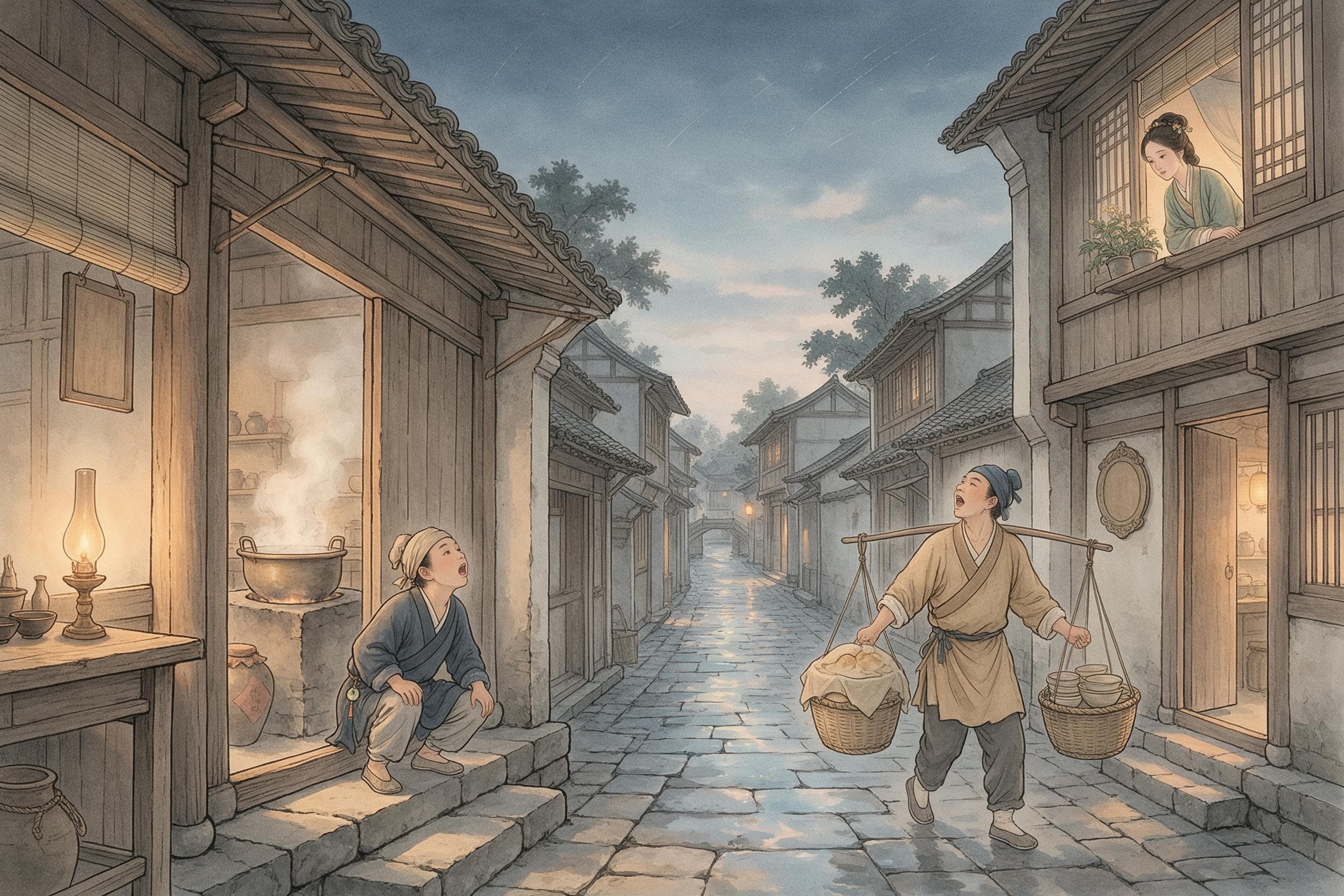
A passage on the city's famous courtesans shows what rental could do for a household's appearance. “Wine vessels, jewellery, bedding and clothes — each had its renters. So when a good guest arrived, the household's equipment was made new, and only those accustomed to such visits would notice.” The richest woman named, Tang An'an, had wine vessels, ice basins, fire-boxes and cosmetic boxes made of gold and silver. Those below her rented. The guest, the text implies, saw little difference. Renting was not merely a poor man's expedient; it was how a household with some money kept up a front beyond its capital.
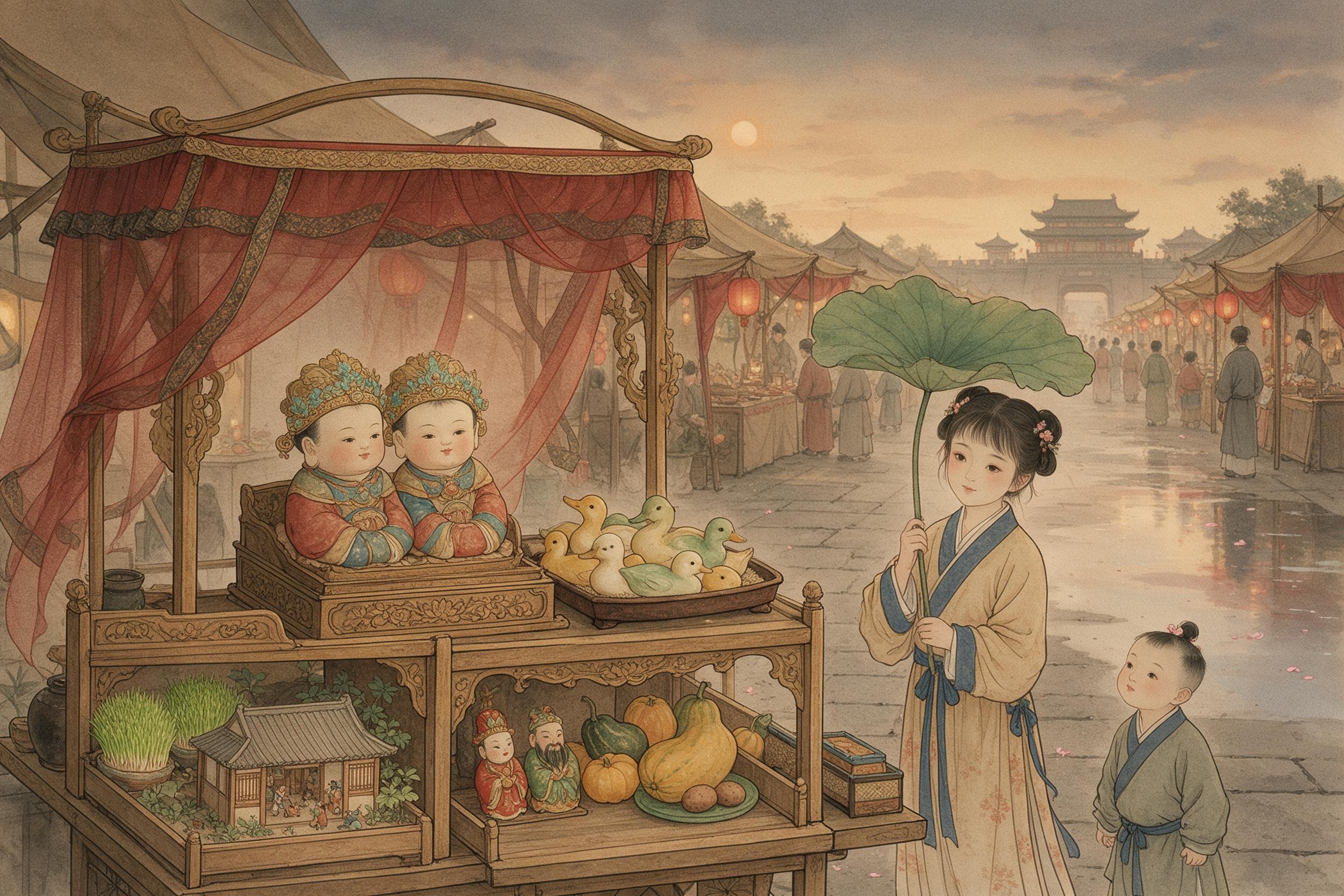
The same logic reached empty space. On the day of the Qiantang tide, Zhou Mi notes, “viewing tents were hired out, and even a patch of bare ground was packed without a gap,” while “food and drink of every kind sold at double the ordinary price.” A festival created a temporary market in standing room, and someone supplied it.
What the inventories leave out
None of these passages gives a rent, a deposit, or a rule for breakage. They do not name a rental firm, describe a contract, or say who owned the stock. The lists are inventories of what existed, not evidence of how often an ordinary household used them.
There is a further caution. Wulin jiushi was written after the Song had fallen, by a man recalling a lost capital; Mengliang lu is a late-thirteenth-century description of a city still standing. Both tend toward the enumerative and the idealised, and both are concerned with the upper end of the market. The four offices and six bureaus served official banquets and wealthy families. For a clerk's household, a wedding may have meant a few rented chairs and a borrowed set of cups. That is inference, not record.
What the sources do establish is the granularity. A host did not have to find a chair-maker, a wine merchant, a cook and a cleaner separately; the package had names, and the names had duties. A family with money but no space, no staff and no silver could stage a full banquet and send it all back the next day. What that cost, and what happened when a cup broke, the lists do not say.
Sources & further reading
- 周密《武林旧事》卷六「赁物」「作坊」(Zhou Mi, Wulin Jiushi, juan 6, "Goods for Hire" and "Workshops") — The inventory of rentable goods, the tea-and-wine caterers who supplied everything for weddings and funerals, and the workshop credit that let a seller with no capital trade.
- 吴自牧《梦粱录》卷十九「四司六局筵會假賃」(Wu Zimu, Mengliang Lu, juan 19, "The Four Offices and Six Bureaus") — The ten named units, their duties, the occasions they served, and the proverb that a household need not keep such skills of its own.
- 周密《武林旧事》卷三「观潮」(Zhou Mi, Wulin Jiushi, juan 3, "Watching the Tide") — Rented viewing tents on the Qiantang tide day, and food and drink selling at multiples of the normal price.