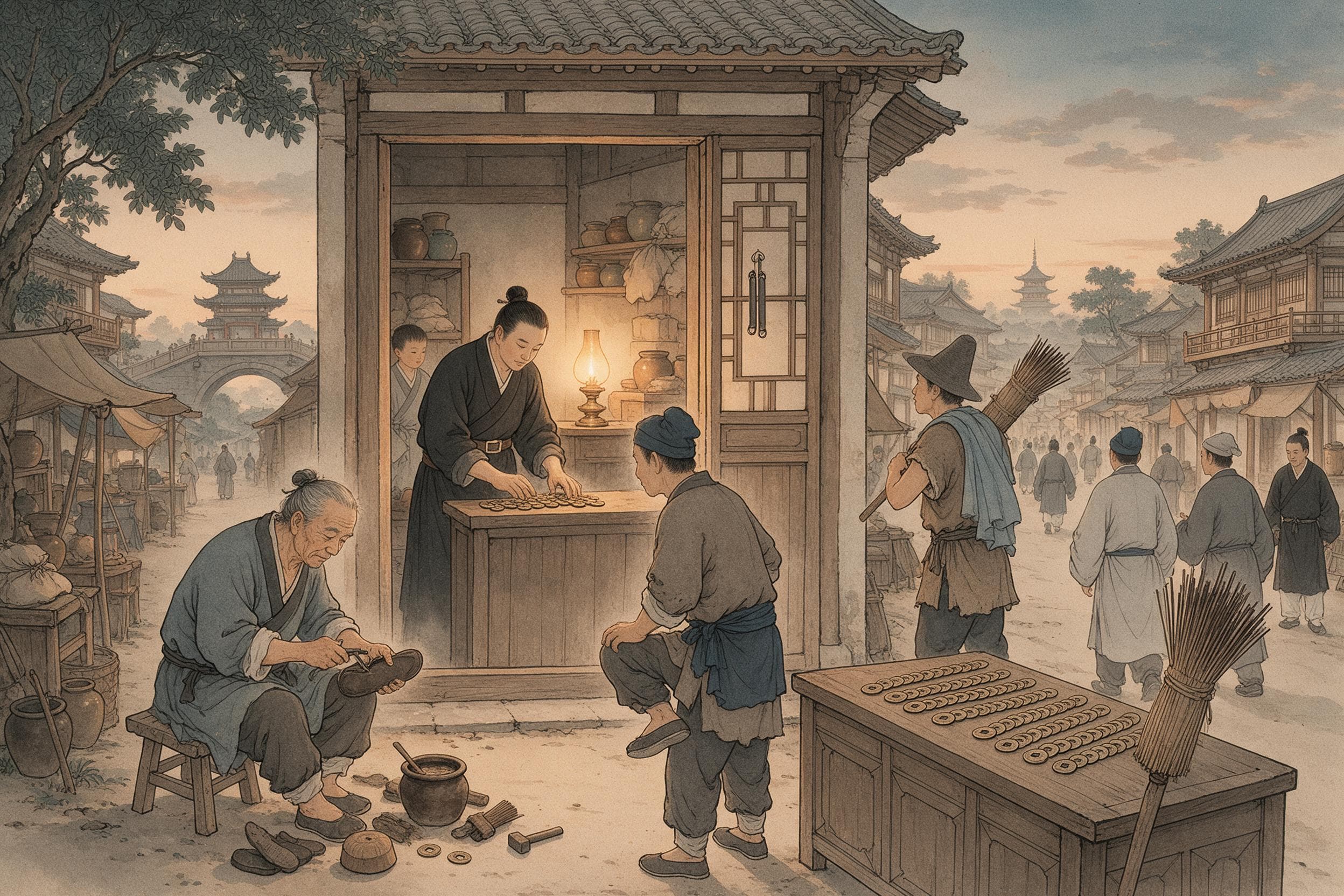
Two men come up the street in Kaifeng, and you know their trades before either speaks. One wears a tall hat and a garment draped over his back: he wraps incense in a shop. One wears a black robe, a horn-buckled belt, and no hat: he manages a pawnshop. Meng Yuanlao introduces them with the words “for example”. He gives two examples, but the claim is universal: “The dress of scholars, farmers, artisans and merchants, of every trade and every household, each has its proper colour, and none dares overstep it.”
Tall hat and draped back; black robe and horn belt
The sentence is as short as a label: “For example, the man who wraps incense in an incense shop wears a tall hat with a back-drape; the manager of a pawnshop wears a black robe and a horn belt, with no hat.” Six characters a man, twelve for the pair. What shape the tall hat had, whether the back-drape was a cape or a panel with ties, the text does not say. Both can be matched to something in Song pictures, but fixing one particular cut to those six characters is reconstruction, not record.
The black robe is easier. Zao is black; a horn belt has buckles of horn — not gold, not jade. In Song dress regulations this combination belongs to men without office. The Song Shi gives it to the unappointed scholar, “cap, black robe, belt”; to the second stage of a boy's capping ceremony, “hat, black robe, leather belt, shoes”; and to commoners and traders, who “may wear only black and white, with iron and horn belts”. A pawnshop manager dressed this way was wearing the sentence “I handle other people's goods; I am not an official.” That is an inference, but it rests on statute. The missing hat does the rest: headgear was itself a rank marker, down to the shape of its feet, so a manager going bareheaded became recognisable by what he did not wear.
The statute is written as a list of prohibitions
Meng describes the order he saw; the Song Shi describes the order the court wanted. They are not the same thing. Li Fang's memorial of 982 puts the problem plainly: “Under the old rules commoners wore white; I ask that clerks outside the regular grades, examination candidates and commoners alike be permitted black.” Seven years later the language had hardened: “All clerks in county and market offices, commoners, traders, technical specialists and entertainers not on the official registers may wear only black and white, with iron and horn belts, and may not wear purple.” In 995 commoners were “again permitted purple”. Banned, opened, banned again: the line was redrawn repeatedly.
Official dress was a separate system. The public robe ran “purple for the third rank and above, vermilion for the fifth and above, green for the seventh and above, blue for the ninth and above”; after the reforms of 1078–1085 blue was dropped, and the ladder became purple from the fourth rank, crimson from the sixth, green from the ninth. That is a ladder: climb, and the colour changes. The commoner's code is a ceiling: stay down. The two get bundled into one sentence about ancient dress denoting rank, but the logics differ — one is a reward, the other an exclusion.
The purple robe that leaked from the barracks into the parlour
The garment that measures how tight the system really was is the zishan, the purple robe. The Song Shi is brisk about it: “The purple robe was originally a military officer's uniform. After the restoration, scholar-officials wore it, for convenience in military business.” In 1139 an edict ordered ministers and senior officials to wear cap and belt; it was never carried out. In 1156 the ban was renewed — no one was to “face the people in military dress” — “and from this the purple robe fell out of use.” Scholar-officials took to the cool robe instead.
The same chapter gives an earlier version: the maoshan, “a hat of black gauze, a robe of black silk, horn belt, tied shoes”, which Northern Song scholar-officials wore for ordinary social occasions. After the court moved south it “changed once into the purple robe, and again into the cool robe.” Three generations of informal dress in under thirty years. The regulation tried to fix it; the wearers kept walking it somewhere else. A garment's standing, more often than not, is not conferred by the court but accumulated by the people who put it on.
Every trade its proper colour, and the expiry date
Wu Zimu, writing in Lin'an, copied Meng almost word for word: “The dress and headgear of scholars, farmers, artisans and merchants, of every trade and household, all have their grades. The incense-shop man wears a tall hat and a back-drape. The pawnshop manager wraps his head and wears a black robe with a horn belt. The traders in the street each have their colour and their headcloth, so that anyone can be told what he is.” Two books describing one practice, with the same two examples, are not two pieces of evidence: the Meng Liang Lu borrows heavily from the earlier book, and this is among the most visible borrowings.
But Wu adds something Meng could not have written: “Since the Chunyou years, cap and gown have shifted. There are young men of late years who do not respect the old rules, wrapping strange headcloths and wearing strange clothes, in groups of three or five, competing in beauty and finery — quite tiresome to look at, no longer the simplicity of former times.” Chunyou ran from 1241 to 1252. The man writing had already watched the readable city come unstuck: young men in odd cloths, in gangs, comparing how they looked. “Tiresome to look at” is an old man's tone. Inside the complaint is a fact — by his day you could no longer read a man reliably off his clothes.
And a code carried on clothes needs people to maintain it. The Kaifeng chapter on miscellaneous street trades lists them: “mending cracks, riveting, hoop-binding tubs, repairing fittings, soling shoes, brushing belts, repairing caps and hats, patching horn crowns.” Hats wear out, belts get dirty, soles wear through. A city that identifies people by their dress needs a trade devoted to putting the markers back. The same entry gives the water-carriers a fixed ward and lane, and the hat-mender probably worked the same grid.
One night, the whole city changed clothes
On the fourteenth of the first month, when the emperor visited the Five Peaks Abbey, the street he came back along was lined with a different wardrobe. The close attendants wore round-topped great hats with flowers stuck in them, red brocade lion shirts and gilt belts of the Heavenly Kings; the palace guard wore flowered caps with two feet curling backwards, and robes in crimson, blue and purple worked with gold thread; “the remaining attendants all wore the public robes of purple, crimson and green.” One city, one night, and identity had switched from trade to rank.
Even the flowers were graded. The Song Shi entry on flower-wearing says that flowers stuck in a cap were called zandai; after the restoration, when the emperor returned from the suburban sacrifices or the Bright Hall rites, officials and escorts all wore them. Great gauze flowers went to the whole body of officials, branched sprays only to the directors and above, silk flowers to officers and below. The flowers were artificial. The ranking was not. And this is as far as the evidence reaches. To turn it into “Song men generally wore flowers in their hair” would be overreach.
So three wardrobes were in use on the same street: the colour of your trade, the colour of your rank, and the gifts of the season. A man might change three times in a day. Meng wrote that the people in the street “can tell at a glance what kind of man you are”. That was his Kaifeng. A century and a half later another Hangzhou man looked at the young men and wrote that it was “no longer the simplicity of former times”. The same code: intact in one man's memory, failing in another man's eyes.
Sources & further reading
- 孟元老《东京梦华录》卷五「民俗」(Meng Yuanlao, Dongjing Meng Hua Lu, juan 5, “Customs”) — The claim that every trade had its proper dress, with the incense-wrapper and the pawnshop manager as the two examples, and the line about reading a man's kind from the street.
- 吴自牧《梦粱录》卷十八「民俗」(Wu Zimu, Meng Liang Lu, juan 18, “Customs”) — The borrowed passage with the same two examples, plus the complaint that from the Chunyou years young men abandoned the old rules of dress.
- 脱脱等《宋史》卷一百五十三《舆服五·士庶人车服之制》(Tuotuo et al., Song Shi, juan 153, “Carriages and Dress V: Dress Rules for Commoners”) — The statutory side: rank colours for public robes, the repeated bans on purple for commoners and traders, the purple robe's origin as a military uniform, and the grading of flowers worn in caps.
- 孟元老《东京梦华录》卷三「诸色杂卖」(Meng Yuanlao, Dongjing Meng Hua Lu, juan 3, “Miscellaneous Street Trades”) — The itinerant trades that kept clothing wearable: soling shoes, brushing belts, repairing caps and patching horn crowns, each with a fixed ward territory.