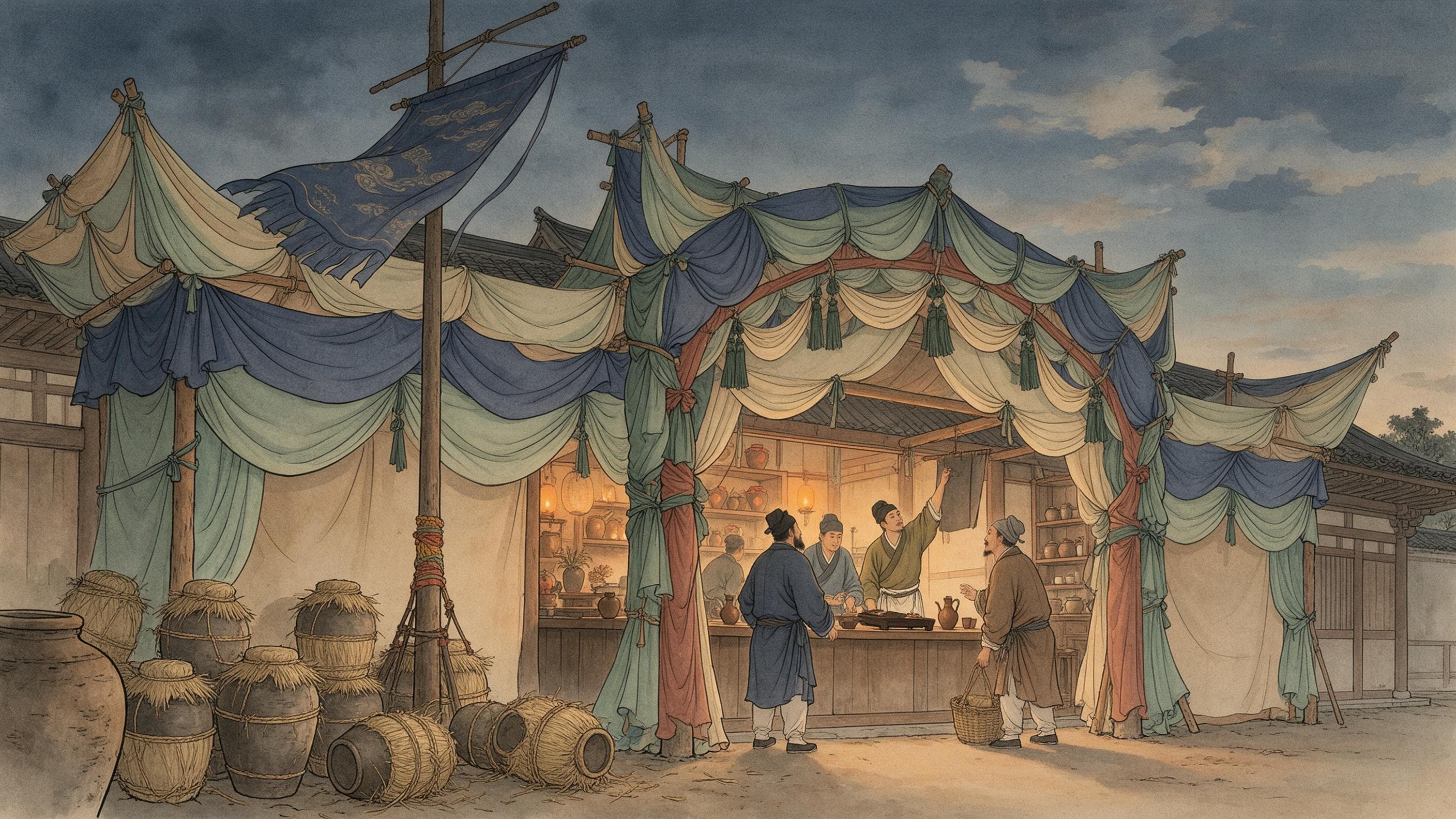
A few days before mid-autumn the wine shops took their fronts apart and built them again. Bolts of coloured silk were gathered into the shape of a gate-tower and pushed out over the roadway; a painted pole went up in front of it, carrying a brocade banner with the Drunken Immortal on the cloth. The work was done once a year, and it was done to sell one thing: new wine.
Before the festival: the front rebuilt
The Mid-Autumn entry of the Dongjing Meng Hua Lu opens with exactly this, the refit and the new wine in one breath.
中秋節前,諸店皆賣新酒,重新結絡門面彩樓花頭,畫竿醉仙錦旆。 — Before mid-autumn every shop sold new wine, rebuilding its front with coloured silk towers and flower heads, painted poles and brocade banners of the Drunken Immortal.
Every one of these words is decoration, and all of it faces the street. Jieluo menmian (結絡門面) is the facade tied up and done over; cailou huatou (彩樓花頭) is coloured silk worked into the shape of a tower and finished with flower heads; the huagan (畫竿) is a painted pole; the zuixian jinpei (醉仙錦旆) a brocade banner of the Drunken Immortal. Who the Drunken Immortal was, or what stood on the cloth, the text does not say (uncertain).
"New wine" is left unexplained too. Whether it was the year's first pressing, or a brew hurried to readiness for these few days only, the text does not say (uncertain). What it does fix is the moment and the spread of it: before the festival, and not one shop but zhu dian (諸店), the shops, all of them.
Between noon and afternoon: no wine left
Then comes the most concrete sentence in the passage. In a single morning a whole city's wine is sold out.
市人爭飲,至午未間,家家無酒,拽下望子。 — The townspeople drank in a rush, and by the hours of wu and wei there was no wine in any house, and the signs were pulled down.
The hour converts cleanly. The wu hour ran from eleven to one, the wei hour from one to three, so wu-wei zhi jian (午未間) is about one in the afternoon. From opening to just past midday, the wine was gone. The wangzi (望子) was the shop's sign hung out over the street, a cloth banner; zhuai xia wangzi (拽下望子) is to haul it down. A sign coming down over a doorway is a public announcement, and the text needs no word for "sold out": it gives the gesture instead.
Whether jiajia (家家), "every house", means every wine shop or every household is not settled by the sentence (uncertain). Read as shops, it is a whole trade clearing its stock by midday; read as households, it is the festival drink already finished. Both readings point the same way: none of that day's new wine lasted into the night. Why none was held back — because new wine would not keep, or because a shop would rather sell out than sit on stock — the entry does not answer (may have been either).
Fighting for a table
At night the moon itself became something to compete for.
中秋夜,貴家結飾臺榭,民間爭占酒樓玩月。 — On the night of mid-autumn the great houses decked their terraces, and the common people fought for places in the wine shops to watch the moon.
Two sentences, two kinds of people. The great houses built decorated terraces inside their own compounds; the commoners had no terrace, so they went up into the wine shops — and the verb is zheng zhan (爭占), to fight for and occupy. Seats were finite and went to whoever came first. What they fought over was not the moon but the one table from which it could be seen. The same entry gives the sound of it: strings and pipes boiling over, and the residents near the inner court, late at night, still hearing mouth organs and flutes from far off, as if from beyond the clouds. The noise of the wine shops had spilled into the lanes outside the palace wall.
The night market: until daybreak
That night the city did not go to bed.
閭里兒童,連宵嬉戲。夜市駢闐,至於通曉。 — Children of the lanes played all night long. The night market was packed shoulder to shoulder, and went on until daybreak.
Lianxiao (連宵) is the whole night; tongxiao (通曉) is until daybreak. Children played in the lanes all night, the night market was too crowded to walk through, and it broke up at dawn. The entry just before this lists what was in season: crabs newly out, and pomegranates, pears, jujubes and chestnuts among the new fruit. The wine had run out and the food was just arriving. The night's trade was done in two shifts. And the same Hangzhou book opens its Double Ninth entry with the city drinking new wine that month: the new wine was not one night's business but a whole season's.
Xieyan, and the lamps on the river
Hangzhou's mid-autumn has a second record, of shopfronts and of water. The Wulin Jiushi takes the imperial street first.
御街如絨線、蜜煎、香鋪,皆鋪設貨物,誇多競好,謂之「歇眼」。 — On the imperial street the thread shops, the honey-preserve shops and the incense shops all laid out their goods, vying in quantity and quality, which was called xieyan.
Thread, preserved fruit, incense — every one of them spread its stock across the frontage, competing in abundance and finish, and this was called xieyan (歇眼). The word is left unglossed and has no settled explanation (uncertain); from the context it describes goods laid out until the eye is overwhelmed. The next sentence is dengzhu huacan, jingxi nai zhi (燈燭華燦,竟夕乃止), lamps and candles blazing, and so all night. The shops stayed open until morning, and the lamps were what kept them open.
Then the river.
此夕浙江放「一點紅」羊皮小水燈數十萬盞,浮滿水面,爛如繁星。 — That night on the Zhejiang they released "one spot of red" little sheepskin water lamps, several hundred thousand of them, until the whole surface floated with them, bright as a sky full of stars.
"One spot of red" is the lamp's name, and "little sheepskin water lamp" gives the material: sheepskin does not soak through, so a lit lamp set on the river would not go down at once (may have been the reason; the text gives the material and not the motive). "Several hundred thousand" is the count; "bright as a sky full of stars" the effect. The same entry records what people said about it — that this pleased the river god, and was not done merely for the look of it. Whether the number is a count or a figure of speech, the text does not distinguish (uncertain).
The festival did not end with that night. The Wulin Jiushi runs straight on into the tide: the Qiantang's bore is at its greatest from the sixteenth to the eighteenth of the month. Mid-autumn is the fifteenth, the tide the eighteenth, and in the days between the river bank stayed full. As for the accounts — how much wine a city drank, what one water lamp cost, who paid for them, where the lamps finally drifted — none of it is recorded. What survives is one gesture, a sign pulled down, and one number, several hundred thousand lamps, with everything between them left blank.
Sources & further reading
- 孟元老《东京梦华录》卷八「中秋」(Meng Yuanlao, Dongjing Meng Hua Lu, juan 8, "Mid-Autumn") — The rebuilt shopfronts and new wine, the sell-out by the wu-wei hours with the sign pulled down, the scramble for wine-shop tables, and the night market to dawn.
- 周密《武林旧事》卷三「中秋」(Zhou Mi, Wulin Jiushi, juan 3, "Mid-Autumn") — The imperial street shops laid out for the night under the term xieyan, and the hundreds of thousands of sheepskin lamps set on the river.