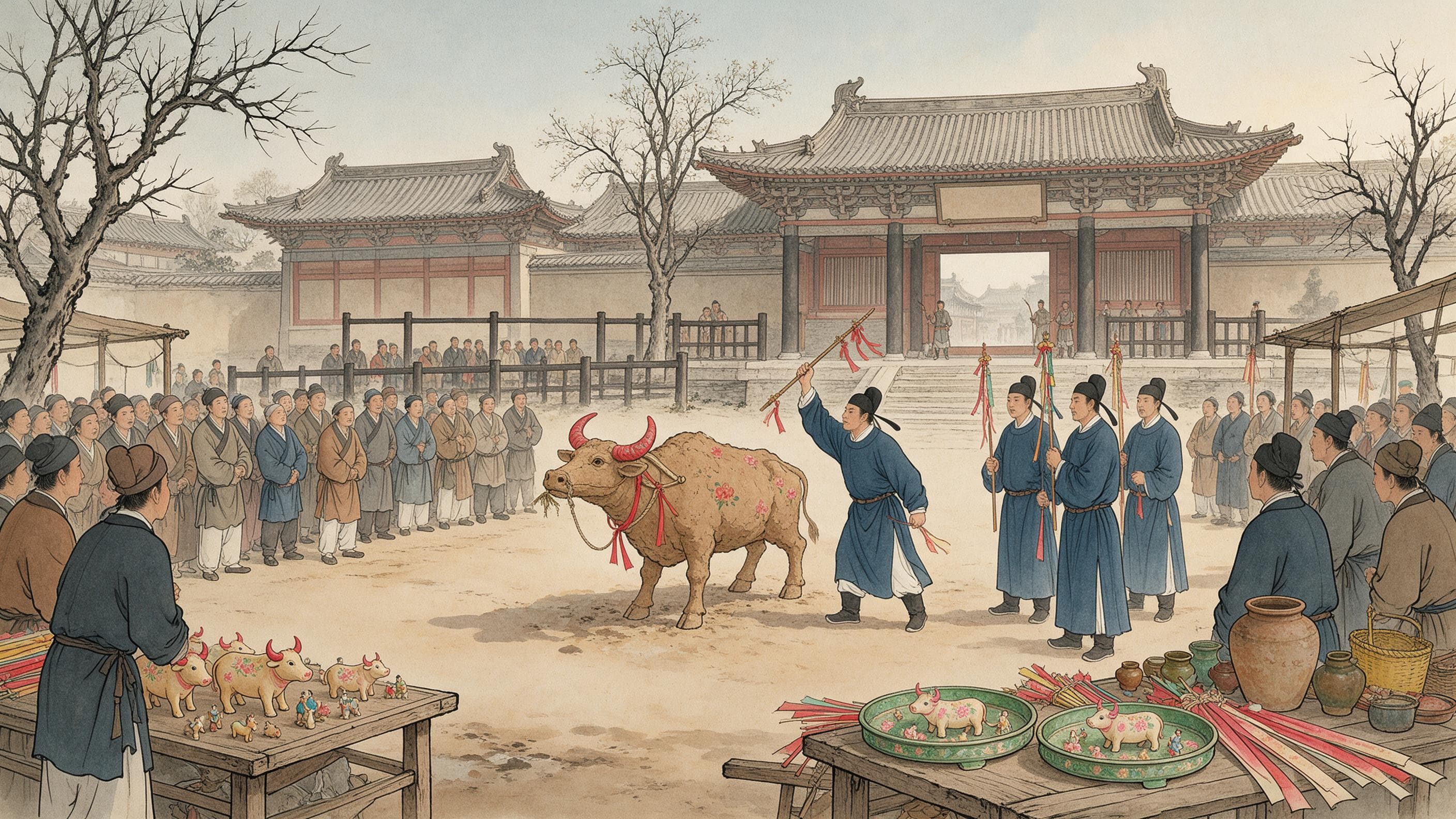
The day before the first day of spring, the Kaifeng prefecture sent a spring ox into the palace to be "whipped into spring", and the two counties of Kaifeng and Xiangfu set up oxen of their own before the prefectural office. Early the next morning the officials came out and beat them, following the rite used in the provinces. At that same hour, at that same gate, the stalls went up: people sold small spring oxen mounted on flower-decorated stands with tiny figures of the hundred entertainments on top, along with spring banners and snow-willow sprays, and gave them to one another as gifts. A state ceremony had a seasonal market at its front door.
The government struck first
The first stroke of the day belonged to the government. The Dongjing Meng Hua Lu is blunt about it: the day before spring, the prefecture sent the spring ox into the palace for the whipping; the two counties placed oxen before the office; at dawn the officials beat them, as in the provinces. The ox was clay, the stroke symbolic, but the organiser was the yamen, not the ward. So there were two whippings: one in the palace the day before, one at the county offices at dawn — one rite, two audiences, inside the wall and outside the gate.
After the move south, Lin'an's version was more elaborate. The Wulin Jiu Shi says the Lin'an prefecture brought in a great spring ox and set it in the courtyard of Funing Hall; when the emperor visited the inner palace, the ox was whipped with staffs of five-coloured silk. One part of the animal was taken for a specific purpose: "the Imperial Pharmacy routinely took the ox's eyes to make eye medicine." That is a ritual taking, not medical evidence; the rest of the ox went to the palace matron in charge.
Toy oxen at the office gate
Once the rite began, trade followed. The stalls outside the Kaifeng office sold miniature oxen, "usually mounted on flower-decorated stands with the hundred entertainments set out on top, with spring banners and snow-willow" — a little clay ox on a decorated base, with tiny performers fixed to it like a portable stage set. Ox, base, performers: the three parts of the ceremony at pocket size. The stalls stood at the office gate for a reason: the crowd left the rite and spent its money where it stood. Buyers gave them to one another as seasonal gifts.
Lin'an took another route. The government "had several dozen small spring oxen made in advance", decorated them with coloured banners and snow-willow, and sent them to the palace halls and to powerful eunuchs, who returned the courtesy with gold and silver coins and bolts of silk. The same object was a street commodity in Kaifeng and a currency of official courtesy in Lin'an.
Banners, spring plates and a price
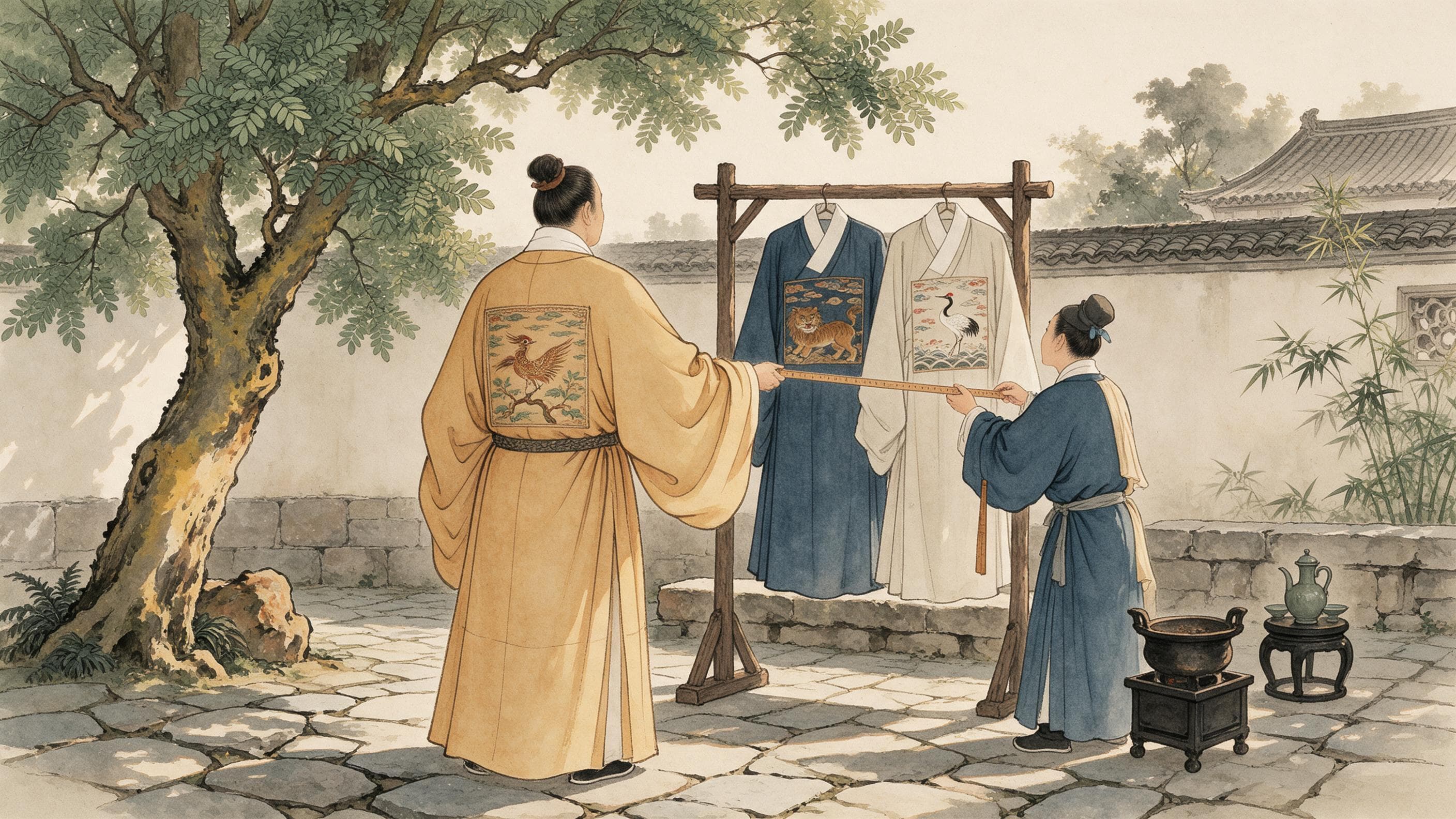
On the day itself officials were given "spring banners" to wear home. They were graded: the chief ministers and imperial princes received gold, everyone else gold-washed silver or silk, made by the Palace Workshop, "each hung on the left of the cap" — a small ornament at the side of a hat that marked a rank. "After the audience they wore them home": the rank a man had been given in the hall was carried out into the street.
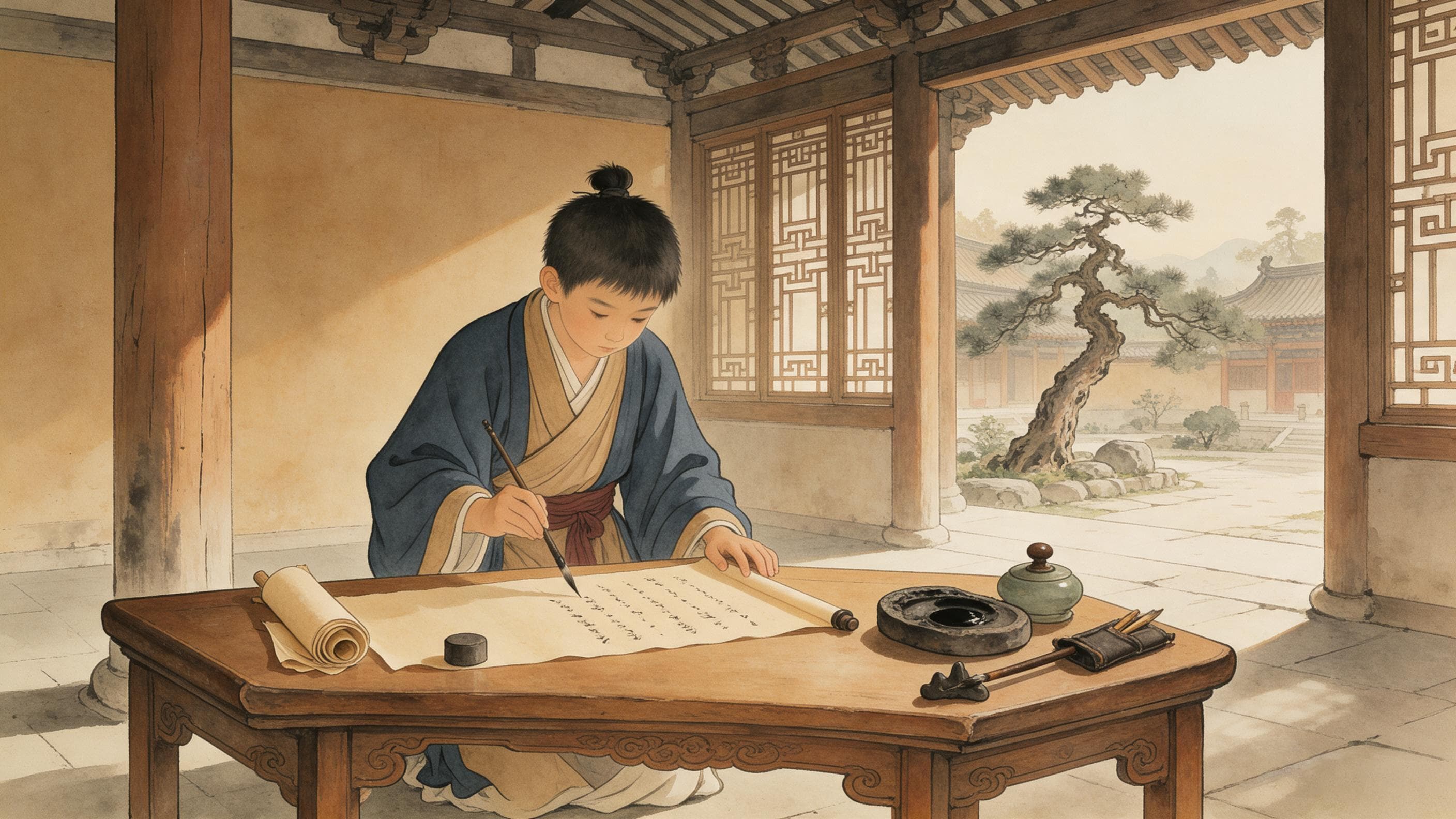
Dearer still was the food. The rear gardens prepared "spring plates" for the throne and for distribution to great houses, ministers and eunuchs, with "green threads and red silk, golden cockerels and jade swallows, exquisitely made". The text gives the price: "each plate was worth ten thousand cash." A plate of fine seasonal greens, ten thousand cash. The Academy of Scholars also submitted "spring-post" verses (春帖子), with fixed forms for empresses, consorts and each palace hall, written on crimson silk with gold thread.
After the whipping, a banquet
The Wulin Jiu Shi ends by connecting three levels: "the Lin'an prefecture also whipped the ox and held a banquet, while the gifts exchanged among noble houses mostly imitated the palace." The palace set the style, the prefecture performed the rite, the markets and the great houses copied it. One solar term occupied all three at once: the top level supplied the show, the bottom level paid for it. The word "imitated" matters: this was not spontaneous festivity but a following of palace form.
What not to add
One thing must be said clearly: this was not a uniform national rite. The whipping of the ox varied greatly from place to place, and only the two capitals are described here. The taking of the ox's eyes was a palace ritual, not a pharmaceutical record. And the spring-ox pictures of later New Year prints cannot be used as Song visual evidence.
What the sources make solid is the price and the count: several dozen small oxen, a spring plate at ten thousand cash, banners graded in gold and silver. The spring-post verses belong to the same ledger: the Academy wrote them, the palace hung them, and the format was fixed down to colour and material — even the season's words were institutionalised. A solar term opened by the government tied the rite, the rewards and the market into one morning. Beyond the two capitals the record is silent, which is why this account stops at Kaifeng and Lin'an. Whether the people standing outside the gate were buying an ox or buying the occasion, the record does not say.
Sources & further reading
- 孟元老《东京梦华录》卷六·立春 (Meng Yuanlao, Dongjing Meng Hua Lu, juan 6, "The First Day of Spring") — Kaifeng's spring ox sent into the palace and set up at the prefectural office, the officials beating it, the toy oxen sold at the gate, and the gold and silver banners given to officials.
- 周密《武林旧事》·立春 (Zhou Mi, Wulin Jiu Shi, "The First Day of Spring") — The Lin'an rite: the great ox in the palace courtyard, whipping with five-coloured silk staffs, the ox's eyes taken for eye medicine, the dozens of small oxen made in advance, the spring plates at ten thousand cash each, and the graded banners.