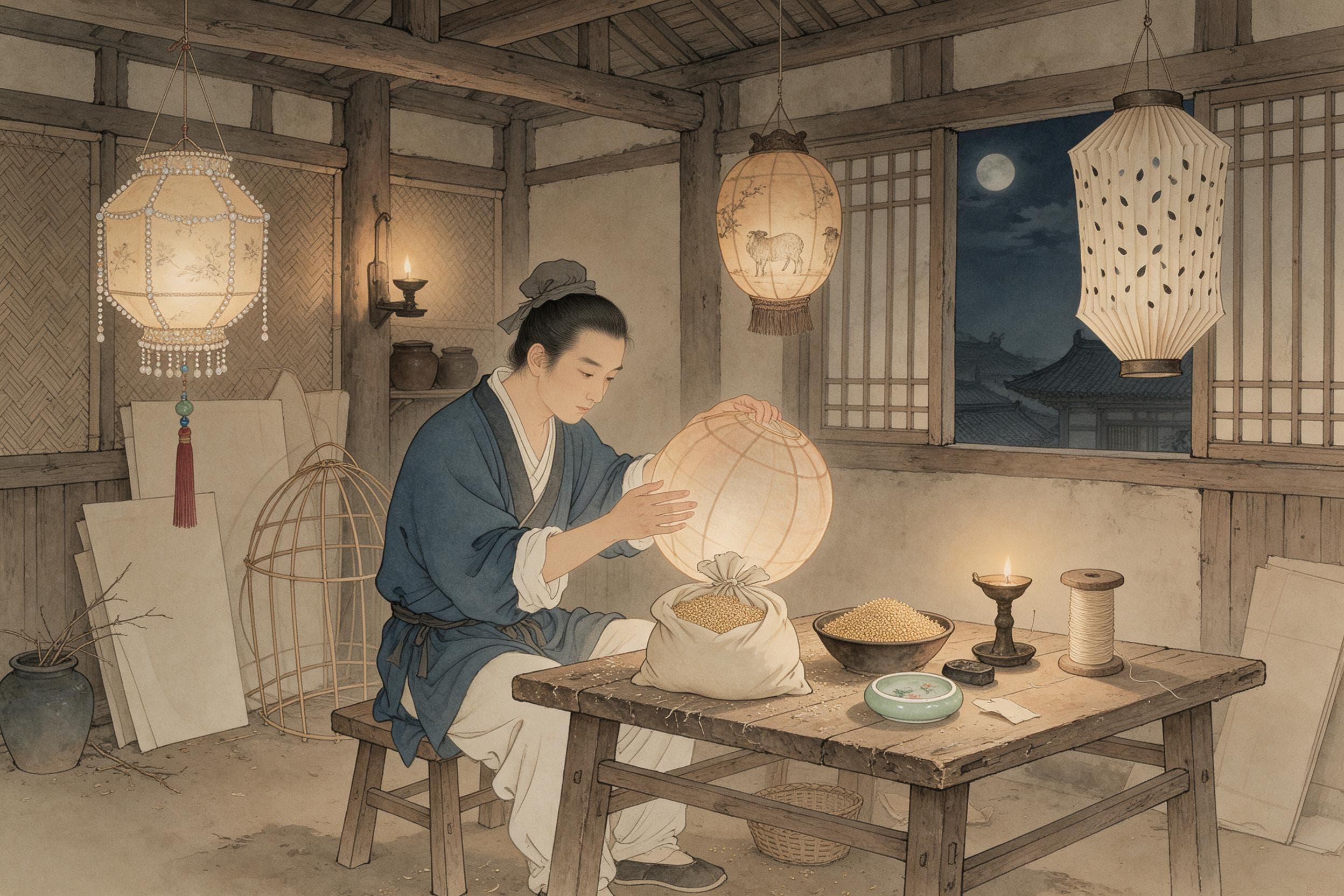
The Southern Song "boneless lantern" was made by a strange method: a silk bag was packed with millet to serve as the mould, the silk was stitched and bound over the grain, and then the millet was poured out. What remained was "a sheer glass ball" — a lantern with no frame at all, lit from within. The recipe occupies a sentence and a half in the Wulin Jiu Shi, and it is one of the few places in Song writing where a festival object is described as something made. The lantern was a product before it was a symbol.
A market that opened before the festival
Lanterns did not appear only on the fifteenth night. In Lin'an, "the teahouses along the imperial street gradually set out lantern balls and the like for sale, which was called the lantern market" — the stock appearing at the door, a little more each day. Kaifeng started earlier still: after the winter solstice the prefectural government roped up the timber frame of the lantern mountain facing the Xuande Tower, and by the seventh day of the first month "the lantern mountain was coloured up, gold and blue flashing at each other". The state's mountain and the street's stalls opened together.
The sellers sold more than lanterns. On the sixteenth night, every ward and lane, and the incense, tea and wine shops, "brought out new and curious lamps"; among them "the Wang family's incense shop by the Lotus Flower" was famous for its lighting. A shop's lanterns were its signboard as well as the street's decoration.
The lantern the government built
Meng Yuanlao describes the Kaifeng mountain as a machine. On either side of the coloured hill stood Manjushri and Samantabhadra on a lion and a white elephant, "each sending five streams of water from its fingers, and the hands moved". Where the water came from is given too: "a windlass lifted water to the top of the lantern mountain, wooden tanks stored it, and it was released from time to time like a waterfall." On the gates, dragons were shaped from bound straw under a blue curtain, with tens of thousands of lamps packed onto them, so that from a distance they "writhed like two flying dragons".
In front ran a cross-street of a hundred-odd zhang, enclosed with thorns — the "thorn basin". Inside stood two tall poles, and "paper figures of the hundred entertainments hung from them, moving in the wind like flying immortals". Mountain, waterworks, straw dragons and paper figures were a set built by the government with its own money and labour. In Lin'an the palace version was glass: a lantern mountain five zhang high whose figures "all moved by machinery" — taller, and far dearer.
Those dimensions need discounting. The Wulin Jiu Shi was written after the Song fell and heightens its numbers; but the techniques — a windlass, a tank, figures moving on machinery — appear in both books and are the more trustworthy part.
Lanterns had regions
Lin'an buyers shopped by origin. "There are very many kinds of lantern, and Suzhou and Fuzhou are the best, with Xin'an a late arrival": Suzhou lanterns, their hoops up to three or four feet across, "all made of five-coloured glass", painted with landscapes, figures, flowers, bamboo and birds; Fuzhou's tribute lanterns "pure white jade", dazzling; Xin'an's frame entirely glass, hence "boneless".
The largest was a commission. When Zhao Zhonghui governed Suzhou he had "five great bays of the Spring Rain Hall" made: on the left the palace tower of Kaifeng, on the right the lantern market of Hangzhou, with singers and acrobats worked into it down to the smallest detail. The source gives one number: "a thousand workdays were used." A thousand days of labour for one set of lanterns.
The catalogue
The Wulin Jiu Shi lists the types. Bead lanterns, nets of five-coloured beads with tassels hanging, worked into dragon boats, phoenix carriages and tower stories. Sheepskin lanterns, finely cut and dyed in five colours, "by the method of shadow play". Silk gauze lanterns, flowers or fine eyes in red and white, called the "ten-thousand-eye net". There were coloured wax-paper lanterns and bodhi-leaf lanterns, and the "sand-play shadow lantern", with horsemen "turning like flying". Gauze lanterns carried poems and pictures, hidden riddles and jokes of the old capital, "to tease the passers-by" — a lantern as a broadside.
There is also a palace rush order. A great house produced a lantern of fine bamboo thread, "open and bright, quite lovely"; Emperor Lizong liked it and ordered a hundred, with a tight deadline. The palace eunuchs, unwilling to let anyone else supply them, cut and dyed yellow grass cloth to look like bamboo thread, "and in two days a hundred were presented". A hundred lanterns in two days: that is court procurement speed.
The nights the lanterns burned
On the sixteenth night the two corridors of Xiangguo Monastery in Kaifeng hung "poem-board lanterns": characters carved through wooden boards, gauze stretched over them, a lamp inside, lines of verse set out one after another — poems made into lighting. In the streets another order showed: at the mouth of every ward, where there was no music shed, "small shadow-viewing booths were set up so that visitors and children from the ward would not be lost" — a lantern booth that doubled as a lost-child station.
The barracks had their own rule: soldiers were forbidden to go out at night, so "each unit put lantern balls out on bamboo poles into the air, high and low, like flying stars". Men who could not leave the compound lifted their lanterns over the wall. In Lin'an, over the last five nights, the prefect "filled a great bag with paper money" and tipped every small trader a few thousand cash — "buying the market", propping up the night trade with cash.
What is missing is blunt: not one Song lantern survives, no lantern price is recorded, no workshop address, no record of how many years an apprentice served. The boneless recipe is a sentence and a half, and the rest is inference. What survives is a supply chain — silk, millet, glass, bamboo, paper, wax, beads — and a government willing to pay a thousand workdays for one set.
Sources & further reading
- 孟元老《东京梦华录》卷六·元宵、十六日 (Meng Yuanlao, Dongjing Meng Hua Lu, juan 6, "Lantern Festival" and "The Sixteenth Day") — The Kaifeng lantern mountain built by the prefectural government, the water lift and waterfall, the grass dragons, the thorn enclosure, the poem-boards at Xiangguo Monastery, and the ward lanterns.
- 周密《武林旧事》卷二·元夕、灯品 (Zhou Mi, Wulin Jiu Shi, juan 2, "Lantern Festival" and "Kinds of Lantern") — The Lin'an lantern market, Suzhou and Fuzhou lanterns, the boneless lantern's grain-mould method, the 1,000-workday commission, the catalogue of lantern types, and the palace's hundred bamboo lanterns.