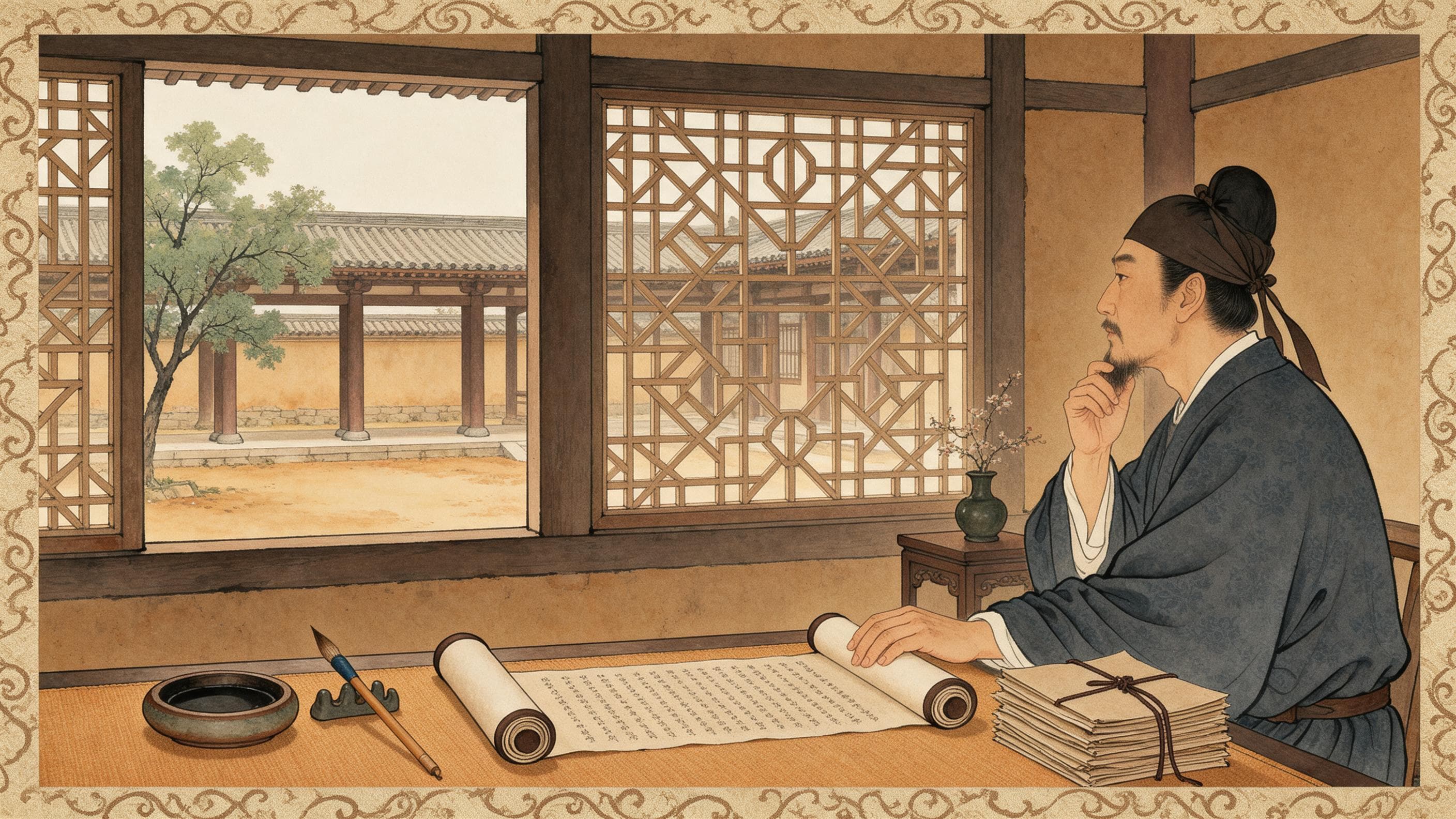
In a thirteenth-century guide to Hangzhou there is a chapter heading that reads like an occupation and an insult at once: 闲人, “idle persons.” What follows is not about leisure. It is about a trade, and it is graded. The definition is almost legal: “originally retainers, the middle and lower sort of Lord Mengchang's household; men who hold no occupational slot, and eat at other people's expense by means of idle business” (本食客也……但不着业次,以闲事而食于人者).
A trade written into a book
The Meng Liang Lu, a later Hangzhou book, has a chapter with the same title, opening “idle persons were originally retainers; Lord Mengchang kept three thousand of them, all guests.” Large stretches of the two chapters are identical, sentence for sentence, with a few characters changed. They are not two independent witnesses: one text was copied, expanded and recopied in the same city. What can be used is what the later version adds.
Both books organise the chapter the same way, by what a man could offer. Men who could write and play music came first; men who could keep birds and fight crickets came next; men who could run errands and broker deals came after that; and last came the men who could do nothing but present themselves and ask for money. The scale is not measured in cash. It is measured in distance from respectability.
Guests, tutors and a list of skills
The top layer was still treated as guests. In the great houses, the Meng Liang Lu says, a man who instructed the children was a 馆客, a “house guest”; a man who could “discourse on antiquity and the present, chant poems and match songs, play chess and the zither, throw arrows into a pot, ride, and dash off bamboo and orchids in a few strokes” was a 食客, a “retainer” — and this was what 闲人 meant. Below them were the “good-for-nothing sons”: able to read, write and handle music, but “not proficient in the hundred arts,” who accompanied rich young men to parties and out-of-town officials around the capital. Below them, men who wrote letters and ran deliveries for brothels.
Then the skills. The book gives a list: “such as 纽元子, imitating the calls of street vendors, training insects, playing instruments, miscellaneous crafts, singing narrative and patter, drinking games and riddles, water tricks and boxing, and being good at running messages and waiting on guests” (如纽元子,学像生叫声,教虫蚁,动音乐,杂手艺,唱词白话,打令商谜,弄水使拳,及善能取覆供过,传言送语). What 纽元子 was, neither book explains and nobody now knows for certain. One item on the list would buy a man a place in a rich household.
Another grade was the 棚头, also called 习闲, “the practised idler,” or simply 闲汉, “idle fellow”: “hawks on the forearm, falcons on a perch, pigeons trained, quail fought, cocks fought, gambling and the catching of live things” (凡擎鹰、驾鹞、调鹁鸽、斗鹌鹑、斗鸡、赌博、落生之类). The Meng Liang Lu adds fighting yellow-headed birds, keeping a hundred kinds of insects, and crickets. None of this produces anything. What it produces is the right to be around people who are being entertained.
The barber who carried two trades
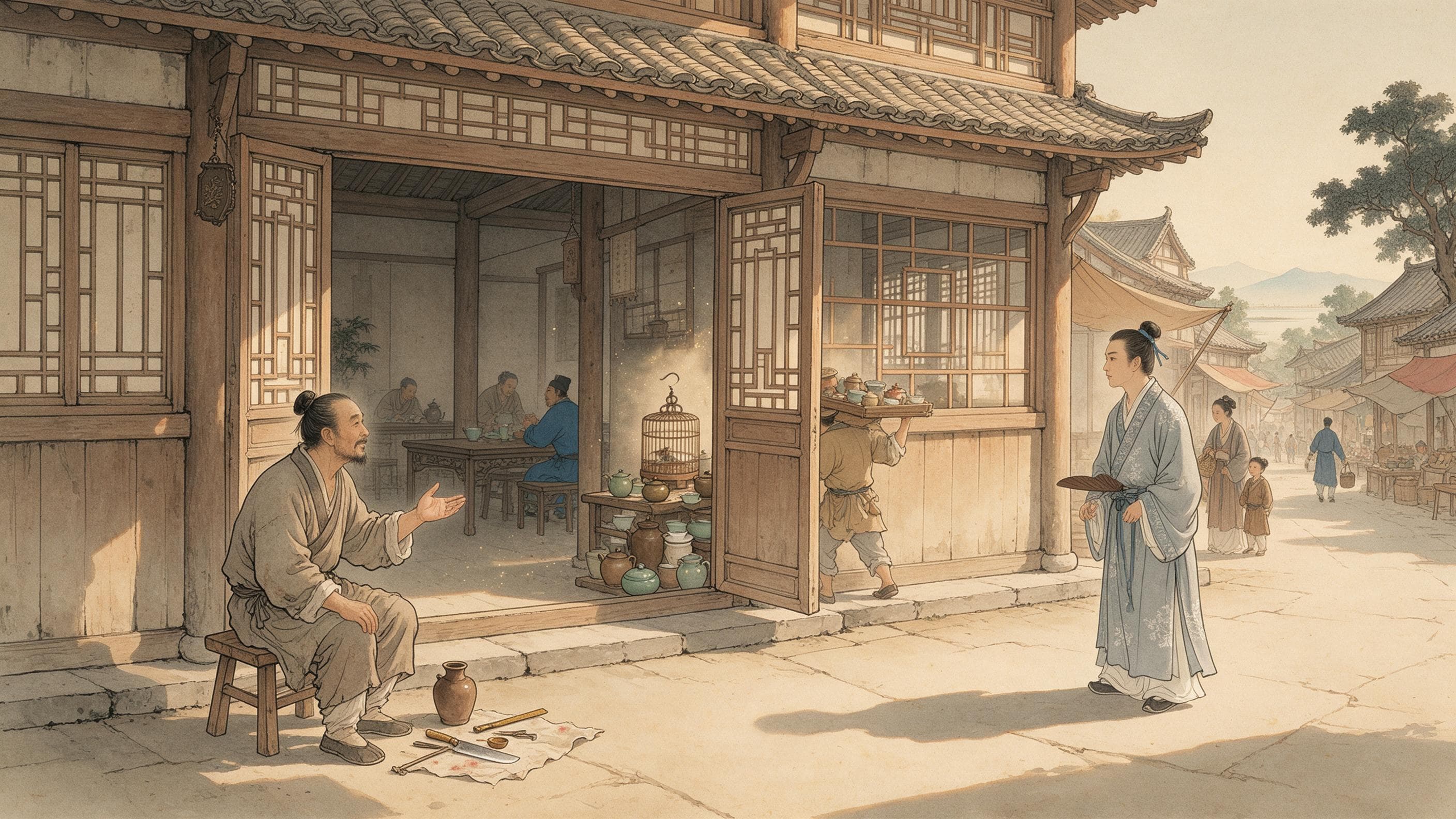
The next grade has the best name in the chapter. “There is another sort of craftsman who specializes in the knife and tweezers, going in and out of compounds, courting young gentlemen, doing odd jobs for them, arranging flowers and hanging pictures, bringing buyers and sellers together, helping along dubious undertakings; he is called a 涉儿, which takes the sense of wading across” (专攻刀镊,出入宅院……插花挂画,说合交易,帮涉妄作,谓之涉儿,盖取过水之意). The knife and tweezers are the barber's tools — shaving, trimming, cleaning ears. The trade that put a man's hands near a customer's face also put him inside the house.
The name explains itself: wading across, from one bank to the other, ferrying between two people and two deals. He had no shop and no guild. What he had was a face that got through the gate.
Set this beside the Meng Liang Lu's chapter on hiring, and the line becomes visible. Legitimate employment ran through brokers and guarantors: “for all hired labour and men of affairs … each has a 行老 to lead him in. If one absconds and takes goods with him, the original guarantor is sought out and made to track him down” (俱各有行老引领……有元地脚保识人前去跟寻). Pawnshop managers, tavern stewards, chair-bearers, cooks — every one of them had a broker, and a guarantor behind the broker. The 涉儿 had neither. He did the same kind of work off the register. The 闲人 is the unrecorded half of the labour market.
Sibo, who sold a greeting
The bottom grade had a name: 厮波. “There is another sort with no proper craft at all, who make it their business to find out which singing house has guests and to hurry over and hail them, to buy things and wait on people, and at the lake, in taverns, wherever there is drinking, to use the offering of incense and the pressing of a cup as their pretext for begging money to support a family — these are called 厮波” (以献香送劝为由,乞觅赡家财,谓之厮波). What he sells is very light: an appearance, a compliment.
Both books close the grade with the same sentence: “if you notice them they are insatiable; if you do not, they put on a brave face and ingratiate themselves, displaying all their tricks, and will not stop until they have got something” (若顾之则贪婪;不顾之,则强颜取奉,多呈本事,必得而后已). The writers stand on the side of the man being asked. That contempt is itself part of the evidence: this is how such people were recorded.
Beauty traps and daylight thieves
Further down, the heading is no longer 闲人 but 游手, “roving hands.” The Wulin Jiu Shi has it: “in a crowded district, with people in abundance, the roving and the cunning are truly many. There are what are called the beauty trap, the deposit-house gambling den, the water-merit bureau — and more besides” (有所谓美人局,柜坊赌局,水功德局,不一而足). Three names are given and not one is explained. How each swindle worked, the text does not say; the explanations usually offered are guesses. What the source guarantees is only that these things had names, and that contemporaries understood them at once.
The 白日贼, the “daylight thief,” is described more concretely: “they buy and sell goods, passing the false for the true, until paper becomes clothing, copper and lead become gold and silver, earth and wood become aromatics, transformed as if by magic — these are called daylight thieves” (以纸为衣,铜铅为金银,土木为香药,变换如神,谓之白日贼). The received text writes 铜铅为金银 twice over; the repetition is a copyist's slip and is not reproduced here. Men who cut purses and hook girdle-pendants in the market crowd are 觅贴儿. The gangs that swaggered through the streets carried nicknames like 拦街虎, “street-blocking tiger,” and 九条龙, “nine dragons.”
The only number in the passage counts the men who chased them: the capital investigation office, with its commissioners and clerks down to the ward patrols, “several thousand men in all, whose sole duty is arrest” (凡数千人,专以辑捕为职). How many idlers there were is not given. What they earned is not given. What happened to them after arrest is not given.
So what survives is a taxonomy, not a census. It was drawn up by men on the respectable side, who fixed each slot with a word — cunning, base, thuggish — and the Ducheng Jisheng even reaches back to Lord Mengchang of the Warring States to make the category old and faintly dirty at the same time. How a city digested the people it had no place for is in these few pages: give them names, put them in a column, and hand them to several thousand constables.
Sources & further reading
- 耐得翁《都城纪胜》「闲人」(Nai Deweng, Ducheng Jisheng, section "Idle Persons") — The definition of the 闲人 as a man with no occupational slot, and the five grades from cultured hanger-on to incense-offering beggar.
- 吴自牧《梦粱录》「闲人」(Wu Zimu, Meng Liang Lu, section "Idle Persons") — The later, fuller version of the same chapter, adding the 馆客, the cricket-fighting 闲汉 and the name 厮波.
- 周密《武林旧事》卷六「游手」(Zhou Mi, Wulin Jiu Shi, juan 6, "Idlers") — The confidence tricks — 美人局, 柜坊赌局, 水功德局 — the 白日贼 who pass paper for cloth and lead for silver, and the thousands of police employed against them.
- 吴自牧《梦粱录》卷十九「顾觅人力」(Wu Zimu, Meng Liang Lu, juan 19, "Hiring Labour") — The licensed hiring route through 行老 brokers and guarantors, which the 闲人 by definition stood outside of.