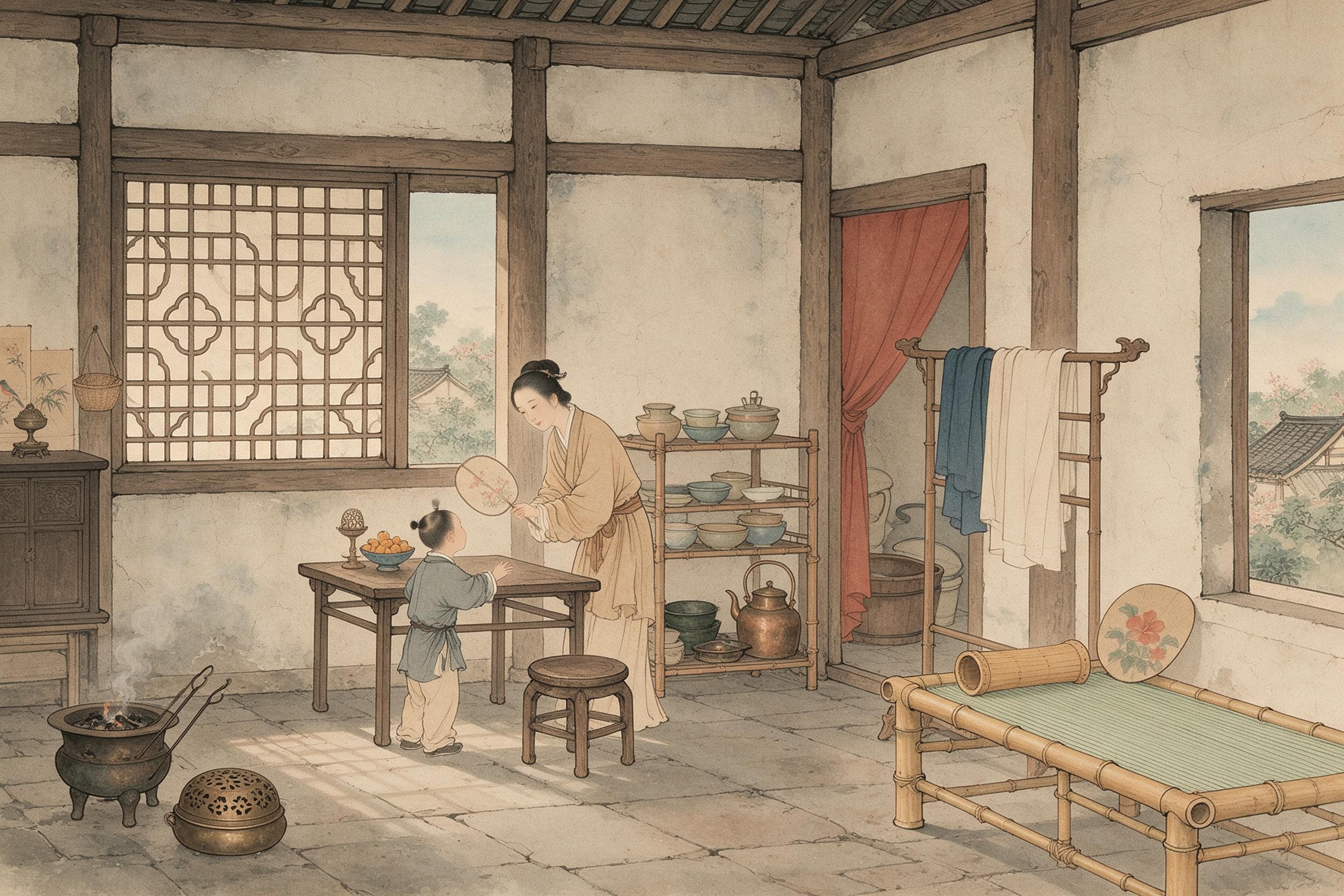
Read out a market list from Southern Song Lin'an and you walk into a room: tables, stools, a cool bed, folding chairs, low seats, a rope bed, bamboo chairs, a clothes rack, wash basins for face, feet and body, a chamber pot, pillows, bean bags, a 'bamboo wife' (竹夫人), a reclining frame, summer mats of bamboo, straw and rush. This is not a novelist's description. It is the goods list in juan 13 of Wu Zimu's Mengliang Lu, item by item, of what a city could sell — and it shows what a Song house contained more concretely than any phrase about antiquity.
One room, item by item
By use, the list falls into groups. Sitting and lying: tables, stools, folding chairs, low seats, rope beds, cool beds, bamboo chairs. Bedding and mats: pillows, bean bags, the bamboo wife, a reclining frame, bamboo summer mats, straw mats, rush mats, plain mats. Washing and waste: washbasins — 面桶 for the face, 脚桶 for the feet, 浴桶 for the body, and a 项桶 whose exact use the list does not explain — plus a bucket stand and a chamber pot (马子). Hanging: red curtains, mottled-bamboo curtains, curtain hooks. Metal: a copper kettle, a copper pot, an iron, fire tongs and fire chopsticks, a slotted ladle, a bronze hand-warmer. And there are incense burners, incense cakes and charcoal briquettes. The list also mixes in goods for shops and taverns — the 'urgent needs of the wine market', such as wine cups and decanters — so it is a catalogue of supply, not an inventory of one household. The list goes on far beyond furniture: porcelain, bowls, dishes, tea cups, a mortar, bamboo strainers, steamers, water vats, earthenware pots, a rice-washing basket; a rack for clothes, an inkstone, brushes, ink, a bookshelf, scissors, paper; combs of wood and horn, toothbrushes, mirror cases, needles and thread. A room needed far more than a few pieces of furniture.
The bed, the mats and the bamboo wife
The bedding shows how a southern summer was lived. There is a 'cool bed' (凉床) and a 'rope bed' (绳床, its sleeping surface strung with rope); on the bed goes a 'cool mat' of bamboo (凉簟). Straw, rush and bamboo mats (槁荐, 蒲合, 席子) lie under or over. Besides pillows there is the 竹夫人, 'the bamboo wife', a hollow bolster woven of bamboo, held at night for coolness; the 懒架 was probably a reclining frame, but its exact form is uncertain, so only the name is given here, without a drawing. Most materials can be read off the names — bamboo chairs, bamboo wife, bamboo mat, rope bed, rush mat: a house of bamboo, wood, cane and grass, not of rosewood. The furniture is low, too: tables, stools, low seats and folding chairs all belong to a floor-sitting order of life. Curtains and hooks on the same list show that a room was divided and shaded as much as furnished.
Fire for the winter
The heating gear is on the list as well: a bronze hand-warmer (铜火炉), fire tongs (火箸), fire chopsticks (火夹), and an iron (熨斗) — all implements that deal with fire. The same list sells 香饼炭墼, scented cakes and charcoal briquettes. In Kaifeng a little earlier, according to juan 3 of the Dongjing Menghua Lu, there were people who 供香饼子、炭团 — supplied incense cakes and charcoal balls — and in summer 洗毡淘井者, cleaners of felt and wells, appeared with the season. How exactly a Song household burned its charcoal, and how a hand-warmer was used, the sources do not describe; and neither book records the price of charcoal or how much a winter consumed.
The people who came to the door
Behind the list lies another layer: things were repaired, and water was delivered. The Mengliang Lu says that 供人家食用水者,各有主顾供之 — those who supplied household water had their regular customers; that 扫街盘垃圾者,每支钱犒之 — street sweepers collecting rubbish were paid a few coins; and that in the lanes there were regularly lacquerers and repairers, men with great axes splitting firewood, umbrella-menders, pewter-workers, stove-menders, men who fixed leaking pots, and craftsmen who hooped buckets, riveted, patched cooking pots, mended shoes, repaired official caps and ground mirrors — 时时有盘街者,便可唤之, men walking the streets at all hours, ready to be called. There were also incense-stamp men who 各管定铺席人家,每日印香而去,遇月支请香钱 — kept a set of shop households, stamped incense for them daily, and collected their incense money by the month. Kaifeng's list matches: hooping buckets, repairing utensils, mending shoes, and water-sellers 各有地分坊巷, each with his own lanes. It is also domestic in a smaller way: 若养马,则有两人日供切草;养犬则供餳糟;养猫则供猫食并小鱼 — keep a horse and two men brought cut grass daily, a dog and there was mash, a cat and there was cat food with small fish. The same juan lists the workshops such trades belonged to — 碾玉作 (jade grinding), 木作 (woodwork), 砖瓦作 (brick and tile), 泥水作 (plastering), 石作 (stone), 竹作 (bamboo), 漆作 (lacquer), 钉铰作 (riveting), 箍桶作 (coopering), 裁缝作 (tailoring), and a 修香浇烛作 for incense and candles: a whole division of labour aimed at houses and their fittings. It also lists rows and markets — vegetables, fish, crab, ginger, water caltrop, pork, cloth, chickens; a charcoal-bridge medicine market, a flower market, a bead market, a meat market, a rice market — and a 香水行, the class name under which bathhouses were registered. In short, the room came with a service list: water, rubbish, repairs, incense — and a bathhouse down the street.
What the list cannot tell you
The limits have to be stated. First, this is a market catalogue, not a household account: it shows what Lin'an could sell, not what any family owned, and the difference between a poor house and a rich one is invisible on it. Second, there are no prices anywhere — not for a bed, a hand-warmer or a month of incense money — so nothing here is valued. Third, there are no dimensions, methods or arrangements: how big a room was, where the bed stood, how a curtain hung, must come from other material. Fourth, this is Southern Song Lin'an with a Northern Song Kaifeng cross-check, and cannot be stretched into 'all Song houses alike'. One gap should be admitted plainly: lighting — lamps, candles, lamp oil, how they were bought and burned — is not systematically covered by this list, and is not padded out here. The practical question remains: what did it cost to furnish a room from this list? No one kept that account for us. But the list makes one thing visible: a room like this was assembled from many small purchases — bed, mat, pot, basin, brazier, curtain — added one at a time, not inherited as a set.
Sources & further reading
- 吴自牧《梦粱录》卷十三·诸色杂货(南宋临安,成书约1270年代) — 「家生动事」货单:桌、凳、凉床、交椅、兀子、绳床、竹椅、衣架、面桶、项桶、脚桶、浴桶、马子、枕头、豆袋、竹夫人、懒架、凉簟、槁荐、蒲合、席子;铜铁器(铜铫、熨斗、火锹、火箸、火夹、铜火炉、帘钩);香饼炭墼;上门服务(供食用水各有主顾、扫街盘垃圾支钱、箍桶、钉铰、修锅铫、磨镜、供香印盘月支香钱);另有行名、铺席名目。同一卷还载团行、都市钱会、铺席等,本文只用「诸色杂货」一条
- 孟元老《东京梦华录》卷三·诸色杂卖(北宋开封,南渡后追忆) — 「若养马,则有两人日供切草;养犬则供餳糟;养猫则供猫食并小鱼」「箍桶、修整动使、掌鞋」「日供打香印者…时节即印施佛像」「其供人家打水者,各有地分坊巷」「供香饼子、炭团」「夏月则有洗毡淘井者」