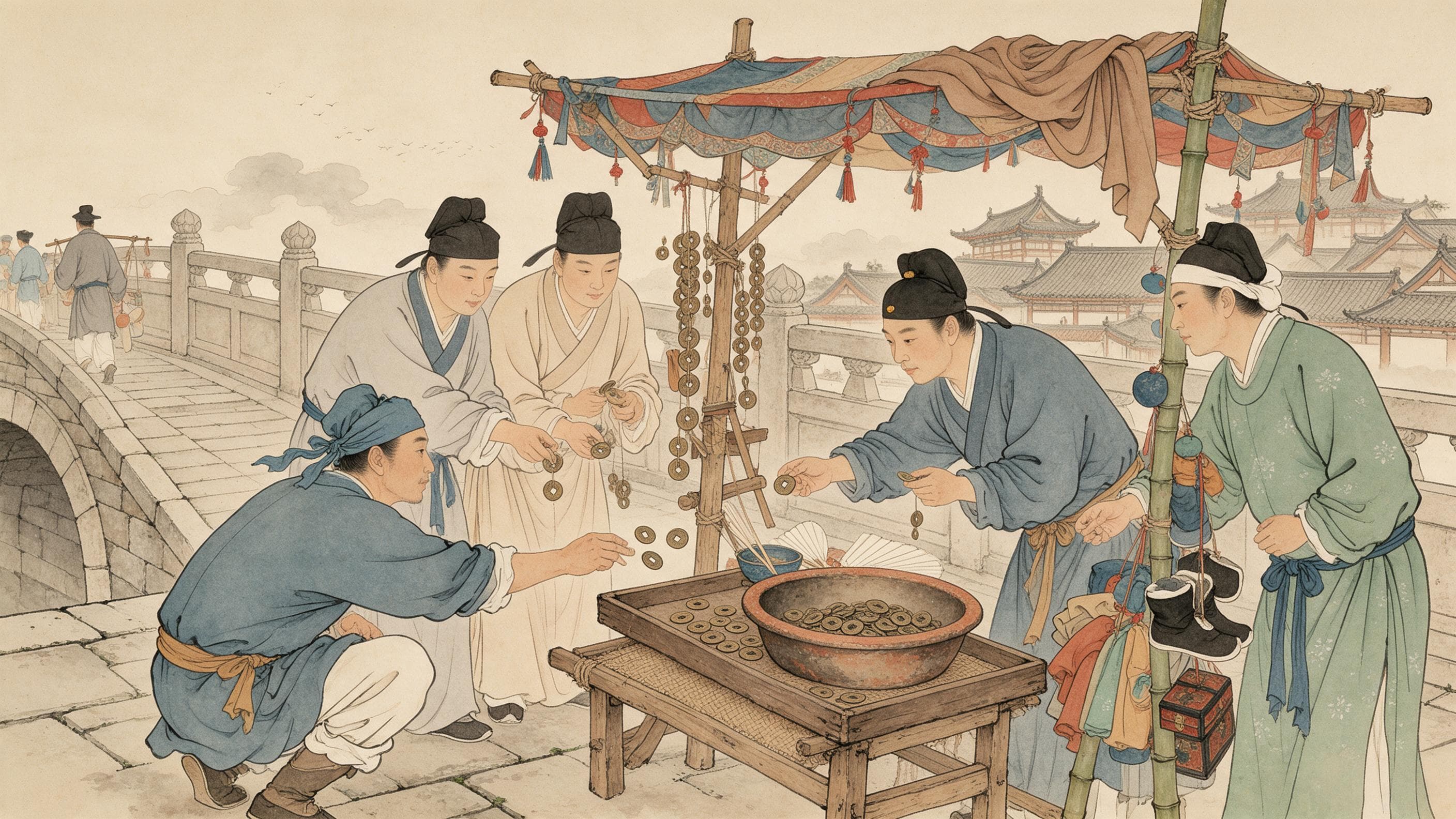
On the first day of the third month the Golden Brightness Pond (金明池) opened, and the bridge across it filled with shallow earthenware basins. Men set them on the walkway, tossed copper coins into them, and settled wagers on how the coins came to rest — staking cash, clothes, household goods. The pond stayed open until the eighth day of the fourth month; for that month the basins and the crowds were part of the capital's spring, "visitors coming and going, lotus-leaf parasols in sight of one another." The wager was called guanpu (关扑): buying by gambling, a purchase in which a throw decides who takes the thing home. It is the one scene in the record with bodies in it. Almost everything else about guanpu survives as rules, goods and numbers. The basin is the whole mechanism in miniature: a price agreed, a stake laid down, a throw to decide.
Three days the prefecture released it
The year opened with the prefecture releasing guanpu for three days: 开封府放关扑三日. Stalls went up at the horse market, on Panlou street, outside the Song, Liang and Fengqiu gates and along the south of the city, each under a coloured awning. Inside stood combs, kingfisher and pearl ornaments, hairpins, clothes, artificial flowers, collars, boots and curios — and just as readily food, utensils, fruit, firewood and charcoal. Stallkeepers called their wares in singsong, 歌叫关扑, to draw a crowd. Toward evening women of good families came in to watch, the text says 纵赏关赌, and afterwards went to drink in the taverns; even the poor turned out in clean new clothes. The Cold Food festival and the winter solstice each got three days of the same. The solstice mattered as much as the New Year: families saved and borrowed through the year, the text says, to put on new clothes for it, prepare food and make offerings to the ancestors — and the prefecture released guanpu again, 一如年节. Whether the women who came to watch also placed bets is never stated.
The operative word is 放, released. This was not a licensed trade with a fee schedule; it was a window the prefecture opened and shut. Which implies that the rest of the year was not open, though how tightly guanpu was restricted on ordinary days is not recorded. By the Xuanhe years the lantern display at the Zaozhao gate had 关扑买卖 on both sides of the road, stall after stall, folded into the market that supplied the palace.
A month at the pond
The pond kept a much longer window. The halls' corridors were lined with guanpu, food sellers and entertainers; the bridges held the basins; deeper inside, apart from the wine houses and performers who held their pitches, the rest of the space was netted over with coloured cloth, and the stalls beneath it spread out jade, curios, bolts of silk, utensils, tea and wine vessels. The odds are given once, at their most spectacular: 有以一笏扑三十笏者 — one hu staked against thirty. A hu was a unit of silver whose exact weight is unsettled, so it is left standing rather than converted. The stakes ran past goods altogether: carriages, houses, land, singers and dancers, all 约以价而扑之 — the price agreed first, then the throw deciding who paid it.
Winners carried the day's takings home on a bamboo pole, 游人往往以竹竿挑挂终日关扑所得之物而归. The trade had names: Ren Datou and Huohuo San, listed among the 出九和合, a phrase nobody has explained, so only the two men are named here. It also ran small — clay elephants and painted paper were sold by throw, 卖扑, a few coppers at a time, the elephants being souvenirs of the imperial elephant parade that went with the great sacrifice. What the texts never supply is the mechanics. What was guessed, how many coins were used, who threw first: unrecorded. The stallholder's cut, and what happened when a loser would not pay: also unrecorded.
What the prefecture got out of it
The state's profit is real and indirect. Inside the park, fishing required a licence bought on the spot, 必于池苑所买牌子, and the fish a visitor caught could be bought back at twice the price. Stands along the water were rented out, 临水假赁. The street on the east side held taverns, broker yards, entertainers and pawnshops, and the pawnshops held their pledges until the pond closed, then sold off whatever was never redeemed. So the takings came from licences, rents and the crowd itself — the park was the doorway, and the money was in the ring of business around the people it drew. On guanpu there is no tax entry anywhere: no 关扑 fee, no percentage, no register. The festival was the argument; the spending around it was the arithmetic.
A century later it no longer waited for the festival
In Southern Song Lin'an, guanpu left the festival calendar and moved into the night. The main streets traded around the clock, guanpu stalls standing beside the food stalls: honey cakes, lotus root stuffed with rice, seasonal fruit, sugar figurines, fresh fish, pork and sheep trotters, painted silk fans. The stock changed with the season — bead-strung lanterns in winter and spring, blue gauze and grass-cloth mosquito nets in summer and autumn (Meng Liang Lu, juan 13, 1270s). By 1235 a writer could describe the lanes' markets — buying, selling, guanpu, wine shops and singing houses — going on until the fourth drum, 四鼓, the hours before dawn; the best pitches were in front of the Central Tile theatre, 中瓦前, where fine vessels and "a hundred kinds of goods" went by throw, no different from daytime (Du Cheng Ji Sheng). On West Lake excursions guanpu was catalogued among the lake's "local products", beside fruit, soup and wine (Wu Lin Jiu Shi, juan 3). One wealthy man opened his garden in spring and, the text says, amused himself by imitating guanpu. By then the trade had a second word, 扑卖, used almost interchangeably.
The contrast between the two capitals is the argument. Kaifeng shut guanpu into three days at the New Year and one month at the pond; Lin'an let it run until the fourth drum as ordinary shopping. What did not change was the silence around the numbers: the rule of the throw, the stall's margin, the price of the goods. Four notebooks all stop at the same line. They do not even answer whether a guanpu price was inflated to cover the risk, since no text sets the two prices side by side. Which returns the question to the basin: if a thing could be had by throwing for it, what was its ordinary price worth?
Sources & further reading
- 孟元老《东京梦华录》卷六·正月、十六日 (Meng Yuanlao, Dongjing Meng Hua Lu, juan 6, "First Month" and "Sixteenth Day") — New Year's Day, when the Kaifeng prefecture released guanpu for three days: the stall locations and goods, women of prominent families attending, and Xuanhe-era stalls at Zaozhao Gate.
- 孟元老《东京梦华录》卷七·三月一日开金明池琼林苑、池苑内纵人关扑游戏 (Meng Yuanlao, Dongjing Meng Hua Lu, juan 7, "Opening Jinming Pond" and "Gambling in the Park") — Tossing head coins into a ceramic basin; one hu staked against thirty; carriages, land, houses and performers all "priced and gambled for"; winners hang their winnings from bamboo poles. The electronic title reads 範苑 for 池苑, a transcription error.
- 孟元老《东京梦华录》卷十·冬至、大礼预教车象 (Meng Yuanlao, Dongjing Meng Hua Lu, juan 10, "Winter Solstice" and "Rehearsing the Elephants") — "The authorities release guanpu, with visits and congratulations as at New Year"; clay elephants sold at a lottery-style sale.
- 吴自牧《梦粱录》卷十三·夜市 (Wu Zimu, Meng Liang Lu, juan 13, "Night Markets") — The Southern Song contrast: guanpu along the main streets, with goods changing by season; not to be merged with the Northern Song three-day release.
- 周密《武林旧事》卷三·西湖游幸、放春 (Zhou Mi, Wulin Jiu Shi, juan 3, "Imperial Excursions on West Lake" and "Spring Outings") — Local products of the lake include guanpu; private gardens "playfully imitate guanpu".
- 灌圃耐得翁《都城纪胜·市井》 (Guanpu Naideweng, Ducheng Ji Sheng, "City Markets") — "In the lanes and markets, buying and selling, guanpu... quiet only after the fourth watch."