On the ninth day of the ninth month, a Song city did three things at once: it looked at flowers that had names, it ate a cake with a lion standing on it, and it walked out of the gate to a hill. The two books that describe this are both acts of memory — the Dongjing Meng Hua Lu, a Southern Song recollection of the Northern Song capital Kaifeng, and the Wulin Jiu Shi, written after the fall of Lin'an. Neither describes a festival being lived; both describe a festival being missed. That does not make the details less useful. It makes them precise about the things people bothered to remember.
Chrysanthemums with names
The Kaifeng chapter on Double Ninth does not begin with a custom. It begins with a list of flowers. “The yellow-white kind, its heart like a lotus pod, is called Wanling ju; the pink is Taohua ju; the white with a sandalwood-coloured heart is Muxiang ju; the yellow and round one is Jinling ju; the pure white and large one is Xirong ju — there is nowhere without them.” Five names, sorted by colour, heart and shape. A modern chrysanthemum catalogue runs to thousands of varieties; this Song city could name five, and the point of the list is the last clause. These were not rarities behind a wall. They grew everywhere.
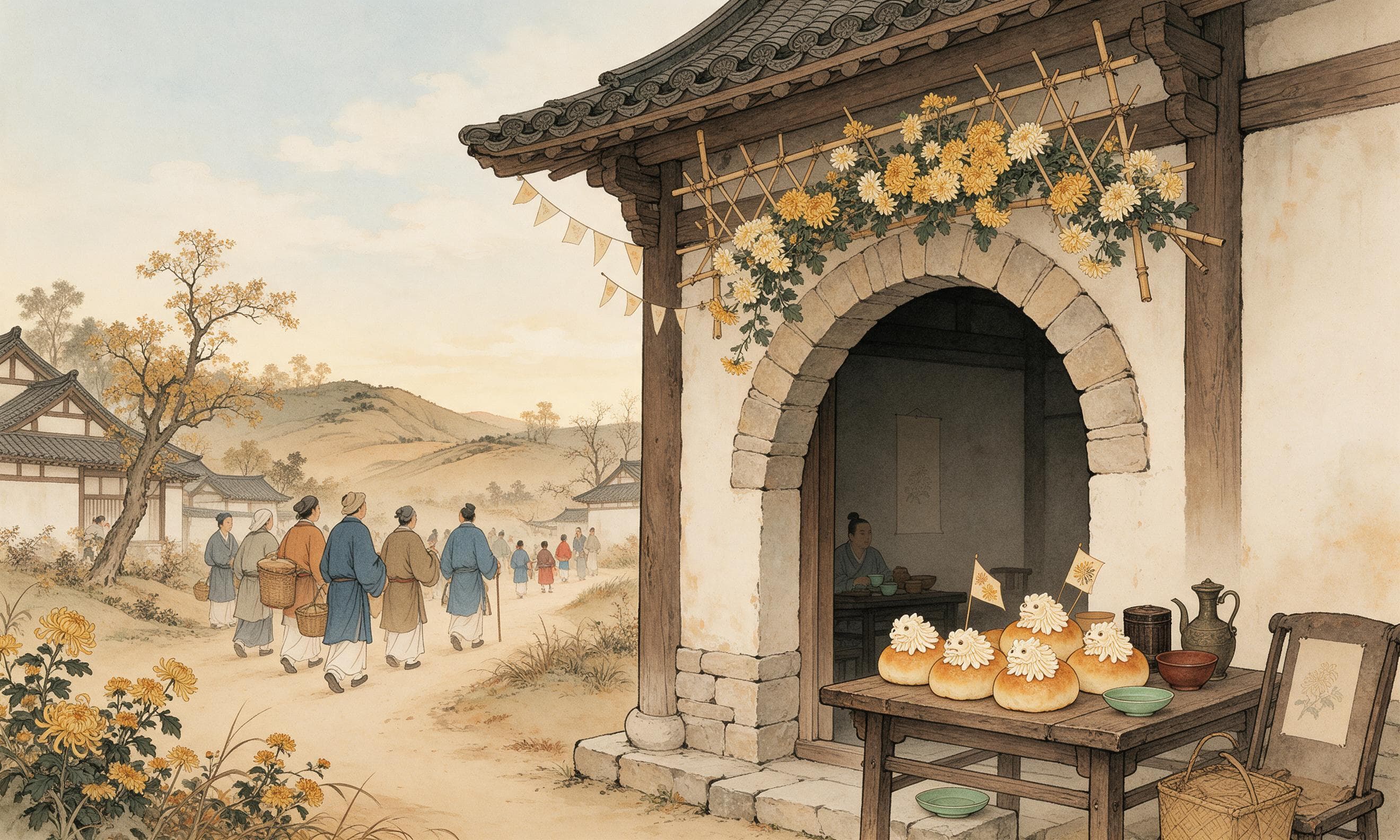
The taverns used them as architecture. “The wine houses all bound chrysanthemums into a cave-like doorway.” A doorway built of flowers, so that a customer walked through the season to reach the wine. The source gives one sentence, no dimensions and no method. The frames were probably bamboo and the flowers probably tied fresh each year, but that is inference. What is certain is that the display was commercial: it faced the street, and it was meant to be seen.
A lion on the cake
A day or two before the festival, households sent each other steamed cakes made of wheat flour, “with small coloured flags stuck in them and fruit arranged on top — pomegranate seeds, chestnut yellow, ginkgo, pine-nut meat.” Then came the figure that gives the cake its name: “Again, with flour they made the shape of a lion and a barbarian king, placed it on the cake, and called it shiman.” Whether that meant a lion, a king, or one lion-shaped king, the sentence does not say. The gift had to look like something before it could be eaten.
Lin'an elaborated. The Wulin Jiu Shi describes a cake of “sugar, meat and glutinous millet flour mixed together, topped with shreds of meat and duck cake, studded with pomegranate grains, flagged with coloured banners, and on it again a barbarian-king lion.” Sweet and savoury, meat and grain, in one block: not a sweet mooncake but something closer to a dish. A second confection was “millet ground to powder, mixed with honey, pressed in moulds and stamped into cakes.”
There was also a sweet with a poet's name: “spring orchid, autumn chrysanthemum” — perilla seed lightly steeped in plum brine, mixed with cane sugar and small pieces of orange and pomegranate. The name is a couplet; the thing itself is close to candied fruit. Why a lion, and why a barbarian king, the text does not say. The figure may have borrowed from the tribute lions and foreign envoys that city-dwellers knew by report. That is a guess, not a reading.
Out of the gate
“The city people mostly went out beyond the suburbs to climb high.” Then the names: Cangwang Temple, Sili Bridge, Choutai, the Liangwang city wall, Yantai, Maotuo Ridge, Dule Ridge. Seven places, all outside Kaifeng. Not one famous mountain — seven pieces of raised ground where a party could spread a mat.
What happened there was “banquet gatherings”. People carried wine, cakes and fruit out of the city for the day. The ninth month is dry and bright on the north China plain, and the terraces outside the city were within reach of a morning's walk. Most of these place-names have not survived as places. What survives is the shape of the outing: not mountaineering, but a search for slightly higher ground and a view.
Dogwood appears once. In Lin'an, the Wulin Jiu Shi says, people “drank new wine, floated dogwood in it and pinned chrysanthemums in their hair.” The fruit went into the cup; the flower was worn. Why, the text does not explain. Later handbooks say dogwood warded off evil and illness, and that explanation may well be later than the practice. All this source supports is the combination: new wine, dogwood, chrysanthemum, on the same day.
The lion sermons
The festival also belonged to the monasteries. In Kaifeng, “the various Chan monasteries each held a vegetarian assembly, but only Kaibao Temple and Renwang Temple had a lion assembly. The monks all sat on lions, performed the ritual and preached, and the crowds were largest there.” A sermon delivered from a lion seat, to a city on holiday.
This is the strangest and most specific detail in the Kaifeng chapter. It tells us that the lion was not only a cake ornament: on the same day, in two monasteries, monks sat on lions and preached. The text does not describe the seats, the sermons or the crowds beyond “largest”. It does suggest that the flour lion and the monastic lion belonged to the same vocabulary of the day, whatever that vocabulary meant.
Lanterns in the palace
The court spent the most. “In the palace, by custom, on the eighth day they prepared the Double Ninth banquet, set out ten thousand chrysanthemums in the Qingduan Hall — dazzling to the eye — and lit chrysanthemum lanterns, much as at the New Year.” The eighth day of the ninth month, one day early. “Ten thousand” is the usual rhetorical figure; the lanterns are the surprise. New Year was the lantern festival. Here the lantern festival was moved two months earlier and hung among flowers.
“Much as at the New Year” is the phrase to keep. The book adds that the lantern-viewing banquet “began here, and from this day grew larger” — the palace's Double Ninth is presented as the origin of a fashion. That claim comes from a nostalgic text written after the dynasty had fallen, and it may be an exaggeration. What is not in doubt is that the palace lit lamps in September.
Outside, the season changed on the stalls. “After the rain, when the cool came, there were already roasted ginkgo and wutong nuts cried in the market.” A few days later came the next festival's stock: grave clothes, shoes, hats and cloth, sold in the last third of the month for burning on the first day of the tenth. The Double Ninth did not end the calendar. It handed the street over to the next thing.
Sources & further reading
- 孟元老《东京梦华录》卷八·重阳 (Meng Yuanlao, Dongjing Meng Hua Lu, juan 8, “Double Ninth”) — Kaifeng's Double Ninth: the five named chrysanthemums, taverns arched with flowers, the seven hilltop gathering places, steamed cakes with flour lions, the lion sermons at Kaibao and Renwang monasteries, and the mourning clothes sold later in the month.
- 周密《武林旧事》卷三·重九 (Zhou Mi, Wulin Jiu Shi, juan 3, “Double Ninth”) — Lin'an's Double Ninth: the palace banquet on the eighth day with ten thousand chrysanthemums and chrysanthemum lanterns, new wine with dogwood and pinned chrysanthemums, the elaborate chrysanthemum cakes, and roast ginkgo cried in the market.