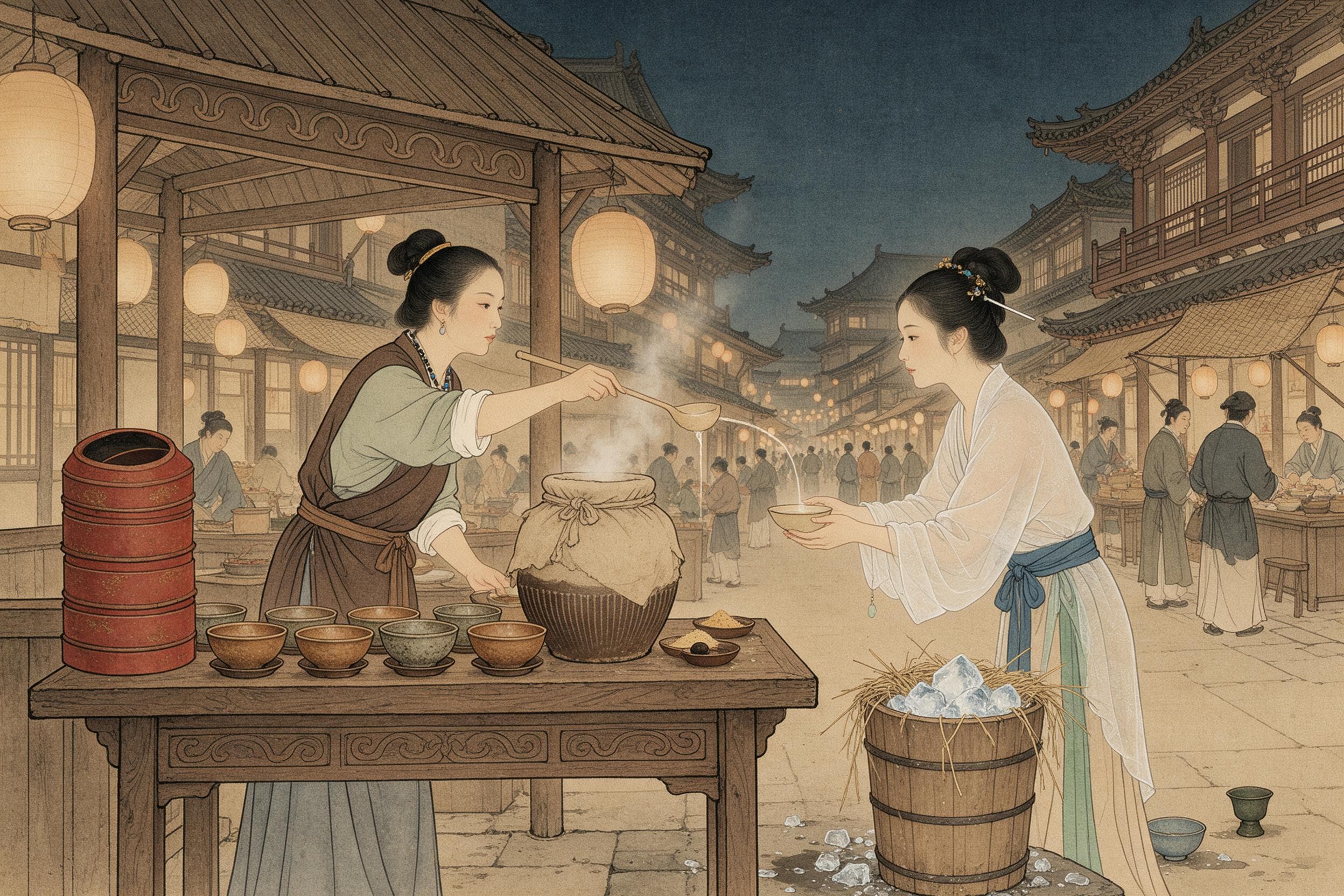
A summer night in Kaifeng, on the street running south from Zhou Bridge. The stalls carried "ice-cold leng yuanzi (冰雪冷元子), crystal jelly (水晶皂儿), brined papaya (生淹水木瓜), medicinal papaya (药木瓜), foxnut sugar (鸡头穰沙糖), green beans, liquorice ice water (甘草冰雪凉水), lychee paste (荔枝膏)" — followed by a long tail of pickles, apricot slices, ginger and lettuce shoots. Then the source adds one line: "all of it was stored in plum-red lacquered boxes." Cold food in lacquered boxes was the face of the night market, and the market ran until the third watch.
What the list contains
Read apart, the list in juan 2 holds three kinds of thing: iced sweets (the rice balls, the lychee paste), ice water (liquorice ice water), and brined fruit (brined papaya, medicinal papaya). The key word is bingxue (冰雪), "ice and snow", which is not one dish but a method: put ice in it.
Half the names can still be read. The ice-cold yuanzi were most likely chilled glutinous rice balls; lychee paste was lychee boiled down to a paste or syrup; brined papaya was papaya pickled and then chilled; medicinal papaya was cured with aromatics. What "crystal jelly" (水晶皂儿) actually was, the text does not say, and no recipe should be invented for it.
In juan 8, listing the sixth-month street trade, bingxue appears again with a detail attached: "ice was busiest at only two shops outside the old Song gate, and they used silver vessels throughout." The best-known ice sellers were two shops, and they served in silver. Ice in this city was not a cheap way to cool down; it came in a silver bowl.
The same juan also says that the sixth month was the height of summer, the three fu (三伏), when "people of the capital made the most of it": they went to pavilions by the water, to high towers, set out ice basins, floated melons in cold water and sent wine cups drifting along winding channels. Ice basins, cold water and chilled fruit were one way of living through the heat; the cold-drink stall was simply its most visible corner. The trade rode on that whole way of living.
Where the ice came from: not stated
The one link the sources leave out is the most important: where the ice came from. A Song city's summer ice ordinarily came from winter storage, but these two passages describe only the retail end — the stalls and the bowls — and never the icehouse, the cutting, the hauling. All that can be said is that ice was for sale and sold as a trade. Whether the supply was official or private, these texts do not say.
What is firm is the retail surface: ice, vessels, packaging. Ice was the raw material, silver the display, the plum-red box the takeaway. Whether a cold drink was expensive is not given; the "no more than fifteen cash apiece" in the Zhou Bridge passage refers to buns and the like, not to the cold water.
Lin'an's cold-drink list
After the move south the names multiplied. The Wulin Jiu Shi, juan 6, has a section headed "Cold Drinks" with seventeen entries: sweet bean broth, coconut wine, bean water, pear syrup, sour plum water, ginger honey water, papaya juice, tea water, aloeswood water, lychee-paste water, bitter water, kumquat balls, xuepao shuopi yin (雪泡缩皮饮, "snow-frothed shrinking-skin drink"), plum wine (梅花酒), aromatic elsholtzia drink, the five-ingredient powder, and perilla drink.
In that book "cold drinks" is a section of its own, standing between street foods, fruits, vegetables and porridge on one side and cakes on the other — a category, not an item on a wine-shop list. The classification is itself evidence: the trade was big enough to be listed apart.
The snow-frothed drink is the famous one, and the text keeps a note: the Song printed edition reads shuopi (縮脾) for shuopi (縮皮). "Plum wine" is listed separately from the snow-frothed drink; later writing often runs the two names together as "snow-frothed plum wine", but on this list they are two entries.
Among the seventeen are sweet soups, medicinal drinks (the elsholtzia drink, the five-ingredient powder and the perilla drink are all summer remedies) and wines. A cold drink in Song China belonged not only to food but also to medicine and to drink: the summer stomach was managed with all three.
Why the trade could live in a night market
Cold drinks could become a night-market line because the city had ice, spare cash and a night life. The Zhou Bridge market ran to the third watch, which means people were eating in the street late; silver vessels and lacquered boxes mean the trade could afford equipment. Whether these sellers had fixed premises or carried their goods is not separated in the record.
The Zhou Bridge passage also leaves a winter list: braised rabbit, roast pork skin, wild duck, sliced jellyfish, fried dumplings. On the same street summer sold ice and winter sold hot meat; the seasonality of the cold drink is written into that contrast.
What survives is a menu and a set of conditions: ice, silver, red boxes, a night market. What is missing is the recipe, the price, the icehouse and the vendor's name — all four, though the stalls came back every summer night. Of the Song summer's cold bite we know what it was called and what it was served in; not how it was made or what it cost.
Sources & further reading
- 孟元老《东京梦华录》卷二·州桥夜市 (Meng Yuanlao, Dongjing Meng Hua Lu, juan 2, "Zhou Bridge Night Market") — The summer list at the Zhou Bridge night market — ice-cold rice balls, crystal jelly, chilled papaya, liquorice ice water, lychee paste — packed in red-lacquered boxes, and the market running to the third watch.
- 孟元老《东京梦华录》卷八·是月巷陌杂卖 (Meng Yuanlao, Dongjing Meng Hua Lu, juan 8, "This Month's Street Sales") — The sixth-month street trade, where ice was sold: only two shops outside the old Song gate were busiest, and they served it in silver vessels.
- 周密《武林旧事》卷六·凉水 (Zhou Mi, Wulin Jiu Shi, juan 6, "Cold Drinks") — The Lin'an list of cold drinks, from bean broth and coconut wine to 雪泡縮皮飲 and 梅花酒, with a note that the Song printed text reads 縮脾 for 縮皮.