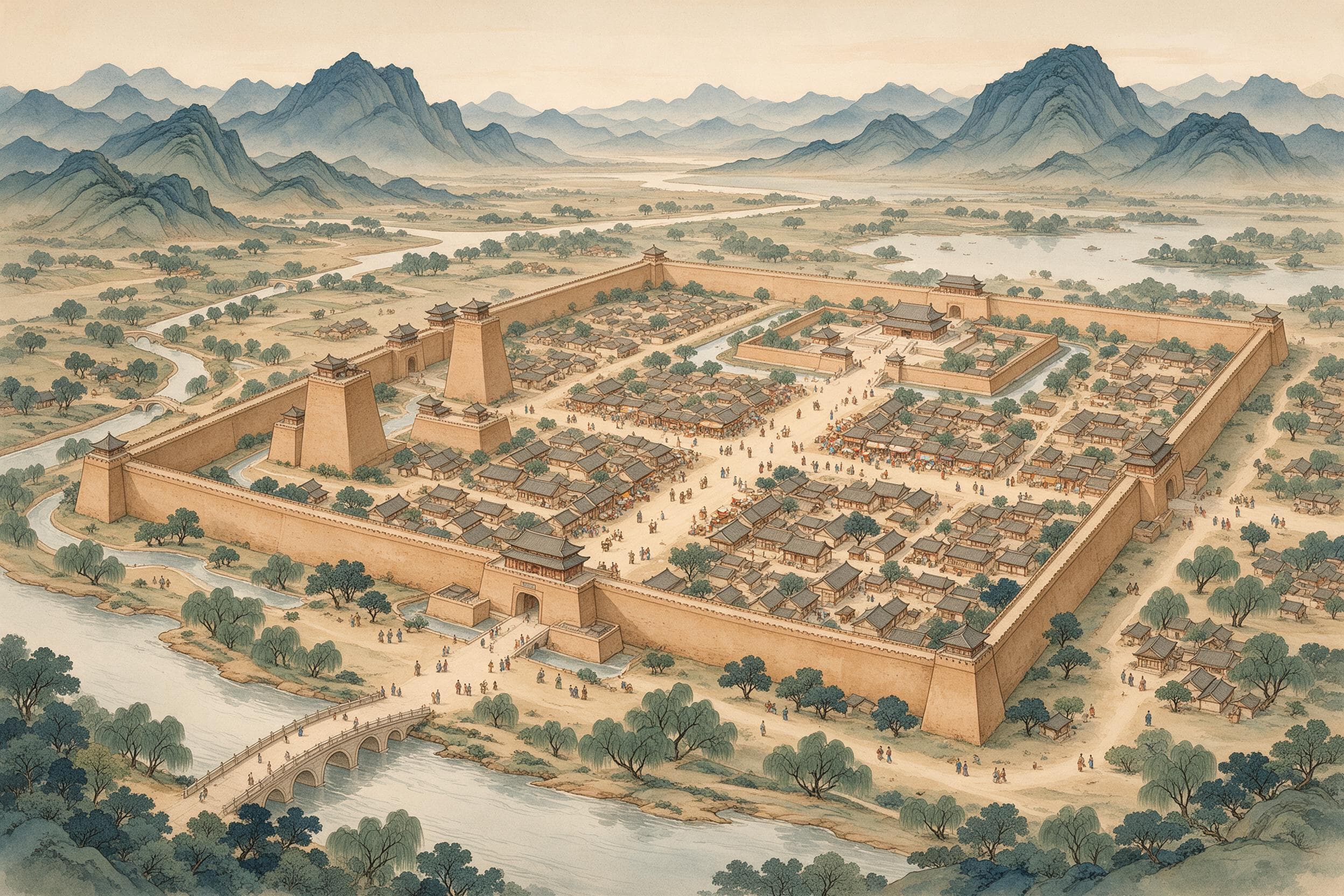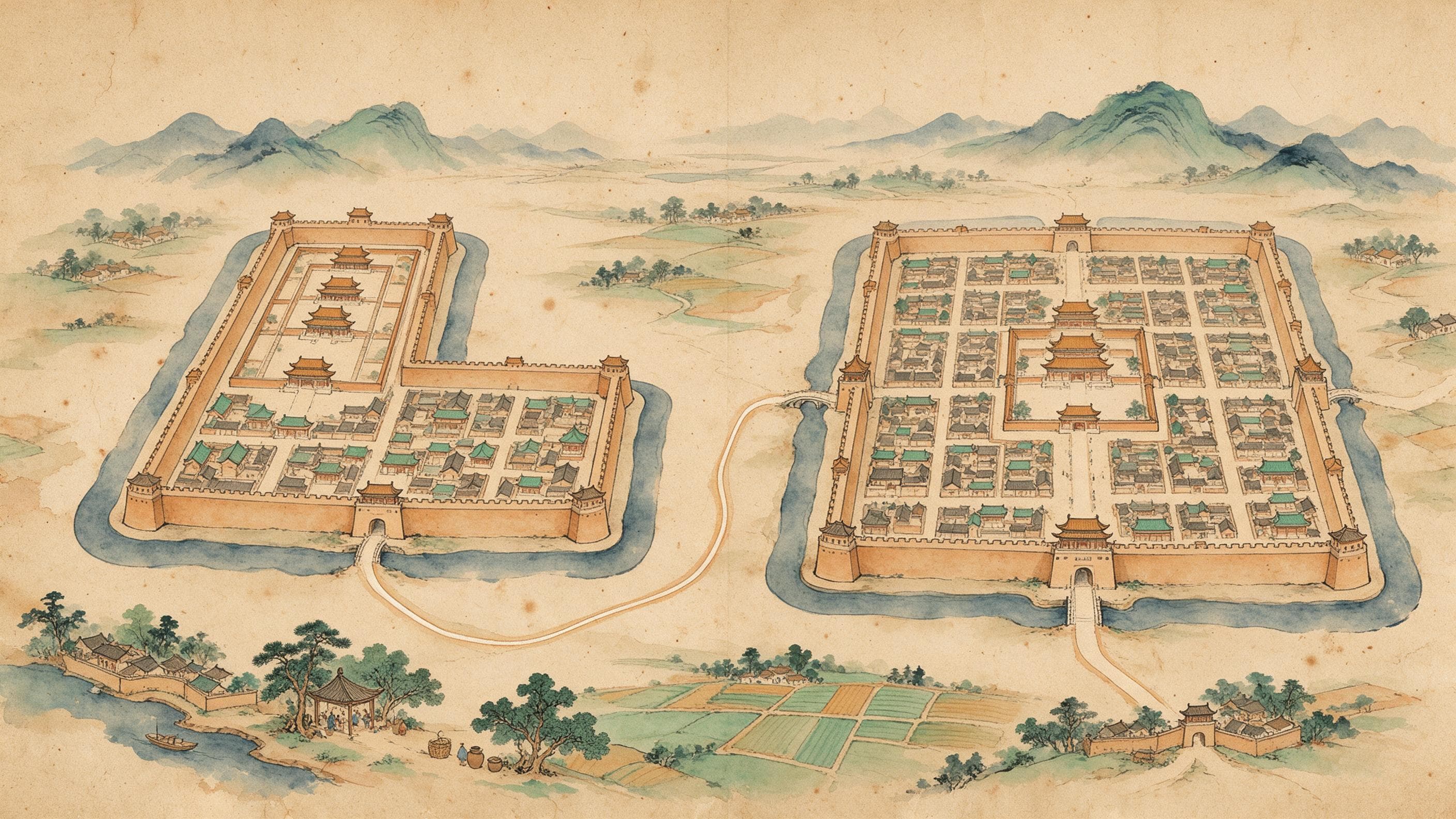
Winter in the Northern Song capital began with two deliveries. On the first day of the tenth month, “the authorities sent in charcoal for the warming braziers; among the people, everyone set out — the character is written jian, and later editions read jiu, wine — and held a brazier party.” The Kaifeng text is quoted here as it stands, with the doubt noted rather than silently corrected. Five days before the Beginning of Winter, the western imperial garden sent in winter vegetables: the capital was cold and had no greens in winter, so from the palace down to ordinary houses everything was laid in at once, “carts and pack animals filling the roads.” Charcoal and cabbages: that is how the season started. The same day the ministers received lined silk jackets, and three days later ordinary families went out of the city to sweep the graves.
The sources are four memoires of the two capitals: Meng Yuanlao on eleventh-century Kaifeng, Zhou Mi and Wu Zimou on thirteenth-century Hangzhou. They are notes, not ledgers. None of them gives a price for charcoal, a wage for the men who made it, a recipe, a size or a daily output. So this article does not describe how the thing was made. It describes where the trade stood in the city's winter: what hour it appears, who is called to the door, what it is sold beside, and which lane kept the name.
Two names: charcoal cake and charcoal brick
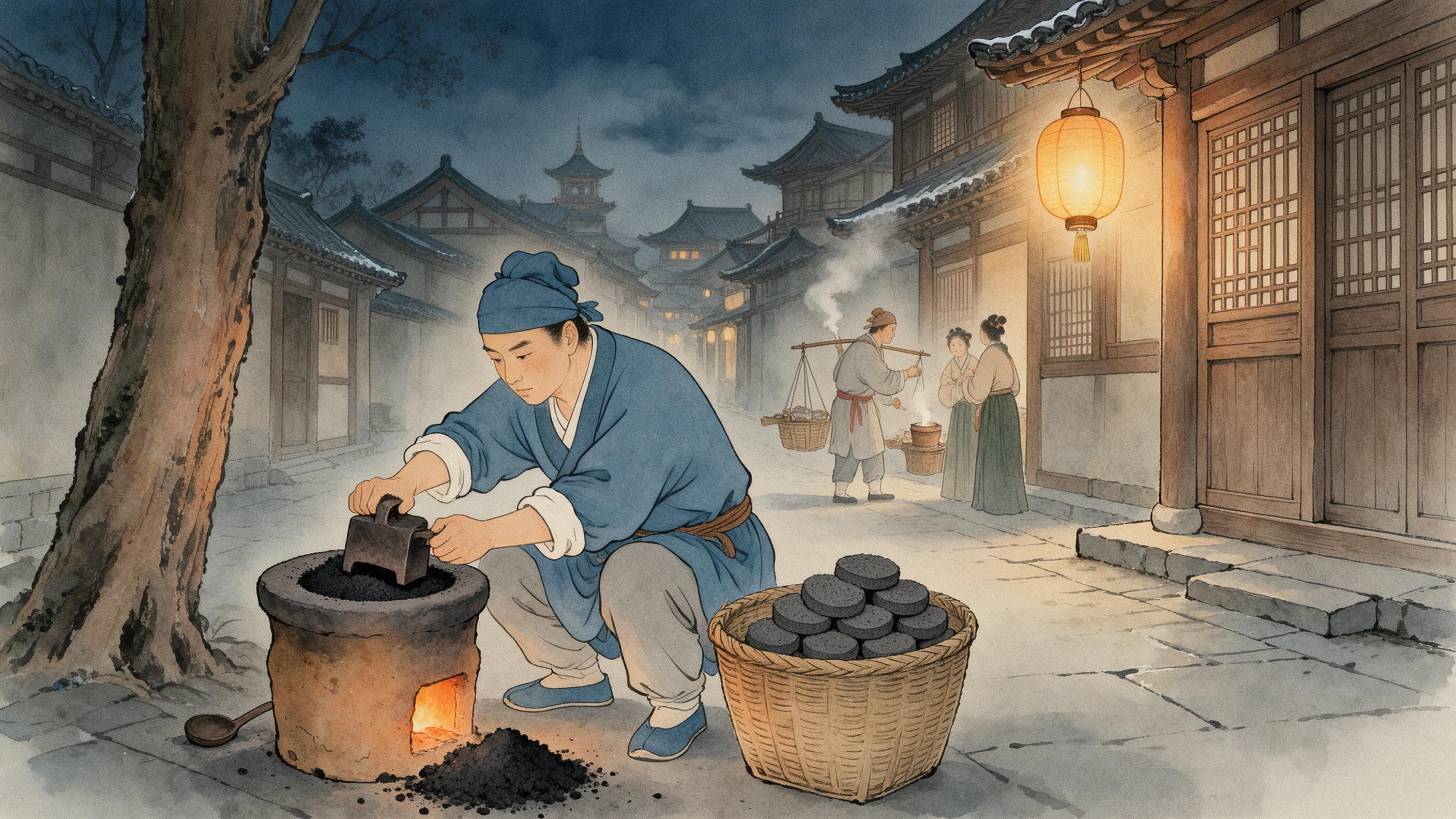
In Kaifeng it was tantuan, “charcoal cake,” listed among the door-to-door services in juan three: water carriers “each with his own ward,” then lacquerers, hairpin-makers, men with great axes splitting firewood, fan handles changed, “incense cakes and charcoal cakes supplied” — “at a word, before your eyes.” Kaifeng had the same pattern of fixed households: the man who printed incense “was attached to his shops, and at festivals printed Buddha images for distribution.” In Hangzhou it was tanji. Zhou Mi places “beating tanji” among the small trades “not found elsewhere,” beside mending pots, plastering stoves, stopping leaks and hooping buckets. The character ji originally means a pressed earthen brick, so the name carries the idea of pressing into a block — an inference from the word, not something the Song texts explain.
A shout at the door
The trade came to the house. In Hangzhou, Wu Zimou writes, “in the lanes and market streets there are always lacquerers and repairers... who supply incense cakes and charcoal cakes,” and in the same passage, “from time to time men go round the streets; call them and they come.” The paragraph lists a whole economy of door service: the man who prints incense “has his fixed shopkeeping households, prints for them every day, and is paid a monthly incense fee”; the water carrier “has his own customers”; the street sweeper “is tipped a few coppers.” Incense cakes and charcoal cakes travel together but are not one thing: the first is charcoal mixed with aromatics, burned in an incense burner; the second is fuel for a fire.
First a stove, then a cake
And fuel implies a stove. A few lines further down the same inventory: “earthenware wind-stoves and portable stoves for sale,” then copper and iron ware — “pressing irons, fire shovels, fire tongs, fire clips, copper braziers” — and a “baking tray.” A charcoal cake is not a thing on its own; it comes with a stove and a pair of tongs. That is also why this article can only describe its position: the objects are listed in detail, the process is not described at all.
Winter hours
Winter fixed the hours too. In Kaifeng “the night market ran until the third watch, and at the fifth it opened again”; “even in the great winds, snow and rain of winter there was a night market”; “only after the third watch did someone come by with a bottle of tea for sale.” At the fifth watch the monks and novices “went round the doors striking an iron tablet or a wooden fish to announce the hour,” and the wine shops “lit their lamps and sold by the cup, no portion more than twenty cash, with rice, food and snacks.” That twenty cash is the price of food and drink before dawn, not of charcoal, and it stays where it is. Hangzhou ran the same way: the night market until the third or fourth drum, the bell at the fifth, and in winter breakfasts of “five-flavour meat gruel and seven-treasure vegetarian gruel.” Its dawn round was the same institution: “at the fourth watch the monasteries rang their bells, and the novices and mendicants went along the streets striking iron tablets or wooden fish,” each in his own district, calling out whether the sky was clear or overcast, whether there was a great audience or a small one — “in wind, rain, frost or snow they dared not leave it out.”
Where the charcoal cake sits on that clock can only be inferred: it belongs to the stretch between the night market's end and the morning bell, when a brazier has to be kept alive. That is a reading of the timetable; none of the four texts states it.
A name left on the map
The name survived in street names. In Kaifeng, “Xianning monastery stands in Charcoal Yard Lane.” In Hangzhou the list of markets gives “the medicine market at Charcoal Bridge” — the medicine market stood at the bridge; the bridge is not a charcoal market. Elsewhere a fan shop is recorded “below Charcoal Bridge, on the river.” Such names show that charcoal marked the city's map. They do not show an industry, and they do not prove that either lane sold fuel.
What is absent is equally clear: no price, no wage, no daily output, no recipe, no size. There is no history of Song heating here, and no claim that Song cities were heated as public infrastructure. Nor is there coal: none of the four sources mentions stone coal at all, though Song cities did burn it — that is another file. Nor should a Song charcoal cake be imagined as a modern honeycomb coal ball: different material, different shape, different century, and one sentence is enough. An early-Song collection does record a comparable method from the Five Dynasties — charcoal dust, rice gruel, an iron mould, hammered hard — but that belongs to the Five Dynasties and to another article, and it is not presented here as Song procedure. What remains is position: the brazier party of the tenth month, a shout in the lane, an inventory that sets fire tongs beside the fuel, a night market after the third watch, and a bridge that kept the name.
Sources & further reading
- 孟元老《东京梦华录》卷九「十月一日」「立冬」(维基文库) — The first day of the tenth month: the authorities send in charcoal for the warming braziers, and among the people everyone sets out (the text reads 間, probably for 酒) and holds a brazier party. Five days before the Beginning of Winter the western garden sends in winter vegetables; the capital was cold and had no greens in winter, so carts and pack animals filled the roads.
- 孟元老《东京梦华录》卷三「諸色雜賣」「上清宮」「馬行街鋪席」「天曉諸人入市」(维基文库) — Kaifeng's door-to-door trades, including “incense cakes and charcoal cakes”; “Xianning monastery, in Charcoal Yard Lane”; the night market to the third watch and again from the fifth, in winter wind and snow; the fifth-watch bell-announcement and the wine shops' twenty cash a portion.
- 周密《武林旧事》卷六「小經紀(他處所無者)」「諸市」(维基文库) — Among the small trades “not found elsewhere”: beating charcoal cakes, beside mending pots, plastering stoves and hooping buckets. In the list of markets: “medicine market (Charcoal Bridge)” — the bridge is where the medicine market stood, not a charcoal market.
- 吴自牧《梦粱录》卷十三「諸色雜貨」「團行」「夜市」「天曉諸人出市」「鋪席」(维基文库) — “Incense cakes and charcoal cakes” supplied among the street trades; “from time to time men go round the streets; call them and they come”; the inventory of earthen stoves, fire tongs, braziers and baking trays; the winter night market after the third watch; the fourth-watch bell; “the medicine market at Charcoal Bridge” and the fan shop below Charcoal Bridge.