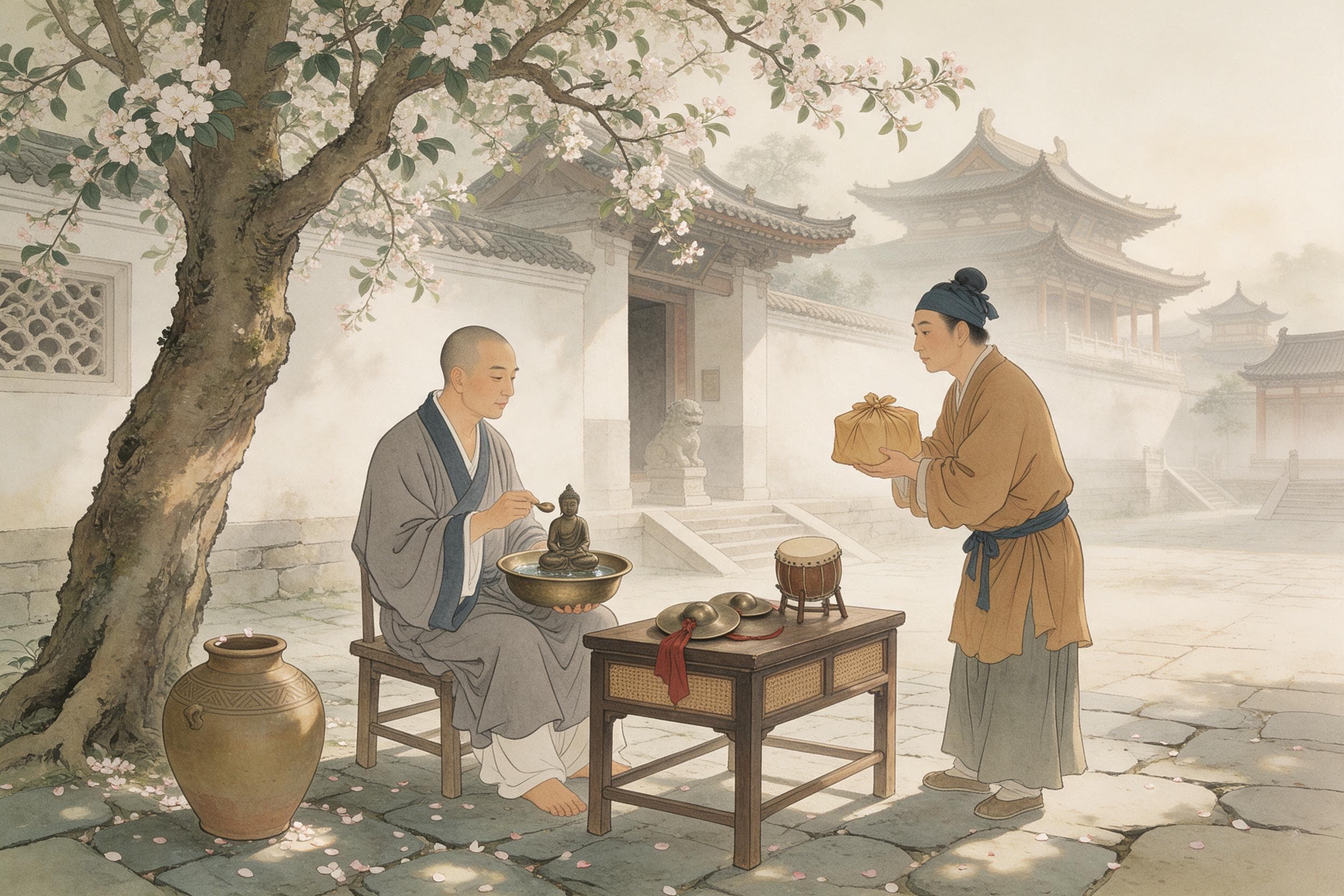
The eighth day of the fourth month, in Lin'an. A monk carries a shallow basin in which a small bronze Buddha sits immersed in sugar water, a canopy of flowers over it; the people with him strike cymbals to clear the way. They go into the courtyards of officials and rich households, and with a small spoon he ladles the sweet water over the image. The text states the purpose without embarrassment: "to seek alms" (以求施利). One ladle of water, one donation. The scene is in the Wulin Jiu Shi, juan 3, and it is the closest thing in the Song Buddhist calendar to a door-to-door service.
Kaifeng: sweet water and seventy-two wine houses
Kaifeng's version was grander. "On the eighth day of the fourth month, the Buddha's birthday, the ten great monasteries each held a bathing assembly, boiling fragrant medicinal sugar water and sending it to one another; it was called Buddha-bathing water." Ten monasteries, ten assemblies, and a sweet water gifted between them. The entry also keeps the season: pomegranate flowers in the courtyards, orioles calling to one another, swallows leading their young under the willows.
The same entry keeps a very practical city account: "In the capital, the seventy-two great licensed wine houses began selling boiled wine, and the markets looked new." The Buddha's birthday, the sweet water and the wine season are recorded in one breath — a religious festival and a trade opening borrowing momentum from the same month.
Lin'an: one spoonful, one donation
Lin'an turned it into a moving rite. "Monks and nuns competed to carry bronze images in small basins, soaked in sugar water and covered with a canopy of flowers, with cymbals escorting them; they went through the mansions of the rich, ladling the water with small spoons, to seek alms." Small basin, bronze image, sweet water, flower canopy, cymbals, the doors of the wealthy: a ritual kit that could be carried anywhere.
What matters in the passage is the phrase "to seek alms". The rite was real, and so was the money. It does not say how much a blessing cost, or who gave and who refused, but it sets out the structure: the monastery supplied the ritual, the household supplied the cash, and the small basin and bronze image were the equipment in between.
The wording is worth a second look. Shili (施利) joins almsgiving (施) to profit or benefit (利) in one word; a translator might simply write "donations". The text does not present the monk's round as charity received but as a service rendered, with a return. That is not the author being cynical; it is how a commercial city described a religious transaction.
The release of life: buying animals to let them go
That same day there was a second scene, on West Lake. "On this day a release-of-life assembly was held on the lake, with boats in great number, much like the small boats of spring; people competed to buy turtles, fish, snails and mussels and set them free." Boats crowded the water; the buying was competitive; the animals went back in.
Releasing life was merit, but "competed to buy" makes it a market as well: to release, you first had to purchase, and where there were buyers there were sellers. The source gives no figures and does not say who sold. It can be taken only this far: on that one day, the demand for merit supported a temporary trade in live animals. West Lake was the right place for such a market: the same book says that on the lake "sightseeing and buying and selling were all without prohibition" (凡游观买卖,皆无所禁) — commerce there was not tolerated, it was the point.
A release market fitted an entertainment ground already organised around stalls, boats and buyers. What it did not need was a separate institution: the lake supplied the customers, the ritual supplied the demand, and the animals were for sale at the water's edge.
The ledger the sources do not keep
No prices: what a spoonful of sweet water brought, what a turtle cost, what the release assembly cost to run — neither book says. Nor is the organiser clear: whether the monastery sent monks out, or monks went out in their own groups "to seek alms", is not recorded. Kaifeng's ten monasteries held a collective assembly; Lin'an's passage reads more like individuals or small groups. The two may not be the same institution at all.
One separation is needed: the boiled wine belongs to the wine trade, not to Buddhist practice. It appears in the same entry only because these things happened in the same month; it cannot be used to argue that monasteries sold wine. The same month's record does give one price, though not one connected with the festival: at the East Gate the first aubergines and gourds were rushed to the palace, "a pair worth thirty to fifty strings". That is a palace price for a rarity; it shows only how wide the month's price range could be. On the ritual economy itself, the sources stay silent.
What survives is three pictures: a basin of sweet water with a bronze image in it; a line of monks with cymbals at the doors of great houses; a lake of turtles, fish, snails and mussels bought in order to be let go. The income and outlay of a religious festival are inside those pictures. The ledger is not. A basin, a line of monks, a lake of animals: between them is a festival that ran on gifts, and a city that knew how to price a service.
Sources & further reading
- 孟元老《东京梦华录》卷八·四月八日 (Meng Yuanlao, Dongjing Meng Hua Lu, juan 8, "The Eighth Day of the Fourth Month") — Kaifeng's ten great monasteries holding bathing-the-Buddha assemblies, the fragrant sweet water given as gifts, and the seventy-two great wine houses starting their boiled wine the same month.
- 周密《武林旧事》卷三·浴佛 (Zhou Mi, Wulin Jiu Shi, juan 3, "Bathing the Buddha") — Lin'an monks and nuns carrying small basins with bronze images through the great houses, ladling sweet water 'to seek alms', and the release-of-life gathering on West Lake where people bought turtles, fish, snails and mussels to set free.