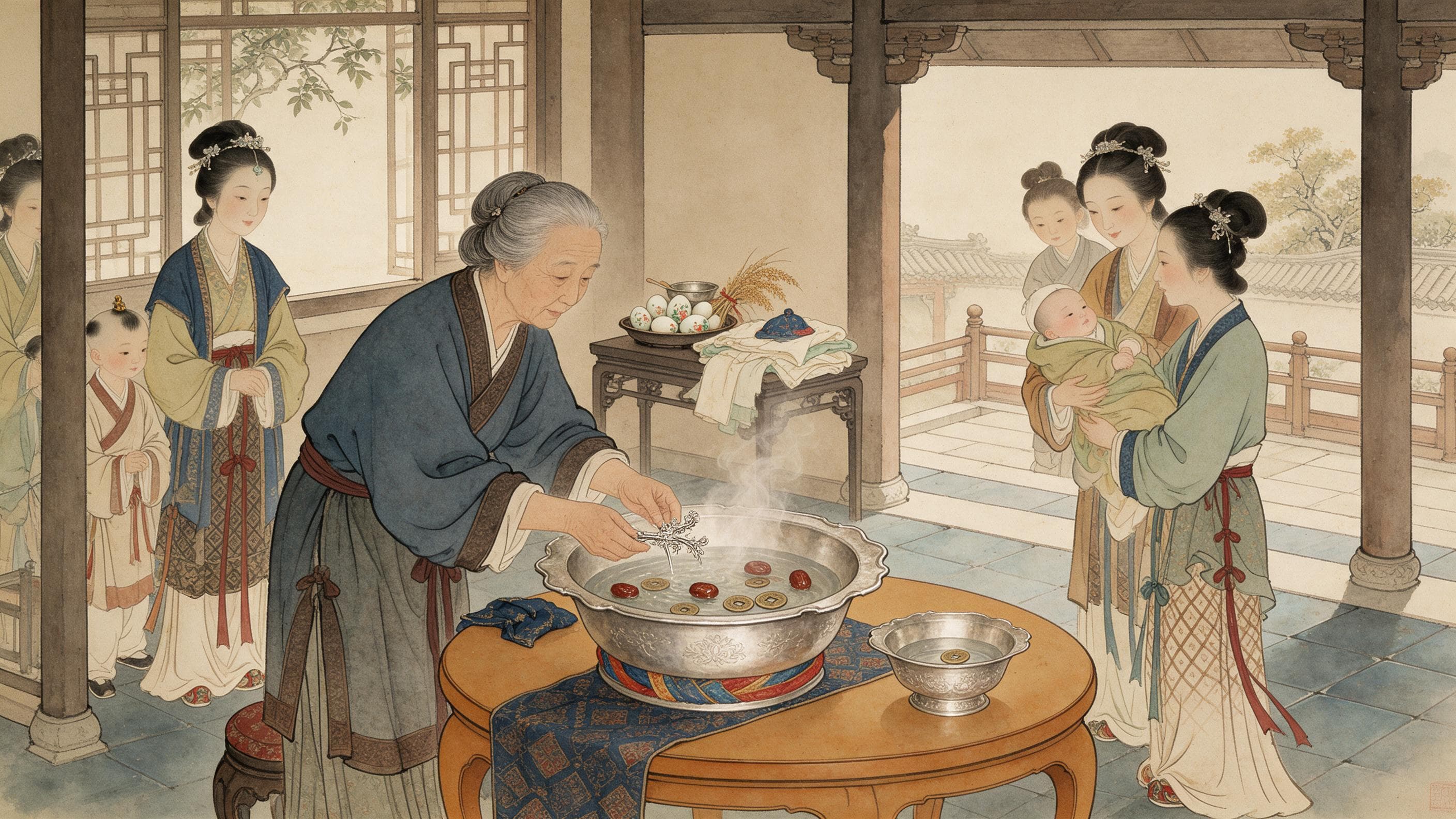
On the day the child turned one month old, a silver basin was set out in the main hall. It held warm scented water, fruit and painted coins, and several lengths of coloured silk were wound around the rim. When the relatives had gathered, the senior member of the household took a gold or silver hairpin from her hair and stirred the water; the guests threw coins and silver pins in after her. Jujubes lay in the basin, and one of them stood upright. Young women fished it out and ate it, since a standing jujube was read as a sign that the next child would be a boy.
The gifts that arrived before the birth
The rites began before labour. In the last month of pregnancy the wife's parents sent over a silver or painted basin holding a bundle of millet stalks, covered with brocade or paper, stuck with flowers and pith ornaments, and pasted with the motif of “five boys and two girls”. With it came recumbent figures of a sheep and a deer, one hundred and twenty painted duck eggs, provisions, a sheep, fresh dates, chestnuts and embroidered baby clothes. The Dongjing Meng Hua Lu, a memoir of the Northern Song capital, adds steamed buns and calls the consignment the “sharing of pain” (fentong 分痛) and “hastening birth” (cuisheng 催生) gift.
Only part of this is explained. The sheep and deer are said to stand for sleep, the buns for sharing out the pain of labour; the text goes no further. Why one hundred and twenty eggs, it does not say. “Five boys and two girls” was a stock auspicious pattern, not a prediction about this household.
The third day, and the three weeks after
Once the child was born, relatives and friends competed to send fine rice, charcoal and vinegar. On the third day the umbilical stump was treated and moxa was applied to the fontanelle. The seventh day was the “first la” (一腊), the fourteenth the second, the twenty-first the third; on each, the wife's family and friends sent food, recorded as pork kidney, tripe, trotters and feet. At the full month the wife's family sent painted or gold and silver coins, mixed fruit, silk, pearls, food and small ornaments, and the washing party took place.
The two books differ in detail. The Dongjing Meng Hua Lu has only the seventh-day la and no moxa at the fontanelle; the Meng Liang Lu, written more than a century later in Lin'an, adds the second and third and names the cuts of pork. Neither is a mistake: the same custom was remembered at different density in different cities and decades. Why the first month was divided into so many stations the text does not say. The density itself suggests that the first weeks were the ones a family watched most anxiously, but that is an inference, not a Song explanation.
Three things in one basin
The Meng Liang Lu gives the fullest account: the relatives assemble, scented water is heated in a silver basin, washing fruit and painted coins are put in, and coloured silk is wound around the basin, “called the enclosed-basin red” (weipen hong 围盆红); the senior elder stirs the water with a gold or silver hairpin, “called the stirring hairpin” (jiaopen chai 搅盆钗); the guests scatter gold coins and silver pins into the basin, “called adding to the basin” (tianpen 添盆).
Scented water is heated in a silver basin; washing fruit and painted coins are put in; coloured silk is wound around the basin, which is called the enclosed-basin red. The senior elder stirs the water with a gold or silver hairpin, which is called the stirring hairpin. The guests also scatter gold coins and silver hairpins into the basin, which is called adding to the basin. (Wu Zimu, Meng Liang Lu, juan 20, “Child-Rearing”)
Three actions share one basin: washing, stirring, scattering. The washing is for the baby; the stirring is the elder's hand, beginning the rite on the child's behalf; the scattering puts money into the water. What happened to the money afterwards the text does not say. It was probably a gift to the household, but the source is silent, and the guess should be labelled as one. The “enclosed-basin red” is equally unexplained: the silk may be decoration, or a boundary drawn around the water, and only the name survives.
After the bath the baby's first hair was cut and sealed in a small gold or silver box tied with coloured thread; the child was carried around to thank the guests and then into the room of a nurse or aunt, a step called “moving the nest” (yike 移窠). Through all of it the child makes no sound in the record. He is held, washed, shaved and passed from hand to hand. The actors are the basin, the hairpin, the coins and the ring of adults.
A world laid out on the floor
The first birthday was the zhouzui (周晬). A brocade mat was spread in the central hall, incense lit and candles set out, and beside the fruit and food went a row of objects: the grandfather's and father's patents of office, gold and silver toys, writing materials and books, Daoist and Buddhist scriptures, steelyard, rule, knife and scissors, grain measures, silk flowers, official paper money, needlework, and an assortment of useful things and playthings. The child was seated in the middle, and whichever object he picked up first was read as an omen. The rite was called nianzhou shizui (拈周试晬), “picking on the anniversary”.
The list is the adult world in miniature: patents and paper money point to office and cash, the scales and measures to trade, the knife and scissors to craft, the scriptures to faith, the needles to women's work. Yet the sources say only that the first object was taken as a “good omen” (jiazhen 佳谶). The modern notion that the object forecast a career is a reading of the list, not a Song statement; no key to the objects survives.
The Dongjing Meng Hua Lu has a shorter list — fruit, food, a patent, brush and inkstone, a scale and steelyard, scriptures, needlework — but the same core. Both books include the patent and the scriptures, which suggests continuity between the two capitals. How many objects a family set out, and in what order, is not recorded.
Who could afford the rite
The Meng Liang Lu ends with the most revealing sentence in the passage: “If a wealthy or official household, then this rite is used; poor households follow their means, and the rules are not as prescribed.” The silver basin, the gold hairpins, the silk and the seven-treasure toys were a standard, and the standard cost money. The full ceremony belonged to the well-off; the poor scaled it down. Both books describe urban households of the middle sort and above, written by people of that background. How a poor family marked a birth is not in the record.
One more pattern: the flow of gifts runs through the mother's family. The pre-birth gift comes from the wife's parents, the full-month gift from the wife's family, the food at each la from her family and friends. The child carries the father's surname, but almost everything in the first year arrives from the mother's side. That does not make the maternal house dominant; it makes the first year a contract between two households.
The evidence stops there. The cost of a washing party is not given, nor the number of guests, nor whether the child fell ill afterwards. Song memoirs record rites, not accounts, and not risks. What remains is a very concrete picture: one silver basin, a few yards of silk, a hairpin, and a basin of water with jujubes and coins floating in it.
Sources & further reading
- 孟元老《东京梦华录》卷五「育子」(Meng Yuanlao, Dongjing Meng Hua Lu, juan 5, "Child-Rearing") — The Northern Song account: the pre-birth gift, the full-month washing party and the first-birthday trial.
- 吴自牧《梦粱录》卷二十「育子」(Wu Zimu, Meng Liang Lu, juan 20, "Child-Rearing") — The fuller Lin'an account, with the three la days, the basin rites and the list of objects laid out at the first birthday.
- 《梦粱录》卷二十「育子」(识典古籍本,异文对照)(Meng Liang Lu, juan 20, Shidian edition, for textual comparison) — A modern punctuated edition; it drops the character 囟 in 落脐灸囟, which the Wikisource text preserves.