On one turtle plastron, on one day, the diviner Wei asked the same question twice. On the left: 丙子卜,韋貞,我受年 — cracked on the day bingzi, Wei divined, "we receive the year". On the right, mirroring it: 丙子卜,韋貞,我不其受年 — Wei divined, "we do not receive the year". The two inscriptions are cut opposite each other, the strokes filled with cinnabar so the characters stand out red against the bone. The object, catalogued as 《乙》867 and now in the museum of the Institute of History and Philology in Taipei, is one of the best teaching pieces Shang archaeology has produced, because everything about it is legible: a day, a name, a technology, a question. What it cannot show is the person who grew the grain being asked about.
A year is a sheaf of grain on someone's back
The question turns on one character. In oracle-bone script, 年 — the word that later means "year" — is written with 禾, grain, above 人, a person: a figure carrying a sheaf of millet on his back. The museum's caption says it plainly: the two elements combined mean "the grain ripened", a good harvest. So 受年 is not a question about time; it is a question about food, addressed to the powers that might or might not send rain. The Shang king asked it often, which is why the phrase recurs across the corpus.
The double question is itself the method. Rather than ask once and accept the answer, the diviner put the proposition and its negation to the shell on the same day, one on each side, so that the crack would fall into one of two prepared slots. This is usually called paired divination, and it tells us something about the state of mind behind the whole archive: the point was not to get a favourable answer but to get a readable one. And the range of questions was wide. A museum description of Shang divination practice sums it up: from great matters of natural disaster and war down to illness and the interpretation of dreams, the king divined on all of them.
What it took to make one shell askable
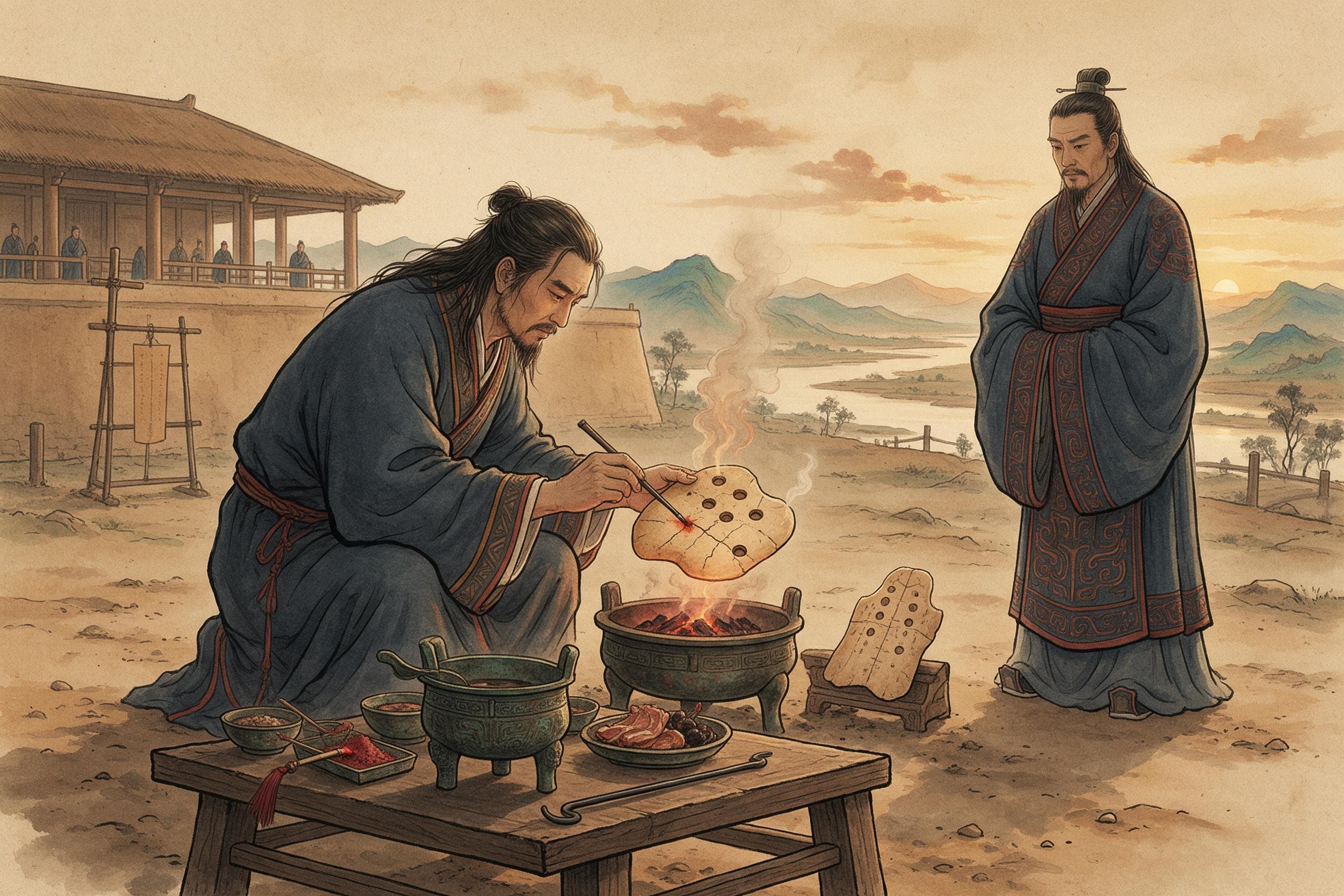
The plastron did not arrive ready to use. The museum's step-by-step account begins with a turtle, which was cleaned and boiled and stripped of flesh, and then cut: the belly plate and the back plate were sawn apart along the bridge of shell between the front and back legs, and both were ground flat. The belly plate, being flatter, was the usual surface for inscriptions; back plates were often split lengthwise into left and right halves, and some were cut further into shoe-sole shapes with a hole through the middle, the so-called turtle tablets. Then came the working of the surface: round hollows drilled on the back, oblong slots chiselled next to them, so that the shell was thin at exactly the points where it would be heated. A hot stick was pressed into a hollow; a crack ran across the front, in the shape of the character 卜; that crack was the answer.
And the shells came in quantity, as a levy. On the bridge of many plastrons, where no divination was done, there are short inscriptions recording deliveries: one reads 雀入二百五十 — "Que sent in two hundred and fifty". Two hundred and fifty turtles from one place, noted on the shell itself. The museum notes that the shells were both local and imported. So behind a single crack there is a supply chain: collection, tribute, cleaning, sawing, drilling, heating, reading, and finally the carving of the record — the date, the diviner, the question, sometimes the prediction and its outcome. What the crack itself meant, however, is lost: the museum says outright that the rules for judging an omen can no longer be reconstructed. Anyone who tells you how a Shang diviner read a particular crack is inventing.
The king's list of worries
Line up the questions and a portrait appears — not of a farmer, but of a ruler. Will the harvest come? Will it rain, will the river rise, will the campaign succeed, will the child be born, will the pain in this body pass, what does this dream mean? These are the concerns of a household that happens to be a state: its fields, its weather, its wars, its heirs, its sick. The archive is vast, and it is tempting to read its density as evidence that everyone in Shang China lived inside this system of cracks and answers. That inference is not supported. What survives is what the court carved and buried; the selection is theirs.
The ordinary appear as "the many"
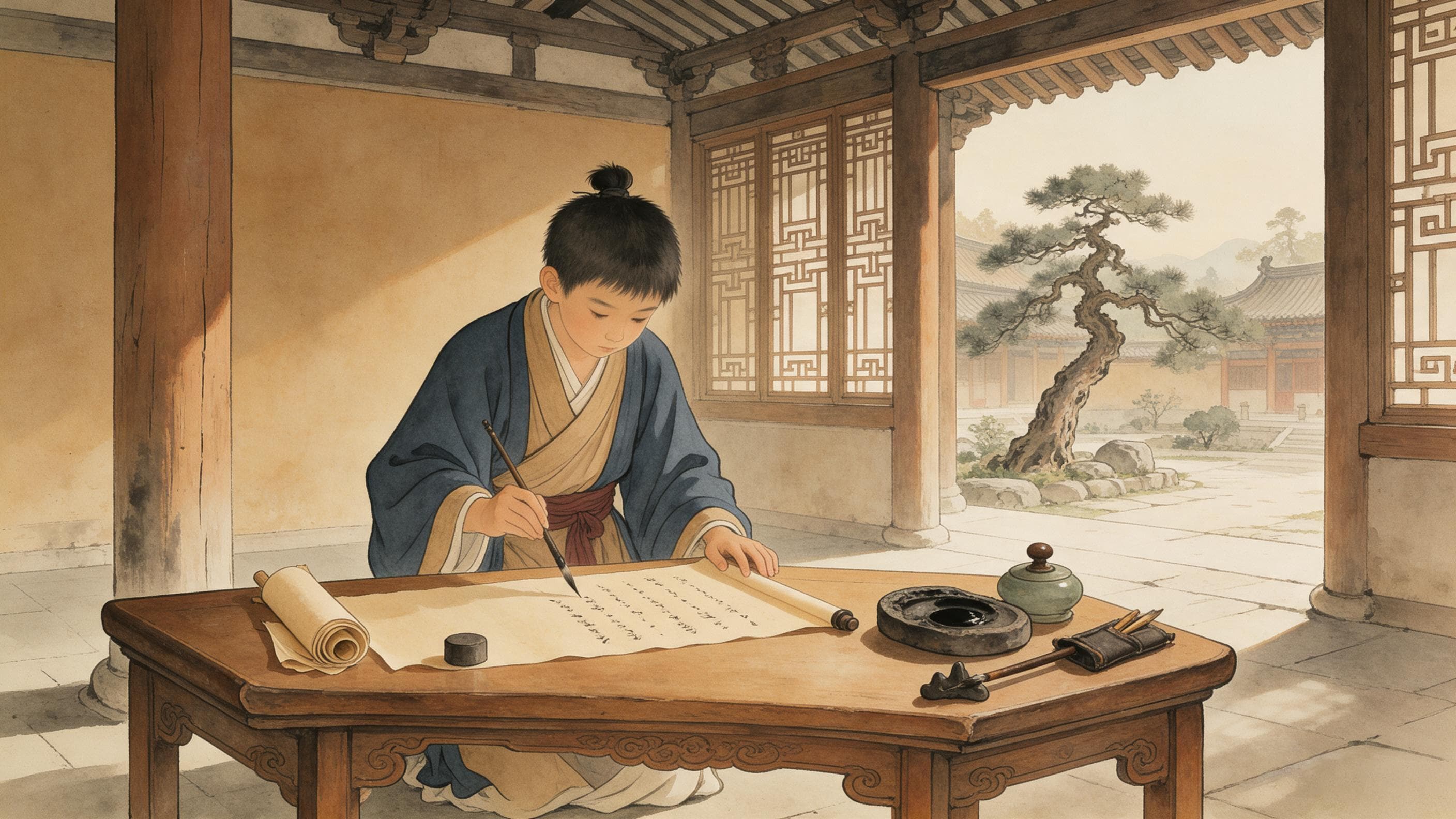
There is one place where non-elite people step into the record, and it is a speech. In the Book of Documents, the chapter called Pan Geng, the king is trying to move the capital to Yin, the people are unhappy about it, and he calls them in: 王命眾,悉至于庭 — the king ordered the many, and they all came to the courtyard. Then: 格汝眾,予告汝訓 — "come, you many, I will announce my instruction to you." He scolds, he threatens, and he reaches for farming as his image: 若農服田力穡,乃亦有秋 — if the farmer works his fields and labours at the harvest, then he has an autumn; 惰農自安,不昬作勞,不服田畝,越其罔有黍稷 — the lazy farmer who takes his ease, who will not work hard and will not tend his fields, will have no millet at all. And then the line that gives the passage its edge: 邦之臧,惟汝眾;邦之不臧,惟予一人有佚罰 — if the state is well governed, it is because of you, the many; if it is not, I alone am to blame.
What we cannot know
The Pan Geng is a transmitted text, and its date of composition has been argued over for centuries: some read it as Shang material, others as a later rhetorical reconstruction. Whatever its date, it gives us the king's view of the many — as farmers who must not be lazy, as a body to be summoned into a courtyard and instructed — not the many's own account of themselves. Their day is not in it. What time they rose, what they ate, how their houses were arranged, who did which task inside a household: nothing in these sources says. The excavation reports for ordinary dwellings at Yinxu exist, but they were not available to me in a citable form for this piece, so no house plan is described here.
It is also worth saying what cannot be counted. Did ordinary people divine for themselves? No source says. Did they use the same shells? No. How often did the court divine? The number of surviving bones cannot answer that, because what survives is a sample shaped by burial and by later digging, not a logbook. So this article deliberately does less than its title promises. What it can offer is a shell with two questions cut into it, filled with red; a levy of 250 turtles noted on a bridge of bone; and a king telling a courtyard full of farmers that a lazy man gets no millet. Everything else about an ordinary Shang day — the waking, the cooking, the talk — is gone, and the honest thing is to leave it gone.
Sources & further reading
- 中央研究院歷史語言研究所歷史文物陳列館〈我受年──甲骨文「年」的故事〉(Museum of the Institute of History and Philology, Academia Sinica, "We Receive the Year") — The inscribed plastron 《乙》867: on the same day the diviner Wei asked both "we receive the year" and "we do not receive the year"; the graph nian as grain over a person; the cinnabar-filled incisions.
- 中央研究院歷史語言研究所歷史文物陳列館〈通天神龜──商代占卜用具說明書〉(Museum of the IHP, "The Turtle That Reached Heaven") — How a shell was prepared step by step; the drilled hollows and oblong cuts; the crack read as a 卜; the bridge inscription "Que sent in 250" turtles; the range of royal questions.
- 《尚书·盘庚上》(Book of Documents, "Pan Geng", part one) — The king summons the many to the courtyard and lectures them, using the lazy farmer as a warning; a transmitted text whose date of composition is disputed.