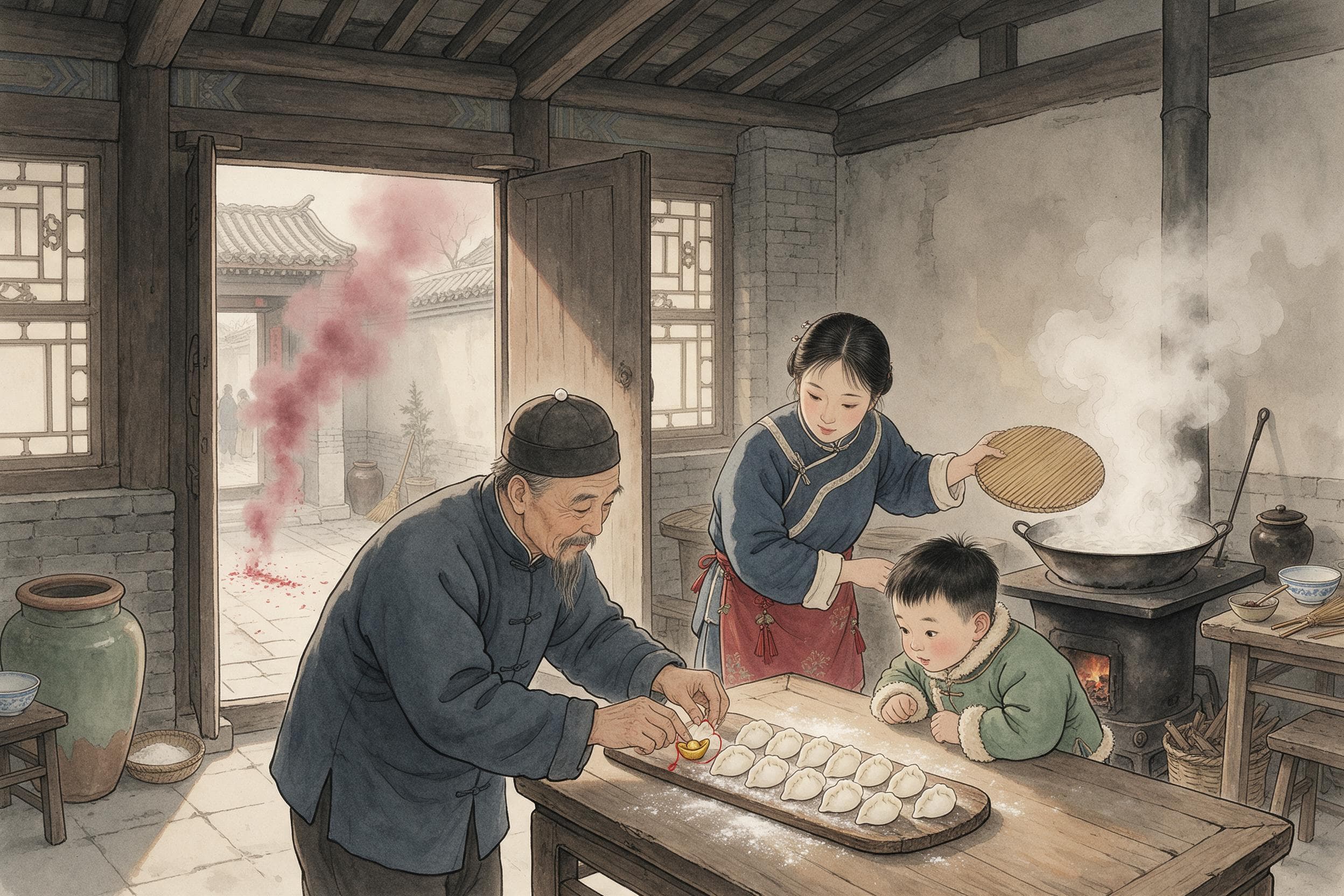
On the first morning of the year, the table in a Beijing house was covered with white flour. The dough was folded into crescents, pinched shut around a filling and boiled: 煮餑餑, the boiled bo bo, the northern word for wheaten food. A single book describes it, 富察敦崇's Yanjing Suishi Ji (燕京岁时记, Records of the Seasons in Beijing), written in 1900: 是日无论贫富贵贱,皆以白面作角而食之,谓之煮餑餑 — on that day rich and poor alike fold white-flour horns and boil them. In wealthy houses there was one more step: 富贵之家,暗以金银小锞及宝石等藏之餑餑中,以卜顺利 — a tiny ingot of gold or silver, or a gemstone, was hidden in one of them to test the year's luck. Whoever bit into it, 则终岁大吉, had a lucky year.
A wager inside a dumpling
The dish itself is plain: white flour, a folded edge, boiling water. What makes it a festival is the object inside. The book gives no filling, no price, no recipe, and no household account survives to say how many a family made. Three things can be said. The ingot was hidden secretly (暗藏), so the household was in on the joke. The lucky eater got a year of good fortune. And the custom was claimed for everyone, 举国皆然, regardless of wealth. The same morning had a court version: 每至元旦,凡内廷行走之王公大臣以及御前侍卫等,均赏八宝荷包,悬于胸前 — at the New Year, princes and ministers serving in the inner court, and the imperial guards, were given eight-treasure purses to wear on the chest; the ministers of the outer bureaus were not on the list. One purse, one dumpling: both sorted people by distance from power on the same day.
Spring cakes and bitten radishes
打春, the striking of spring, fell on 立春, usually in the first month. The day before, the prefect of Shuntian went out the east gate to a field a li away to welcome spring. On the day itself the Board of Rites presented a spring-mountain seat and the prefecture a picture of the spring ox; then the clay ox was led out and struck: 引春牛而击之,曰打春. The book also copies the ritual regulations: the prefect and his staff in court dress went out with drums, porters carrying the ox and the herd-boy god to a coloured awning before the yamen; at dawn the two county magistrates set a table at the palace gate to present ox and boy to the emperor, empress dowager and empress; then the prefect struck the ox 以示劝农之意, to encourage farming. For ordinary households the book has one line: 是日富家多食春饼,妇女等多买罗卜而食之,曰咬春 — the rich ate spring pancakes, and women bought radishes and bit them, 'biting spring', to drive off the lethargy of the season. Notice the division inside one custom: the cake for wealthy households, the radish for women — the same festival, joined at different prices, though the book gives no price at all.
Five nights of lanterns
The lantern festival ran from the thirteenth to the seventeenth, 惟十五日谓之正灯 — only the fifteenth was the true lantern night. The court banqueted and set off fireworks; the markets hung lamps. The book even ranks the streets: 六街之灯以东四牌楼及地安门为最盛,工部次之,兵部又次之 — the East Four Archway and Di'anmen first, the Ministry of Works next, the Ministry of War after that, everything else below; the War Ministry's display was banned in 1883. Lamps were made of gauze, silk, glass and horn, painted with stories old and new; clever craftsmen froze ice into vessels and raised wheat seedlings into figures. Firecracker stalls competed in novelty — boxes, flowerpots, firework poles, peonies threaded on wire, lotus in water, grapes on a trellis, two-stage crackers, ten-bang rockets — and rich families bought them all, the streets roaring until the second drum, when the crowd finally drifted home under a clear moon. Even the fish were for sale: goldfish carried in glass bottles, a speciality the book says had no equal elsewhere. And the book quotes an older account of the Ming lantern market at the East Gate — two li of stalls, tall towers facing each other down the street, rooms let by the day for as much as several hundred strings of cash to the households of the rich — a reminder that the lanterns were never free: the market underneath them was the point. The commercial sentence that matters is the plainest one: 市卖食物,干鲜俱备,而以元宵为大宗 — the food stalls sold everything dried and fresh, but the main article was 元宵, the sweet rice-flour balls.
One hundred and eight lamps, four nights or one
On the eighth evening came 顺星: papers dipped in oil, one hundred and eight lamps lit, incense offered. Before it came 人日, the seventh day, the day of people: 是日天气清明者则人生繁衍 — clear weather meant a prosperous year for the people. From the thirteenth to the sixteenth, lamps were lit from the inner rooms out to the front gate — 散灯花, also called scattering the petty men, to drive off ill fortune. The book adds an older account from the 帝京景物略: one hundred and eight small cups lit and scattered over wells, stoves, doors and washing stones, 其聚如萤,散如星, gathered like fireflies and scattered like stars — and then the line that cuts: 富者灯四夕,贫者灯一夕止,又甚贫者无 — the rich kept their lamps four nights, the poor one, and the very poor none at all. The same festival, measured out by income.
The sixth day, the shutters come up
Before the lanterns there were other gates. On the second day the god of wealth was worshipped, 鞭炮甚夥,昼夜不休, firecrackers day and night. The fifth was 破五: 破五之内不得以生米为炊,妇女不得出门 — no raw rice cooked, no women out of the house. On the sixth everything turned: 王妃贵主以及各宦室等冠帔往来,互相道贺。新嫁女子亦于是日归宁 — the wives of princes and officials called on one another in full dress, and newly married daughters went home to their parents; spring mud, perfumed carriages, lanes packed. Then the hinge of the whole passage: 而闤闠诸商亦渐次开张贸易矣 — the shops along the market streets began, one by one, to open and trade. The holiday was not over, but the money had started moving again.
The limits are as clear as the customs. Fu Cha Dunchong was a Manchu official writing in the 1900s about the capital's year, and his book carries its own praise — 诚太平之景象也, truly a scene of peace. His 举国皆然, everyone does it, is a scholar's impression, not a survey. The court purses and the banned ministry lamps show a festival graded by rank; the lines on lamps show it graded by income. No prices appear in these entries at all, so nothing here can be turned into what a New Year cost. What the book does give is a fortnight programmed to the day: dumplings on the first, crackers on the second, lamps on the eighth, a radish at spring, rice balls and fireworks on the fifteenth, shutters up on the sixth — a calendar in which every date has a purchase attached to it.
Sources & further reading
- 富察敦崇《燕京岁时记》(清光绪二十六年,1900)「元旦」「八宝荷包」「祭财神」「破五」「人日」「顺星」「打春」「灯节」诸条 — 煮餑餑与藏金银小锞卜顺利、八宝荷包、破五与初六开张、顺星一百零八盏与散灯、打春迎春与咬春、灯节十三至十七以元宵为大宗;引文据维基文库转录本
- 《燕京岁时记》光绪刻本(识典古籍影印本)「元旦」条 — 据光绪刻本核对「元旦」条文字(煮餑餑、金银小锞、终岁大吉),与维基文库本对读;本书两条来源为同一书的不同版本