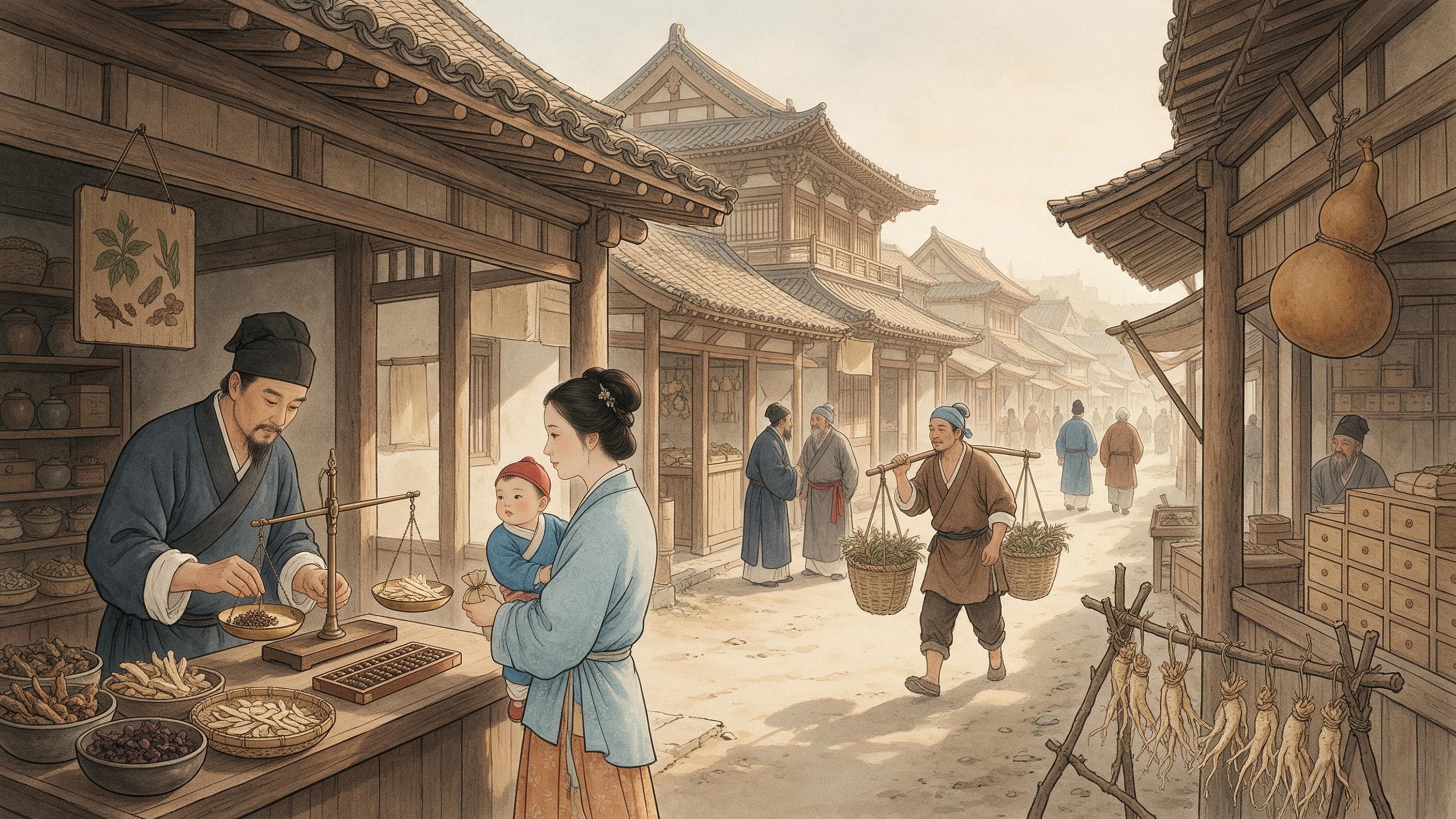
Walk north out of Maxing Street in Kaifeng, past the small-goods row, and the signs on either side name parts of the body. The house of Du Jingou, the Cao family, Dushengyuan, the Li family of Shanshui: medicines for teeth and throat. Shi Yu'er, Ban Fangyu, Yin Hai'er, the house of Physician Bai: children's medicine. The Ren family of the big shoes: childbirth. One street, walked end to end, takes you from the jaw to the delivery room. The man who wrote the names down, Meng Yuanlao, was recalling the old capital after it had fallen. He set the passage out as a list: one line a shop, one shop a specialty.
A street sorted by body parts
The sentence runs: “two rows of dispensaries of gold-and-purple medical officials, such as the house of Du Jingou, the Cao family, Dushengyuan, the Li family of Shanshui, for medicines of teeth and throat; Shi Yu'er, Ban Fangyu, Yin Hai'er, the house of Physician Bai, for doctoring children; the Ren family of the big shoes, for childbirth. The rest — incense and drug shops, officials' residences — I will not record one by one.” The semicolons divide the shops into three groups, and each group is a specialty. Not sorted by remedy, not by drug, but by who walks in the door.
One clause at the start of that entry is hard to read — “the small-goods row, the Shilou Dagu drug shop” does not parse cleanly, and editions differ — so nothing here is built on it. What is solid is the double structure. First the specialties. Second the closing line: the medical shops stood among incense shops and private houses. This was no planned medical quarter. It grew inside the busiest retail district in the city, and the entry ends by saying that the night market at North Zhou Bridge was “a hundred times” busier still, so crowded with carts and horses that a man could not stand his ground. The people of the capital called that quarter “the inside”.
What “gold and purple” was doing on a shop sign
“Gold and purple” borrows the language of rank: purple was the highest colour of the formal robe, and gold the metal of the belt and the fish-bag worn with it. Put in front of “medical official” on a shopfront, the four characters read as: this physician holds a title, and not a low one. But Meng never says these men were palace doctors, and reading it that way adds something the text does not contain.
The safer reading — an inference, not a statement in the text — is that the title was part of the advertising, a way of telling the street that the man behind the counter had standing. The text gives no grade, no office and no posting, and it would be dishonest to supply them. What is interesting is the fact itself: a physician's standing could be painted up over a door, in four characters, alongside whatever he sold.
The drug market, and the guild behind it
Kaifeng gives us a street; Lin'an gives us a market. Wu Zimu, describing Hangzhou's trade associations, ends a long roll of trades with the city's named markets: “There are those called ‘markets’: the drug market at Char Bridge, the flower market in Guan Lane, the bead market at Ronghe West Ward, the meat market in Xiuyi Ward, the rice market north of the city.” Drugs had a market of their own, at a fixed address.
A tuanhang was not a chamber of commerce. Wu's explanation of the word is blunt: these guilds existed because the government bought goods and called up labour — “whatever the size of the thing, all were organised into guilds; even physicians and diviners had duties, the same as any trade on the roster.” Physicians are named in that sentence. The street of specialists sat inside a system of requisition: the state could call on a doctor, and the guild was how it found one. Behind a street of independent signboards stood a ledger kept by the prefecture.
What the text does not supply is a calendar. The drug market has an address and no season. It is tempting to fill that gap with the seasonal medicine fairs known from other places and later centuries, but nothing in this passage says the Char Bridge market opened on particular days. The absence is worth stating plainly, because “drug market” invites exactly that assumption.
The shop roll: eyes, infant wasting, childbirth
A later entry in the same chapter is a roster of Lin'an shops “famous since the Chunyou years” — name after name, with no prices and no addresses beyond a bridge or a lane mouth. Drug shops crowd it: the Pan Jiegan prepared-medicine shop, the Sanbuqi shop, the Jinyaojiu Tower Taicheng shop, Chen Zhiong's, Liang Daoshi's, Yang Jiangling's, the Ren'ai Tang, Chen Mama's wind-medicine shop with its clay masks, the Great Buddha Temple shop for gan medicine, Baohe Dashi's smoked-plum shop, the Mao family's raw-drug shop, Zhang Xinggan's Golden Horse Ladle children's shop, Physician Guo's childbirth-medicine shop. Outside the Shapi Lane mouth stood a shop whose sign was a pair of gourds: eye medicine.
The specialties match Kaifeng's three-way split and extend it. Children, childbirth, eyes and gan — the wasting sickness of small children — each have their own house. The words in front of the shop names are titles: taicheng, jiangling, xinggan, jiegan, official and clerical designations used the way a later signboard uses “Doctor”. The words after are a different distinction: shuyao, prepared medicine, against shengyao, raw drugs — pills and powders already compounded, versus materials still to be worked.
The list records reputation, not turnover, and it closes with a general statement rather than a total: “From the great street into every ward and lane, large and small shops stand door to door; there is no empty house.” Drug shops were not rare. They were among the densest categories of retail in the city.
The state's dispensary, and the blanks in the ledger
Beside the commercial street ran a public system. Kaifeng had a Western Prepared-Medicine Huimin Bureau near the north lane mouth; huimin, “benefiting the people”, marks it as relief as much as trade. Lin'an's version is described in more detail: the prefecture set up a dispensary west of Jiezi Bridge, allocated a hundred thousand strings of cash to it, appointed officers to supervise, had pills and powders compounded to prescription, and had anyone who came examined, questioned about the source of the illness and given medicine. Physicians' case counts went up to the prefecture each month. Next door stood a Foundling Bureau, where the government paid wet nurses to raise infants abandoned in the streets.
The tone is official self-congratulation — “must produce the effect of rebirth” is the author's claim, not a cure rate. But it establishes that a sick man in Lin'an had two doors to choose between: a shop with a signboard, or a bureau that handed him medicine. What each cost, how long the queue ran, who was eligible — none of it is recorded.
The blanks can be listed. No drug prices. No consultation fees. Nothing on how long a physician trained, or what qualified him, or what happened when a treatment went wrong. Nothing on where a woman took a woman's complaint, or who attended a birth. For the Ren family of the big shoes the text offers two characters — childbirth — and turning those two characters into a delivery scene would be fabrication. The street can be reconstructed this far: as a list of specialties and a roll of shop names. One step beyond, and the record simply stops.
Sources & further reading
- 孟元老《东京梦华录》卷三「马行街北诸医铺」「大内西右掖门外街巷」「寺东门街巷」(Meng Yuanlao, Dongjing Meng Hua Lu, juan 3, “Medical Shops North of Maxing Street”, “Lanes Outside the Western Right Ye Gate”, “Lanes East of the Monastery”) — The two rows of titled physicians' dispensaries sorted by specialty, the incense-and-drug shops among private houses, the Huimin prepared-medicine bureau, and the raw-drug shop with Li Cheng landscapes on its walls.
- 吴自牧《梦粱录》卷十三「团行」「铺席」(Wu Zimu, Meng Liang Lu, juan 13, “Guilds”, “Shop Rows”) — The Char Bridge drug market named among Lin'an's markets, the guilds created for government purchase and labour duty, and the roll of famous drug shops including eye, infant and childbirth specialists.
- 吴自牧《梦粱录》卷十八「恩霈军民」(Wu Zimu, Meng Liang Lu, juan 18, “Graces to Soldiers and People”) — The prefectural dispensary west of Jiezi Bridge, its budget, its diagnostic routine and monthly returns, and the Foundling Bureau beside it.