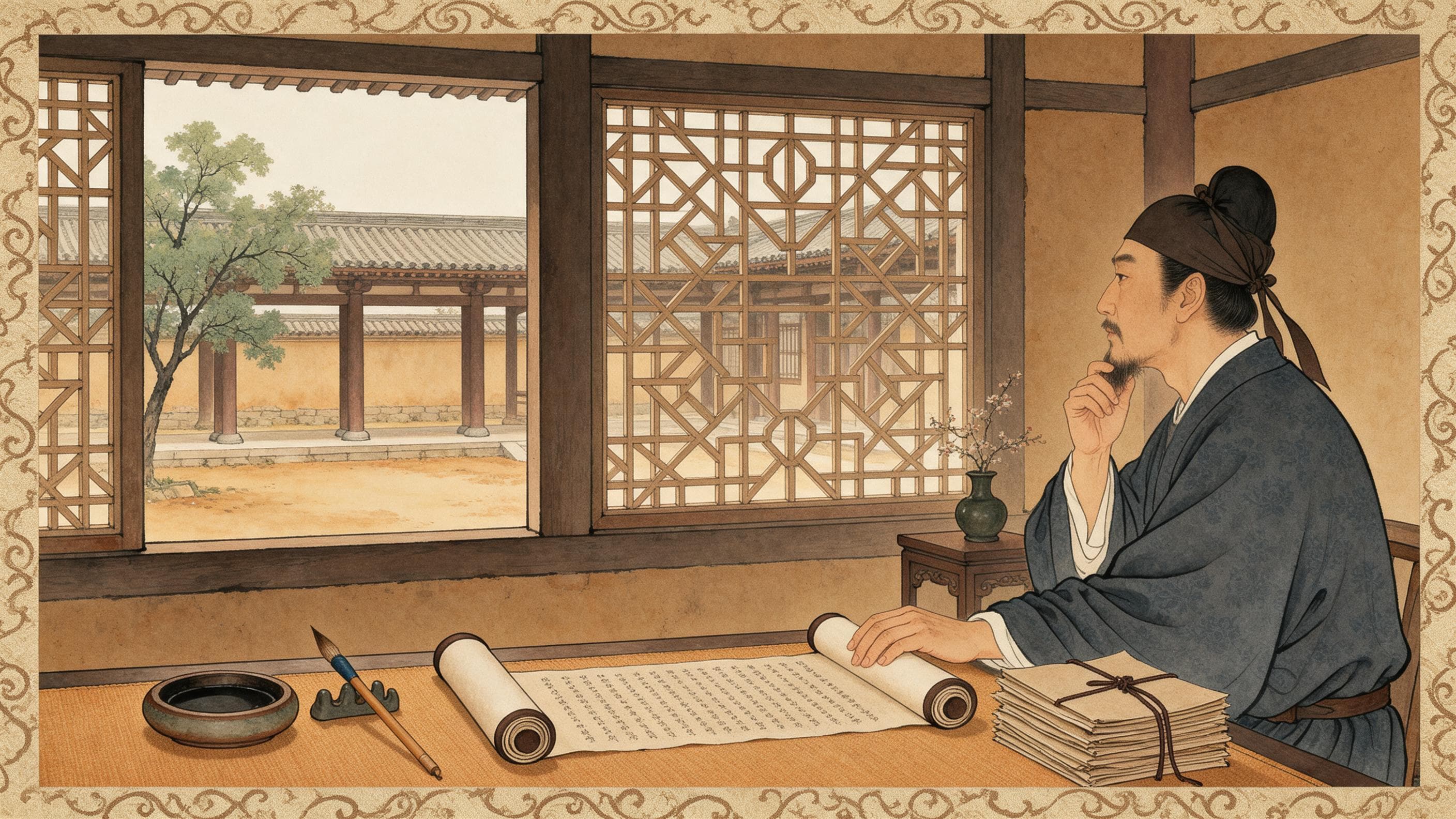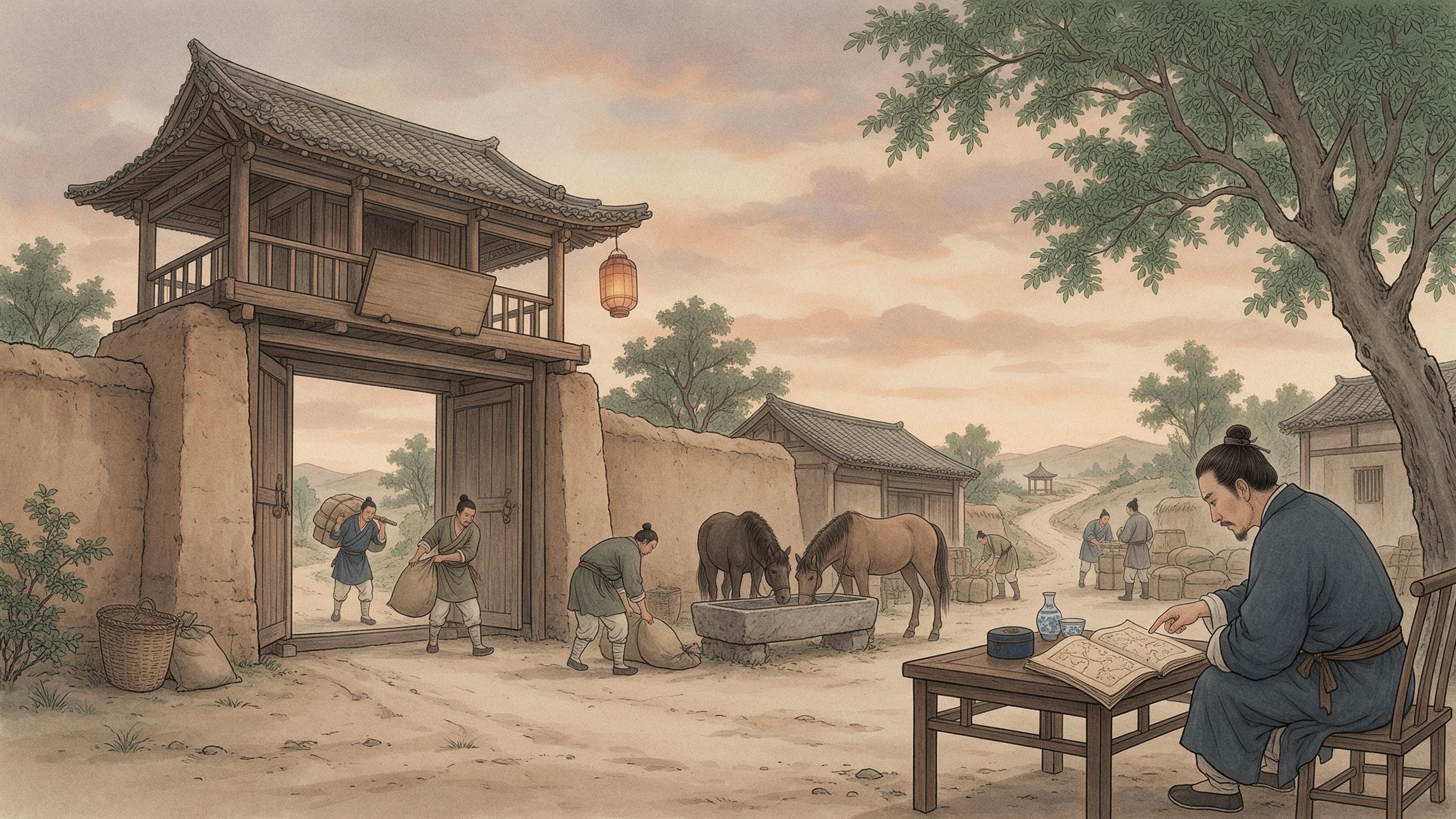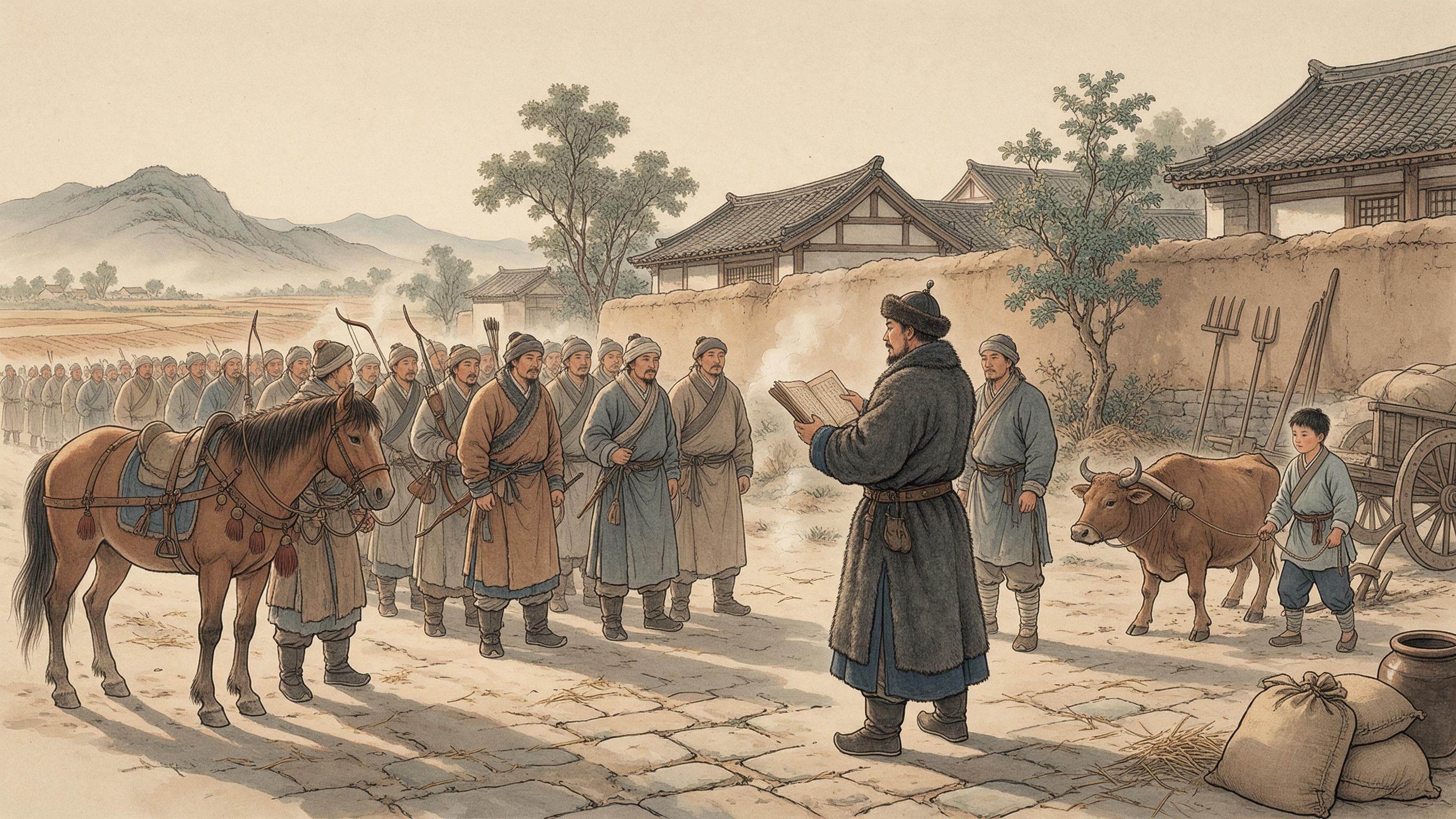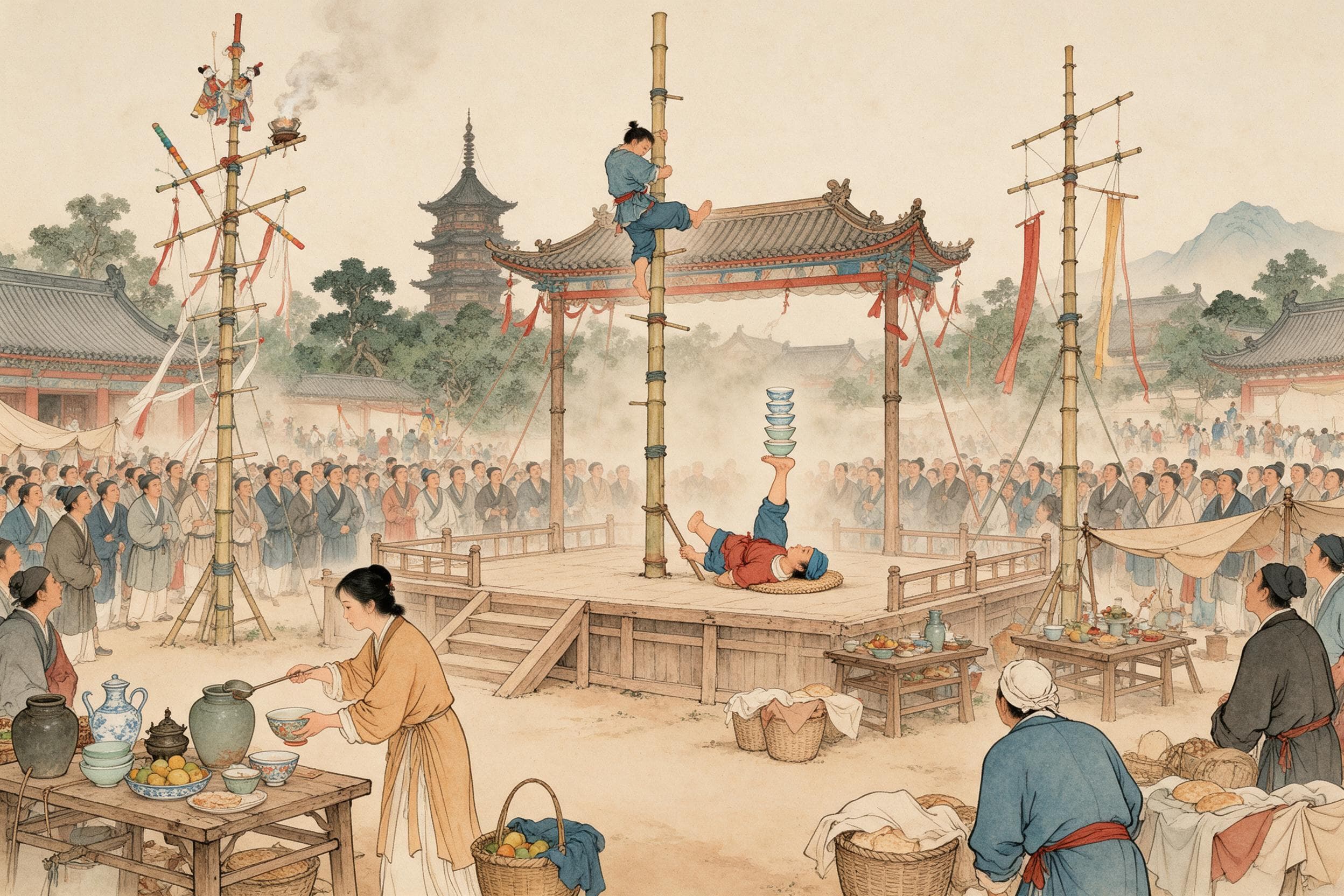
On the twenty-fourth day of the sixth month, before it is light, the ground in front of the temple a li outside the Ten Thousand Surnames Gate, west of Kaifeng, is already packed. On the raised stage before the hall the entertainments start at first light and run until dark without finishing. The man who recorded it used six characters: 至暮呈拽不盡 — by evening they were still bringing them on.
1. Twenty-Two Acts on One Bill
The temple is the shrine of the Second Lord of Guankou, granted the name Shenbao Abbey, a li or so outside the gate. The sixth of the month is the birthday of Lord Cui north of the city, and that too drew offerings, but the twenty-fourth is the great day. On the twenty-third the palace sends its own gifts — toys made in the Rear Garden Workshop and the Calligraphy Bureau, polo sticks, pellet bows, saddles and cages — carried to the temple with music. By the fifth watch next morning men are racing to burn the first incense, some having slept at the temple and risen at midnight to be first.
自早呈拽百戲,如上竿、趯弄、跳索、相撲、鼓板、小唱、鬥雞、說諢話、雜扮、商謎、合笙、喬筋骨、喬相樸、浪子、雜劇、叫果子、學像生、倬刀、裝鬼、砑鼓、牌棒、道術之類,色色有之。至暮呈拽不盡。 — From first light they brought on the hundred entertainments: pole-climbing, kick-juggling, rope-walking, wrestling, drum and clapper, small songs, cock-fighting, comic patter, knockabout turns, riddles, mouth-organ bands, mock contortion, mock wrestling, wastrel turns, variety plays, street cries, mimicry, sword dance, ghost masquerade, drum-dance, staff play and Daoist tricks — every kind was there. By evening they were still bringing them on.
Count them: twenty-two. Pole-climbing, rope-walking and kick-juggling are the acrobatics; 相撲 is real wrestling and 喬相樸 mock wrestling, both on one bill. Drum-and-clapper and mouth-organ are music; small songs, comic patter, street cries and mimicry are voice work; variety plays and knockabout are theatre; sword-and-staff play is weapon work; riddles are a paid game; ghost masquerade and Daoist tricks stand alone. One bill covers the climber, the wrestler, the singer, the talker, the riddler and the man in the ghost mask.
The day was not only theatre. The imperial kitchen supplied food, twenty-four courses through the night, each in its proper order, and the offerings set out on the stage were counted in tens of thousands. The acts were threaded between offerings, courses and incense.
2. Two Banner Poles
In front of the stage stand two banner poles, reputedly tens of feet high. The temple did not pay for them. Two government workshops each put up one:
殿前兩幡竿,高數十丈,左則京城所,右則修內司,搭材分占上竿呈藝解。或竿尖立橫木列於其上,裝神鬼,吐煙火,甚危險駭人。 — In front of the hall stood two banner poles tens of feet high, the Capital Works on the left, the Palace Maintenance Office on the right, the scaffolders taking one each and working their climbing turns on their own. On the crossbar at the top a man stood rigged as a god or demon, spitting fire and smoke: dangerous, and frightening to watch.
Both were building bureaus, and one pole had one proprietor. The fire and smoke came out of the top of the pole: stage effect.
The same pole turns up at the Lantern Festival in another form. In the thorn enclosure before the Xuande Tower two tall poles were set up, and what hung from them was not men but paper-cut figures of the hundred entertainments, so that when the wind moved they looked like flying immortals. One pole: in the sixth month a living climber, in the first month paper figures.
3. The Lantern Night Roll-Call
On the fifteenth of the first month the lantern mountain faces the Xuande Tower and the crowd has long since filled both arcades of the Imperial Way, the music carrying more than ten li. At the centre of it:
奇術異能,歌舞百戲,鱗鱗相切,樂聲嘈雜十餘里,擊丸蹴踘,踏索上竿。 — Strange skills and odd powers, songs and dances and the hundred entertainments, packed scale on scale, the music a din for more than ten li: pellet balls, football, rope-walking and pole-climbing.
Then comes a roll of names, one trade each: Zhao the Wild Man, who eats cold noodles upside down; Zhang the Ninth, who swallows a sword; Li Waining with clockwork puppets; the Little Strongman, who spits five-coloured water and burns clay pellets; Da Teluo with his ash tricks; Gu Duo'er in variety plays; Wen Datou and Little Cao on the two-string fiddle; Dang Qian on the pipe; Sun the Fourth, who refines drug recipes; Fifty-Two with his stage illusions; Zou Yu and Tian Diguang in knockabout; Su the Tenth and Meng Xuan at ball-play; Yin Changmai telling the History of the Five Dynasties; Liu Hundred Birds with his insects; Yang Wenxiu on drum and flute.
There were animals too: monkeys doing the hundred entertainments, fish jumping through a knife gate, bees and butterflies called up, ants summoned by name.
That these names were written down at all suggests they had a following. The same passage ends with medicine sellers, fortune-tellers and sand-writers of character riddles — a hundred kinds of ingenuity, new to the eye every day. The crowd paid for novelty; the troupe wanted them back tomorrow.
4. The Golden Rooster Pole
Acrobatics in Song times was not only a street trade; it was part of state ceremony. In years of the great sacrifices at the Bright Hall, when the amnesty was proclaimed at the Lizheng Gate, the kick-jugglers were requisitioned:
百戲踢弄家,每於明堂郊祀年分,麗正門宣赦時,用此等人,立金雞竿,承應上竿搶金雞。 — In years of the Bright Hall sacrifices, when the amnesty was read at the Lizheng Gate, these men were used: the golden rooster pole was set up, and they were called on to climb it and seize the rooster.
The golden rooster pole was part of the amnesty rite — a gilded bird at the top, men racing up for it at the proclamation. The climbers were not masters of ceremony but variety performers. A fairground skill thus had an official use.
兼之百戲,能打筋鬥、踢人、踏蹺、上索、打交輥、脫索、索上擔水、索上走裝神鬼、舞判官、斫刀蠻牌、過刀門、過圈子等。 — Besides this they could tumble, kick a man, walk on stilts, walk the rope, roll over and over, slip out of the rope, carry water along the rope, walk the rope dressed as a god or demon, dance the judge, fight with sword and rattan shield, pass through a knife gate, pass through a hoop.
Tumbling, stilts, the rope, water carried on the rope, slipping free of it, the knife gate, the hoop — all of it can be checked on the spot. A man who had it had two routes: requisition to the palace court, or summons to official banquets and great-house parties, where the rewards were substantial. The palace was face; the banquet was income.
5. Names, from Temple to Bridge
One level further down is the street. The same chapter is blunt:
又有村落百戲之人,拖兒帶女,就街坊橋巷,呈百戲使藝,求覓鋪席宅舍錢酒之貲。 — There are also the village entertainers of the hundred arts, dragging sons and daughters after them, working the streets, bridges and lanes for the price of a mat, a room, money and wine.
Dragging sons and daughters says it all: no fixed pitch, the children are the company. What they ask is not a fee but money and wine. The chapter then lists what they could do, under the heading of miscellaneous handicraft, which is to say skill: kicking bottles, juggling bowls, kicking a chime stone, kicking a vat, kicking a bell, juggling coins, flower drums, kicking brush and ink, sleeping against a wall, hanging a censer on nothing, juggling flower balls, ball tricks, juggling a measure, hard-body feats, training insects, keeping a bear, hiding a person, playing with fire, swallowing a sword, eating needles, crossbow tricks, back-carrying, piling jars.
The bottle and bowl turns belong together: foot and hand keep the object from touching ground or breaking. Sleeping on a wall means sleeping flat against it; hanging a censer in the void means hanging it where nothing should hold. Hiding a person, hiding a sword, eating needles and playing with fire fall under the art of making things disappear, of which the text gives one line of judgement:
此藝施呈,委是奇特,藏去之術,則手法疾而已。 — When this art is performed it is genuinely uncanny; the trick of making things vanish is simply that the hands are fast.
Lin'an sorted these people into a roll by trade: eleven names under danced entertainments, nineteen sleight-of-hand men, three kick-jugglers — Wu Jinjiao, Shua Datou, Wu Yaozi — five kinds of puppet, and a separate wrestling list. A man can appear twice: Shua Datou is billed with the jugglers and with the sleight-of-hand men.
From temple stage to bridge lane, one kit of skills serves three tiers of occasion: the palace court, the official banquet, the street corner. The roll is evidence for the middle tier; the families are the lowest. The pole is the same pole.
Sources & further reading
- 孟元老《東京夢華錄》卷八「六月六日」(Meng Yuanlao, Dongjing Meng Hua Lu, juan 8, 'The Sixth of the Sixth Month') — The festival days of Lords Cui and of the Second Lord of Guankou, the twenty-two acts performed on the temple stage from dawn until dark, and the two banner poles owned by rival government workshops.
- 孟元老《東京夢華錄》卷六「元宵」(Meng Yuanlao, Dongjing Meng Hua Lu, juan 6, 'The Lantern Festival') — The Lantern Night programme on the Imperial Way, the roll of named performers and their trades, the animal turns, and the paper figures hung from the tall poles in the thorn enclosure.
- 吳自牧《夢粱錄》卷二十「百戲伎藝」(Wu Zimu, Mengliang Lu, juan 20, 'The Hundred Entertainments') — Climbing the golden rooster pole at amnesties, the list of feats from tumbling to knife gates, the rewards for court and banquet service, and the village troupes who worked the streets with their children.
- 周密《武林舊事》卷六「諸色伎藝人」(Zhou Mi, Wulin Jiushi, juan 6, 'Performers of Every Kind') — The Lin'an roll of performers grouped by trade, with the names of the danced entertainments, sleight-of-hand artists, kick-jugglers, puppeteers and wrestlers.