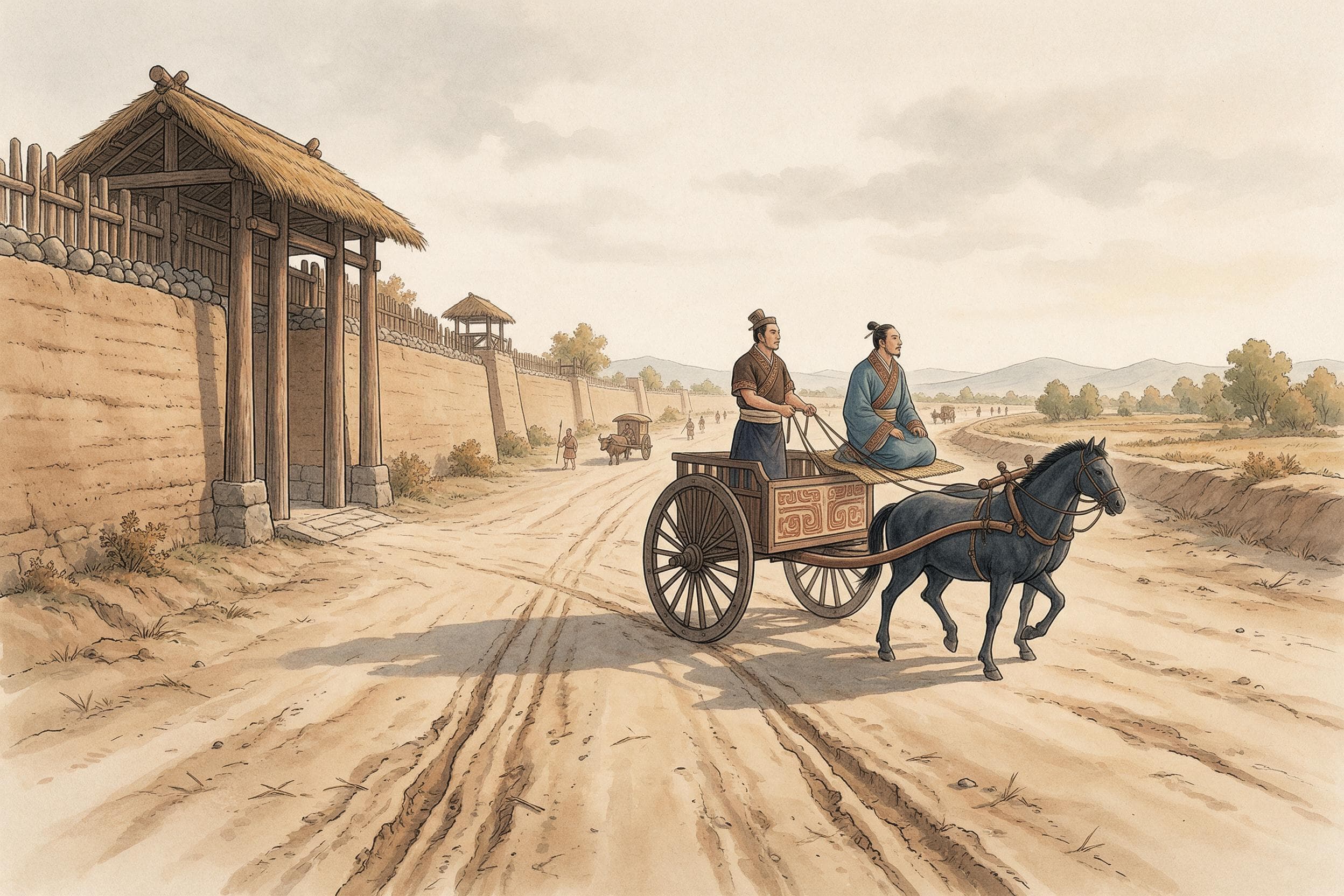
In the autumn of 2024, on the north bank of the Huan River at Yinxu in Henan, the excavators found what they had been looking for on a road surface: ruts. Two parallel grooves pressed into the road, left by wheels roughly 3,300 years ago. That season's work confirmed the framework of the late Shang capital's streets — 三横三纵, three roads running east-west and three north-south — including one north-south avenue whose two ends are now defined and which is the longest city road yet found there. A capital with a plan is not something the texts tell us here; the road surface does.
A city laid out on a grid
The result is very new, and the wording of the report is cautious: the grid is 'beginning to appear' (初现), which means it is still being pieced together. How wide the avenues were, whether the surface was rammed earth or gravel, and who maintained them are not given — and so this article does not say. Three things are solid: the grid of east-west and north-south roads, one north-south avenue with both ends identified, and wheel ruts on its surface. The third matters most: ruts prove that this road was actually driven on, not merely drawn. In the same season more than forty late Shang sacrificial pits were excavated in the royal cemetery area, roads and ritual space each keeping their place in one capital. A grid implies an authority able to lay out streets before the houses rose along them, though the report names neither the planner nor the date; the usual guess is the palace, and it remains a guess. The ruts carry a second implication too: the surface was worn down by wheels over time, so the road was used long enough to be used down — though no traffic rule was ever written on it.
One yoke, one shaft, one box, two wheels
The chariot's construction is described plainly in the excavation literature: one yoke (衡), one shaft (辕), one carriage box (舆), one axle (轴) and two wheels (轮). The yoke lay across the horses' necks, the shaft ran back from it to the box, and the axle sat under the box with a wheel at each end — light, fast and fragile, with the strain falling exactly where the sources say it broke. A chariot was drawn by two horses and carried one or two men, at least one of them the driver; that pairing is the standard arrangement in the material, and no other combination is described. Chariots excavated early had straight shafts; only later were curved shafts found. The researchers also say the vehicle was not very sturdy: at speed, and on a bad road, the shaft and axle were the parts most likely to break. That plain sentence says most of what there is to say about transport three thousand years ago.
The boxes came in sizes: the larger held three people, the smaller only two. The Shang honoured the right, so when three rode together the master probably sat on the right, the driver stood in the middle and the companion was on the left; the master and companion knelt, while the driver stood. A seat in a chariot was a small-scale table of rank.
The lacquered carriage from Guojiazhuang
Yinxu's chariots served different purposes — riding carriages, ceremonial vehicles and war chariots — and the riding carriage was the most common. One cleaned in 1987 south-west of Guojiazhuang gives a concrete picture of a Shang luxury vehicle: the wooden railing panels of the box were lacquered and painted in red and black, red cloth was pasted over the front panel, and a mat was laid inside for seating. By an incomplete count, more than a hundred chariots have come out of Yinxu so far, which makes the vehicle a mature product of a workshop tradition rather than a rare curiosity.
The crash that required an oracle
The oracle-bone script has dedicated characters for a broken shaft and a broken axle. One divination records a crash during a royal hunt: the axle snapped and the horses bolted. A traffic accident was worth carving into turtle shell, which shows how close the chariot sat to royal life — travel, hunting, ritual and war all depended on it. Researchers hold that the vehicle reached the Central Plains around 1200 BCE; that is a scholarly view, not something the bones say, and it should be quoted as such. Divination was the ordinary instrument of royal decision-making: journeys, hunts and campaigns were put to the bones before and after they happened, which is how a broken axle ended up in the record at all.
Who rode, and who went into the pit with the horses
The riders were normally kings and nobles. The chariot was therefore more than transport: it was a mark of rank, and its owners took it into the ground — the vehicle was buried in or beside the tomb, and horses and drivers were often buried with it. It is not a garage; it is part of a grave. In 2005, about three kilometres west of the palace-temple area, seven late Shang chariot-and-horse pits were excavated at once; five of them stood in a single row, north to south, with five chariots, all horses' heads pointing east, seven human victims in the pits, and a bronze short sword with a faced blade — all firsts in more than a century of digging at Yinxu. Whether commoners rode is simply not in the material, and this article does not guess. Nor does the report say who the seven dead were: it uses only the words 'sacrificed persons', and whether the drivers are among them the material does not show.
Taken together, a road and a chariot tell the same story: the late Shang capital had a planned road network, chariots built from yoke, shaft, box, axle and wheels ran on it, the vehicles belonged to the nobility, and a broken one was worth a divination while a dead owner took his into the tomb. The gaps are real: the width, surface and upkeep of the roads are unrecorded, as is the chariot's speed, and so is the travel of commoners; nor does the report say what the grid was for — processions, haulage, the movement of bronze or grain. For objects, the Yinxu museum park displays chariots, ruts and road foundations (a visiting note, not a scholarly source); the vehicles were built of wood, and once in the ground what archaeology recovers is mostly the traces they left. The plainest question is also the hardest: the ruts prove that wheels went down that road, but who swept it and who spread the earth?
Sources & further reading
- 岳占伟、荆志淳〈殷墟出土的商代马车〉,《人民日报》2022-11-12 — 马车部件(衡、辕、舆、轴、轮)、一车两马一或二人、直辕与曲辕、车舆容2—3人、座次、乘车/仪车/战车、身份象征与殉葬、甲骨文车辕车轴断裂专字与商王田猎车祸卜辞、殷墟出土马车上百辆;作者单位为中国社科院考古所与南方科技大学
- 中新网〈安阳殷墟发现迄今最长大邑商都城城市干道〉2024-12-26(图/中国社会科学院考古研究所安阳工作队) — 洹河北岸三横三纵骨干道路网络格局初现;一条纵向干道为已发现两端明确、长度最长的城市干道;路面车辙(2024年9月3日摄);王陵区40多座商代晚期祭祀坑
- 文化和旅游部网站〈安阳殷墟首次发现一组五乘车马坑和青铜短剑〉2005-05-27(转中新社稿) — 2005年一次发掘七座商代晚期车马坑,其中五座一组排列、南北一字排开、马头向东、殉葬者共七人;坑内面刃青铜短剑;距宫殿宗庙区西约三千米