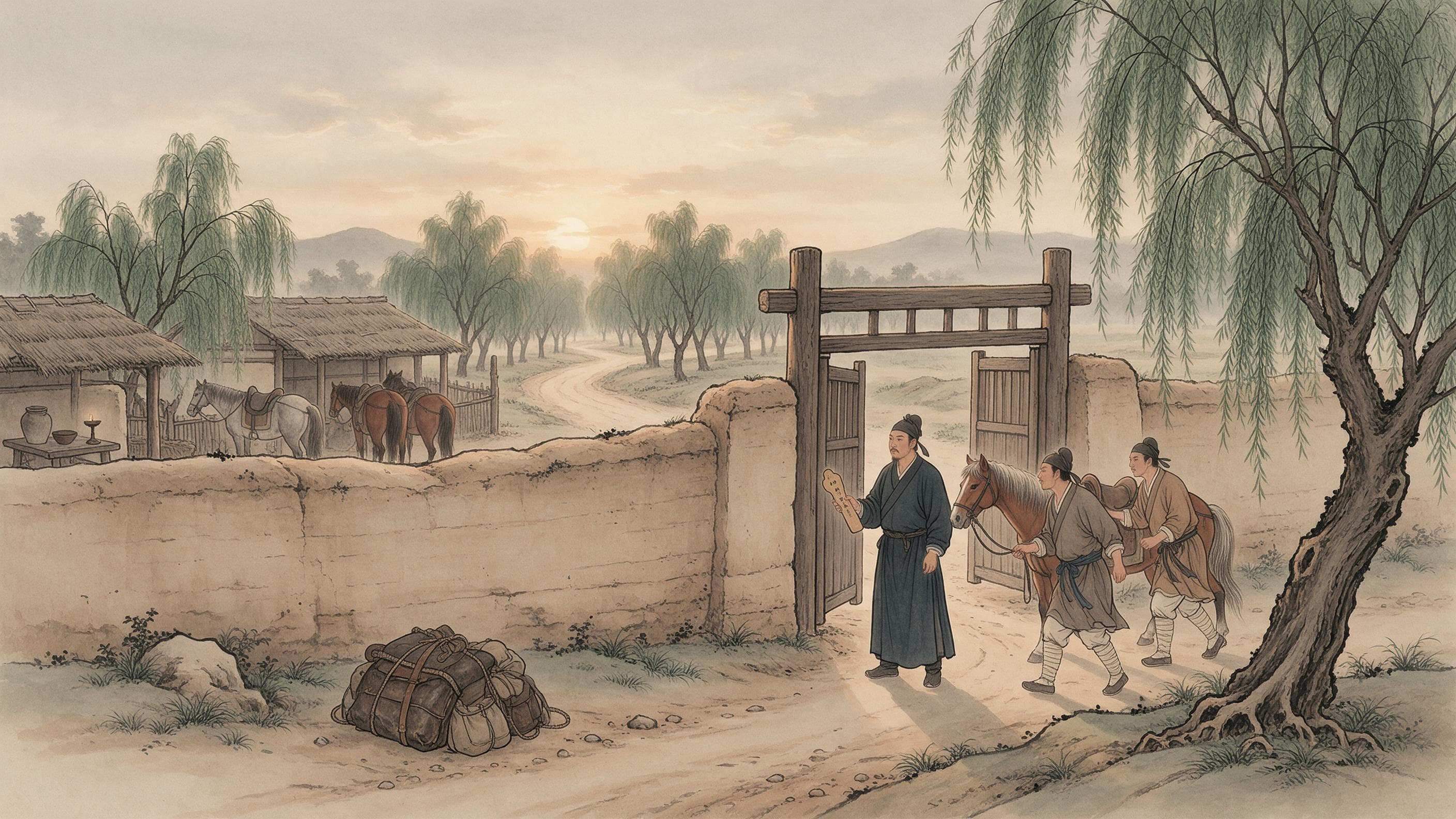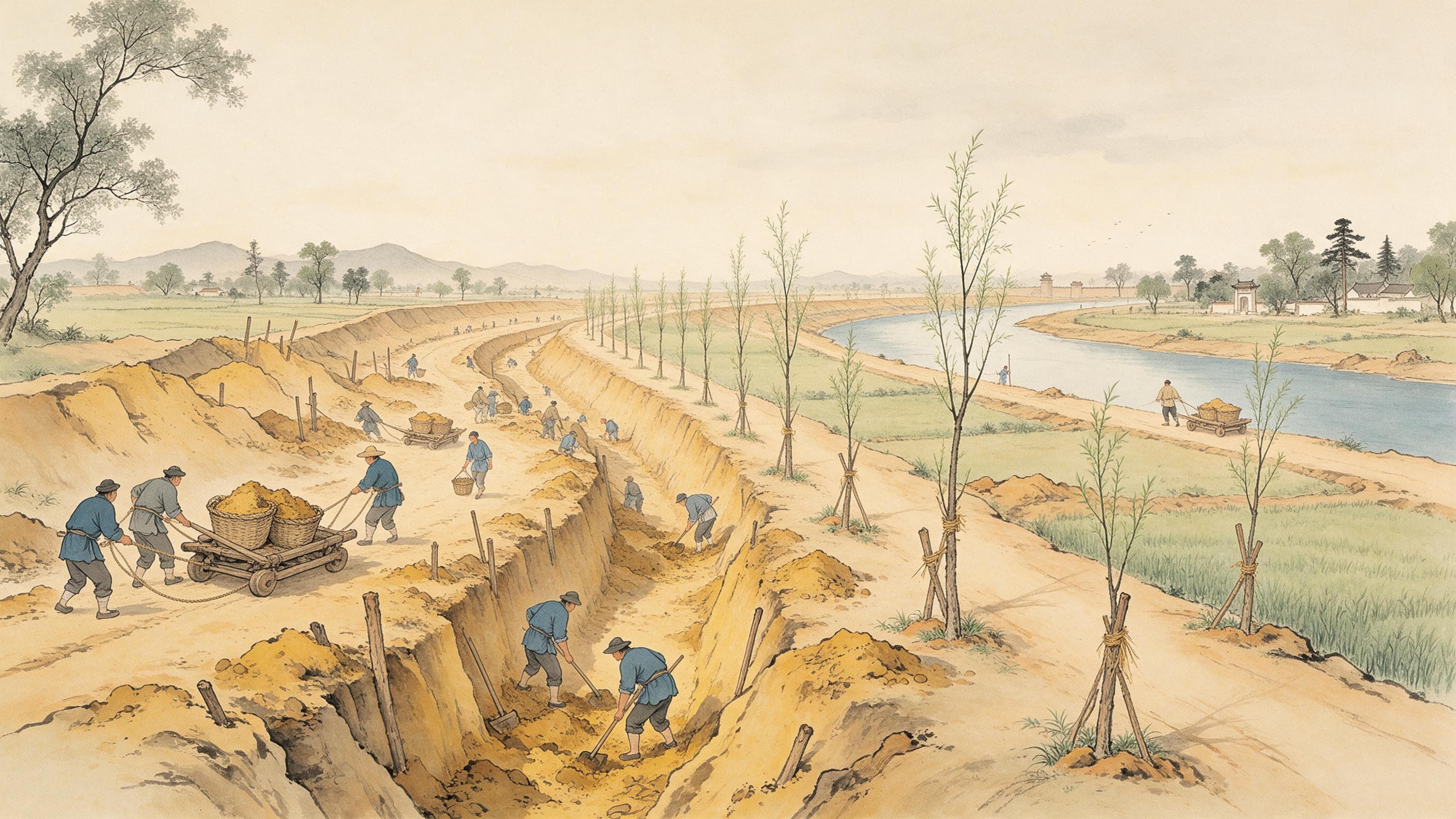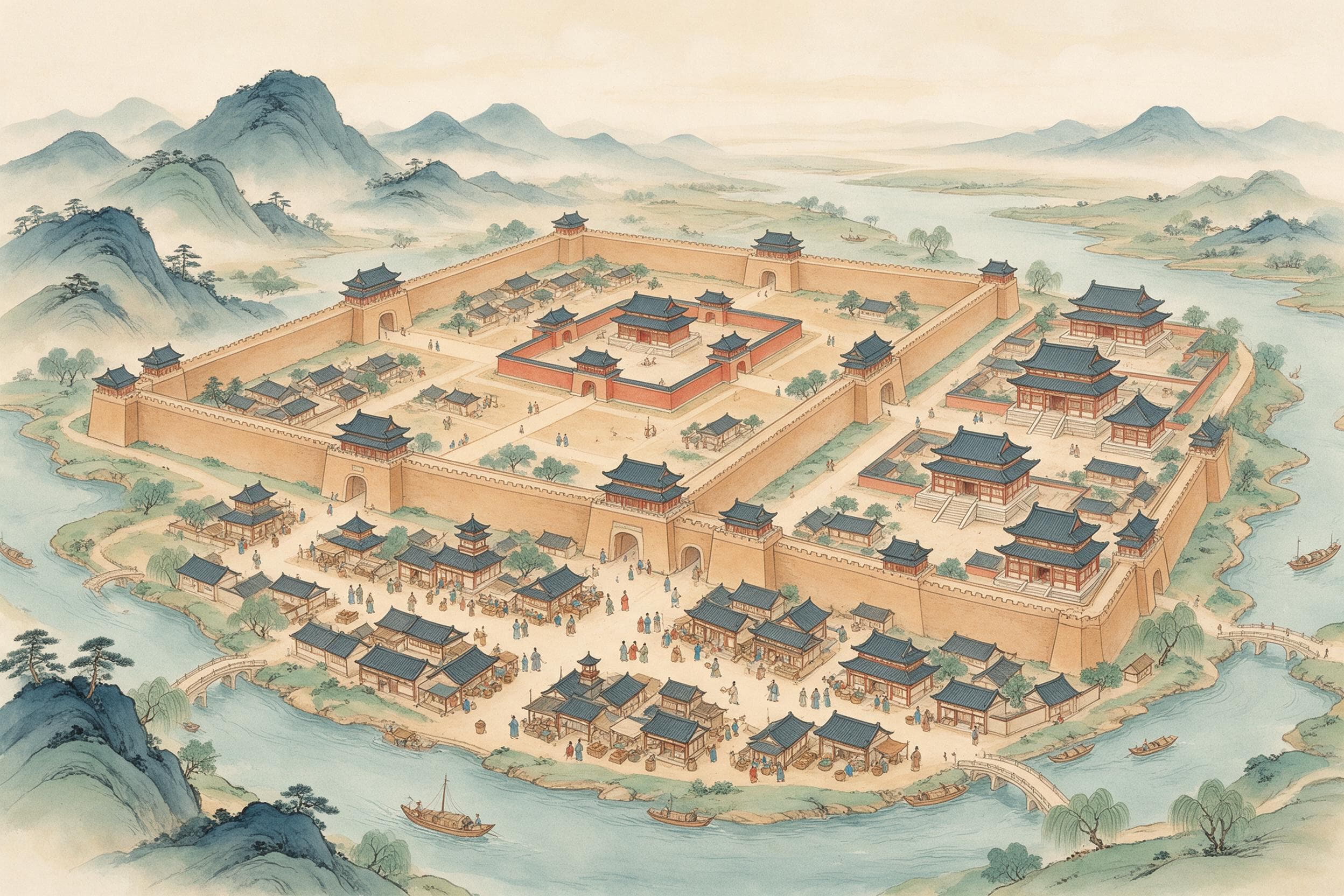
In 516, the first year of the Xiping era, work began on a foundation trench a li south of the Changhe Gate of the Luoyang palace, on the west side of the imperial road. The diggers went down until they struck water — the chronicle's phrase is 掘基至黃泉下, 'they dug the foundation as far as the Yellow Springs' — and in the soil they found thirty gilt statues of the Buddha. The Empress Dowager Hu took this as proof that the Law favoured the project, and 是以營建過度也, 'on that account the building exceeded all measure.' The scale of the tower begins with an accident in a hole in the ground.
Framed in wood: the dimensions as written
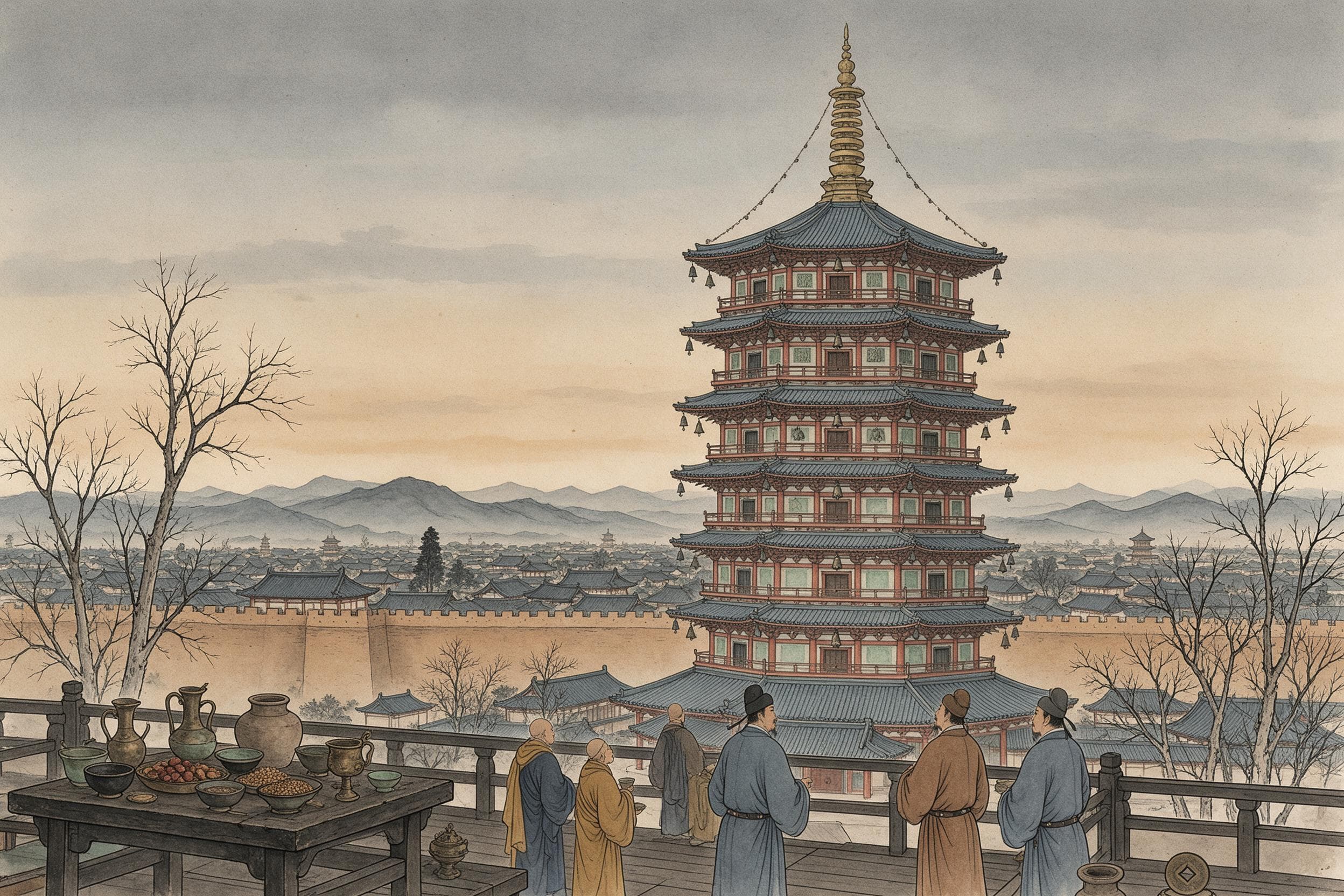
The Record of the Monasteries of Luoyang describes the body of the tower in a single breath: 中有九層浮圖一所,架木爲之,舉高九十丈。上有金剎,復高十丈;合去地一千尺. Nine storeys, built of timber; ninety zhang high; a golden spire above, another ten zhang; a thousand feet from the ground in all. 架木爲之, 'framed in wood', is the phrase that matters: this was a timber structure, not a brick one. And the chronicle adds the effect: 去京師百里,已遙見之, from a hundred li outside the capital it could already be seen.
Conversion needs care. A Northern Wei foot is usually put at roughly 0.28–0.30 m, a range that shifts with the ruler and the region, so any figure in metres here is an approximation. On that basis a thousand feet comes to about 280–300 m, which cannot be taken literally: it would stand far above any premodern timber building. The Wei Shu, the official dynastic history, notices the same tower as 佛圖九層,高四十餘丈, nine storeys and a little over forty zhang, which by the same rough conversion is about 110–120 m, less than half the other figure. Both texts say nine storeys; the heights differ by more than double. The Record's third juan adds that the seven-storey pagoda at Jingming Monastery rose 去地百仞, a hundred ren, and if a ren is seven feet that is seven hundred feet — taller again than the Wei Shu's Yongning tower. Three numbers that cannot all be right. They are not survey data; they are measurements taken with the breath held. Every metre figure in this article is a calculation from the written numbers, not an archaeological measurement.
An inventory of gold
What follows in the text is a list. On the spire stood a golden vase holding twenty-five hu; beneath the vase, eleven tiers of a dew-catching golden dish, 周匝皆垂金鐸, with golden bells hanging all around its rim. Four iron chains ran from the spire down to the tower's four corners, and these too carried bells, 鐸大小如一石甕子 — each bell the size of a jar that holds a bushel. The tower had nine stages, 角角皆懸金鐸,合上下有一百三十鐸, bells at every corner, a hundred and thirty from top to bottom.
A second set of numbers belongs to the doors. Each of the four faces had three doors and six windows, all lacquered vermilion, and 扉上有五行金鈴,合有五千四百枚, on the door leaves five rows of golden bells, five thousand four hundred in all, with gilt ring-handles besides. A hundred and thirty and five thousand four hundred are two different orders: the great bells hung at the eaves and on the spire, the small ones were nailed to the doors. North of the tower stood a Buddha hall shaped like the Taiji Hall, holding a sixteen-foot gilt image, ten of medium height, three of embroidered pearl, five woven in gold thread, two of jade; the monks' quarters and galleries came to more than a thousand bays. The list preserves the order of the work: raise the frame, cap it with the spire, hang the bells, then nail the bells to the doors.
A sound at night, and a man who had seen the world
Half the tower's fame was acoustic. 至於高風永夜,寶鐸和鳴,鏗鏘之聲,聞及十餘里: on a night of high wind the precious bells sounded together, and the clang carried more than ten li. A hundred and thirty bells the size of water jars, ringing at once, heard from villages an hour's walk away.
One visitor is worth pausing on: the monk Bodhidharma, from the Western Regions, whom the chronicle calls 波斯國胡人, a Persian, and who claimed to be a hundred and fifty years old and to have travelled everywhere. What he saw was 金盤炫日,光照雲表,寶鐸含風,響出天外 — golden dishes dazzling in the sun, light above the clouds, bells holding the wind, sound going out beyond the sky — and he called it a divine work, saying 此寺精麗,閻浮所無也, nowhere in the world of Jambudvipa was there anything like this monastery. The emperor and the empress dowager climbed the tower together and looked down 視宮內如掌中, the palace like something lying in the palm of a hand; after that 禁人不聽升之, no one was allowed up. Yang Xuanzhi went up himself once, with the governor of Henan: 下臨雲雨, looking down on cloud and rain.
What the wind took first
The tower did not die by fire first. In 526 a gale 發屋拔樹, tore off roofs and uprooted trees, and the golden vase on the spire came down 入地丈餘, driving more than a zhang into the ground. Smiths were ordered to cast a new one. That was the first time the weather took a piece off the building.
After that it became a barracks, and then a prison. In 528 the warlord Erzhu Rong 總士馬於此寺, mustered troops and horses in the monastery; in 529 the pretender Yuan Hao gathered his army there; in 530 Erzhu Zhao held the emperor captive and 鎖帝於寺門樓上, chained him in the monastery's gate tower. A tower famous for golden bells spent its last years receiving armies, rebel princes and prisoners.
Three months of fire
In the second month of 534 the pagoda burned. 火初從第八級中平旦大發, the fire started inside the eighth storey and broke out at dawn; 當時雷雨晦冥,雜下霰雪, there was thunder and rain and darkness, with sleet falling through it, and the fire could not be put down. The emperor climbed the Lingyun Terrace to watch and sent a thousand imperial guards with two princes to fight the flames; 莫不悲惜,垂淚而去, they all went weeping. Monks and laypeople came to see, 悲哀之聲,振動京邑, and the sound of grief shook the capital. Three monks walked into the fire and died.
火經三月不滅。有火入地尋柱,周年猶有煙氣. It burned for three months without going out; the fire went into the ground, following the pillars, and a year later there was still smoke. In the fifth month a man came from Laizhou and said he had seen the pagoda out at sea, 光明照耀,儼然如新, shining as if new, seen by all the people of the coast; then fog rose and it was gone. In the tenth month the court moved to Ye.
From 516 to 534 is eighteen years — the 'twenty years later' of memory is eighteen on the calendar. Those reign years are the only thing here that can be checked; the tower's size can only be left where the text leaves it, with the conversion flagged as uncertain. What survives is not survey data but a list and a fire: the list says how many bells there were, the fire says that all of them came down. Yang Xuanzhi wrote in Ye, remembering a city that no longer existed, and the last number he gives the tower is not a height. It is three months.
Sources & further reading
- 楊衒之《洛陽伽藍記》卷一「永寧寺」(Yang Xuanzhi, Luoyang Qielan Ji, juan 1, "Yongning Monastery") — The full record of the tower: its 90-zhang timber frame and 10-zhang spire, the twenty-five-hu vase, 130 bells and 5,400 door bells, Bodhidharma's visit, the gale of 526, and the fire of 534 that burned for three months.
- 魏收《魏書》卷一百一十四〈釋老志〉(Wei Shou, Wei Shu, juan 114, "Treatise on Buddhism and Daoism") — The official history's independent notice of the same tower: nine storeys, a little over forty zhang, costs beyond reckoning — less than half the height given in the Record.
- 楊衒之《洛陽伽藍記》卷三「景明寺」(Yang Xuanzhi, Luoyang Qielan Ji, juan 3, "Jingming Monastery") — Jingming's seven-storey pagoda, said to rise a hundred ren and to rival Yongning in ornament — a third height figure that does not agree with the other two.