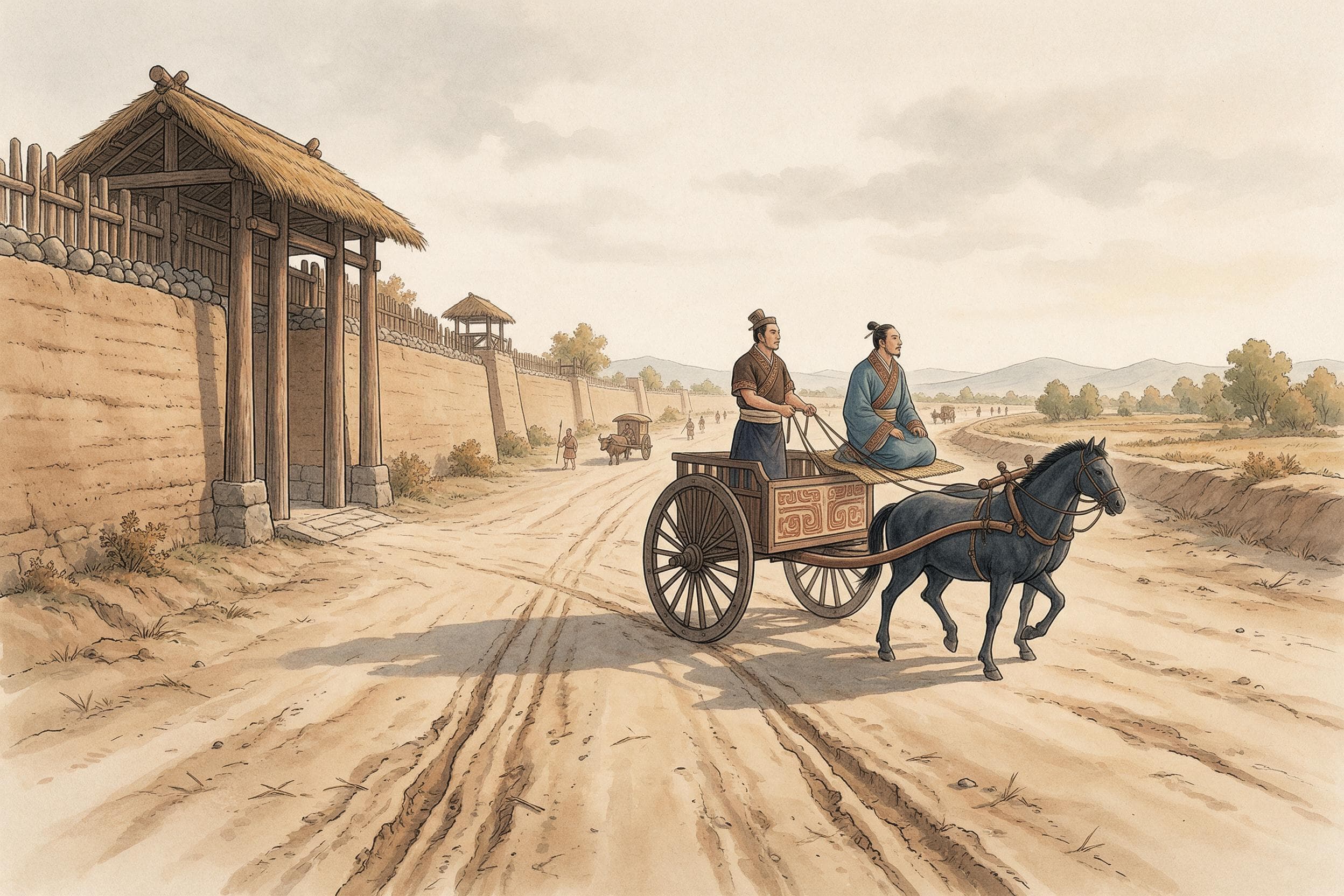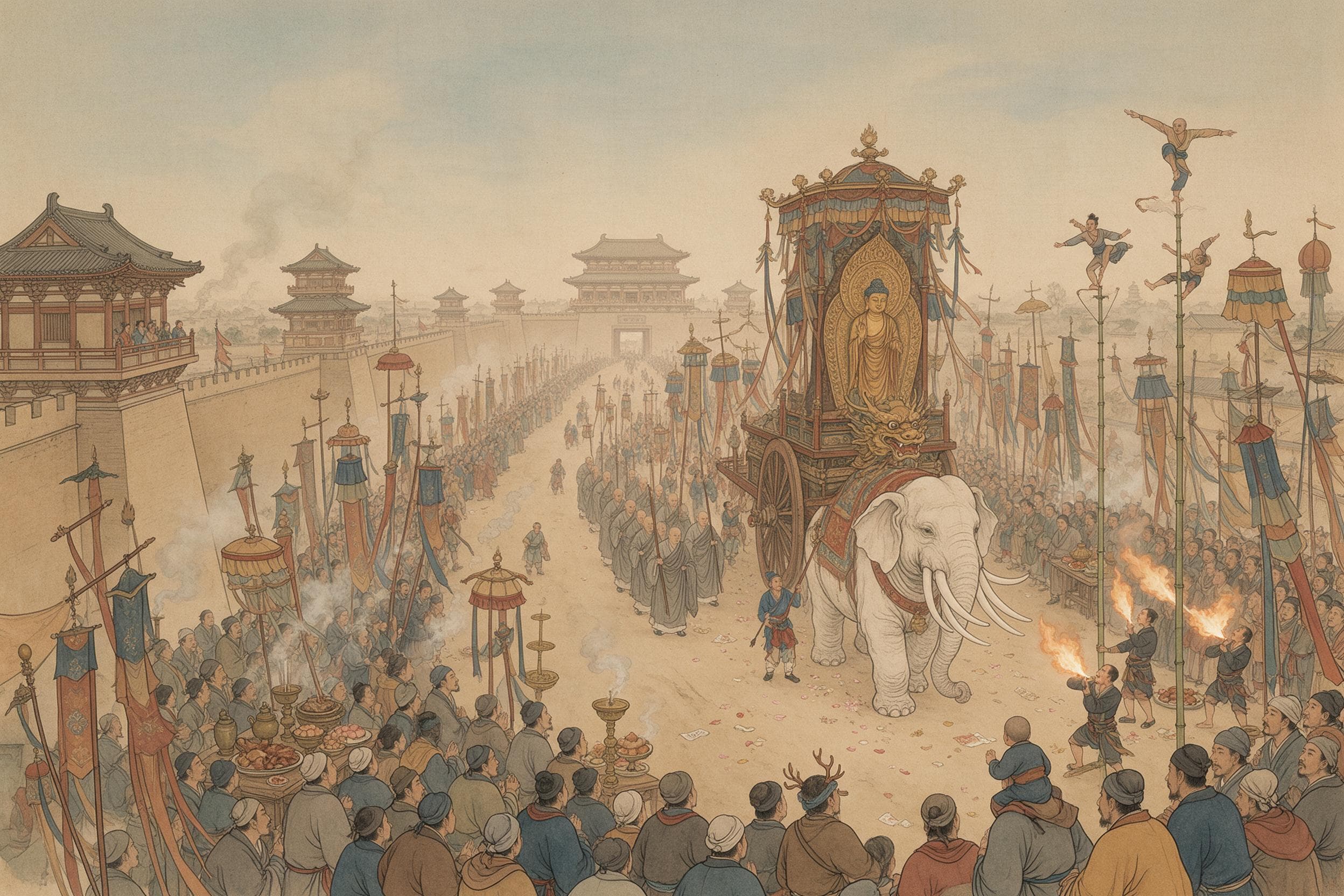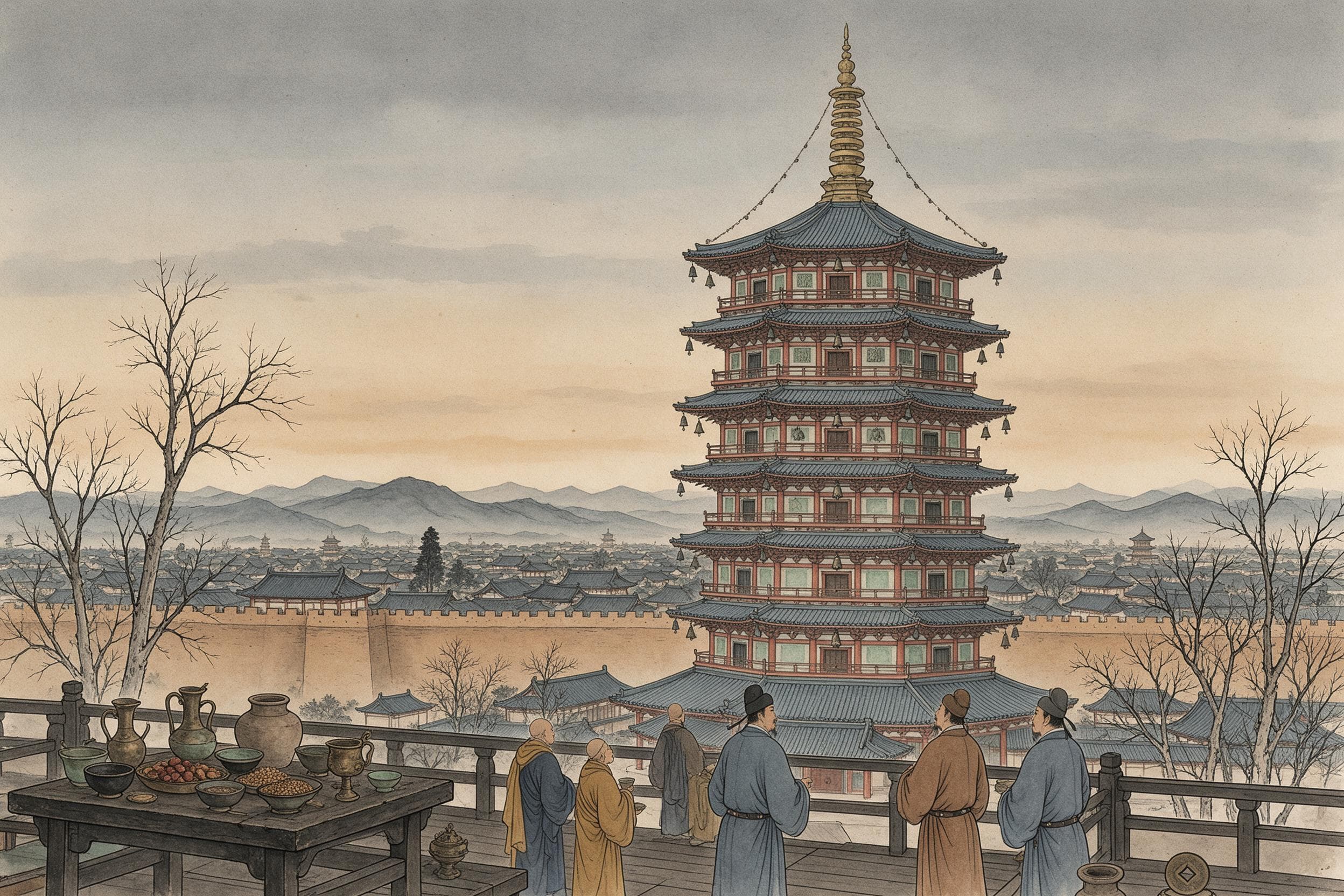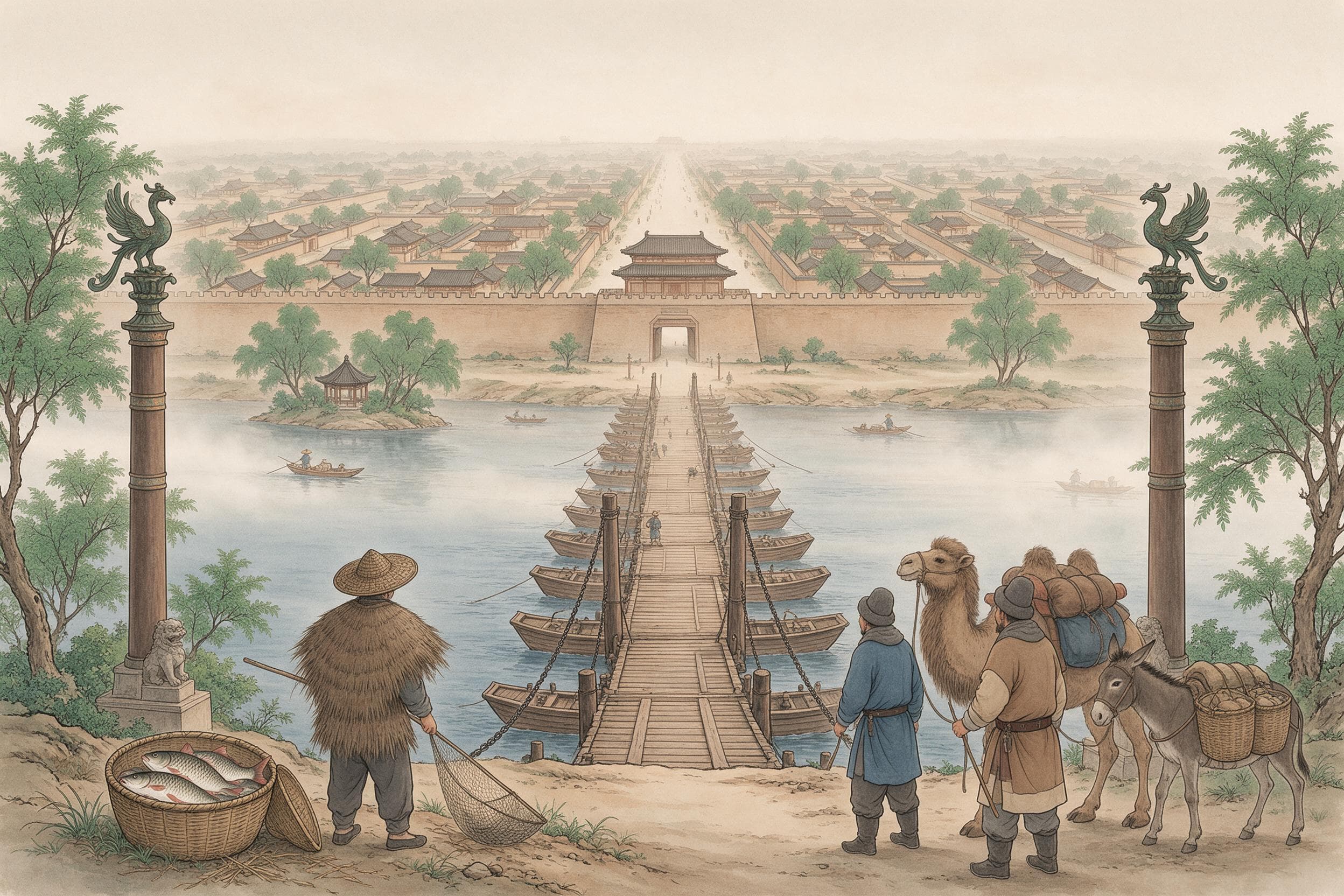
South of the palace, the Luo river was crossed on a float bridge called the Yong Bridge. At either end stood a pair of pillars 舉高二十丈, twenty zhang tall, each topped with a bronze phoenix 似欲衝天勢, as if about to launch into the sky. South of the water the imperial road ran straight, laid out in blocks: four hostels east of it, four wards west. Which gate a newly arrived foreigner was taken through depended on where he had come from.
Four hostels, four wards
The chronicle lists them with bureaucratic neatness: 夾御道東有四夷館,一曰金陵,二曰燕然,三曰扶桑,四曰崦嵫。道西有四夷里:一曰歸正,二曰歸德,三曰慕化,四曰慕義. East of the road, the Four Barbarian Hostels: Jinling, Yanran, Fusang, Yanzhi. West of it, the four wards: Guizheng, Guide, Muhua, Muyi.
The pairing is fixed. 吳人投國者,處金陵館。三年已後,賜宅歸正里 — men from the Wu region who submitted were lodged in the Jinling Hostel, and after three years given a house in Guizheng ward. Northerners who came to submit went to the Yanran Hostel and after three years to Guide; easterners to the Fusang Hostel and the Muhua ward; westerners to the Yanzhi Hostel and the Muyi ward. Hostel and ward are two stages: the hostel is where you arrive, the ward is where you are settled three years later. The names run in pairs too. Jinling, Yanran, Fusang and Yanzhi are places and directions of origin; Guizheng, Guide, Muhua and Muyi — 'returning to the upright', 'returning to virtue', 'admiring transformation', 'admiring righteousness' — are what the court hoped the arrivals would become.
The three-year rule is an institution, not the biography of everyone who came. It shows a court that thought of settlement as something countable in years. What the book cannot supply is a register: who completed the three years, who left early, who never left the hostel at all, is not recorded.
Who came, and who refused the address
The arrivals were not equals, and the text says so without softening it. At the start of the Jingming era the Qi prince Xiao Baoyin defected to the north, was enfeoffed as Duke of Kuaiji, and had a mansion built for him in Guizheng ward; later he was raised to Prince of Qi and married a Wei princess. Then comes the sharp sentence: 寶寅恥與夷人同列, he was ashamed to stand in the same rank as barbarians, and had the princess petition the emperor to let him move inside the city wall. The emperor agreed and gave him a house in Yong'an ward. The same street was a resettlement to one man and an insult to another.
In 523 Xiao Yan's son, the Marquis of Xifeng, also came over, was lodged in the Jinling Hostel and given a house in Guizheng; later he gave that house up to become the Guizheng monastery. Northern arrivals were handled with more ceremony. In 520 the Rouran ruler Yujiulü Anagui came to court and the officials did not know where to place him; the secretariat drafter Chang Jing proposed that he be ranked 蕃王儀同之間, between the enfeoffed princes and the titular ministers of the same grade, and the court agreed, lodging him in the Yanran Hostel and granting him a house in Guide ward. There was a third category: sons of northern chieftains sent to serve at court, who 常秋來春去,避中國之熱, came in autumn and left in spring to avoid the Chinese heat, 時人謂之雁臣, 'the wild-goose officials'.
Living in these wards became a joke at someone's expense. In Zhonggan ward, north of the Prince of Gaoyang's mansion, the thirteen-year-old Xun Ziwen was asked where he lived and answered, 僕住在中甘里. His questioner said: 何為住城南, why live south of the city? The chronicle adds: 城南有四夷館,才以此譏之 — the Four Barbarian Hostels were in the southern district, so the man used that to mock him. Xun's reply was not humble: it is the finest ground in the city, and as for people, 有我無卿, there is me and there is not you.
The ten thousand households
Beyond the hostels and wards lies the larger picture: 自蔥嶺已西,至於大秦,百國千城,莫不款附。商胡販客,日奔塞下 — from west of the Pamirs as far as Daqin, a hundred countries and a thousand walled towns, all submitting; merchant strangers running to the frontier every day. Then: 樂中國土風因而宅者,不可勝數。是以附化之民,萬有餘家。門巷修整,閶闔填列。青槐蔭陌,綠樹垂庭。天下難得之貨,咸悉在焉. Those who liked Chinese soil and manners and settled were too many to count; the naturalized population came to more than ten thousand households. Lanes and alleys orderly, gates and doors packed in rows, green locust trees shading the paths, green trees hanging over the courtyards. And: the rare goods of the world were all here.
Ten thousand households is the number in this article most likely to be mistaken for a census. It is not one. It sits inside a passage that opens with 'too many to count'; the author is giving a round figure, decades later, in Ye, after the city he is describing had been destroyed. What can be said is that the district was remembered at the scale of ten thousand households, its lanes orderly, its goods rare. It is also worth noticing where the sentence about rare goods stands: after the street scene of the wards and before the market — so it describes the residential quarter, not the market.
A market where carp cost more than beef
The market was established separately: 別立市於洛水南,號曰四通市。民間謂為永橋市 — a market south of the Luo, officially the Sitong Market, popularly the Yong Bridge Market. Two names, one official and one popular: a market that did business with people crossing the river. Its speciality was fish: 伊洛之魚,多於此賣,士庶須膾,皆詣取之。魚味甚美. Fish from the Yi and the Luo were mostly sold here; anyone, officer or commoner, who wanted sliced raw fish came to get it. The saying in the capital was 洛鯉伊魴,貴於牛羊 — carp from the Luo and bream from the Yi cost more than beef and mutton.
A fish dearer than beef implies two things: a short route from river to stall, and enough people in the city able to pay. The market sold more than fish, but the only goods the chronicle names are fish; everything else is covered by four characters, 難得之貨, rare goods.
The elephant and the lion
East of the road south of the bridge stood two more compounds, the White Elephant Yard and the Lion Yard. The elephant was sent by the king of Gandhara in 509, with a five-coloured screen and a jewelled couch on its back. It was first kept at the imperial stables, where 象常壞屋毀牆,走出於外。逢樹即拔,遇牆亦倒 — it smashed buildings and walls, got out, pulled up trees and pushed over walls — until the empress dowager moved it to this yard.
The lion was sent by the king of Persia, seized on the way by the rebel Wanqi Guinu and kept among the rebels until their defeat at the end of the Yong'an era, when it finally reached the capital. Emperor Zhuang, wanting to test the belief that 虎見獅子必伏, tigers crouch before a lion, ordered the mountain counties to send tigers; Gongxian and Shanyang sent two tigers and a leopard, and the emperor had them brought to the Hualin Garden. The tigers and the leopard 悉皆瞑目,不敢仰視, all shut their eyes and dared not look up; a blind bear in the garden smelled the lion and 驚怖跳踉,曳鎖而走, bolted in terror, dragging its chain. The emperor laughed aloud. In 531, on his accession, the Prince of Guangling ordered captive animals released to the mountains, and the lion was to be sent home; its escorts decided Persia was too far, 遂在路殺獅子而返, killed it on the road and came back. The law officers moved to prosecute them for disobeying an edict; the prince said: 豈以獅子而罪人也, would you punish a man for the sake of a lion? and pardoned them.
That ending makes the point better than any figure. A system that could sort arrivals into hostels by origin, and make river fish dearer than beef, could not get one lion back to Persia. There is also harder evidence than the ten thousand households: 菩提寺,西域胡人所立也,在慕義里 — the Bodhi Monastery, founded by Western Regions foreigners, in the Muyi ward. Foreigners built a monastery in their own ward. That needs no statistic to show that people lived there, and lived long enough to raise buildings, install images and support monks.
Sources & further reading
- 楊衒之《洛陽伽藍記》卷三(永橋、四夷館、四通市)(Yang Xuanzhi, Luoyang Qielan Ji, juan 3: the Yong Bridge, the Four Hostels, the Sitong Market) — The core passage: four hostels and four wards by origin, three years before a house is granted, the ten thousand naturalized households, the Sitong Market and its fish, the elephant and lion yards, and the Bodhi Monastery built by Westerners.
- 楊衒之《洛陽伽藍記》卷一「永寧寺」(Yang Xuanzhi, Luoyang Qielan Ji, juan 1, "Yongning Monastery") — Scriptures and images offered by foreign countries were kept at Yongning, and the Persian monk Bodhidharma came there — evidence of the traffic that fed the southern wards.
- 魏收《魏書》卷一百一十四〈釋老志〉(Wei Shou, Wei Shu, juan 114, "Treatise on Buddhism and Daoism") — In 516 the court sent the monk Huisheng west to collect scriptures; he returned in 522 with 170 titles — the same routes the merchants and envoys used.