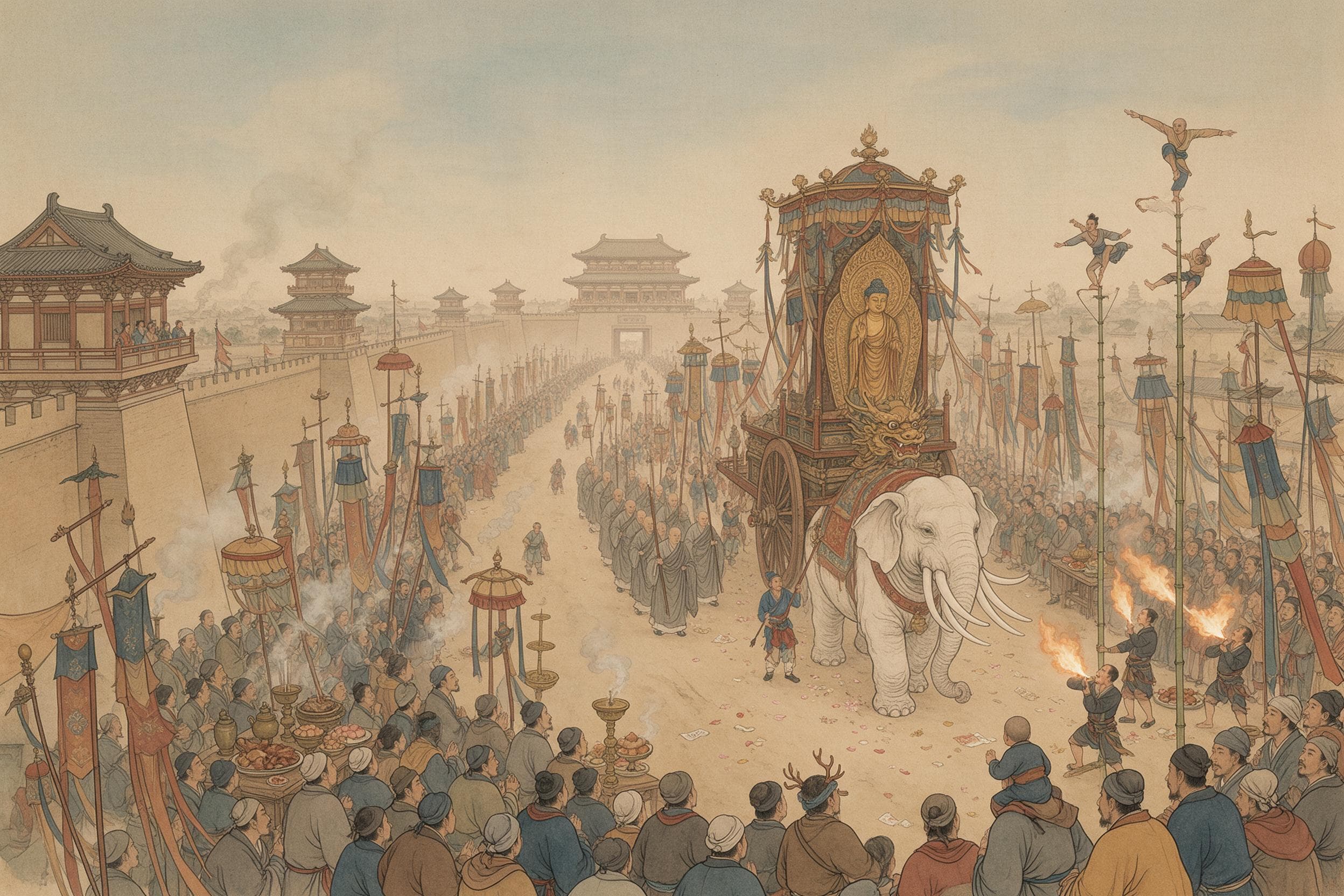
On the fourth day of the fourth month, the image kept at Changqiu Monastery came out. It was carried on a six-tusked white elephant, the Buddha seated aloft as if in the air, and in front of it went a lion to clear the way. Then came the performers: men swallowing knives and breathing fire, others somersaulting, still others balancing coloured banners on tall poles. The costumes, the chronicle says, surpassed anything else in the capital. And wherever the image halted, 像停之處,觀者如堵 — the spectators stood like a wall, shoved and leapt over one another, and 常有死人, there were often deaths. One sentence in a sixth-century chronicle, and the whole logistics of a mass festival is visible: a route, a lead vehicle, roadside acts, and a crowd that could kill.
Four days, and every image in the city
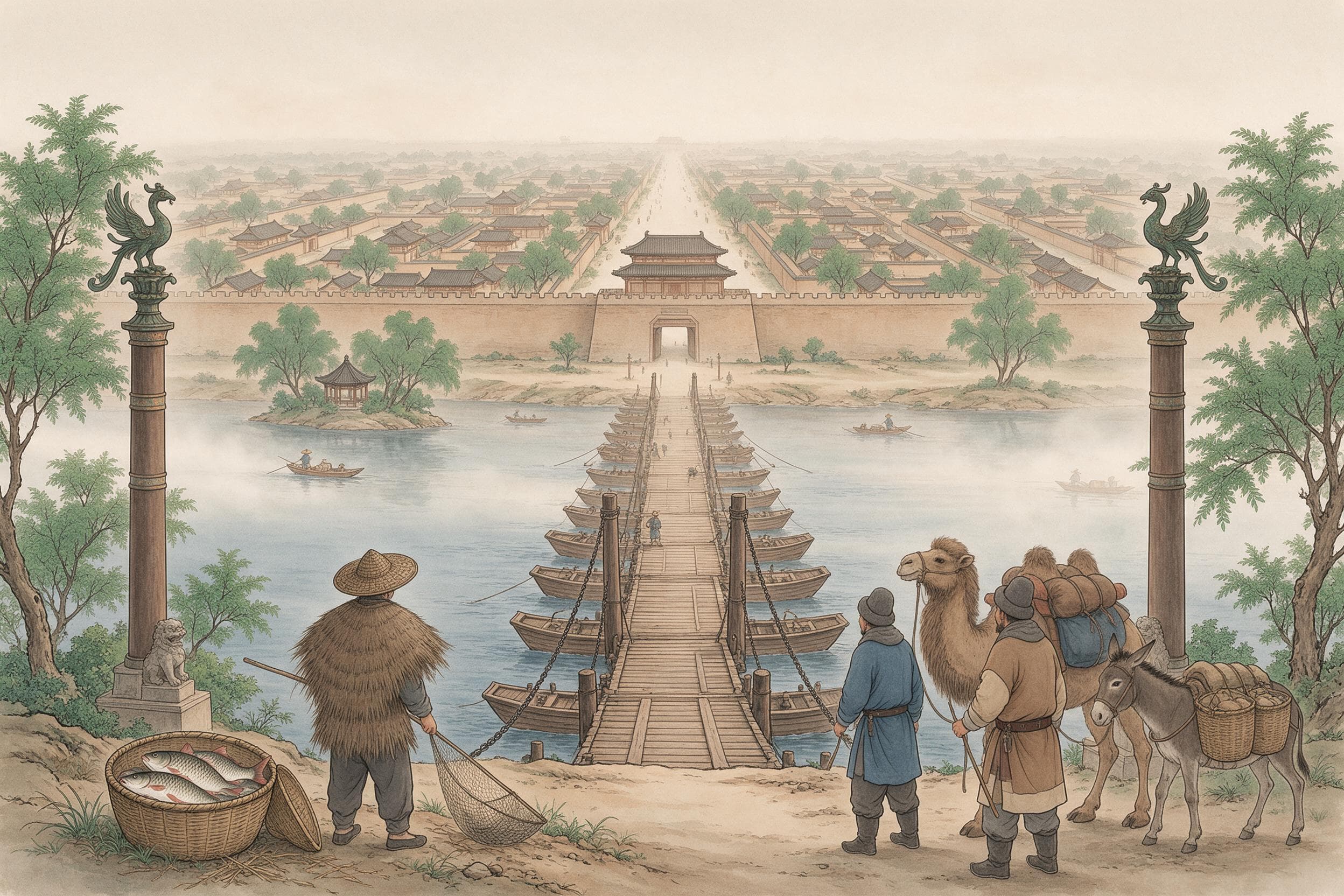
The main event came three days later. At Jingming Monastery, which stood a li outside the Xuanyang Gate on the east side of the imperial road, the images of the whole capital assembled on the seventh day of the fourth month. The office of the 尚書祠曹 — the secretariat bureau that handled sacrifices — registered them: 凡有一千餘軀, more than a thousand images in all. On the eighth they went in order through the Xuanyang Gate and halted before the Changhe palace gate, where the emperor scattered flowers over them. One of the smaller temples, the Zhaoyi nunnery, is recorded as sending its image to Jingming on the seventh, while Jingming's own three images went out to meet it — a detail that shows the routes crossing and the courtesy between foundations.
The description of the eighth is the most famous crowd scene in the book. Gold flowers shone against the sun; jewelled canopies floated like clouds; banners and streamers stood thick as a forest; incense smoke hung like fog; Sanskrit music and the sound of the Law shook heaven and earth; 百戲騰驤, the hundred entertainments pranced and galloped wherever one looked, packed close together. Famous monks came in companies with their staffs; lay believers carried flowers in heaps; carriages and horsemen jammed the road. A monk from the Western Regions, seeing it, cried out that this must be the Buddha-land.
Who ran it
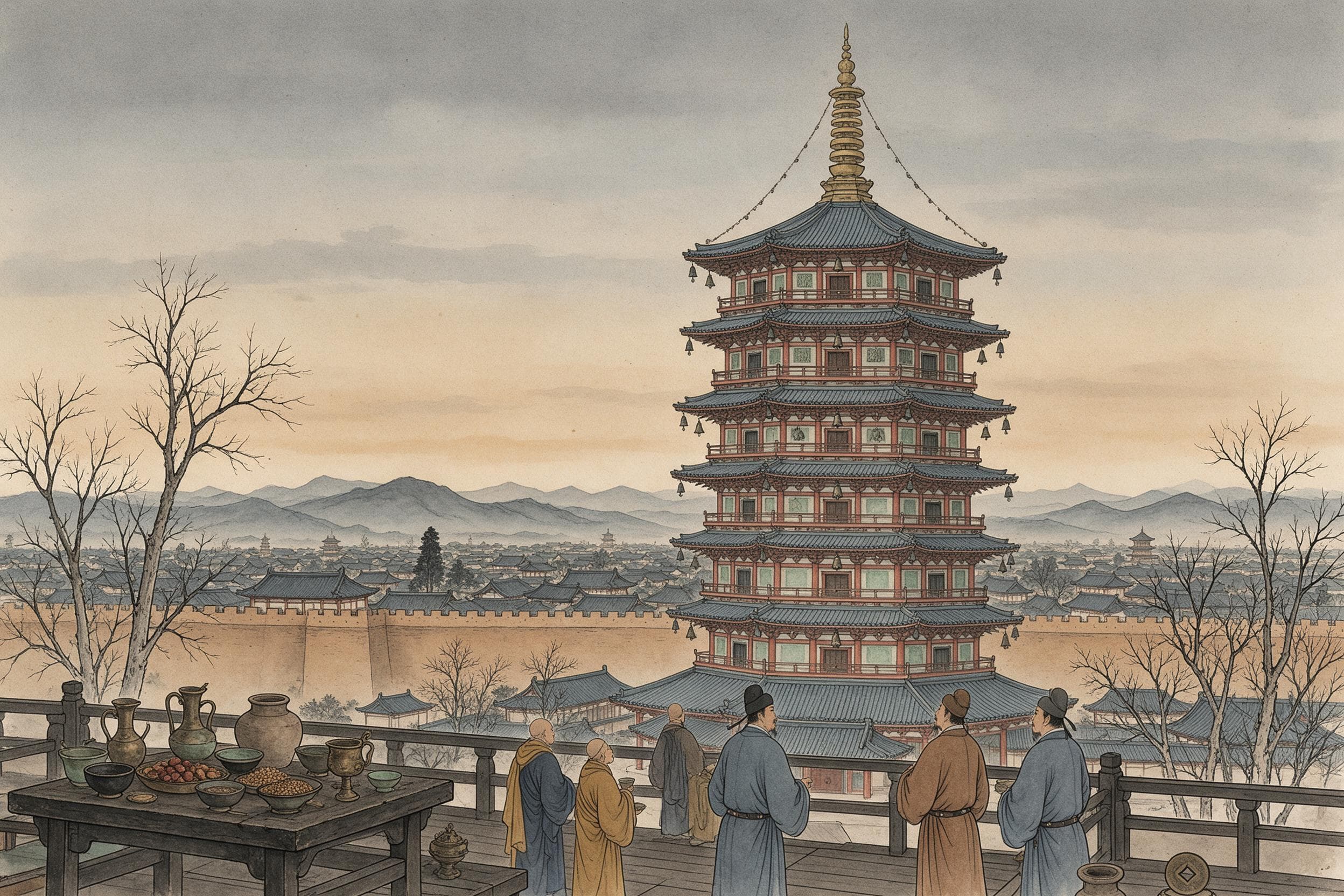
Three parties can be identified. The first is the state: an office of the Ministry of Rites kept the register of images, which means the procession was counted, not merely permitted, and the emperor's scattering of flowers made the palace the endpoint of the route. The second is the great monasteries, above all Jingming, founded by Emperor Xuanwu and named for his reign period, with a seven-storey pagoda rising a hundred ren and three ponds whose water powered mills and husking pestles — a foundation wealthy enough to host a thousand images and their escorts. The third is the crowd itself, which the text treats as a force of nature: 車騎填咽,繁衍相傾. What the chronicle does not give is any account of cost: no budget, no list of donors for the day, no figure for what the flowers or the canopies came to. This article will not invent one.
There is a fourth party, visible in who founded the temples. Changqiu, whose image opens this article, was built by Liu Teng, a palace eunuch who rose to real power and whose mansion, when it was confiscated, was described in the chronicle as having beams and pillars beyond what his rank allowed. The Zhaoyi nunnery belonged to eunuchs collectively, and the text compares its music and performers to Liu Teng's. A festival of this scale was paid for out of the same court politics that the book denounces elsewhere — which is one reason the chronicle treats the spectacle with such mixed feeling.
Tricks, spectators, and the dead
The performances are part of the procession, not a sideshow added by a later editor. At Changqiu the fire-swallowing and the pole work happen directly in front of the image; the text calls the costumes 冠於都市, the finest in the capital, and the acts 詭譎不常, weird and unpredictable. This is a religious procession with a commercial entertainment economy attached, and it drew the kind of crowd that such things draw. The register of a thousand images at Jingming and the wall of spectators at Changqiu are the same event seen from two ends: an institution counting its assets, and a street where the counting no longer mattered. The line 迭相踐躍,常有死人 is not a metaphor — it is the chronicle's explanation of why a festival needed managing.
What kind of source this is
The Record of the Monasteries of Luoyang was written after the city's world had collapsed, by a man who had watched the monasteries fall into ruin, and its descriptions are shaped by that retrospective grief. So the thousand images should be read carefully: the figure comes from an office register, which makes it firmer than most numbers in the book, but it is still reported by a literary author decades later. The deaths at Changqiu are a lament as much as a statistic. And the custom itself — parading an image of the Buddha on his birthday — is generally thought to have come to China from India and the Western Regions; the chronicle does not say so, and the dating of its arrival should be marked as a scholarly view, not a fact the text supplies.
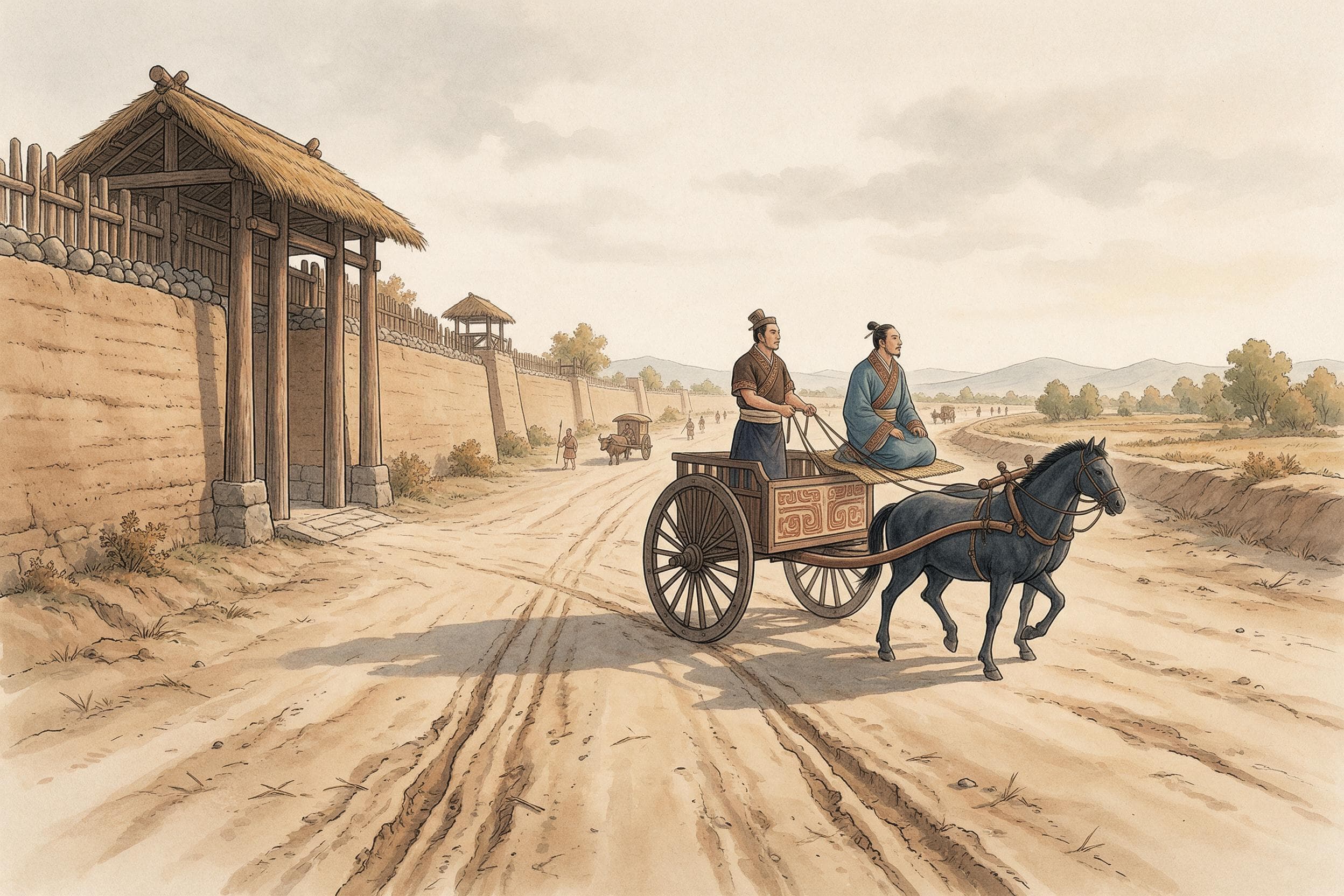
What survives, then, is a street on the eighth day of the fourth month: a thousand gilt images halted in front of a palace gate, the emperor above them with a handful of flowers, banners to the rooftops, a foreign monk weeping at the sight, and, at the edges, crowds pressing hard enough to kill. Twenty years later the great pagoda of Yongning Monastery burned for three months. The procession is the picture of the city before that fire — not because the chronicle says so, but because it is the kind of detail that only a rich and crowded place could produce.
Sources & further reading
- 杨衒之《洛阳伽蓝记》卷一·城内 (Yang Xuanzhi, Record of the Monasteries of Luoyang, vol. 1) — Changqiu Monastery: on the fourth day of the fourth month its image went out, a lion leading, with fire-swallowing and pole-balancing and crowds so dense that people were trampled to death; the Zhaoyi nunnery's image went to Jingming on the seventh, met by Jingming's three images.
- 杨衒之《洛阳伽蓝记》卷三·城南 (Record of the Monasteries of Luoyang, vol. 3) — Jingming Monastery: on the seventh day all the capital's images gathered there and the 尚書祠曹 office registered more than a thousand; on the eighth they entered the palace gate to receive flowers scattered by the emperor.