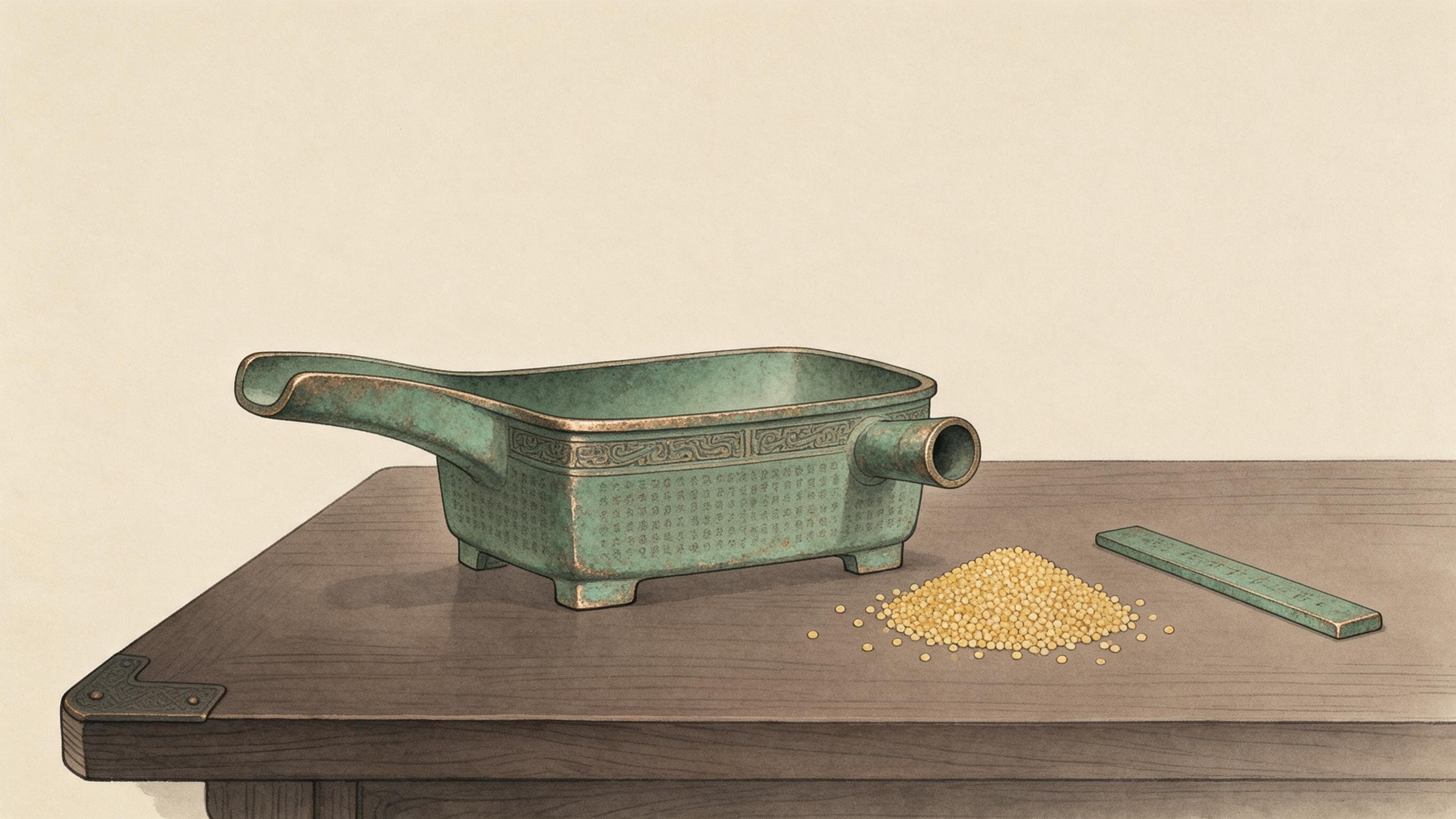
A rectangular bronze box, a little longer than a hand: overall length 18.7 centimetres, mouth about 12.5 by 7, height 2.3, capacity 202.15 cubic centimetres. One end carries a short hollow handle; the other three sides and the base are covered with small engraved characters. It is a measure for grain, and one of the few Warring States objects that can still be put on a table and measured. It is a transmitted piece, not a tomb find: no excavation site, no workshop. The inscriptions run along three sides and across the base: the first group on the side and the edge opposite the handle, the second on the base and the side opposite the first.
It names itself
The first inscription, cut when the vessel was made, gives its own identity: 'In the eighteenth year, Qi led its ministers and great officers to come on a friendly mission. In winter, the twelfth month, on the day yi-you, the Great Liangzao Yang measured out sixteen and one-fifth cubic cun to the sheng. Zhongquan.' The eighteenth year is 344 BC, the eighteenth of Duke Xiao of Qin; the Great Liangzao is Shang Yang, then the state's highest officer; the sheng is sixteen and one-fifth cubic cun — cun being the Chinese inch-like unit, not the English inch; Zhongquan is where the vessel was used, in what is now Pucheng in Shaanxi. A standard measure that states its own date, maker, capacity and destination. The opening words are a diplomatic note: in that year Qi sent a mission. The vessel does not say what the mission had to do with the measure; it only records that the two events share a date.
The figures can be checked against the object. The museum converts: at the Xin-dynasty foot of about 23.1 centimetres the box works out at 5.4 by 3 by 1 cun, which is 16.2 cubic cun, matching the inscription. But the museum says plainly that this is an ideal count and that earlier feet are hard to establish from objects; the conversion is an approximation, not a measured Warring States foot. The measured 202.15 cubic centimetres differ slightly from the self-declared figure, and the museum puts the difference down to deformation and corrosion over time and to the limits of the workmanship. The precise figures on the museum's page — mouth 12.4774 by 6.9742 centimetres, depth 2.323 — are given to four decimals; the rounded numbers are what the object itself would have aimed at.
Another edict, a century and a quarter later
The second inscription was cut much later, on the base and on the side opposite the first. It is an edict: 'In the twenty-sixth year, the emperor, having united all the lords of the world and brought peace to the black-haired people, established the title of emperor. He ordered the chancellors Zhuang and Wan: wherever measures, weights and carriage tracks are not uniform and are doubtful, let them all be made uniform. Lin.' The twenty-sixth year is 221 BC, the year of unification. The same box now carries the standard of a kingdom and the standard of an empire, with more than a century between them. The edict's phrase is practical rather than philosophical: wherever measures are not uniform and are open to doubt, make them uniform. 'Lin' at the end is the place where this copy was to be used.
The museum owns another vessel of the same shape, the 'bronze square sheng with the First Emperor's edict', with a capacity of 215.65 millilitres and the same imperial text. It is a different object, and its figures are not used to fill in this one's. Two boxes, two sets of numbers. The second box matters for a different reason: it shows the empire multiplying the same text across vessels, while the first shows one kingdom's box surviving to be reused.
One sentence in the Records
The literary record is a single line. In the Shiji's life of Shang Yang, after the move to Xianyang and the creation of counties: 'the fields were opened with boundaries and the taxes equalised; the dou, buckets, weights and measures were standardised.' No year, no vessel, no capacity. The date usually assigned to this reform, about 350 BC, is a reconstruction from the narrative order, and the museum marks it as such; it also notes, quoting the Shiji's annals, that Shang Yang became Great Liangzao in 352. The sentence sits in a run of reforms: the move to Xianyang, the ban on families living in one house, the thirty-one counties, the field boundaries, the equal taxes — and then the measures.
Put the sentence beside the box and the two do not quote each other. The Shiji never mentions this vessel; the vessel never mentions the Shiji. What can be said is that a state in the fourth century BC did standardise its measures, and that one of its standard measures survives, dated, named and measurable. Nothing more follows from the pair.
More than one sheng
One object is not a system. The museum, citing the scholar Qiu Guangming, notes that Warring States capacity units number more than twenty, with different step systems — two, four, five, ten, sixteen — and that the various states' measures, converted, come to about 200 millilitres per sheng. Those are a summary of research, not a census; the box's 202.15 cubic centimetres is Qin's sheng, not a universal one. The range matters: a state standard is a claim about one state's grain, not a description of the age.
The same page reports a conjecture: that the Qi mission of 344 BC had something to do with the measure reform. It adds at once that the two 'may have had no connection at all'. The conjecture is recorded here as one, and nothing is built on it.
What one object can prove
The limits. No claim that this is the world's earliest standard measure; no claim that Shang Yang unified the measures of all China, since in 344 the standard is Qin's and the empire's unification comes in 221; no excavation site or workshop invented; no account of how counties enforced it; the 23.1-centimetre foot is a later ideal, not a measured Warring States foot; the two boxes are not merged; and no verdict is offered on Shang Yang's reforms. Nor is the object dated by its style: the date comes from its own inscription.
What is left is a box the size of a hand, with two inscriptions a hundred and twenty years apart. It proves that Qin had, in 344 BC, a standard vessel declaring itself one sheng, and that the same standard was still being cut onto vessels after unification. It cannot prove that every county used it, or that the Warring States knew only one sheng. An object can testify to itself, and this one does so in its own words.
Sources & further reading
- 上海博物馆「每月一珍」·商鞅方升(上海博物馆官方藏品说明)(Shanghai Museum, 'Treasure of the Month': the Shang Yang square sheng) — Museum collection note; the object is a transmitted piece, not an excavation find. Warring States, 344 BCE: overall length 18.7 cm, mouth about 12.5 by 7 cm, height 2.3 cm, capacity 202.15 cubic centimetres; a rectangular box with a short hollow handle, inscribed on three sides and the base. The first inscription records the eighteenth year of Duke Xiao, the Great Liangzao Shang Yang, a volume of sixteen and one-fifth cubic *cun* to the sheng, and the place Zhongquan; a second inscription, added on the base and the opposite side in 221 BCE, carries the First Emperor's order to unify measures. The conversion to 16.2 cubic *cun* uses the Xin-dynasty foot of about 23.1 cm and is explicitly an approximation; the page also notes a second, different vessel with the same imperial text (215.65 ml) and cites Qiu Guangming's estimate of more than twenty Warring States capacity units.
- 司马迁《史记》卷六十八·商君列传 (Sima Qian, Shiji, juan 68, 'Biography of Lord Shang') — The only literary statement used here: after the move to Xianyang and the creation of counties, 'the fields were opened with boundaries and the taxes equalised; the dou, buckets, weights and measures were standardised.' It names no vessel and gives no year; the date commonly assigned to this reform comes from later reconstruction, not from the text.