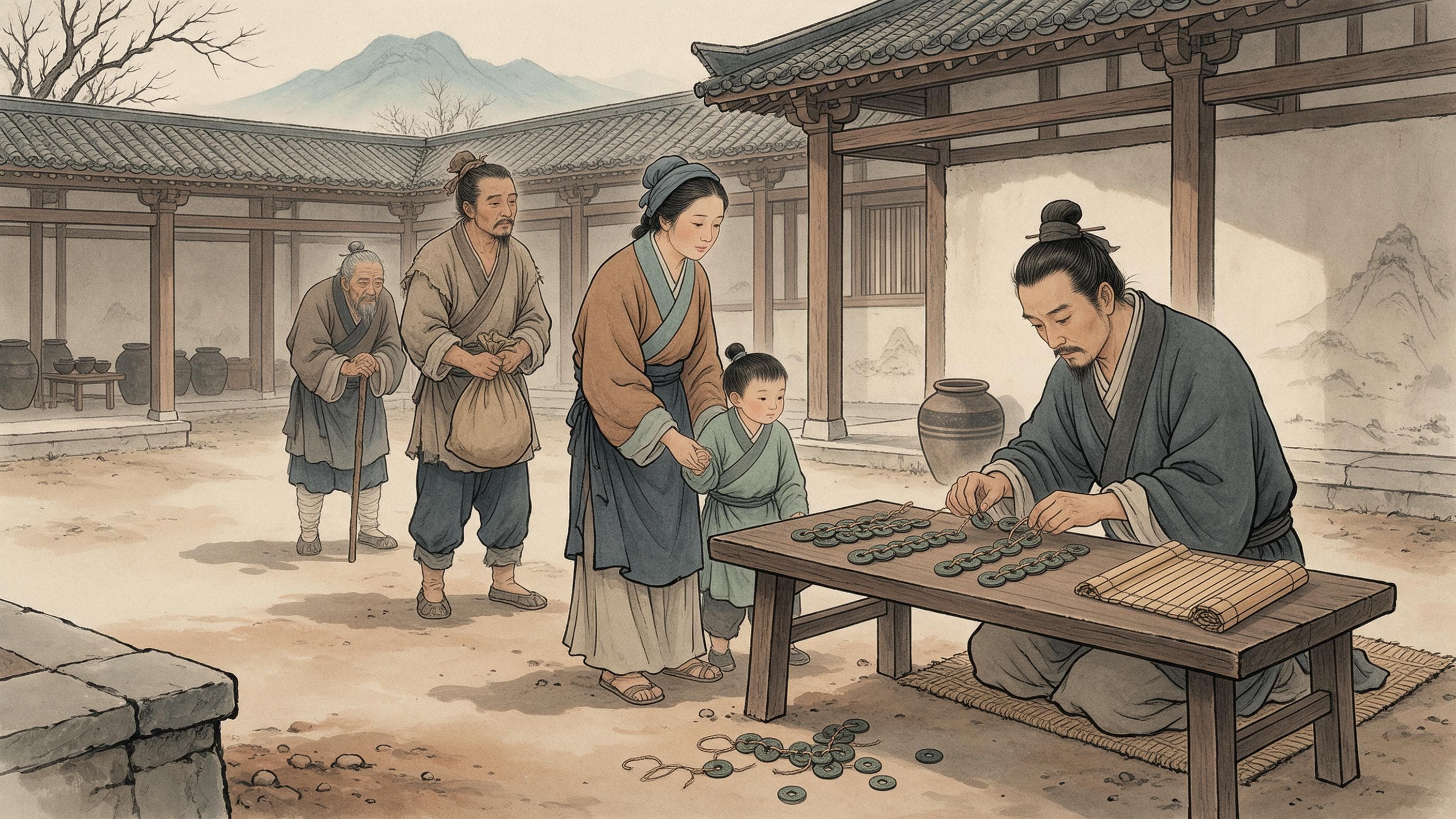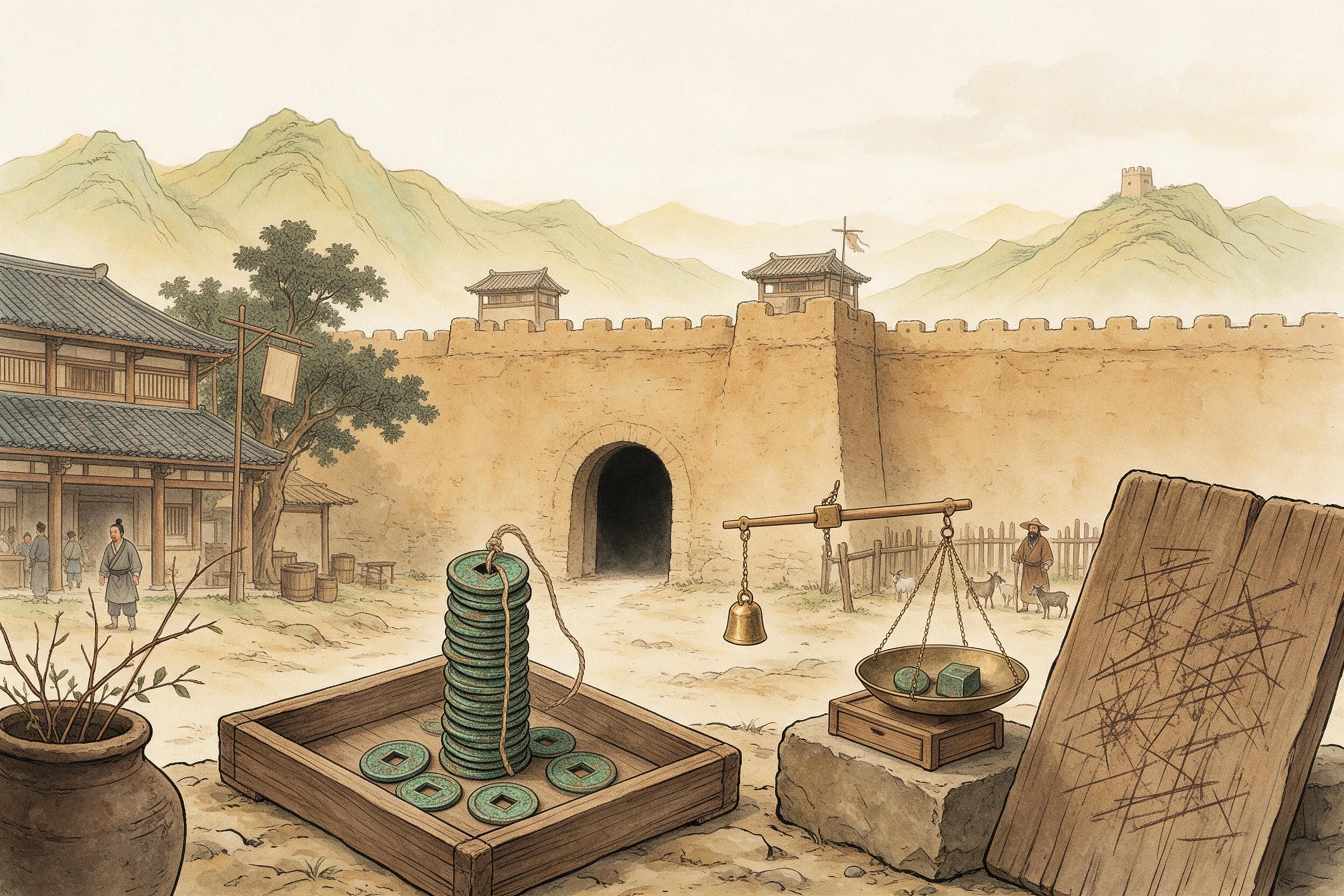
In the fourth month of 583 an order went out to the passes on the frontiers: each was to be given a hundred coins to serve as a sample. A traveller coming in from outside compared his coins against the sample; if they matched, he was let through. If they did not, the coins were 'broken up for copper and taken by the state'. That is the reform in one scene: no decree changing what money was, just a coin laid beside a coin at a gate.
At the pass
The record gives the procedure and nothing else. Each pass received its hundred sample coins; the officer compared; the traveller passed or lost his copper. No penalty is named for the man carrying bad coin — only the coin is destroyed. The order does not say who cast the samples, how often they were replaced, or what happened at a pass where no officer could judge a coin by eye and hand. The hundred are a sample, not a payment: nothing says whether the pass kept them or spent them. Those blanks are in the source, not in this article.
Nor is this a monetary standard in the modern sense. It is a check at the frontier: the state had a coin it wanted to circulate, and the pass was where the coin was tested. Later the same word — yang, sample — appears on the boards in the markets. Whether the two were one policy or one habit applied twice is not stated; that is an inference, and it is marked as one. A frontier gate was simply the first test a coin met.
The coin that weighed what it said
The new coin itself was cast in 581, the first year of Kaihuang. The Suishu says the founder, having taken the throne from the Zhou, found the coinage of the realm of unequal weight and had new coins cast: 'the face and the hole both with a rim; the legend reads Five Zhu, and the weight matches the legend. A thousand coins weigh four jin two liang.' The Suishu adds why: 'the coinage of the realm was of unequal weight.' The Tongdian dates the same act to the first year of Kaihuang; the Suishu only says it followed the accession. The weights are Sui weights, not converted here.
What was new was the promise on the face. Five zhu was a weight; a coin marked Five Zhu that actually weighed five zhu could be checked, coin against sample, without trusting anyone. That is why the sample at the pass makes sense: the coin carried its own specification. Whether the promise was kept everywhere, the sources do not say; a sample tests a coin, not a mint.
From the pass to the shopfront
The same device reappears later, after worse money had got into circulation. Following the ban on base coin: 'at the capital and in the markets of the provinces, boards were to be set up at the shops, with a sample coin placed as the standard; those that did not match the sample were not to enter the market.' The pass tested travellers; the board tested sellers. The record places this after the tenth year, when a mint was allowed at Yangzhou — it is a later cleanup, not the first act of the reign.
The old coins took years to kill. The Suishu says that after the new coin was ordered, the coins of earlier dynasties — the Five Elements Great Coin, the Ever-Circulating Ten Thousand Countries, the Qi peace coin — 'continued to be used in trade without stop'; in 584 magistrates who failed to stop them forfeited half a year's salary; in 585 the order was tightened again, and 'from this the coinage was at last unified, circulated everywhere, and people found it convenient'. (The Tongdian reads the old-coin clause the other way — 'ordered not to be used', with trade continuing anyway; the Suishu is followed here and the variant noted.) The forfeit is telling: the state punished the magistrate who let old coin through, not the man who used it.
Furnaces and private casting
The state's own mints were few and named. In 590 the prince of Jin was allowed five furnaces at Yangzhou; in 598 the prince of Han five at Bingzhou, and the prince of Shu five at Yizhou; the prince of Jin also asked for ten furnaces at the copper mine on Baizhu Mountain in Ezhou, and was allowed them. The character for 'furnace' is written once as lü and once as lu in the text; the text is followed and the slip noted. There is no total for the country.
Private casting was the real problem, and it is described in materials. Coin in use 'had all to be alloyed with tin and lead'; the metals were cheap, so profit-seekers multiplied, and the court forbade private mining of tin and lead. Forgers filed the rims of good coins to get copper for new ones; by the Daye years the coin was worse — 'at first a thousand weighed two jin, later gradually down to one' — and some cut iron sheets, or pasted leather and paper, to make 'coins'. 'Goods were cheap and things dear, and so it went to ruin' — the historian's closing judgement, quoted and not developed.
The scales do not match
One number needs care. Du You, in the Tongdian, sets the Sui coin against an earlier one: the Northern Qi rule that a coin of five zhu might be used in the market, which works out to a hundred coins weighing one jin four liang twenty zhu, and so a thousand weighing more than twelve jin; against the Sui thousand at four jin two liang. The gap is too large, and Du You concludes: 'it must be a difference between large and small scales.' That is his inference, not a measurement; the scales of the two courts are not described. The two weights cannot be set side by side as if on one balance. Comparing coin weights across dynasties means first asking whose scales. Du You gives no scale factor; the note stops at a possibility.
The limits, listed. No grain price, no purchasing power, no rate of exchange, no annual output, no national furnace count, no weight in grams; the sample is not a gold standard or a 'sample-coin standard'; Du You's scale explanation is his, not a finding; and the line about cheap goods and dear things is the historian's ending, not an economic analysis. What the record does give is a coin with a specification, a gate with a sample, a board in the market, and a weight that depends on whose scales you use. Whether the sample outlived the reign is not recorded.
Sources & further reading
- 魏征等《隋书》卷二十四·食货志 (Wei Zheng et al., Sui shu, juan 24, 'Food and Money') — Main narrative for Sui coinage: in 581 the new coin was cast with the legend Five Zhu and a weight matching the legend, a thousand coins weighing four jin two liang; in the fourth month of 583 each of the frontier passes was given a hundred coins as a sample, travellers' coins were checked against it, and coins that did not match were broken up for copper and taken by the state; later the same standard was posted on boards at the shops of the capital and the provinces, and coins not matching the sample were barred from the market; old coins were suppressed by forfeiting half a year's salary from county magistrates; private casting with tin-lead alloy, the filing of coin rims for copper, the named mints at Yangzhou, Bingzhou, Yizhou and Ezhou, and the leather-and-paper forgeries of the Daye years are all described. No prices, no annual output, no national furnace count.
- 杜佑《通典》卷九·食货九·钱币下 (Du You, Tongdian, juan 9, 'Coins') — Parallel account with two variant readings against the Suishu: it dates the new coin to the first year of Kaihuang where the Suishu dates it to the accession, and it reads the old-coin clause as 'ordered not to be used' where the Suishu reads 'continued to be used in trade without stop'. Also preserves Du You's note comparing the Northern Qi thousand-coin weight of more than twelve jin with the Sui weight of four jin two liang and concluding that the difference must lie in large versus small scales — his inference, not a measurement.