In the winter of 196, the first year of Jian'an, Cao Cao's government 'for the first time established military farming' — six characters in the annals, on the proposal of Zao Zhi and Han Hao. A note to the chronicle adds the result: 'that year they recruited people to farm at Xu and obtained a million hu of grain.' One decision, one total, and no account of how the million was divided. Zao Zhi and Han Hao are named as the proposers; their argument is not recorded here.
A million hu at Xu
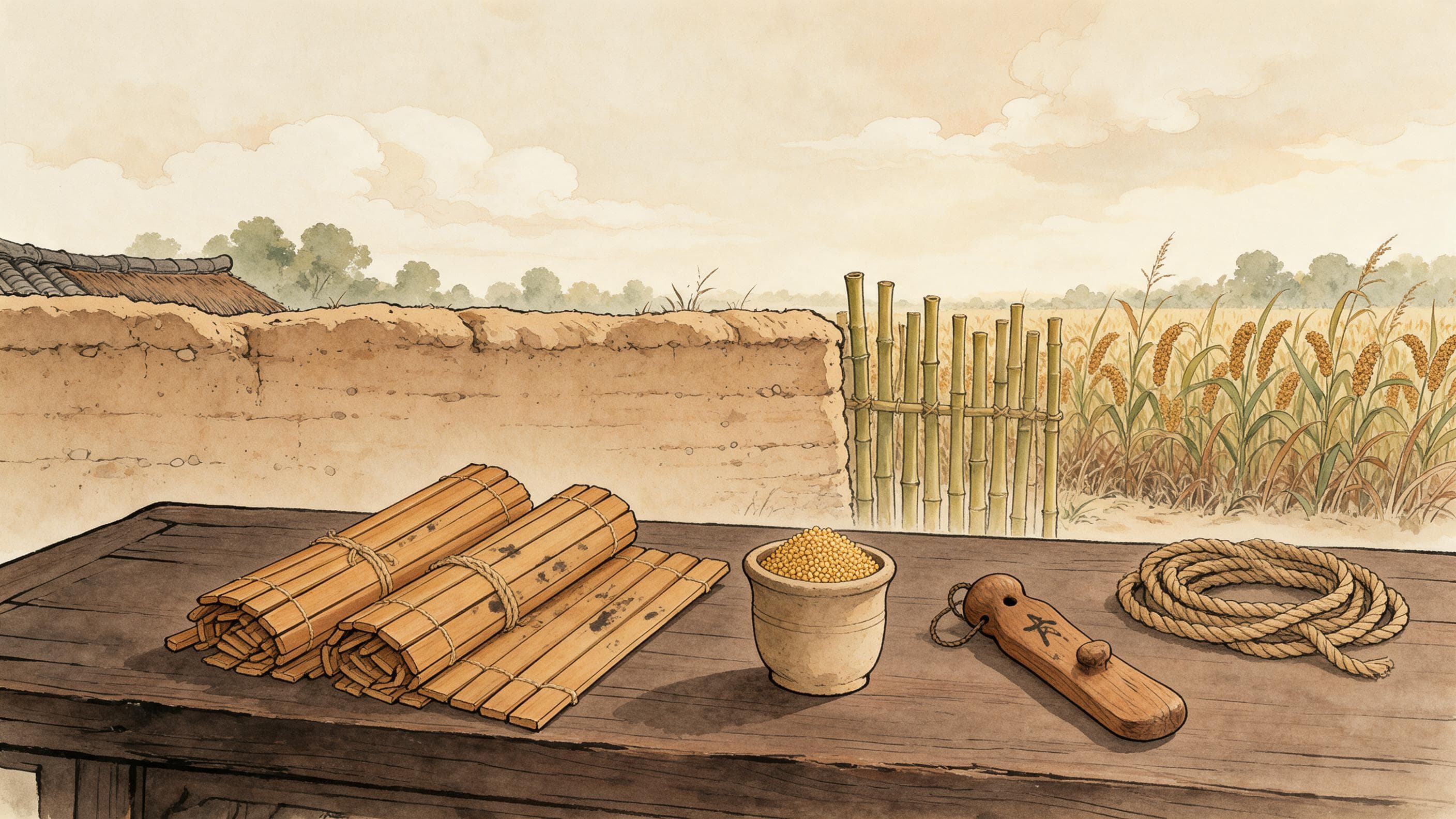
The same note describes the machinery: 'the provinces and commanderies then set up farm officers on the pattern, and grain was stored wherever they were.' The gain was logistical — 'in the campaigns on all sides there was no labour of transporting grain'. The people were recruited, not conscripted; the land was state land; the crop was divided at harvest. The note's word for the workers is 'recruited people'. But the note gives no acreage, no household count, and no rate of division.
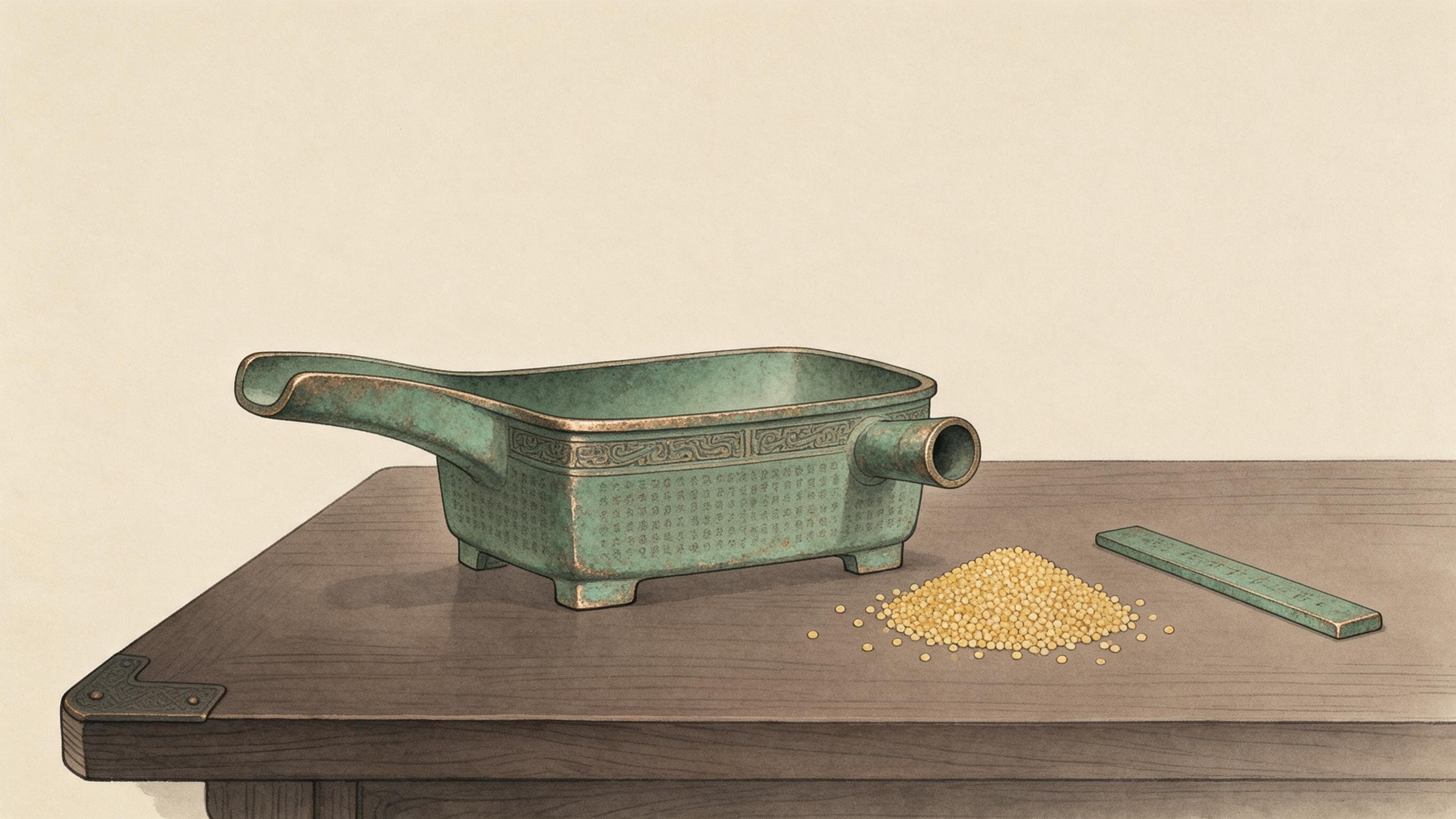
What the million hu is should be fixed first. It is a total for that year — 'that year' — not a rate, not a per-household figure, and not a sum over the whole period of military farming. The sources used here do not say whether the million was grain actually stored or an official tally, and they do not break it down by district. The number is a headline, and this article treats it as one. Nor does the note say what kind of grain the million hu was, or whether it was counted by weight, volume or official measure.
A tax rate nine years later
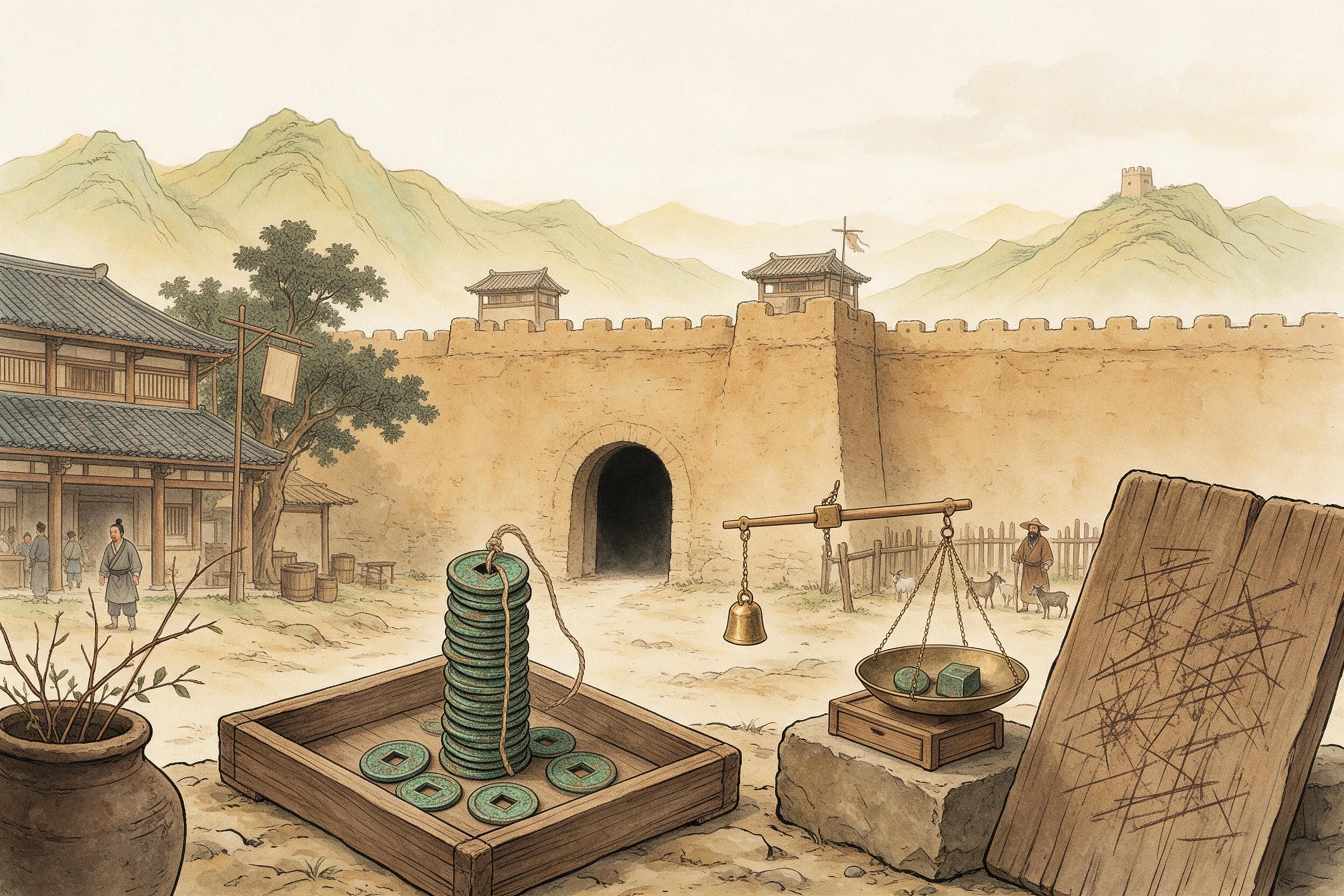
Nine years later, in the ninth month of 204, after taking Ye and driving the Yuan family out of Hebei, Cao Cao issued a taxation order. A note to the chronicle preserves it: 'Let the land tax be four sheng per mu, and each household pay two bolts of silk and two catties of floss, and nothing else; no other levies are to be raised at will. The governors and chancellors are to inspect it carefully, so that the strong may not hide their land and the weak be taxed twice over.' The order follows two other acts: the exemption of Hebei from that year's tax, and a tightening of the law against land concentration.
This is a tax schedule for registered households, not a tenancy rate for military-farm land. The land tax is counted by the mu, the household levy by the household; 'nothing else' forbids extra exactions; the last clause is aimed at great families hiding land and pushing the levy onto the poor. Read as a whole, it is a settlement of the ordinary tax after the conquest of Hebei — not the division of a harvest between the state and a tenant farmer. It gives two rates and a ban on further levies; that is more than any other tax document used here. The order is dated by month, not by day.
The fraction is recorded elsewhere
The only record that goes down to fractions is somewhere else, and later. In the fourth year of Taishi, 268, three years after the Wei house had yielded to Jin, the official Fu Xuan sent up a memorial on five matters. The first was this: 'Formerly, when soldiers held an official ox, the office took six shares and the soldier four; when they held their own ox, they divided equally with the office. This had been practised a long time and the men were content with it. Now, all at once, those with an official ox are reduced to eight shares for the office and two for the soldier, and those with a private ox or none to seven and three. The men have lost their place and will not be glad.' Fu Xuan asked that the old division be restored.
Two limits must be put on this passage. First, it is about 'former soldiers' — soldiers, not the civilian households settled on military farms. Second, the memorial does not say which dynasty the 'former' practice belonged to; it is dated 268, three years after the abdication of Wei, and 'practised a long time' is as far as it goes. So the passage can be used for one thing only: in early Jin there was an old soldier-farm division of six to four or half and half, and it was being cut. It cannot be quoted as the Cao Wei sharecropping rate. The six-to-four is a ratio of the harvest, not of land: the soldier keeps four parts of what he grows, not four mu.
The three accounts do not meet
The three accounts do not share a unit. A million hu is a quantity; four sheng per mu and two bolts per household are rates; six to four is a division of a harvest. They cannot be multiplied together, because the sources give no acreage under military farming, no household count on it, and no yield per mu. Nor is there a price or a money value anywhere in them: the tax is paid in grain, silk and floss; the division is in grain. This article makes no conversion and no total.
One more caution about the million hu: the note places it in the year the farms were founded, which would mean a million hu in the first season. That may be what the note says, and it is quoted as it stands; but whether it means the first year's crop, or the accumulation of the first years, the note does not say, and the article does not decide. It is a note, not a statute: one sentence in a commentary.
The ledger and the land
The limits, listed. The military farms are not described as giving every household land; Cao Cao is not said to have unified the north because of them; the six-to-four division is not transferred to civilian farms; the four-sheng tax is not turned into a farm rent; mu and hu are not converted; no modern economic vocabulary is imposed on the material; and nothing is added from sources not read here.
So three entries remain. In 196 the state began military farming at Xu and recorded a million hu; in 204 it fixed the land tax at four sheng a mu and the household levy at two bolts of silk and two catties of floss; in 268 an official complained that the old soldier's division of six to four, or half and half, had been cut to eight to two. Each entry records one thing. What the land was, who worked it, and what each household actually handed over — the sources stop at the ledger, and so does this article. The ledger is not the field.
Sources & further reading
- 陈寿《三国志》卷一·魏书·武帝纪(含裴松之注引王沈《魏书》)(Chen Shou, Sanguozhi, juan 1, Annals of Emperor Wu, with Pei Songzhi's notes quoting Wang Chen's Wei shu) — Main text: in the first year of Jian'an (196) Cao Cao 'for the first time established military farming' on the proposal of Zao Zhi and Han Hao. Pei's note from the Wei shu: 'that year they recruited people to farm at Xu and obtained a million hu of grain; the provinces and commanderies then set up farm officers on the pattern, and grain was stored wherever they were.' A second note preserves the ninth-month 204 order: land tax four sheng per mu, two bolts of silk and two catties of floss per household, 'and nothing else; no other levies at will', with governors to prevent the strong hiding land and the weak being taxed twice.
- 房玄龄等《晋书》卷四十七·傅玄传 (Fang Xuanling et al., Jin shu, juan 47, Life of Fu Xuan) — Memorial of the fourth year of Taishi (268), first of five matters: formerly soldiers holding an official ox gave the office six shares and kept four, those with their own ox divided equally; now the division has been cut to eight to two and seven to three; Fu Xuan asks for the old division to be restored. The passage speaks of 'former soldiers', not civilian farm households, and does not name the dynasty the old practice belonged to.