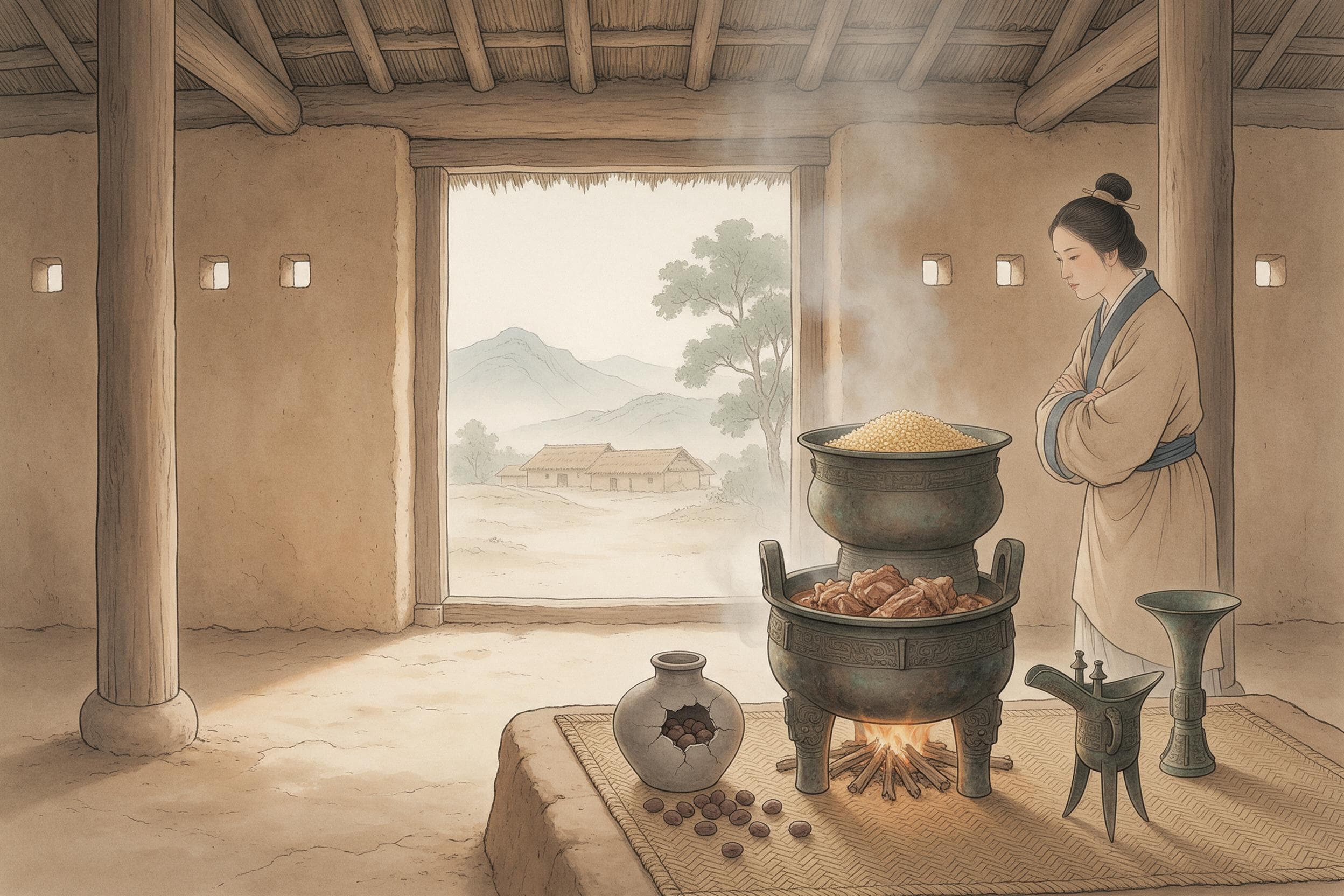
In the 2000–2001 excavation of tomb M54 at Yinxu, a few small earthenware jars came out of the ground with their contents hardened into single blocks of soil. Broken open, the blocks held small fruit stones. They were identified as plum: the jars had probably held a fruit stew. The tomb belonged to a general known as Ya Zhang, and it is one of the rare places in the Shang record where a meal can be read at once from human bone, bronze vessel and plant residue. The plum stones are the charm of it. The harder evidence is that the bowl underneath them was nine-tenths millet, that meat was rationed by rank, and that the wine came in matching bronze sets.
A man carrying grain, cut into bone
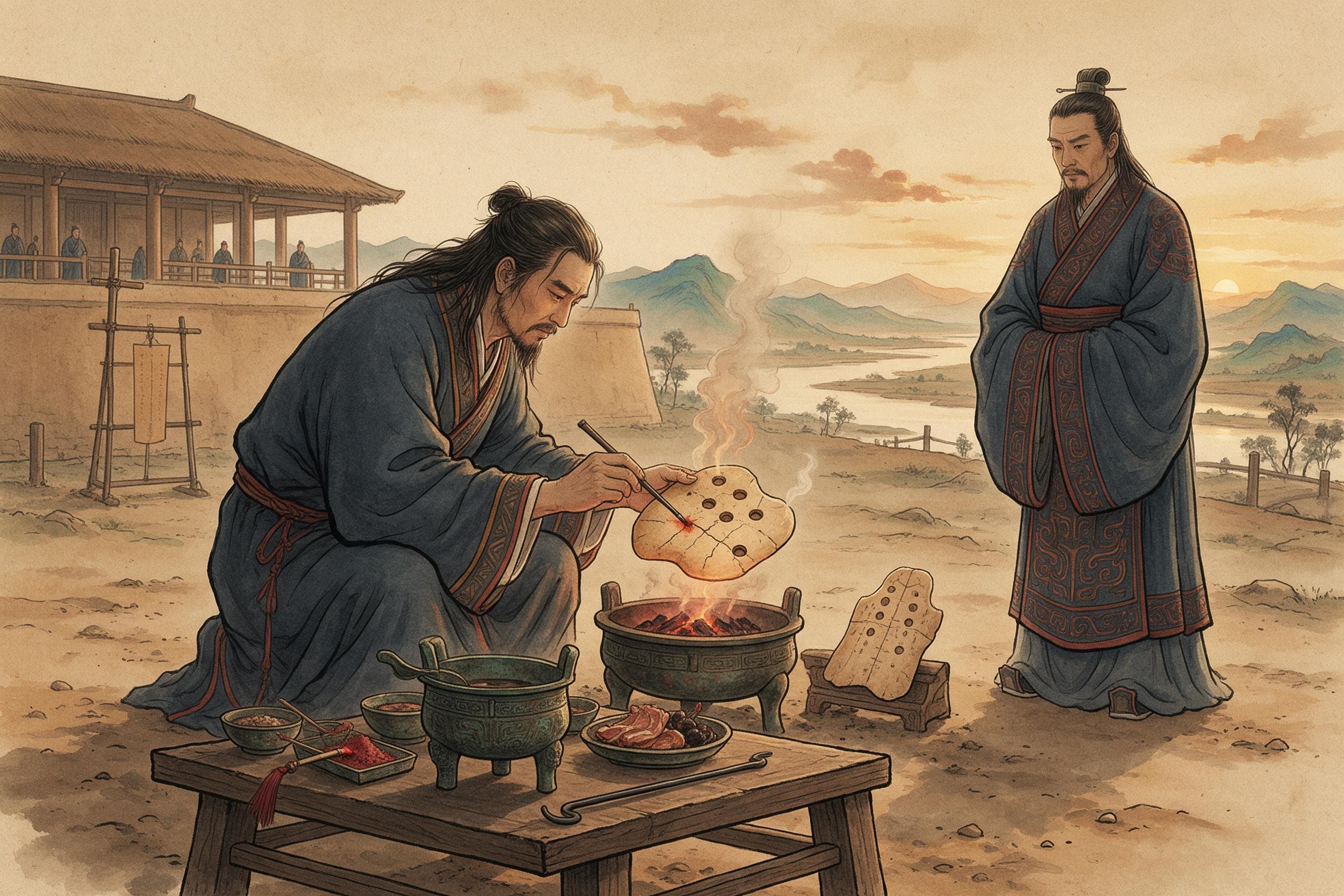
The Shang kept their worry about food on turtle shell. In one inscription a diviner named Wei, on a bingzi day, asked whether the king would receive the harvest — 我受年 — and then asked the reverse, 我不其受年: will the grain come, or not. The character for year, 年, is a person with grain on their back: 禾 above 人. The king was not asking for a number; he was asking whether there would be grain. Oracle bones also record the king going out to the four quarters to oversee the harvest, which tells you how much of royal attention was farm work. What such inscriptions are not is a household menu — they are the king's questions about the state's crop.
Nine parts millet
The hard evidence is in the bones. Nine individuals from M54 — the general, his retainers, and the sacrificial victims laid on the ledge — were sampled for stable isotopes. All of them drew more than ninety percent of their diet from millet, and the researchers note that this agrees with earlier analyses of Yinxu residents. So millet was not a preference but the floor of the cuisine. Other crops were grown — foxtail millet (粟), broomcorn millet (黍), wheat (麦), soybeans (菽), rice (稻) — but in this diet they were supplements. Even Ya Zhang, the best-fed person in the tomb, ate about a tenth less millet than the others, and the gap was filled with rice and fruit. Rice appears in low proportions overall at Yinxu and more often in elite diets; that should not be read backwards as a commoner staple.
Meat was a ladder
The same isotope series draws the sharpest social line in Shang archaeology. Ya Zhang's diet was the richest in the tomb: pork, beef and mutton from the ordinary domestic animals, and probably wild game and aquatic food as well. The retainers buried with him ate far less meat. The sacrificial victims on the ledge dropped to "only slightly above the level of herbivores" — their food was overwhelmingly vegetable, and meat hardly entered it. In one grave, at one moment, diet maps onto status: the man with the bronze ate well, and the men arranged around him did not. One caution: Ya Zhang was a high-ranking officer in a richly furnished tomb, so his table is a case, not the Shang average, and how often anyone ate meat is not recorded. Horses and chickens were kept, but the dietary material gives them no measurable share, so they are left out here.
The bronze is the table setting
The Shang cast their table manners in bronze. Food vessels — the ding for meat, the gui for grain, the li cauldron and yan steamer — handled cooking and serving; wine vessels — jue cups, gu beakers, gong, zun, you, hu, lei, jia — handled the drinking; water vessels, pan and he, were for washing at table. A ding simmered meat, a gui held grain, a yan steamed, and a jue was drunk from: one set of vessels is one way of eating. The wine set is the striking part: heavy, varied, made in matched groups. M54's showpiece is a rare ox-shaped zun, and it came with a square zun, a lei, a square jia and a square yi. The reason is not luxury for its own sake. The Shang believed the dead became ancestors who could protect the living, and they fed and wined them. Food was an offering before it was a meal, and the drink offered was a low-alcohol fermented brew; distillation did not exist in the Shang.
Plum stones, bone broth, and the missing greens
The plum stones are the small proof that Shang food could be more than gruel. The researchers also describe cooks using natural spices to build a broth, and cracking animal bones and boiling them down to enrich a millet porridge. That last is a synthesis by the researchers, not a line from an oracle bone, but it fits the equipment: the li and the yan are built for boiling and steaming, and the ding is a meat pot. Roasting has no direct Shang evidence and is a guess. Then the record stops. Oracles, graves and plant samples give no list of vegetables, and the later Zhou ritual books cannot be read back into the Shang to fill the gap. Salt is not attested either; the seasonings that can be named are spices and bone broth.
So the line between what is known and what is not is sharp. What is known: the Yinxu bowl was nine-tenths millet, and that holds for people who never touched a bronze vessel; meat followed rank, from the general's pork, beef and game to the sacrificial victims' diet barely above that of grazing animals; the vessels came in sets, boiling and steaming were the methods, and the fruit stew was real. What is not known: how many meals a day, how often anyone but a noble had meat, and which greens went with the millet. The nine-tenths is a group average, not a plate, and the richest plate in the tomb belonged to a privileged man. Which is why the little jar earns its place: for one moment, a cuisine measured only in percentages leaves a single plum stone in the hand.
Sources & further reading
- 中研院历史语言研究所历史文物陈列馆〈我受年──甲骨文「年」的故事〉 — 甲骨《乙》867 填硃卜辞释文「丙子卜,韦贞,我受年」「我不其受年」;「年」字上禾下人,像人背负谷物
- 吴梦洋〈亚长的餐桌:一位商代将军的饮食人生〉,《中国社会科学报》2026年7月28日A12版(中国社会科学院考古研究所网站转载) — 亚长墓(M54,2000—2001年发掘)9例人骨稳定同位素:小米类占九成以上;贵族小米比例低约一成、以稻与瓜果补齐;肉食等级(亚长—殉人—牲人);青铜食器酒器组合;陶罍梅核与果羹;香料与骨汤提鲜
- 光明网〈【节气里的大美中国】3000年前的「五谷丰登」,你想象不到!〉(2024-09-21) — 仅用于「商代已种禾、黍、麦、菽、稻」一句;科普稿,不作数据来源