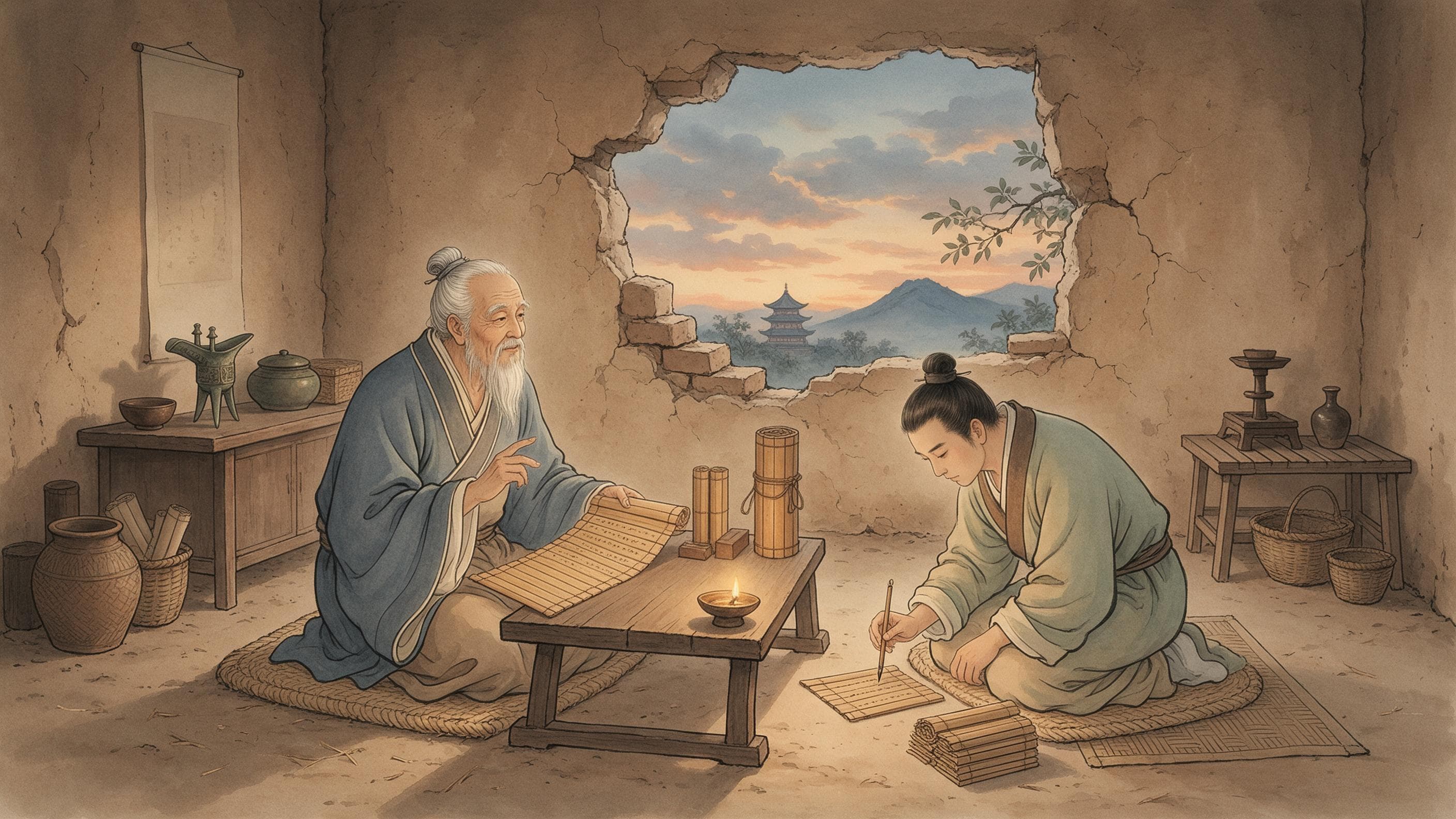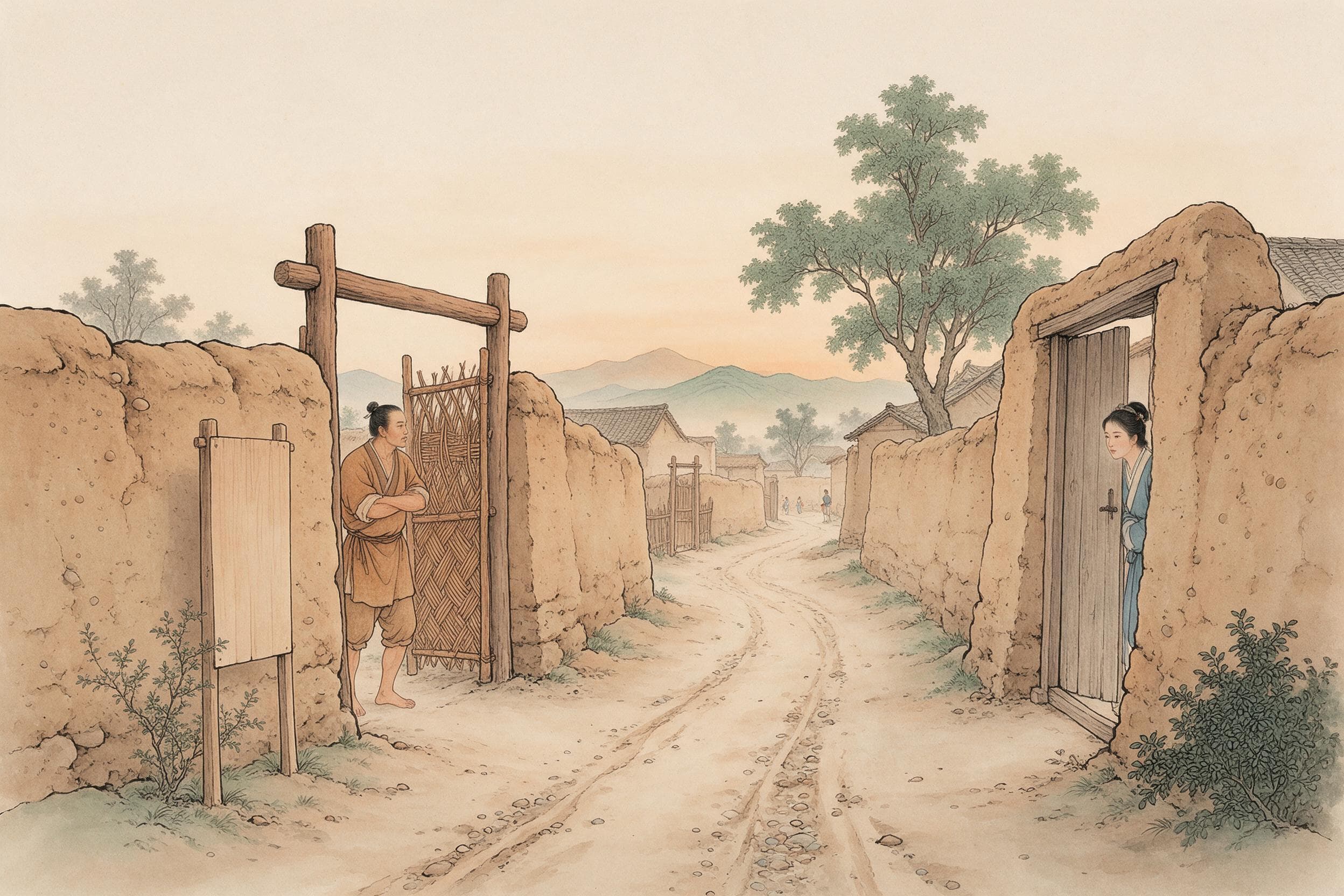
Twelve characters and a decree: 令民為什伍,而相牧司連坐 — order the people into companies of five and ten, to supervise one another and be punished together. Then three sentences of exchange: 不告姦者腰斬,告姦者與斬敵首同賞,匿姦者與降敵同罰 — whoever does not denounce a crime is cut in two at the waist; whoever denounces one gets the same reward as for cutting off an enemy's head; whoever conceals one gets the same punishment as for surrendering to the enemy. The material first: both sources are transmitted texts, and neither is the text of a Qin statute. The Shiji passage is a Han historian's account of a Qin order; the Hanshu's treatise on punishments is a Han verdict on it. Excavated Qin documents are not among these sources, so wherever a rule is stated below, it is stated as 'this order as the history gives it'.
One: twelve characters
The twelve characters give the machinery: the fives and tens are the grouping, 相牧司 is mutual supervision, 連坐 is shared liability. The three sentences give the exchange rate: denounce a neighbour and receive what a severed enemy head earns; hide a criminal and take what surrender earns; fail to denounce and be cut at the waist. The page sets the three cases side by side and does not rank them, explain them, or describe how the punishment was carried out. The three characters 相牧司 are not glossed either.
Nor is much else on the page: how the fives and tens were formed, how the registers were kept, how they fitted the village and the post stations, what the reach of shared liability was and what its penalties were — none of it is given. Apart from Shang Yang's own case below, the chapter contains no single example of anyone actually sitting for another's crime. So the article can say what the order laid down, not what every lane did; that limit is fixed here.
Two: the ring of decrees around it
After the twelve characters, in the same block, comes a ring of rules: 民有二男以上不分異者,倍其賦。有軍功者,各以率受上爵;為私斗者,各以輕重被刑大小。戮力本業,耕織致粟帛多者復其身。事末利及怠而貧者,舉以為收孥。宗室非有軍功論,不得為屬籍。明尊卑爵秩等級,各以差次名田宅,臣妾衣服以家次。有功者顯榮,無功者雖富無所芬華 — households with two or more able-bodied men that do not divide pay double tax; military merit earns rank, private brawls earn punishment by degree; those who work at grain and cloth are exempted in person, those after secondary profit or idle and poor are seized with their families; clansmen without military merit drop off the register; rank and precedence are fixed, with fields, houses, servants and clothes graded by household; the meritorious are made glorious, and the rich without merit have no lustre. The same block adds 令民父子兄弟同室內息者為禁, the ordering of small towns into counties with magistrates and assistants, 凡三十一縣, the opening of field boundaries with equalised taxes, and 平斗桶權衡丈尺. The rules do not explain each other; they simply stand in one list, and the thirty-one counties are the only administrative number the page allows to be counted.
Three: how the order was made to land
The order was written but not published, and no one trusted it: 令既具,未布,恐民之不信,已乃立三丈之木於國都市南門,募民有能徙置北門者予十金。民怪之,莫敢徙。復曰「能徙者予五十金」。有一人徙之,輒予五十金,以明不欺。卒下令 — a three-zhang pole at the south gate of the market, ten gold to move it to the north gate, no takers, then fifty, one man moves it, and he is paid on the spot so that no one can say the order lies. The objectors are recorded too: 令行於民朞年,秦民之國都言初令之不便者以千數 — a thousand or more saying the new order was no good; when some later said it was good, Wei Yang called them 亂化之民 and 盡遷之於邊城, and 其後民莫敢議令.
Then the crown prince: 太子犯法。衛鞅曰:「法之不行,自上犯之。」將法太子。太子,君嗣也,不可施刑,刑其傅公子虔,黥其師公孫賈。明日,秦人皆趨令 — the heir could not be punished, so his tutor was punished and his teacher tattooed, and the next day everyone hurried to obey. What follows is the historian's summary: 行之十年,秦民大說,道不拾遺,山無盜賊,家給人足。民勇於公戰,怯於私斗,鄉邑大治. It is narrative, not a statistic, and this article labels it so.
Four: from the rule to one man
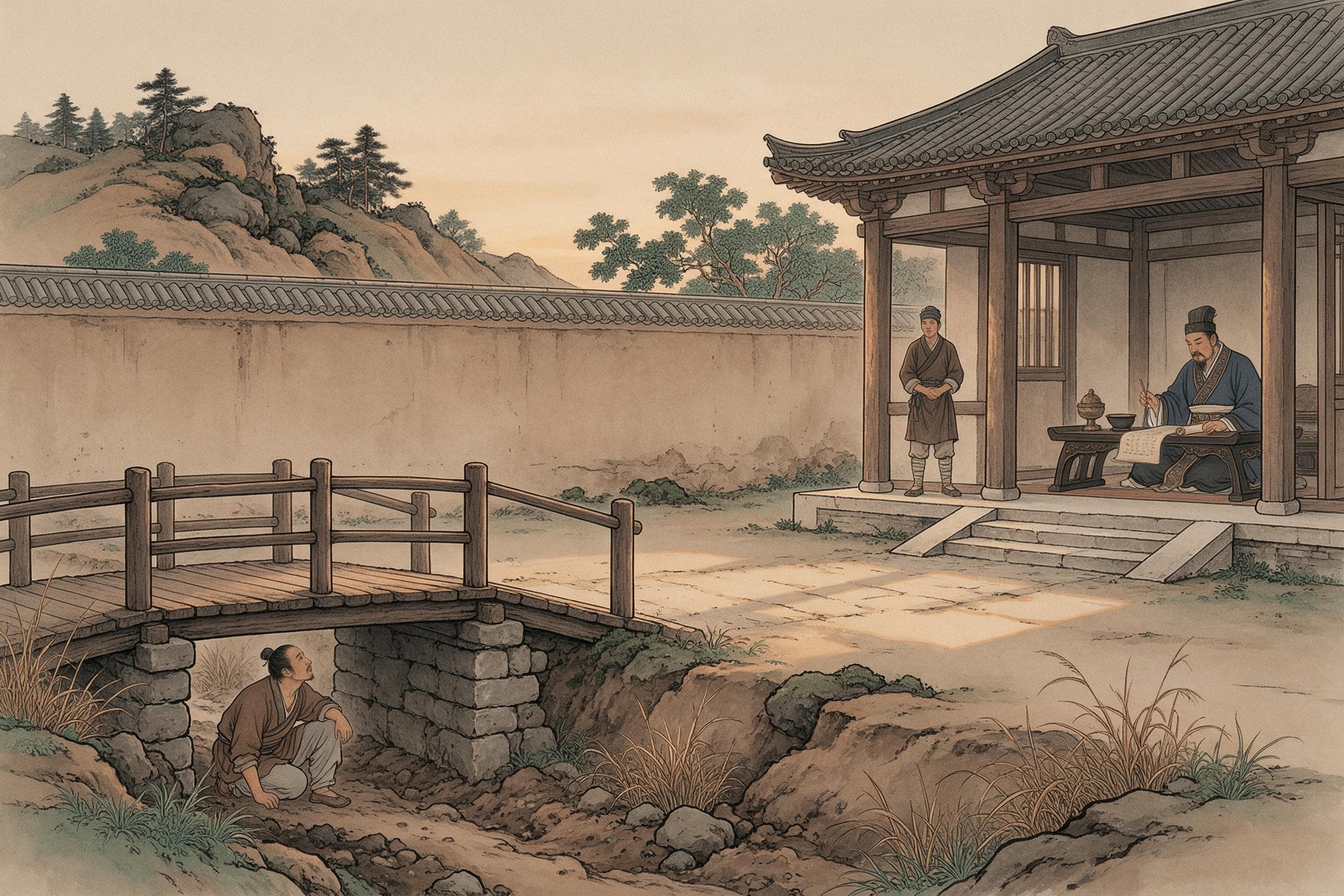
The only place in the chapter where shared liability lands on a particular man is Shang Yang himself: 商君亡至關下,欲舍客舍。客人不知其是商君也,曰:「商君之法,舍人無驗者坐之。」 — in flight, he asks for a room at an inn, and the keeper, not knowing him, says that by the Lord of Shang's law an innkeeper is punished for lodging a guest without credentials. He sighs: 嗟乎,為法自斃一至此哉 — alas, the harm that comes of making laws. He goes to Wei, is refused, is sent back, and 秦發兵攻商君,殺之於鄭黾池。秦惠王車裂商君以徇……遂滅商君之家 — killed, his body torn apart by chariots as a warning, his family destroyed. That is the one 'sitting' the page offers, and the man sitting is the lawgiver.
Two centuries later the Hanshu compresses the whole thing into eleven characters: 陵夷至於戰國,韓任申子,秦用商鞅,連相坐之法,造參夷之誅;增加肉刑、大辟,有鑿顛、抽脅、鑊亨之刑 — Qin employed Shang Yang, linked the law of mutual sitting, created the extermination of the three clans, increased mutilating punishments and capital crimes, with punishments of splitting the skull, drawing out the ribs and boiling alive. That is Ban Gu's retrospect and judgement, not a Qin statute; and where the Shiji says 連坐, the Hanshu says 連相坐. The two also differ in what they mention: the Shiji has no 參夷 and only says 遂滅商君之家, while the Hanshu states 造參夷之誅. Each is quoted for what it says; they are not merged into one conclusion.
Five: repealed, and restored
The law was once repealed. At the start of Han, 漢興之初,雖有約法三章……然其大辟,尚有夷三族之令。令曰:「當三族者,皆先黥,劓,斬左右止,笞殺之,梟其首,菹其骨肉於市。其誹謗詈詛者,又先斷舌。」故謂之具五刑。彭越、韓信之屬皆受此誅 — the three-clan sentence remained, carried out in a sequence called the five punishments, and Peng Yue and Han Xin suffered it. In the first year of Empress Lü the three-clan crime and the law against strange talk were abolished. In the second year of Emperor Wen a decree asked: 法者,治之正,所以禁暴而衛善人也。今犯法者已論,而使無罪之父母妻子同產坐之及收,朕甚弗取。其議. Zhou Bo and Chen Ping answered that 父母妻子同產相坐及收,所以累其心,使重犯法也。收之之道,所由來久矣……以為如其故便 — the practice weighs on people's minds and makes them take crime seriously, and is of long standing. The emperor replied: 法正則民愨,罪當則民從……既不能道,又以不正之法罪之,是法反害於民,為暴者也。朕未見其便,宜孰計之. And the answer came: 臣等謹奉詔,盡除收律、相坐法. Then the single line: 其後,新垣平謀為逆,復行三族之誅 — afterwards Xin Yuanping plotted rebellion, and the three-clan sentence was put into practice again. Ban Gu comments: 由是言之,風俗移易,人性相近而習相遠,信矣。夫以孝文之仁,平、勃之知,猶有過刑謬論如此甚也,而況庸材溺於末流者乎 — a comment, kept apart from the record before it.
- Statute and verdict are two layers. The Shiji passage is a historian's account of the reform decrees; the Hanshu's 秦用商鞅,連相坐之法,造參夷之誅 is Ban Gu's retrospect and judgement. The verdict is not quoted as a statute, and the statute is not quoted as a verdict.
- Excavated Qin documents are not among these sources: both pages are transmitted texts, and not one line of a Qin statute is quoted. Every rule is given as 'this order as the history gives it', never as 'the Qin code says', and no later commentary is used to fill the rules in — both pages are plain text without notes.
- The punishment words are copied as written: 腰斬, 參夷, 連坐, 告姦, 匿姦, 收孥 — no modern equivalents, and no ranking of severity.
- 'The order laid down' is not 'every household did it': how the fives and tens were formed, the registers, the reach and penalties of shared liability, and how it fitted the villages and posts are all absent. Apart from Shang Yang's own case there is no example at all, and no claim is made that one man's crime hanged five households.
- Same chapter as another article, different stretch: the Tiying story and the abolition of mutilation in Hanshu 23 belong to that piece; this one uses only the mutual-sitting verdict and the repeal under Emperor Wen.
- Lines kept apart: Qin market rules, the three-point covenant and the Nine Chapters, and the growth of Han statutes are other articles; this one is the fives and tens and denunciation. No general talk of harsh Qin law or of Legalist thought, and no modern gloss of the fives and tens as local governance.
One law, beginning with twelve characters: group the people in fives and tens, supervise one another, answer together; no denunciation means execution, denunciation pays what a severed head pays. In the Shiji it lands through a pole at the gate, a tutor's punishment and a deportation, and it closes on one man — the man who made it. Two centuries on, the Hanshu gives it eleven characters of verdict, records its repeal, and records its return after one plot. Rule, story, verdict, repeal: four layers, all on these two pages, each in its own place.
Related reading:Three Cases: How Zhang Shizhi Passed Sentence · Dog-Killing, Cloth-Selling, Flute at Funerals: What the Han Founders Did Before · From Zhaoyi to Yezhe: Fourteen Ranks of the Han Palace and Their Stipends
Sources & further reading
- 《史记》卷六十八〈商君列传〉(西汉司马迁撰;维基文库本,白文,页头未标 textquality,未与中华书局点校本复核;页面为节本) — The decrees come in one block: 令民為什伍,而相牧司連坐。不告姦者腰斬,告姦者與斬敵首同賞,匿姦者與降敵同罰。民有二男以上不分異者,倍其賦。有軍功者,各以率受上爵;為私斗者,各以輕重被刑大小。戮力本業,耕織致粟帛多者復其身。事末利及怠而貧者,舉以為收孥。宗室非有軍功論,不得為屬籍。明尊卑爵秩等級,各以差次名田宅,臣妾衣服以家次。有功者顯榮,無功者雖富無所芬華。 Later in the same block: 令民父子兄弟同室內息者為禁;集小鄉邑聚為縣,置令、丞,凡三十一縣;為田開阡陌封疆,而賦稅平;平斗桶權衡丈尺. Making the order credible: 立三丈之木於國都市南門,募民有能徙置北門者予十金……復曰「能徙者予五十金」。有一人徙之,輒予五十金,以明不欺. Objectors: 令行於民朞年,秦民之國都言初令之不便者以千數;those who later praised it 盡遷之於邊城。其後民莫敢議令. The crown prince: 太子犯法。衛鞅曰:「法之不行,自上犯之。」……刑其傅公子虔,黥其師公孫賈。明日,秦人皆趨令. And the sequel, marked in the article as the historian's narrative: 行之十年,秦民大說,道不拾遺,山無盜賊,家給人足……鄉邑大治. The law catches its author: 商君亡至關下,欲舍客舍。客人不知其是商君也,曰:「商君之法,舍人無驗者坐之。」商君喟然嘆曰:「嗟乎,為法自斃一至此哉!」……秦惠王車裂商君以徇……遂滅商君之家.
- 《汉书》卷二十三〈刑法志〉(东汉班固撰;维基文库本,白文,页头未标 textquality,未与中华书局点校本复核) — The verdict, in eleven characters: 陵夷至於戰國,韓任申子,秦用商鞅,連相坐之法,造參夷之誅;增加肉刑、大辟,有鑿顛、抽脅、鑊亨之刑 — Ban Gu's retrospect, not a Qin statute. Then the repeal story: 漢興之初……尚有夷三族之令。令曰:「當三族者,皆先黥,劓,斬左右止,笞殺之,梟其首,菹其骨肉於市。其誹謗詈詛者,又先斷舌。」故謂之具五刑。彭越、韓信之屬皆受此誅。至高后元年,乃除三族罪、祅言令。孝文二年,又詔丞相、太尉、御史:「……今犯法者已論,而使無罪之父母妻子同產坐之及收,朕甚弗取。其議。」周勃、陳平 answer 父母妻子同產相坐及收,所以累其心,使重犯法也。收之之道,所由來久矣……以為如其故便, and the emperor replies 法正則民愨,罪當則民從……是法反害於民,為暴者也。朕未見其便,宜孰計之. The result: 盡除收律、相坐法. The relapse, in one line: 其後,新垣平謀為逆,復行三族之誅. Ban Gu's comment: 由是言之,風俗移易,人性相近而習相遠,信矣。夫以孝文之仁,平、勃之知,猶有過刑謬論如此甚也,而況庸材溺於末流者乎. The chapter also contains the story of Tiying and the abolition of mutilation, which belongs to another article and is not used here.